Opening the Role Before the Salary: Testing Meaning Without Quitting

The Salary Filter at 8:42 p.m.
If you rent a room in an expensive city and open your banking app the second a job description makes you feel hopeful, the salary-versus-fulfillment bind can feel less like a preference and more like self-protection.
At 8:42 on a Sunday night in west-end Toronto, I met Jordan (name changed for privacy) with Indeed open on her laptop and the salary filter set before she had finished reading a single role. The radiator clicked beside her. Blue screen light washed over a mug of cold tea, and when a rent reminder appeared on her phone, I watched her thumb stop moving.
She wanted work that felt useful and alive, but the number on the screen kept deciding what counted as responsible. She told me, “I can tolerate being unfulfilled if I know the rent is covered,” then asked, “Why do I keep choosing the paycheck over feeling fulfilled at work?”
The feeling did not sit in the room as a vague idea. I could see it move through her like a smoke alarm calibrated so sensitively that a thirty-minute career experiment and a financial crisis set off the same internal volume: tight chest when she imagined a smaller paycheck, heavy shoulders when she pictured another Monday, and a jaw that locked whenever curiosity came too close to becoming a choice.
“You are not wrong for protecting your rent,” I said. “And you are not selfish for noticing that staying has a cost. We do not have to turn this into a dramatic leap or a verdict on your character. Today, I want to help you draw a map through the fog so that practical safety and meaningful work can occupy the same decision.”

Choosing a Compass at the Career Crossroads
Before I touched the deck, I invited Jordan to take one slower breath and name the question in plain language. I shuffled gradually, using the pause as a psychological transition from salary calculations to observation rather than as a supernatural test.
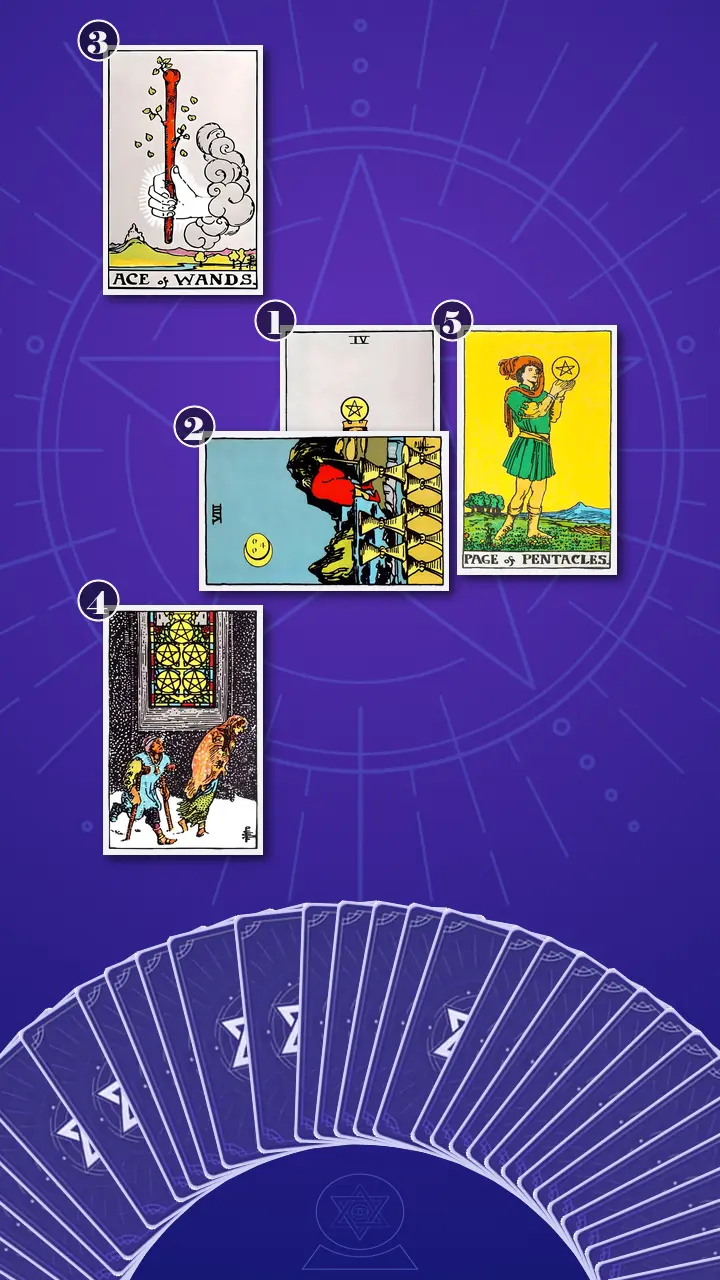
“I’m using a five-position Decision Cross,” I told her. “It is a focused classic spread for a trade-off like salary versus job satisfaction. It lets us look at the visible habit, the force crossing it, the desire you can already sense, the fear underneath it, and a practical way to hold both needs without pretending you have to decide your whole career tonight.”
I explained this to Jordan and to anyone reading along because this is also how I understand how tarot works: the cards are a reflective structure, not an authority issuing a job outcome. My Jungian lens treats the images as a way to notice different parts of a decision system. The Celtic Cross was considered, but its ten positions would add layers that this single trade-off did not need. The Decision Cross was shorter, clearer, and better suited to self-exploration.
“The centre will show the presenting dilemma,” I continued. “The crossing card will show what makes movement feel unsafe. Above it, we will meet the conscious pull toward more meaningful work. Below it, the hidden root: the fear that choosing fulfillment could expose you financially or prove that you cannot keep yourself safe. Then the final position will offer an integrating choice, not a prediction.”
That structure mattered. It meant we could ask not only why the paycheck keeps winning, but what it has been asked to represent, what staying has been costing, and what small piece of evidence might allow Jordan to investigate fulfillment without quitting.
Reading the Number, the Door, and the Spark
I laid the five positions in a cross and began with the centre. I wanted the card meanings in context, close to Jordan’s actual browser tabs, rent reminders, body signals, and unfinished plans—not floating above her life as generic definitions.
Position 1: The Hand Around the Paycheck
Now I turned over the card for the presenting dilemma: the observable habit of staying with paid work while postponing meaningful alternatives. It was the Four of Pentacles, upright.
The figure presses one pentacle against the chest, plants two beneath the feet, and sits with a city behind them. I read that posture as earth in excess: stability has become gripping, and control has started standing in for choice. The card does not condemn money. It shows what happens when one measurable resource is asked to carry safety, adulthood, responsibility, identity, and the future all at once.
I returned with Jordan to the Sunday bedroom scene she had described. She finds a role whose actual work interests her, but her hand moves to the salary range before she finishes the description. She opens her budget, sees that her current pay covers rent, feels an immediate drop in uncertainty, and closes the listing. The paycheck is performing a real protective function, but it has also become the only evidence allowed to decide whether a role is responsible.
“This is a salary-first search algorithm,” I said. “It down-ranks meaning before the work has even been evaluated. The relief is immediate, while the depletion remains in a hidden column.” Then I gave her the sentence I wanted her to keep: “The paycheck can be a safety tool without becoming the only vote.”
I asked, “The last time an interesting role appeared, what did you do immediately after seeing the salary range? Which tab or app did you open next?”
Jordan gave a short, bitter laugh instead of nodding. “That is too accurate,” she said. “Almost rude.” I watched her fingers curl around the edge of the chair, then loosen. Her reaction was not a failure to connect; it was the protective strategy recognising itself before it could turn into shame.
“I’m not trying to take away the strategy that helped you stay housed and employed,” I said. “I’m helping you notice when a useful safety check has become the only vote in the room.” She looked back at the card, and I saw the first small shift from self-judgment toward behavioural recognition.
Position 2: The Door She Keeps Leaving Open
Now I turned over the card for the crossing force: the emotional and practical resistance that makes leaving an unfulfilling role feel unsafe, including the blocked impulse to walk away. It was the Eight of Cups, reversed.
In the image, a cloaked figure has turned from eight carefully stacked cups but has not completed the journey. Reversed here, the water is blocked. Jordan already recognises that something in her work is emotionally insufficient, but the path away feels so uncertain that she keeps returning to the familiar threshold.
I brought in the Thursday laundry-room scene. Jordan had told me that she once folded warm clothes in the basement of her shared rental while scrolling past a former colleague’s LinkedIn announcement about moving into purpose-driven work. The dryer thudded. Detergent hung in the humid air. She searched for similar roles, bookmarked three, checked the salary again, and told herself she would return after one more month of saving. Twenty minutes later, she was back in Slack answering a non-urgent message.
“The pattern sounds like this,” I said. “I am not staying forever; I am just waiting until…” I left the sentence unfinished. The condition never arrived with a date, amount, or definition, which allowed postponement to keep disguising itself as preparation.
Waiting for zero risk is still a career decision.
Jordan became very still. Her eyes moved from the card to the empty space beside it, and I could almost feel the expired job listing she was remembering. The pause held longing, but also grief: she had been calling the job temporary while repeatedly investing more time in making the temporary arrangement sustainable.
“The reversed Eight of Cups does not tell you to resign,” I said. “It asks you to stop turning every exploration into a departure. For one week, you could gather one concrete fact about one meaningful direction without applying, quitting, or promising anyone a new identity.”
Position 3: The Spark Before the Job Title
Now I turned over the card for the conscious pull: the part of Jordan that wants inspiration, purpose, and a more enlivening relationship with work. It was the Ace of Wands, upright.
The hand emerging from the cloud offers a living wand, already sprouting fresh leaves, across an open landscape. The image carries upright fire: not a finished plan, but available energy. The spark is present before the map, the title, and the guaranteed outcome.
I asked Jordan about the Friday meeting room she had mentioned almost in passing. She had been helping redesign a broken campaign handoff. The dry-erase marker squeaked, the ventilation fan hummed, and she began speaking faster as she connected the missing steps. I heard her describe the moment her shoulders released and she stopped checking the time. When the meeting ended and the routine dashboard queue returned, she told herself, “Enjoying that does not mean it could become real work.”
“The Ace is asking you to record that moment as data,” I said. “It may reveal something about contribution, usefulness, systems, creativity, or collaboration. It does not need to name your perfect career.” Then I gave her the central distinction: “A spark is evidence of energy, not a command to quit.”
Jordan exhaled through her nose and leaned slightly closer to the card. I asked her to notice which task, during the previous two weeks, had made her sit forward, lose track of time, speak more quickly, or breathe more easily. Her face changed when she named process improvement. The desire did not become a demand; it became observable information.
Position 4: The Lit Window in the Snow
Now I turned over the card for the hidden root: the fear that choosing fulfillment over the paycheck would create material insecurity and expose a lack of safety or self-trust. It was the Five of Pentacles, upright.
The card shows two figures crossing snow beside an illuminated stained-glass window. I read it as a fear image, not a forecast. The window represents the warmth and adult stability Jordan believes her current paycheck provides. The exposed figures show the internal story that a smaller salary or uncertain transition would put her outside that warmth.
I brought her to the grocery checkout near Bloor Street, a scene she had described from the previous week. The scanner beeped beneath harsh fluorescent light as the total rose. Jordan opened her banking app to check the next rent transfer, and she told me that her stomach dropped and her jaw locked. A concrete question about monthly costs expanded into a verdict: “If I choose meaning and struggle, it will prove I cannot keep myself safe.”
“This is where a realistic financial constraint fuses with an identity-level fear,” I said. “Rent, debt minimums, benefits, commute costs, and savings are facts to examine. But the sentence that one imperfect move would prove you are irresponsible is a fear story. The card is showing the mechanism that keeps the Four of Pentacles gripping; it is not predicting hardship.”
Jordan’s breathing paused. Her eyes fixed on the stained-glass window, then lost focus as if she were replaying several rent reminders at once. Finally, she pressed her lips together and released a long breath. “I know exactly what the paycheck gives me,” she said quietly. “I cannot measure what staying is costing me.”
I let the silence remain kind rather than urgent. In my work across cultures, I have learned that people often do not need a louder answer at this point; they need a structure that can hold both the concrete bill and the emotional bill without shaming either one.
When the Page Turned Security into Soil
Position 5: The One-Pentacle Bridge
Now I turned over the card for the integrating choice: a small, practical experiment that lets Jordan explore meaningful work without demanding an immediate all-or-nothing decision. It was the Page of Pentacles, upright.
The Page studies one pentacle with concentrated attention. A cultivated field lies beneath their feet, while mountains remain in the distance. The Page does not pretend to know the entire route. The figure studies one piece of evidence carefully, learns from it, and lets patience become a form of movement.
For Jordan, the modern version was clear: protect one hour a week to study a single meaningful direction. Speak with one person, test one task, learn one skill, or redesign one current responsibility. Then record what happened to her energy, ability, practical concerns, and curiosity. The Page’s career meaning here is not instant success. It is disciplined learning that turns a vague longing into information.
Fear-Driven Logic Decoupling
I told Jordan about one of my signature lenses: Fear-Driven Logic Decoupling. I use it to separate authentic desire from the subconscious fear of failure inside a decision matrix. Salary belongs in the calculation, but so do the fear’s predictions, the recurring tasks that make her feel alive, and the cost of postponement. When those categories are mixed together, fear can speak in the calm voice of logic and win every time.
I asked her to imagine two columns. In the first: the desire to do useful systems work, create resources, and contribute in a way that feels awake. In the second: the fear that experimenting would expose poor judgment or make her financially unsafe. The goal was not to silence the second column. It was to stop letting it impersonate the first.
At 8:42 on Sunday night, the salary filter was still open while an interesting job sat in another tab. The radiator clicked, a rent reminder tightened Jordan’s chest, and once again a practical number spoke louder than the work itself. She was trying to make one safe answer carry her whole future.
The paycheck is not the only proof of responsibility; begin building fulfillment through one grounded experiment, like the Page studying the pentacle carefully before taking the next step.
The room went quiet except for the radiator. Jordan’s breath stopped halfway in; her eyes widened, and her fingers, which had been pinching the edge of the card, held there for a second. Then her gaze lost focus, as though she were replaying every saved role she had closed, and her jaw began to loosen. Her shoulders dropped—not dramatically, but enough for the chair to receive her weight. A small, shaky exhale left her. “So I don’t have to trust an entire new career today,” she said. “I can see what one test teaches me.” Relief moved through her face, followed by a brief, almost dizzying blankness. If the answer did not have to be guaranteed first, the next choice would belong to her. I invited her to write for eight minutes: one energising task, one possible direction, and one experiment taking no more than thirty minutes. No resignation, application, purchase, or public commitment was required; she could stop after one sentence.
“Now, use this new perspective to recall whether there was a moment last week when this insight might have made you feel differently,” I said.
Jordan looked down at the Page. “I do not need to trust a whole new career today,” she repeated. “I can see what this one test teaches me.” That was the crossing from protective calculation toward grounded curiosity: not fearlessness, not a guaranteed answer, but the first piece of evidence-based self-trust.
Finding Clarity Without a Resignation Letter
When I placed the cards side by side, the story became coherent. The Four of Pentacles showed the visible grip: the paycheck had become physical proof of safety. The reversed Eight of Cups showed the unfinished departure: meaningful roles stayed bookmarked while Jordan returned to the salary spreadsheet and the promise of one more month. The Ace of Wands showed that she was not lacking desire; certain tasks reliably made her more alert. The Five of Pentacles revealed the hidden root: the fear that choosing meaning and struggling would prove she could not protect herself. The Page of Pentacles offered a bridge between those truths.
The elemental movement mattered to me. The spread began with contracted earth, moved through blocked water, flashed into fire, passed through fear-heavy earth, and returned to constructive earth. The answer was not to abandon stability for fantasy. It was to change defensive earth into fertile earth: to let the paycheck remain a base from which inquiry could begin rather than a wall against every meaningful direction.
Jordan’s cognitive blind spot was not that she cared too much about money. It was that she treated salary as factual while treating energy, attention, usefulness, and the hidden cost of staying as subjective noise. I used my second diagnostic lens, Hidden Cost Deconstruction, to make the missing bills visible: Sunday dread, depleted evenings, extra paid hours, expired saved listings, reduced curiosity, and the slow loss of trust in her own observations. I was not adding guilt to the calculation. I was making the calculation more honest.
The key shift was simple but demanding: move from treating fulfillment as a reward that must wait until perfect financial certainty to testing one meaningful work direction within current constraints. The cards did not tell Jordan to take a pay cut, resign, or accept a particular job. They showed her why the paycheck kept winning and gave her a way to gather evidence without handing her agency to the deck, an employer, a social media timeline, or an impossible finish line.
The One-Pentacle Test: Actionable Next Steps
Because the Page of Pentacles values small, observable learning, I gave Jordan three options. She did not need to do all of them. The point was to make fulfillment small enough to enter the calendar and concrete enough to teach her something.
- Protect one salary-second slotOn Thursday at 7:00 p.m., reserve thirty minutes at a Toronto Public Library branch, a quiet café, or the kitchen table. Open one saved role that sounds engaging before checking its salary. In a note titled One-Pentacle Test, record one appealing task, one skill it requires, and one way to test that task without leaving the current job. If useful, send one trusted former colleague a low-pressure message asking for a fifteen-minute conversation.The minimum version is five minutes: open the role, copy one interesting task into the note, and stop. No resignation, paid course, application, or public commitment is required.
- Keep a five-day task-and-body energy logFor five workdays, set a 4:45 p.m. reminder labelled What changed my energy? In Notes or Notion, use only three columns: task, body signal, and what the task may reveal. At the end of the week, circle one pattern that appears at least twice and ask for one bounded contribution that matches it, such as reviewing a process, drafting a resource, or joining one planning session.A one-word body signal is enough: lighter, tight, alert, flat, or drained. Jordan does not owe her employer extra unpaid work; any request should have a defined scope and end point.
- Separate the concrete bill from the alarmDuring a calm ten-minute window, open the current budget and write two headings: Concrete constraint and Fear story. Place rent, debt minimums, benefits, and essential costs under the first. Place statements such as One imperfect move would prove I am irresponsible under the second. Then use my Shadow Choice Experiment over forty-eight hours: on paper only, intentionally imagine choosing the most feared option and let the defensive voice list every predicted consequence, without resigning or changing any financial arrangement.The exercise is for revealing defense mechanisms, not forcing a decision. If the body becomes too tense, stop after classifying one expense and one fear statement. A qualified financial adviser can help with major money questions.
These next steps are deliberately reversible. Security remains visible, but it no longer has to answer every question about identity, meaning, and future direction. Fulfillment does not need a resignation letter; it needs a testable calendar slot. Security works better as a base for inquiry than as a wall against it.

The First Evidence Row
Four days later, I received a message from Jordan. “I did the thirty-minute test,” she wrote. “I opened the role before the salary, copied the process-design task into my note, and asked a former colleague what that part of the job is actually like. She replied. I still do not know what I want to do forever, but I know one direction deserves another look.”
She had also asked her manager for a narrowly defined chance to improve one internal handoff, with a clear beginning and end. The pay had not changed, the current job had not suddenly become meaningful, and the fear had not vanished. Still, one recurring spark had become evidence instead of being dismissed as indulgence.
Jordan told me that after sending the message, she stared at the empty calendar slot for three minutes. The next morning, she still wondered, What if I am wrong? This time, she opened the note and added, Still learning. It was a small response, but it belonged to her.
That was the first proof of our Journey to Clarity. Not a perfect career answer, not a prediction, and not permission from the cards. Just a change in how Jordan gathered information: from risk scanning and save-and-close repetition toward practical curiosity, bounded experimentation, and grounded self-trust.
I know many of us recognise the moment when a rent reminder tightens the chest and makes an emotionally airless job feel like the only responsible choice, even while the body grows heavier each Monday.
If fulfillment only needed one small, protected place on your calendar rather than a resignation letter, what would you be curious to test—the task that makes you sit forward, the conversation you keep postponing, or your own One-Pentacle Test?