When One Notification Wins: Naming What It Costs Before You Choose

Finding Clarity in the 8:34 p.m. Scroll
You are not short on goals. You are competent enough to manage everyone else's product roadmap, yet one notification beside your own unfinished project can trigger forty minutes of instant-gratification drift. That was how Maya (name changed for privacy), a twenty-nine-year-old product designer in Toronto, arrived in my video consultation: capable, self-aware, and tired of watching the fastest reward receive the time she meant to give her life.
She described the previous Tuesday to me. At 8:34 p.m., she had opened her portfolio in Figma at the small desk in her condo. The radiator clicked against the wall, the artboard cast a cold blue rectangle across the room, and a WhatsApp notification lit beside it. She meant to answer one message. Then one small option offered relief, and by 9:16 she was moving between Reels, Uber Eats, and the group chat while the phone grew warm in her palm and the untouched frame remained visible underneath.
“I keep choosing what I want for the next ten minutes over what I say I want for my life,” she told me. “I can explain every choice, but I still don't feel like I chose it.”
I heard the real contradiction immediately: Maya wanted to protect creative independence, genuine connection, financial room, and rest, but whichever option shone most brightly kept receiving her actual resources. The feeling sat in her body like a dozen autoplay screens running behind her ribs, each demanding the next click before her chest could fully unclench.
“I'm not going to tell you that pleasure is the enemy or that your phone has ruined your willpower,” I said. “Let's look closely at the moment the brighter option starts to feel inevitable. We can make a map of that fog, but you will decide where the story goes next.”

Choosing the Switchback Map
I invited Maya to place both feet on the floor, take one slower breath, and hold a single question in mind: What value am I trading away when the tempting option wins again? I shuffled while she breathed. I use this small ritual as a transition of attention, not as theatre designed to make the cards seem more powerful than the person in front of me.
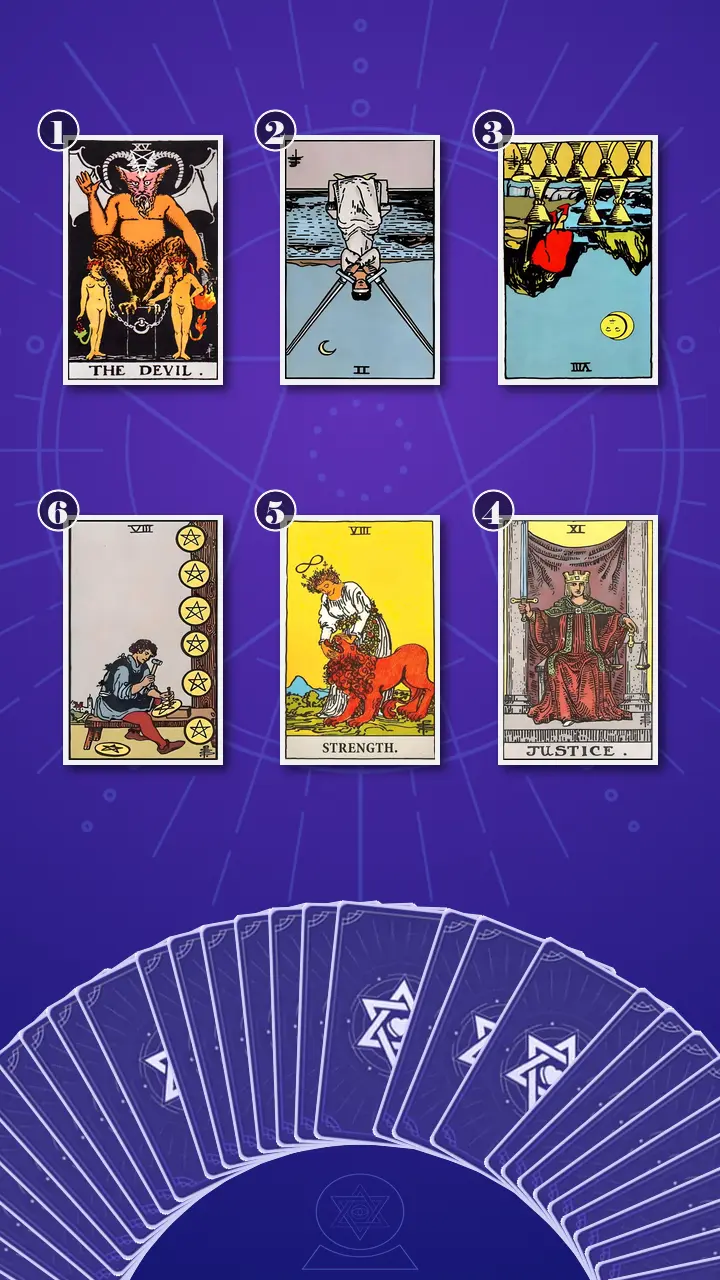
I chose the Transformation Path Grid · Context Edition, a six-card Transformation Path Grid tarot spread for temptation, value trade-offs, and self-trust. For anyone wondering how tarot works in a situation like this, I use card meanings in context as an external visual structure. The cards do not predict whether Maya will scroll, go out, or finish her portfolio. They separate a fast, self-reinforcing loop into parts she can inspect without putting herself on trial.
The phrase “wins again” told me this was not one decision between two options. I needed a spread that could trace the visible trigger, the mental blockage, the fear beneath it, the transforming insight, the practical response, and the integrated result. I arranged the cards in two rows of three, guiding my eye across the upper diagnostic row, down at the far edge, and back across the lower transformation row. It looked like reaching the end of a familiar road, turning around, and deliberately walking home by another route.
I explained that the first position would show where immediate reward overrode her stated priority. The second would reveal the bargaining that prevented a conscious trade-off. The third would uncover what felt dangerous about leaving the familiar loop. Below them, the fourth would identify the leverage point; the fifth would show how to meet desire without obeying it automatically; and the sixth would show how modest repetition could rebuild trust in her own word.
The Road That Kept Looping
Position One: The Loose Chain Behind the Warm Phone
The card I turned over first represented the observable moment when an immediately rewarding option overrode Maya's stated priority and began another cycle of drift. It was The Devil, upright.
I drew Maya's attention to the two figures beneath the dark pedestal. Their chains looked binding at first glance, but they were loose enough to remove. Upright, The Devil carries the energy of attachment and temptation in excess: a real appetite grows so loud that authorship becomes blocked. The pressure is genuine, but the conclusion that no choice remains is part of the pattern.
“This is your 8:30 p.m. Figma scene,” I said. “The notification appears, and your hand moves before the moment even feels like a decision. One reply becomes Reels, takeaway menus, and three group chats. The design file stays visible underneath, but the phone has been promoted into the organising centre of the evening.”
I described it as a recommendation algorithm treating her last click as a permanent preference. Each choice fed the same option back to her until repetition started to feel like identity: I clicked because this is what I always do; because this is what I always do, I may as well keep clicking. Yet the loose chains showed several distinct moments: the first tap, the first app switch, the decision to continue after noticing the portfolio behind it. Choice had not vanished. It had become difficult to see.
Maya gave one short laugh, but there was no amusement in it. Her breath caught, her gaze dropped to her own phone, and then her thumb rubbed twice along its darkened edge. “That's so accurate it's almost rude,” she said. “Especially the part where I decide I've already ruined the evening, so I might as well finish ruining it.”
“Then we won't use recognition as a verdict,” I replied. “We'll use it as data. The urge is real. Its authority is negotiable.”
Position Two: The Design Review That Never Selects a Final Frame
The next card represented the inner conflict and rationalisation that kept the trade-off unresolved until convenience could make it for her. I turned over the Two of Swords, reversed.
The blindfold, crossed swords, and closed posture showed thought operating as a blockage rather than a source of clarity. Reversed, this card often reveals decision overload: analysis continues beyond the point of useful information, consuming the very energy needed to act. Maya was not missing reasons. She was using more reasons to avoid the vulnerability of selecting one value over another.
I brought her back to a scene she had described on Line 1. At 6:18 p.m., wet coats filled the carriage with a damp wool smell while the wheels shrieked through a curve. In her Notes app, she moved “portfolio” above and below “drinks?” three times. I need recovery faced I need momentum. I value friendship faced I need my own evening. Each claim was reasonable, so she kept the design review open until her internal battery reached one percent.
“When the debate stays open long enough, convenience gets the deciding vote,” I said. “You experience the final choice as proof that the easy option was stronger, but fatigue was allowed to become the decision-maker.”
As an artist, I know how seductive endless variants can be. Keeping every sketch alive can look like creative openness, but sometimes it is fear of drawing the line that makes the next scene real. I saw the same mechanism here: Maya's analysis protected every possible version of herself from the risk of becoming one imperfect, practised version.
Her shoulders folded slightly inward. First her jaw tightened; then her eyes lost focus as though she were replaying the train ride; finally she let out a low breath and uncrossed her arms. “I always thought the Notes app meant I was trying to make a responsible decision,” she said.
“Sometimes it is responsible,” I told her. “But once you understand the basic trade-off, another paragraph may be helping you postpone the grief of choosing. The useful question is smaller: which value will this option support for longer than tonight?”
Position Three: The Familiar Emptiness Behind the Reopened App
The third card represented the existential uncertainty and reluctance to leave familiar patterns beneath Maya's repeated return to temptation. I revealed the Eight of Cups, reversed.
Reversed, the card showed emotional movement caught in a return loop. The energy of departure was blocked. Maya already knew that some digital habits, convenience purchases, and abandoned project beginnings did not provide durable satisfaction. What she had not accepted was that leaving them would create a quiet space in which no immediate answer might appear.
“This is 10:07 p.m.,” I said. “You close the app. The room goes quiet except for the refrigerator hum. The cold light from the unfinished Figma file reaches across the desk. You feel pressure gather behind your ribs, and you reopen the app. Not because it has suddenly become meaningful, but because familiar dissatisfaction asks less of you than a blank page.”
The gap in the stacked cups mattered more to me than the number of cups still standing. Maya had abundant stimulation, ideas, saved courses, possible career pivots, and screenshots of possible selves. None of that abundance could decide what deserved sustained contact. The unclear path beyond the cups offered no instant reassurance.
I thought of a film lingering in a painful but familiar scene because the next act had not been written. Staying can resemble patience long after it has become protection. I asked Maya what appeared in the first ten seconds after she stopped distracting herself: boredom, loneliness, difficult effort, possible disappointment, or the fear that she still could not name what mattered.
Her fingers tightened around her mug and then slowly released. “The blank file feels like it might expose me,” she said. “If I stay with it and still don't care, then maybe I built this whole idea of creative independence because it sounded like the person I wanted to be. Scrolling lets me postpone finding out.”
“That makes sense,” I said. “The return is protecting you from an answer you fear. But values are not always discovered through certainty first. Sometimes they become visible only after you stay in contact long enough to gather evidence.”
When Justice Put the Full Price on Screen
Position Four: The Hidden Exchange Becomes Visible
The card I turned over now represented the critical insight that could interrupt temptation bias before the default choice took over. It was the key card of the reading: Justice, upright.
For a moment, neither of us spoke. The radiator in Maya's condo stopped clicking. A notification briefly lit the edge of her phone and disappeared again, leaving the balanced scales, upright sword, and frontal gaze of Justice at the visual centre of our screen.
Upright Justice is discernment in balance: honest accountability without punishment, consequence without moral panic, and a clear endpoint to endless bargaining. Maya had been asking herself to identify the perfect option. Justice asked something more concrete: What does each option genuinely give, and what does it displace?
She was still caught inside the belief that she had to make the correct decision about her whole identity. If the portfolio felt difficult, perhaps it was false. If a spontaneous plan felt exciting, perhaps it was more authentic. That impossible standard kept every evening loaded with the weight of a final verdict.
You are not powerless before temptation; make the exchange visible, weigh it honestly, and let Justice's scales return the decision to your values.
I let the sentence remain between us for a beat.
Then I used what I call Narrative Fork Analysis. I placed her options beside each other as competing plotlines rather than opponents in a morality play. In one plotline, Maya accepted immediate stimulation, relief, or connection. Those benefits were real. In the other, she remained with an uncertain creative scene long enough to find out what it could become. That plotline offered no instant emotional reward, but it served the character arc she kept saying she wanted to explore: becoming someone who could protect a chosen value before certainty arrived.
I also named the second pattern I watch for, Safe-Choice Sabotage Recognition. Sometimes “I deserve recovery” was true. Sometimes it was a perfectly logical defence against the inciting incident Maya most feared: beginning work that might reveal desire, limitation, or change. The distinction was not whether she chose rest or work. It was whether she saw the full exchange before one option claimed inevitability.
“You do not need to prosecute the choice,” I said. “You need to see the exchange. The tempting option can still win. Justice only asks that it win at its full price.”
The tempting option is not only spending your time; when it wins without a conscious trade-off, it is spending your trust in your own word.
“The hidden cost is not pleasure,” I added. “It is authorship.”
Maya stopped breathing for a second. Her fingers hovered above the table as if they had been interrupted midway towards the phone. Then her eyes shifted away from me and went unfocused; I could almost see the past week replaying behind them, one reasonable explanation after another. Her pupils widened, and the muscles around her mouth tightened before her eyes began to shine.
“But doesn't that mean I've been lying to myself for years?” she asked. The words came out sharper than anything she had said before. Her shoulders remained high, but her hands had opened.
“No,” I said. “It means you found effective ways to protect yourself from uncertainty for ten minutes at a time. They worked in the short term. Now you can see that the accumulated price is higher than you intended. Seeing that is accountability, not self-betrayal.”
Her expression moved through three distinct changes: first the frozen stare, then a small frown as the idea reached somewhere deeper than agreement, and finally a long, trembling exhale. Her shoulders dropped so suddenly that she looked momentarily unsteady, as if putting down a heavy bag had made her notice how long she had been carrying it. Relief arrived, but so did the exposed feeling of having a choice again.
“Now, using this new perspective, can you remember a moment last week when this insight might have changed how the choice felt?” I asked.
Maya recalled a rainy Sunday at a Queen West coffee shop. Her case study had been open when Instagram showed friends gathering on a patio. The espresso grinder rattled, rain tapped the glass, and her fingers hovered over “On my way.” She had framed the decision as being either a fun, connected person or a disciplined, isolated one.
I asked her to rewrite it on a scrap of paper. She wrote: This option gives me connection and relief. It displaces the hour I reserved for creative independence.
“That feels less dramatic,” she said after reading it aloud. “And somehow more serious.”
“Because neither side has to pretend the other is worthless,” I replied. “You may still choose the patio. But the decision will belong to you rather than to the first surge of FOMO.”
Justice marked the first real crossing from restless dissatisfaction and rationalised impulsivity towards cautious self-trust and grounded direction. Maya did not suddenly know her ultimate purpose. She had found a way to stop asking immediate pleasure to answer questions it was never meant to answer.
The Hand That Did Not Move Yet
Position Five: Strength and the Ten-Minute Holding Queue
The fifth card represented the practical inner response that would let Maya experience desire without automatically obeying it. I revealed Strength, upright.
The image did not show the woman defeating the lion. Her hands rested gently around its mouth; instinct remained alive, powerful, and included. Upright Strength brought balanced fire to the reading: courage expressed as steady contact with appetite rather than force, shame, or deprivation.
“The next time your fingers reach for the phone and your chest compresses, place the phone on a shelf or charger outside immediate reach,” I said. “Start a ten-minute timer and say, ‘I want the stimulation, and I have not decided yet.’ You do not need the urge to disappear. You are giving it a seat at the table, not the chair at the head.”
I compared it to turning off autoplay without cancelling the streaming service. Pleasure remained available, but the next choice became visible. The pause was not a test of purity or willpower. It was a short holding queue that kept a notification, invitation, or craving from jumping directly into production.
Maya placed her phone one hand-span farther away as we spoke. She smiled, but it carried a trace of uncertainty. “Ten minutes sounds embarrassingly small,” she said.
“Small is the point,” I replied. “A dramatic ban would give you another system to rebel against. Strength is the capacity to remain present for one breath, two minutes, or ten minutes without converting discomfort into an order.”
Position Six: Eight of Pentacles and the Evidence of Return
The final card represented the integrated state: how repeated, modest value-aligned choices could rebuild self-trust and create a more coherent direction. I turned over the Eight of Pentacles, upright.
Here the earth energy that had begun as attachment in The Devil returned in balance. A craftsperson worked on one pentacle while completed pieces stood nearby as visible evidence. The card did not promise one grand breakthrough. It showed attention, bounded repetition, and identity forming through completed units.
“This is you doing twenty focused minutes on your portfolio twice this week,” I told Maya, “then adding two dated checks to a note called ‘Evidence I Returned.’ You don't rate the quality. You don't turn the tracker into a perfect streak. You record that you came back.”
The two eights in the spread formed a quiet before-and-after. Eight of Cups reversed showed Maya repeatedly returning to familiar dissatisfaction. Eight of Pentacles upright showed her repeatedly returning to a chosen practice. Repetition itself was never the enemy. The question was what each return taught her to believe about herself.
“Direction is evidence gathered through return,” I said. “You do not need to know whether the portfolio defines your future. You need enough sustained contact to discover whether creative independence remains alive when it becomes a practice rather than an idea.”
Maya looked at the final card for several seconds. Her forehead smoothed, then she nodded once. “I can do two sessions without turning them into a new personality,” she said. “That actually feels possible.”
The Protagonist Pivot: Writing the Next Five Minutes
I drew the cards together into one continuous story. The Devil showed the visible pull becoming an apparent command. The Two of Swords reversed revealed how Maya kept the decision open until fatigue selected the easiest frame. The Eight of Cups reversed exposed the fear beneath the return: familiar dissatisfaction felt safer than discovering what an uncertain project might reveal. Justice made the hidden exchange visible. Strength created space between urge and action. The Eight of Pentacles turned that space into evidence through modest return.
Maya's cognitive blind spot was the belief that difficulty proved a goal was inauthentic. In practice, difficulty often marked the exact scene where preference had to become practice. Her safer diversions were not meaningless, and genuine rest or connection did not need to lose. The transformation lay in naming the displaced value before acting, pausing long enough to choose, and allowing repeated behaviour to clarify what mattered.
I told her that our lives are films currently in production. She did not need to know the ending before writing the next scene. She only needed to recognise when a bright, frictionless subplot was keeping her from the inciting incident of her own development. We agreed on three next steps, each small enough to begin without a total-life overhaul.
Three Bounded Experiments in Authorship
- The Full-Cost ChoiceBefore opening one high-stimulation app or answering one non-urgent invitation this week, Maya will open a pinned note and complete: “This option gives me...” and “This option displaces...” She will set a ten-minute timer and decide when it ends.The note stops after two sentences. The tempting option remains allowed. On a crowded or exhausting day, a two-minute pause is the complete version.
- The Protagonist Pivot ActionWithin twenty-four hours, Maya will choose the more daunting but authentic plotline and perform one five-minute action at her condo desk: place the phone beyond immediate reach, open Figma, and label or revise one case-study frame.The mandate is one micro-action, not a finished scene. Five minutes counts even if she stops immediately afterward; the purpose is to interrupt analysis paralysis with evidence.
- The Evidence I Returned LogMaya will schedule two twenty-minute portfolio sessions during the next seven days. After each, she will add one dated checkmark to a visible note and record only the unit completed, not her mood or the quality of the work.There are no streak rules and no penalty for a missed session. One five-minute return still counts, and she can revise or abandon the experiment after the week.
I watched Maya pin the two-sentence note before we ended. That mattered more to me than a promise that she would never lose another evening. Tarot had not made the choice for her. It had made the structure of the choice visible enough for her to take authorship back.

A Week Later: Evidence She Returned
A week later, Maya sent me a screenshot: two dated checks beneath “Evidence I Returned.” She had slept through the night, then woken with the old thought, What if I drop this too? This time, she told me, she smiled and opened Figma for five minutes.
She had not solved her career, eliminated FOMO, or become immune to the bright pull of her phone. On one evening, she deliberately chose drinks after completing the full-cost check. On another, she chose twenty minutes of portfolio work before scrolling. The proof was quieter than transformation stories usually allow: the options still pulled, but they no longer arrived disguised as commands.
I think of that as the real Journey to Clarity. The cards offered Maya an objective sequence through temptation, rationalisation, fear, discernment, restraint, and practice. She supplied the courage to pause. Her movement from restless dissatisfaction towards grounded direction began with a modest discovery: she could feel desire, name the exchange, and still remain the author of the next act.
If your hand reaches for the brighter option before your chest has even unclenched, I want you to remember that the hardest loss is not always another hour. It is the gradual quieting of trust in your own promises. The moment you make the hidden exchange visible, that trust has somewhere to begin speaking again.
So I will leave you with the question I left Maya: when the next notification lights up beside the work, rest, or connection you consciously chose, which small value will you keep on Justice's scales for ten more minutes before you decide?