The Laugh That Arrived Before the Boundary
If you are the twenty-something family peacekeeper who can run a client call downtown but still laughs on cue at Sunday dinner, I know how confusing that split can feel. Maya, a twenty-eight-year-old junior account manager in Toronto, brought that exact question to my table: “Why do I laugh at family banter I actually want to challenge?”
She took me back to 7:18 p.m. on a Sunday near St. Clair West. A relative had turned her dating life into the punchline. Cutlery clicked against plates, black pepper hung in the warm air, and a cold glass sweated against her palm as everyone looked over for her reaction. Before she had decided what she thought, she laughed, said, “You’re terrible,” and reached for her water. Her jaw hardened. Her throat narrowed around the objection.
At 9:06 p.m., aboard a westbound 512 streetcar, the brakes squealed beneath her and rain tracked down the dark window. Only then did her real response appear in Notes: “I know we were joking, but I don’t want that said about me.” She drafted three versions and sent none.
“I hear myself laughing before I’ve decided whether anything is funny,” she told me. “I don’t want my laugh treated as agreement. But I don’t want to turn dinner into a confrontation either.”
I could see the physical weight of that conflict: a smile held in place like an app autoplaying the next episode before she had chosen to keep watching. I told her, “I’m not going to ask the cards to judge your family or predict how they’ll respond. I want us to map the seconds between the joke and the laugh, then find one choice that still belongs to you.”

Choosing a Map for Banter, Belonging, and Boundaries
I invited Maya to take one ordinary breath and hold the dinner-table question in mind while I shuffled. I use that small ritual as a transition for attention, not as theatre: it helps the mind stop arguing with every possible future long enough to examine what is happening now.
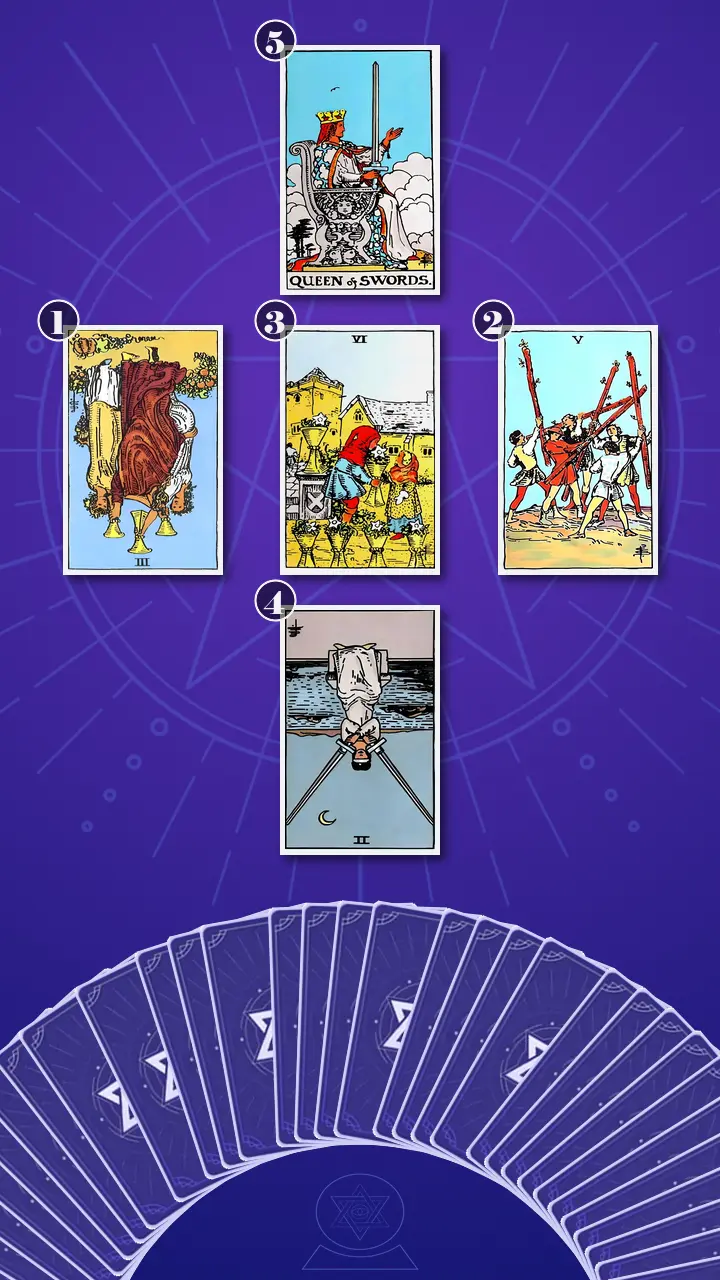
I chose a five-card Relationship Spread. For readers wondering how tarot works in a family-boundary question, this spread is useful because it separates Maya’s visible response from the family’s observable interaction style. It also gives the shared bond its own position, so affection is not erased just because a boundary has been crossed.
I explained the map: the first position would show Maya’s current contribution to the exchange; the second would examine the pace and style of the banter without guessing anyone’s motives; the centre would reveal the familiar bond underneath it. The fourth card would expose the central conflict, and the fifth would identify a constructive response under Maya’s control. I treat a tarot spread as an external thinking surface, not a verdict. The cards give us enough distance to see a pattern; Maya still decides what to do with it.
Reading the Room Behind the Laugh
Position 1: The Smile That Looked Like Agreement
First, I turned the card representing Maya’s current contribution: the observable pattern of laughing, softening, or redirecting while her judgment wants to challenge the joke. It was the Three of Cups, reversed.
I pointed to the three figures raising their cups together and asked Maya to imagine that coordinated celebration inverted. At Sunday dinner, everyone laughs and returns a glass or fork to the conversation. Maya laughs too, says, “You’re terrible,” and looks down at her water even though the joke has crossed her line. The visible harmony of the table has separated from her actual emotional participation.
I read the reversed Water here as a blockage in authentic participation. The laugh is a learned piece of social coordination, not proof of endorsement. I put the split into the words I heard beneath her story: “My face is joining them, but my judgment has already left the joke.”
Maya gave a brief, bitter laugh, then pressed her lips together. “That’s so accurate it feels a bit rude.”
“The card isn’t accusing you,” I said. “It’s separating an automatic reaction from an actual opinion. A reflex can explain the first response without getting the final word.”
Position 2: The Two-Second Gap No One Leaves Empty
Next, I turned the card representing the family’s observable banter style: its speed, competitiveness, and demand for a quick response. The Five of Wands appeared upright.
The five staves crossed without forming a shared structure. I compared them to five relatives talking over one another: one joke lands, another person tops it, and a third adds a callback before the first laugh has ended. Maya recognised the inner countdown immediately: “If I pause for two seconds, everyone will know I’m not playing along.”
I described this as an excess of Fire: speed and social heat leave too little room for deliberate speech. The card did not tell me that anyone intended harm, and I did not use it to turn her relatives into villains. It showed that the pace itself was pressure. Maya’s shoulders rose as I described it, then lowered on a long exhale when I added, “You can acknowledge the family style without accepting it as the only style you’re allowed to use.”
Position 3: The Old Role Waiting at the Door
The centre card represented the shared bond and familiar family script that made laughter feel connected to belonging. I turned the Six of Cups, upright.
I drew Maya’s attention to the flower-filled cup offered inside an old courtyard. She told me how an old nickname could meet her at a birthday dinner and, within seconds, turn a twenty-eight-year-old account manager back into the family member who proved she was easygoing by laughing. The affection was real. That was precisely why the role was hard to interrupt.
I saw balanced Water in the bond itself, but an excess of loyalty to a version of Maya that no longer fit every adult boundary. It was like a phone automatically reconnecting to known Wi-Fi and restoring old settings as soon as she entered the building. Familiarity made the response fast; it did not make the setting current.
Her fingers tightened around her coffee cup, then slowly released. “I do love these people,” she said, more quietly. “I just don’t want love to require the same role forever.” I agreed. The choice was not truth versus family. It was truth versus one inherited method of proving she still belonged.
When Two Scripts Played at Once
Position 4: The Boundary Trapped in the Notes App
The fourth card represented the central challenge: Maya’s internal objection and external laughter remaining active at the same time. I turned the Two of Swords, reversed.
I translated the blindfold and crossed blades into two browser tabs playing audio at once. One said, “Keep it light.” The other said, “That crossed a line.” At the table, Maya held her smile and waited for a perfect opening. On the streetcar, she wrote and deleted three messages because one seemed too soft, one too harsh, and one too likely to “make it a whole thing.”
This was blocked Air becoming overload. The stalemate had provided immediate social relief, but it was no longer neutral: each smooth exit left an unspoken limit, a tight jaw, and another private replay. The reversal was both blockage and catalyst because the old arrangement had become too unstable to carry comfortably.
I used my Analysis Paralysis Deconstruction here. I stripped away the abstract questions Maya could not settle that night: Would they call her oversensitive? Would the atmosphere change? Could she prove the joke was objectively wrong? The grounded reality was smaller. A topic had crossed her line, her laugh had not expressed that, and one accurate correction remained available.
“The goal is not the perfect comeback,” I told her. “It is one accurate sentence.” Her jaw shifted as if she were testing whether speech could fit through the space that had just opened.
When the Queen Raised One Sword and Kept One Hand Open
Position 5: A Clear Line Without a Closed Door
The final card represented the constructive response under Maya’s control: a brief boundary that could align her visible behaviour with her judgment while leaving room for continued relationship. As I turned the Queen of Swords, upright, the rain against my window softened to separate, audible taps. The room seemed to make space around the card.
I showed Maya the Queen’s single vertical sword and her extended open hand. The sword offered balanced Air: discernment, self-trust, and proportionate directness. The open hand mattered just as much. It showed that clarity did not require punishment, emotional withdrawal, or a verdict on the whole family.
I asked Maya to return to 9:06 p.m. on the streetcar, when the family laughter was still in her ears and the calm sentence arrived only after her jaw released. She had been treating the first laugh as a completed decision and the perfect later message as her only route back to honesty.
A reflexive laugh is not a binding vote. One clean sentence can make your next response more accurate than your first.
You do not have to smile against your own judgment; let the Queen's upright sword turn your private truth into one clean sentence while her open hand keeps the conversation possible.
I let the words sit. Maya’s breath stopped first; her fingers hovered above the rim of her cup as though the next movement had been temporarily removed. Then her gaze slipped past the card and lost focus. I could almost see her replaying the dinner, the group chat, and the warm phone on the streetcar. Her eyebrows pulled together. Her eyes brightened, but the first emotion to reach her voice was anger.
“But doesn’t that mean I’ve handled all those dinners wrong?” she asked. The question came out low and tight. Then her shoulders dropped, her hand opened, and a shaky breath left her chest. Relief had arrived, but so had the vulnerable recognition that a clearer response would now be hers to choose.
“It means your old response protected the rhythm before you had another response available,” I said. “That is information, not a conviction. Your second response can be more truthful than your first.”
I reached for Complexity Reduction, another tool I use when a decision has become crowded with imagined consequences. I reduced the live choice to one practical question: “Does my next signal match my actual judgment?” The Queen’s sword made that line clean; her open hand kept the relationship from being falsely placed on the other side of it.
I asked, “Now, with this new perspective, think back: was there a moment last week when this insight might have made you feel different?” Maya remembered hovering over a laughing reaction in the family group chat. She could have left the message unanswered or written, “Actually, not that topic.” Neither option guaranteed an easy response, but both would have restored her authorship.
I named the movement I could see: this was a first step from contracted discomfort, automatic agreement signals, and delayed resentment toward self-trusting, proportionate directness within an ongoing family connection. Tarot had not removed the awkwardness. It had shown her where awkwardness could become the price of accuracy rather than evidence that she had done something wrong.
The Coffee Bean Filter for One Accurate Sentence
I connected the five cards into one practical story. The reversed Three of Cups showed Maya publicly joining a reaction her judgment had already left. The Five of Wands explained the pressure of rapid-fire banter. The Six of Cups revealed the genuine affection and old role beneath the habit. The reversed Two of Swords showed why the private boundary kept getting stuck in draft mode, while the Queen offered the resource that had been missing: one defined line with conversation still available.
The cognitive blind spot was the belief that Maya needed wording no one could criticise before she could speak. That standard quietly made her responsible for both her boundary and everyone else’s reaction. The spread redirected her toward what she could actually control: one breath, one specific sentence, and the freedom to correct course after an initial laugh. Because no Pentacles had appeared, I wanted to add the missing Earth through rehearsal, timing, and a repeatable behaviour.
- Run the 24-Hour Coffee Bean Filter. On Monday evening at the kitchen table, Maya would place two mugs beside her phone note. For twenty-four hours, she would sort each decision variable into “Absolute Must-Haves” or “Emotional Noise.” The must-haves were a specific topic, a sentence of no more than twelve words, and an available exit. Predicting every reaction, proving the entire history, and finding wording nobody could dislike belonged in the second mug. Tip: Sort for seven minutes, then stop. The protocol filters the decision; it does not put the family on trial.
- Build the One-Breath Boundary. Maya would open a note titled “One Breath, One Sentence” and write, “Actually, I don’t want to joke about that.” On Tuesday, she would record herself saying it twice at a normal speaking volume, then practise the minimum version: “Not that one, please.” Tip: Keep the rehearsal under five minutes. She could delete the voice memo immediately; the goal was availability, not performance.
- Use a Second-Response Correction. During one low-stakes exchange, Maya would place both feet on the floor, take one breath, and use the sentence once. If the laugh came first, she could still add, “Actually, I don’t want to joke about that.” If the moment had passed, she could text the speaker later that day and ask for that topic to be left out. Tip: For “It was only a joke,” one prepared reply was enough: “I know it was meant as a joke. I’m still asking to leave that topic out.”
I reminded Maya that direct speech was an option, not a moral test. If speaking in the moment felt unsafe or demanded more energy than she had, a later message, physical distance, support from a trusted relative, or no further engagement could also be a valid boundary. Her task was not to produce a perfect family outcome. It was to choose the response that best protected her participation and well-being.

A Week Later, the Quiet Proof
Six days later, I received a message from Maya. A joke had started in the family group chat, and her thumb had moved toward the laughing reaction. She paused, left the emoji untouched, and wrote, “I’m sitting this one out. Please don’t joke about that with me.” One relative changed the subject. Another sent a private question. Maya answered only the part she wanted to answer.
She told me the pause had felt conspicuous and her hands had stayed warm for several minutes. That night she slept through, though her first thought in the morning was, “What if they think I’m dramatic?” This time, she smiled because the question had not erased what she meant.
I did not see that message as proof that tarot had changed Maya’s fate. I saw it as proof that Maya had used the cards to recognise a pattern, test a grounded next step, and regain control of her own signal. Her Journey to Clarity was not a flawless confrontation. It was a second response that finally sounded like her.
If everyone turns toward you after the punchline and your smile locks while your throat closes around the objection, I want you to remember that losing the joke can feel dangerously close to losing your place in the room. Merely noticing that old equation means it is no longer operating entirely outside your awareness.
If you let one breath sit where the automatic laugh usually goes, what one clean sentence could keep both your boundary and the relationship in the room?
This story is adapted from psychological research, written so that those in a similar struggle can see their own pattern in it — and find their next step clearly.These insights are not a substitute for professional psychological, medical, legal, or financial advice.
Learn more about our Journey to Clarity.
How did this insight land for you?
🫂 This Resonates Deeply
🌀 Living This Story
✨ Now I See Clearly
🌱 Seeing New Possibilities
🧰 Useful Framework
🔮 The Confirmation I Needed
💪 Feeling Empowered
🚀 Ready for My Next Step
Author Profile
 AI
AI“For twenty years, I’ve listened to stories unfold over the warm aroma of coffee. I don’t believe life’s complexities always require grand theories to be solved; often, we just need a safe place to tidy up our reality. I don’t offer high-minded preaching—just grounded, heartfelt insights to help you regain your sense of control amidst the clutter of daily life.”
In this Choice Tarot Reading :
Core Expertise
- Analysis Paralysis Deconstruction: Stripping away abstract 'what-ifs' to focus strictly on the grounded realities and immediate constraints of your options.
- Complexity Reduction: Tidy up cluttered decision parameters into a clean, practical binary choice.
Service Features
- The Coffee Bean Filter Protocol: A 24-hour pragmatic sorting exercise to physically categorize decision variables into 'Absolute Must-Haves' and 'Emotional Noise', instantly restoring decisiveness.
Also specializes in :
Explore Related Patterns:
Approval-Driven Self-SilencingAt the dinner table, Maya's jaw hardens and her throat closes around an objection while her face continues to supply the laugh everyone expects. Later, she withholds three drafted corrections because each could produce criticism, awkwardness, or a change in atmosphere. Her internal judgment is clear, but expression becomes conditional on keeping everyone else comfortable. When you require social approval before allowing your own limit to become audible, self-silencing can feel like consideration rather than self-erasure. The approval-driven form is especially difficult to detect because it appears polite and relationally responsible from the outside. Identifying the mechanism restores a crucial distinction between communicating your boundary respectfully and taking responsibility for whether other people approve of it.
Compulsive PeacekeepingAt Sunday dinner, Maya protects the table's momentum by laughing even after the topic has crossed her line. The same pressure appears around old nicknames and laughing reactions in the family group chat, where being easygoing has become a familiar way to prove that she still belongs. Immediate harmony is preserved, but Maya repeatedly absorbs the cost in silence, tension, and delayed resentment. When you experience another person's discomfort as a problem you must prevent, peacekeeping can become compulsive rather than freely chosen. The mechanism keeps conflict outside the room by relocating it inside you. Naming Compulsive Peacekeeping makes the trade-off visible, so connection no longer has to depend on automatically managing the emotional atmosphere for everyone else.
Family Role RegressionWhen an old nickname appears at a family gathering, Maya can move within seconds from a capable twenty-eight-year-old account manager into the familiar relative who proves she is easygoing by laughing. The affection is genuine, but the setting automatically restores an earlier behavioural script before her current adult preferences have time to enter the exchange. Family Role Regression describes how familiar people and cues can reactivate an older version of your relational self without erasing the person you have become elsewhere. You may sound younger, comply faster, or recover your boundary only after leaving the room. Seeing the role as context-dependent helps you separate love for the family from continued performance of an identity that no longer fits every interaction.
Fawning ResponseAt 7:18 p.m., Maya laughs, says, "You're terrible," and reaches for her water before she has decided whether the dating joke is funny. The sequence immediately communicates friendliness and participation, even as her hardened jaw and narrowed throat register an objection. The laugh is therefore doing defensive social work rather than reporting her actual opinion. When you have learned to restore interpersonal safety before checking your own response, appeasement can arrive faster than conscious judgment. A Fawning Response explains why the first signal protects connection while the real answer appears later. Recognising that timing gap allows you to treat the laugh as an automatic coping response, not as a binding statement of consent or agreement.
Approval-Driven Decision ParalysisAt 9:06 p.m. on the streetcar, Maya drafts three versions of the same boundary and sends none. One appears too soft, another too harsh, and the third too likely to make the joke "a whole thing." The decision has expanded beyond saying what she means and now includes preventing criticism, predicting the atmosphere, and managing every possible response. Approval-Driven Decision Paralysis develops when a choice must pass an imagined social acceptance test before you permit yourself to make it. More analysis cannot resolve the stall because the hidden requirement is not accuracy but guaranteed approval. Reducing the decision to whether your next signal matches your actual judgment returns the choice to a standard you can control.
Cognitive DissonanceAt the table, Maya's face joins the group while her judgment has already left the joke. One internal script says to keep the exchange light, while another registers that the topic crossed a line. Because neither script is resolved in the moment, the public laugh and private objection remain active together and continue competing after dinner. Cognitive Dissonance names the strain created when your behaviour communicates one position while your current belief holds another. The discomfort does not mean either your affection or your boundary is false; it shows that an inherited social response no longer fits your present judgment. A second-response correction reduces the split by letting later behaviour become more accurate than the automatic first signal.
Mind ReadingBefore Maya has tested a boundary, she predicts that a two-second pause will tell everyone she is no longer playing along. She then imagines being called oversensitive, and even after sending a proportionate message, her first thought the next morning is, "What if they think I'm dramatic?" These possible judgments begin influencing her response before anyone has actually made them. Mind Reading turns uncertainty about other people's reactions into an apparently established social fact. When you organise your behaviour around those predictions, the automatic laugh can feel safer than discovering what the room will really tolerate. Separating observable responses from anticipated ones allows you to make a boundary decision from present evidence rather than from a rehearsal of criticism that has not occurred.
Assertive CommunicationSix days after the reading, Maya leaves the laughing reaction untouched and writes, "I'm sitting this one out. Please don't joke about that with me." The sentence identifies the specific topic, states the requested change, and avoids turning the whole relationship into a verdict. When a relative follows up privately, she answers only the part she chooses, extending the same boundary into the next interaction. Assertive Communication gives you a behavioural alternative to both automatic agreement and an all-out confrontation. It allows your visible signal to match your judgment while leaving other people responsible for their own reactions. The awkwardness that follows is not evidence that the boundary was excessive; it is the temporary cost of replacing an established social script with more accurate participation.
Explore Related Struggles:
Agreement-Agency SplitMaya laughs, says "You're terrible," and reaches for her water before she has decided what she thinks. Her objection arrives later in Notes, after the table has already received the laugh as her answer. When your visible signal is produced by the room's pace before your judgment can enter the exchange, other people may read participation where you did not consciously choose agreement. Your agency remains present, but it is forced into a delayed second response while the automatic first response carries public authority. The strain lies in having two different authors for one social moment: the reflex that keeps pace with the group and the deliberate voice that knows where your line is. Recognizing that a reflexive laugh is not a binding vote allows your next response to represent you more accurately than your first one did.
Belonging-Authenticity SplitMaya genuinely loves her relatives, yet the affectionate family rhythm repeatedly asks her to laugh in a role that no longer fits every adult boundary. She wants the joke to stop without turning the entire dinner, or the entire relationship, into a rejection. When belonging has long been demonstrated through being easygoing, one accurate objection can seem to carry the weight of your place in the room. You are then pulled between remaining recognizable to the group and remaining recognizable to yourself, even though neither connection nor honesty inherently requires the destruction of the other. The central struggle is not truth versus family. It is truth versus an inherited condition of participation that says closeness must look like laughing along. A boundary can change the terms of your participation while leaving your care for the relationship intact.
Harmony-Safety FusionAt 7:18 p.m., Maya laughs, calls the relative terrible, and reaches for her water while the objection stays behind a tightened jaw. Later, she leaves three messages unsent because speaking could change the atmosphere and make the joke into a confrontation. When uninterrupted harmony becomes the expected proof that everyone is still connected, even a two-second pause can feel larger than it is. You may preserve the room's rhythm because smoothness has become entangled with continued acceptance, while your own limit is treated as the disruptive element. That arrangement keeps the interaction stable by making your correction absorb the cost of every possible reaction. Separating connection from constant smoothness lets awkwardness become a manageable part of honest participation rather than automatic evidence that the relationship is in danger.
Inherited Role LockAn old nickname can meet Maya at a family event and quickly turn a twenty-eight-year-old account manager back into the person who proves she is easygoing by laughing. The same script reaches into the group chat when her thumb moves toward the laughing reaction before her current judgment catches up. Familiar settings can restore an established role faster than deliberate speech becomes available. When you enter that setting, your relatives know how to interact with the older version of you, and your body already knows how that version keeps the exchange moving. The role becomes restrictive when its speed prevents your present-day limits from participating. Seeing it as inherited rather than permanent gives you room to keep the relationship while revising the part you are expected to play within it.
Clarity-Exposure SplitAt 9:06 p.m. on the streetcar, Maya knows the sentence she wants to communicate, yet three versions remain unsent. Her attention shifts from the topic that crossed her line to whether relatives might call her oversensitive, criticize her wording, or treat the correction as a larger confrontation. Private clarity and public clarity carry different costs. You can know exactly what you mean while still becoming stuck at the point where that meaning will be visible to people whose reactions you cannot control. The exposure does not disappear when the sentence becomes accurate. What changes is the division of responsibility: you can own the specificity and proportion of your request without taking ownership of every interpretation that follows.
Explore Related Emotions:
Approval AnxietyOn the streetcar, Maya discards one message for sounding too soft, another for sounding too harsh, and a third for risking “a whole thing.” Even after she later sets a clear boundary, her first morning thought is that the family might consider her dramatic. When you believe your limit must be expressed in wording nobody can criticise, speaking becomes dependent on securing approval in advance. The laugh offers a fast escape from that impossible standard, while the anxiety returns later as rehearsing, editing, and trying to manage reactions that are not fully yours to control.
Belonging AmbivalenceMaya says, “I do love these people,” and then names what she no longer wants love to require. In the later group chat, she declines the joke, remains in the conversation, and answers only the part of a private question she chooses to answer. You can want closeness and still resist the role that has organised that closeness. Belonging Ambivalence holds both truths without forcing a false choice between family affection and personal accuracy, making room for connection that does not depend on laughing against your own judgment.
Conditional Belonging FearAn old nickname can meet Maya at a family dinner and return her almost instantly to the role of the easygoing relative who laughs along. Because the affection is real, interrupting that role carries more emotional weight than simply objecting to one joke. When belonging has repeatedly been signalled through being agreeable, a two-second pause can feel like a public withdrawal from the group. You may laugh because your body is protecting your place in the room before your adult judgment has had time to test whether connection can survive a different response.
Performative WarmthAt 7:18 p.m., Maya laughs, says, “You’re terrible,” and reaches for her water before she has decided what she thinks. Her jaw and throat register the objection, but the table receives a familiar signal of warmth and participation. When your face supplies social ease faster than your judgment can speak, the warmth can feel performative even if the affection underneath it is real. Naming that split lets you separate an automatic affiliative signal from genuine agreement, so the first reaction no longer has to define your position.
Self-Betrayal AcheMaya describes the split precisely: her face joins the group while her judgment has already left the joke. Once she sees that pattern, she immediately wonders whether she has handled all the earlier dinners wrong. When your visible response repeatedly contradicts what you know inside, the pain can turn inward and feel like abandonment by your own voice. You do not have to convert that recognition into a conviction against yourself; the ache can instead identify the distance between an inherited reflex and the response you now want to author.
Voice Erasure DreadMaya's objection narrows inside her throat at dinner, then appears nearly two hours later in a private Notes draft. She produces three versions, but none reaches the people who heard her laugh. When the room repeatedly receives your automatic signal while your considered response remains private, it can feel as though your real position is vanishing from the relationship. The dread comes from more than silence: it comes from watching a reaction you did not choose stand in for the voice you were trying to recover.
Agency ReliefMaya's shoulders drop and her hand opens when she understands that the first laugh is not a completed decision. Later, she leaves the group-chat reaction untouched, writes one accurate sentence, and chooses how much of the follow-up to answer. Relief enters when the interaction is no longer organised around either perfect control or total silence. You regain authorship by recognising that timing, wording, and degree of engagement remain available choices, even after an automatic response has already happened.
Cautious Self-TrustSix days later, Maya pauses before adding a laughing reaction and writes that she does not want the topic used as a joke. When one relative asks a private question, she answers only the part she wants to answer. The next morning still brings the thought that she may seem dramatic, but it no longer cancels her meaning. Cautious Self-Trust is that unfinished steadiness: you do not need certainty about everyone else's response before treating your own judgment as credible enough to guide the next signal.
Hidden ResentmentMaya's jaw hardens at the table, and the sentence she cannot say follows her onto the streetcar as a private replay. The group has already moved on, but the crossed line remains active in her body and Notes app. When your public response protects the room while your objection receives no space, resentment can accumulate out of sight. It is the after-pressure of participation that looked voluntary but did not include your actual judgment, and noticing it can show you where a clearer signal is needed before another smooth exit becomes another private replay.
Protective AngerMaya's jaw hardens when the dating joke lands, and anger is the first feeling to reach her voice when she recognises what the laugh has been covering. That anger becomes specific: the topic crossed her line, even though she does not want to condemn the whole family. When anger is allowed to carry information instead of becoming punishment, it can protect the part of you that knows what is not acceptable. Its usefulness here lies in definition: it gives your boundary enough force to become audible while leaving you free to choose proportion, timing, and continued contact.
Explore Related Contexts:
Designated Peacekeeper BurdenMaya laughs, says, "You're terrible," and reaches for her water while the objection remains unspoken. She also states that she does not want dinner to become a confrontation, placing the preservation of the group's rhythm inside her own response assignment. You can read the laugh as labor performed by the designated family peacekeeper. It softens the joke, reassures the table that the exchange may continue, and transfers the unresolved cost to Maya after everyone else has moved on. The burden is not simply that she dislikes a remark; it is that her established social function requires her to absorb friction before she can decide whether that function still serves her.
Family Banter BoundaryA relative turns Maya's dating life into the punchline, the cutlery keeps moving, and everyone looks over for her reaction. The laugh arrives before she has evaluated the joke, while the sentence she actually endorses does not appear until she is alone on the streetcar. You are seeing a boundary problem shaped by the public topic, the audience, and the speed of the exchange. The family banter does not leave a neutral gap for deliberate speech, so Maya's first visible signal serves the room's momentum rather than her stated limit. Naming this as a Family Banter Boundary separates the external interaction pressure from her actual position and keeps a later correction available.
Inherited Family Role Lock-InAn old nickname can meet Maya at a family gathering and rapidly replace the twenty-eight-year-old account manager with the person who has long proved she is easygoing by laughing. Her adult judgment remains intact, but the family setting restores an earlier role before she has established a current one. You are looking at a social position that has been reinforced through repetition, familiarity, and affection. The lock-in occurs because the old response is already legible to everyone at the table, while Maya's adult boundary has no equally established place in the family script. Recognizing that mismatch lets her treat the inherited role as a position being renegotiated, rather than as the only version of herself permitted in the room.
Unspoken Table Rule PressureOne relative lands a joke, another tops it, and a third adds a callback before the first laugh has ended. Maya identifies the governing deadline precisely: if she pauses for two seconds, everyone will know she is not playing along. You can locate the pressure in the table's unwritten timing rule. Immediate laughter is treated as normal participation, while reflection becomes a conspicuous interruption that must be socially accounted for. This structure explains why a fast signal can appear before Maya's considered response without converting that signal into genuine agreement.
Adult-to-Adult Communication TrialMaya replaces the expected laughing reaction with a specific request in the family group chat. One relative changes the subject, another asks a private question, and Maya responds only to the part she chooses, keeping both the limit and the communication channel active. You are seeing an adult-to-adult position become available through use rather than through family permission granted in advance. The trial gives Maya control over the topic, timing, and scope of her reply while leaving continued relationship possible. Its value lies in establishing that direct speech and selective engagement can operate together inside the existing family connection.
Family Peacemaker Role ResetSix days later, Maya's thumb moves toward the laughing reaction in the family group chat, but she leaves it untouched and writes, "I'm sitting this one out. Please don't joke about that with me." She remains in contact, answers only the part of a private question she wants to answer, and allows another relative to change the subject. You can see the family peacekeeper role being reset through a limited real-world trial. Maya is no longer taking responsibility for making every reaction comfortable; she is taking responsibility for making her own signal accurate and proportionate. The role remains relational, but its terms are being rebuilt around chosen participation instead of automatic smoothing.