Wanting to Leave Without Knowing What's Next: A Bounded Two-Week Test

The 11:40 p.m. Trap of Wanting to Leave Without Knowing What Comes Next
I know the pattern of the dependable hybrid worker who can track six client deliverables but cannot send the resignation draft that matters most. When Alex sat down with me, they opened their laptop and showed me a photograph from the previous Sunday night. It was not dramatic, which was precisely why it felt so revealing.
At 11:40 p.m. in their shared Toronto apartment, a resignation draft sat beside twelve LinkedIn Jobs tabs and a colour-coded Google Sheet. The laptop fan whirred against the radiator's dry clicking. Blue-white light washed over a cold mug while Alex added one more criterion, closed the laptop, and set a 6:45 a.m. alarm for the job they wanted to leave.
“I know I want out, but wanting out is not a plan,” they told me. “Every option sounds possible until I imagine having to explain it. Then I research everything again.”
I heard the central contradiction immediately: Alex wanted to leave, yet believed movement was permitted only after the entire next chapter had been defined. Their restless uncertainty seemed to move through the body like a train idling beneath the ribs, vibrating without leaving the platform. Staying tightened their chest; designing a complete escape tightened their jaw.
“I am not going to tell you to quit, stay, or wait for a sign,” I said. “I want us to identify which uncertainty can be resolved through thought and which can only be resolved through contact. Let us make a map of the fog, without pretending the map must contain the whole journey.”

Choosing the Compass: The Decision Cross
I invited Alex to take one slow breath and hold a single question in mind: “Why does the wish to leave keep returning, and what would responsible movement look like?” I shuffled slowly. The pause was a focusing mechanism, not a mystical test.
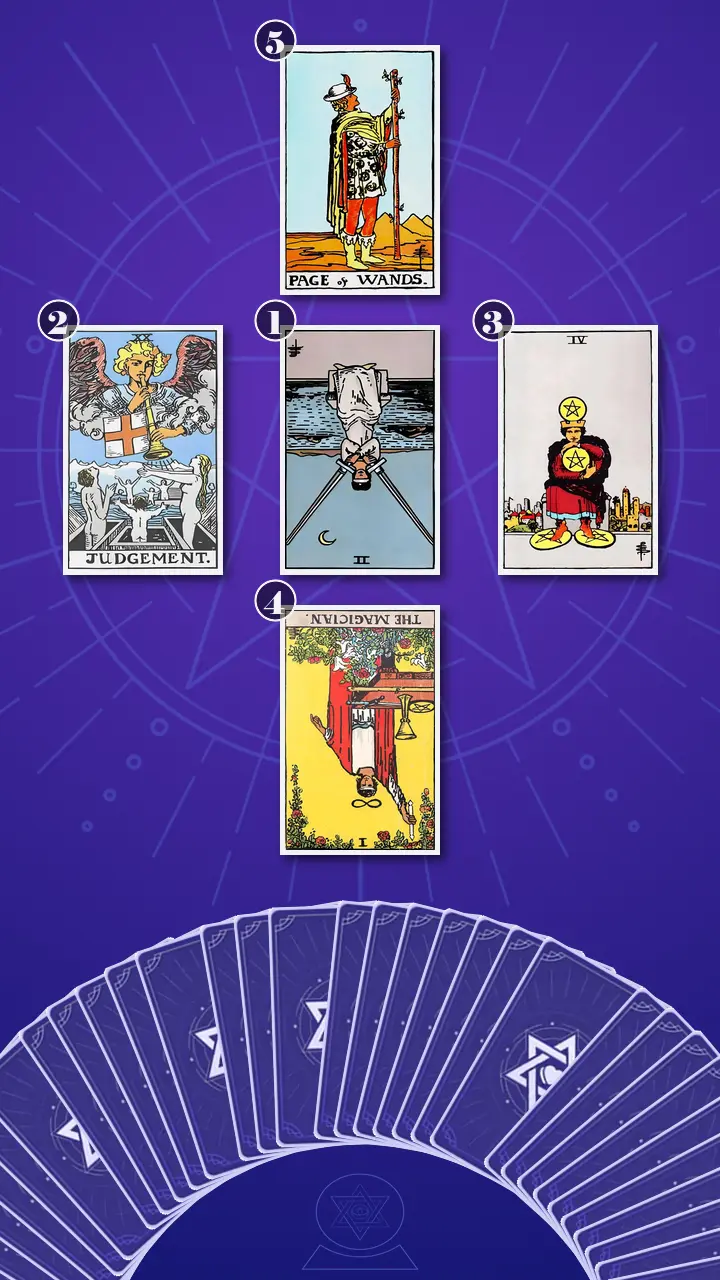
I chose the five-card Decision Cross · Context Edition tarot spread for career-transition uncertainty. I use this focused layout when someone is caught between two legitimate pressures, such as wanting to quit without a backup plan while needing income, stability, and control. A larger spread would have produced more material, but Alex did not need more variables. They needed a clean view of the loop.
This is how tarot works in my practice: the cards do not issue orders or predict an assigned destination. They externalise a decision system so that its competing forces can be examined. Card meanings in context become prompts for observation, comparison, and choice.
The centre would show the present knot. The cards to either side would distinguish the recurring call to leave from the security function of staying. The card below would expose the hidden mechanism keeping the pattern alive, and the card above would offer an integrative next step. The arrangement resembled a compass at a junction: two pressures, one buried root, and one upward point of orientation.
Reading the Knot Behind Career-Change Analysis Paralysis
Position One: Two Swords Across the Exit
I began with the card representing the present knot: the observable cycle of drafting an exit, researching alternatives, and postponing action whenever certainty remained unavailable. I turned over the Two of Swords, reversed.
The blindfolded figure and crossed swords placed Alex's conflict in plain sight. At 11:40 p.m., they had switched among a resignation draft, twelve job tabs, and a transition spreadsheet. Every new criterion created a brief sensation of control while reopening every option. Reversed, the card showed blocked Air becoming excess: thought was no longer clarifying the decision; it was crowding out the experience that might clarify it.
I gave the loop its internal wording: I can leave once I know what comes next, but I cannot know what fits until I leave or test something. Because I cannot guarantee the result, I will add another criterion.
Alex let out a short, bitter laugh. Their fingers stopped on the laptop trackpad before their hand dropped into their lap. “That is so accurate it feels a little brutal.”
“Accurate does not have to mean condemning,” I replied. “This system has been trying to protect you from an uncontrolled move. We are only noticing that it now prevents you from gathering the evidence it was meant to secure.”
Position Two: Judgement as the Notification That Keeps Returning
I next turned the card representing the recurring inner call beneath the wish to leave: what Alex needed to acknowledge about the current chapter before treating the urge as either a command or a mistake. It was Judgement, upright.
I compared its trumpet to a persistent notification. Even after an unexpectedly manageable week, the wish to leave returned on Sunday evening. Judgement asked Alex to notice what felt complete, emotionally flat, or repeatedly unanswered before opening another job board. Its awakening energy was balanced here: strong enough to invite an honest review, but not an instruction to hand in a resignation.
“What if this feeling is neither a command nor a mistake,” I asked, “but a signal you have not fully listened to?”
Alex's breath lengthened. Their gaze moved from the trumpet to the open-armed figures on the card. “Even on good weeks, I still feel like I am managing the shape of other people's ideas. I cannot remember the last time I felt interested in my own work.”
I nodded. “Wanting out is information. It is not yet an instruction. The honest question is not only, 'Should I leave?' It is also, 'What need keeps asking to be acknowledged?'”
Position Three: The Salary That Felt Like Shelter and a Lock
I turned the card representing the security function of staying: the income, competence, routine, and recognisable identity that made the familiar role difficult to release. The card was the Four of Pentacles, upright.
Alex recognised the scene immediately. A rent transfer and payroll notification could arrive within hours of each other, making the known salary feel like both shelter and a lock. The pentacle against the figure's chest resembled the paycheque and competent identity Alex protected; the coins beneath both feet showed how protection could restrict movement. This was legitimate Earth energy becoming overconcentrated, not a moral failure or a shortage of courage.
Seeing those coins, I thought of the shoring used on archaeological digs. A support structure is not the enemy of discovery; it lets us excavate without collapse. But if no trench is ever opened, maintaining the support structure has quietly become the entire project.
“I am not only holding a job,” Alex said. “I am holding rent, routine, and the version of me everyone understands.”
Their shoulders rose at the word rent, then lowered slightly when I answered, “Of course you are. Practical stability belongs in this reading. Security is a condition to design, not a verdict to stay still. We can define a safety floor for exploration without pretending a free informational conversation carries the same risk as quitting outright.”
Position Four: The Magician's Unused Toolkit
I turned the card representing the hidden manifestation gap: how scattered preparation and unused resources allowed the conflict to continue without producing real evidence. It was The Magician, reversed.
The card's table held every suit tool, just as Alex already had transferable project skills, saved contacts, available evenings, and several interests. Yet Wednesday nights disappeared into a Notion dashboard and Google Sheets scoring matrix. A former colleague's contact stayed open on the phone while the outreach message was revised instead of sent. Reversed Magician energy showed blockage through dispersion: every tool remained active in private, but none was directed far enough to receive feedback from the outside world.
I used my Enduring Value Assessment to separate what would survive the transition from what merely offered short-term relief. Alex's coordination, research, writing, and client communication would remain useful across many possible careers. The immaculate dashboard would not. It was a sophisticated container for potential, but it had never met a real person, task, or response.
“You are asking research to provide evidence that only contact can create,” I said.
Alex became still. Their eyes moved away from the cards as if replaying several Wednesday evenings at once. Then their mouth tightened. “So all the productivity stuff is just avoidance?”
“Not just avoidance,” I replied. “It has organised what you know and reduced overwhelm. It becomes avoidance only at the point where another revision replaces the smallest available contact with reality. The blind spot is not that you lack tools. It is that you keep every tool private until you can guarantee how it will perform.”
When the Page of Wands Raised One Living Question
Position Five: A Two-Week Path Instead of a Forever Identity
The room went quiet before I turned the final card. A streetcar bell sounded faintly beyond the window, a clear note against the muted traffic. I revealed the card representing the integrative way forward: one bounded, reversible experiment that could create clarity without requiring Alex to decide the entire transition at once. It was the Page of Wands, upright.
The Page was not holding a complete map or a mature enterprise. They were studying one wand with fresh leaves in an open landscape. I connected that image to a practical scenario: two 45-minute sessions, no resignation deadline, no rent money, and one piece of outside feedback. Alex might speak with one person in user research, complete one trial brief, or attend two sessions of a class. The Page's Fire was balanced because it concentrated curiosity into one test without inflating that test into a permanent identity.
I often use Historical Crossroad Matching when a client expects the present to feel as tidy as history looks in retrospect. People living through a turning point do not see the finished chapter title that later appears in a textbook. They see partial signals, competing structures, and one available action. The clean era boundary is drawn afterward. Alex had been demanding a historian's hindsight before allowing a participant's first step.
At that point, I could see Alex mentally returning to 11:40 on Sunday night: the resignation draft, twelve tabs, one more criterion, and Monday's alarm. They had been treating uncertainty as proof that movement was irresponsible, even though the planning itself kept producing no new evidence.
You do not need a finished map to justify movement; choose one limited experiment and, like the Page studying the sprouting wand, let direct contact with the path generate the next piece of clarity.
I let the sentence remain in the room. Alex's breath stopped first. Their fingers hovered above the cold mug without touching it, and their pupils widened slightly as their gaze lost focus. I watched the meaning move from abstraction into memory: the unsent message, the saved posts, the repeated requests for friends to settle a decision that no one else could test for them. Then resistance arrived. Their brow tightened and colour rose along their cheeks.
“But doesn't that mean I have been doing all of this wrong?” they asked, their voice sharper than before. “I have spent months planning.”
“No,” I said. “It means planning carried you as far as planning could. It helped you identify constraints and possibilities. Now it is being asked to answer a different category of question. You cannot research whether a particular conversation makes you more alert, whether a trial task holds your attention, or whether beginnerhood feels relieving rather than diminishing. That evidence has to be lived.”
Alex's hand closed briefly around the mug, then loosened. Their eyes shone, although they did not look simply relieved. Their shoulders dropped with a long exhale, followed by a moment of almost weightless uncertainty, the slight dizziness that can come when a familiar burden is removed and choice becomes real. “Okay,” they said quietly. “That is less terrifying, but it also means I have to let something be unfinished.”
“Now, with this new perspective, think back to last week,” I invited. “Was there a moment when this insight could have made you feel different?”
Alex remembered opening the contact of a former colleague who had moved into user research. They had deleted the message because one conversation could not prove that user research was the correct career. Under the Page's gaze, the same moment looked different. The conversation did not need to justify a new identity. It only needed to generate one honest response.
“I am not choosing my forever job,” Alex said. “I am checking whether this possibility becomes more alive when I touch it.”
I recognised the shift. This was not certainty, and it was not a promise to leave. It was the first movement from restless certainty-seeking and recursive planning toward grounded openness, focused curiosity, and growing self-trust through a reversible test. Clarity was no longer the entry fee for movement. It could become evidence produced by movement.
Turning Five Cards into the Next Fourteen Days
I gathered the spread into one coherent sequence. The Two of Swords showed tangled thought holding departure and certainty across the same tight chest. Judgement revealed that the recurring urge deserved an honest hearing. The Four of Pentacles showed why staying protected real material and psychological needs. The Magician reversed exposed the mechanism preserving the conflict: Alex kept coordinating resources privately, so no possible direction could answer back. The Page of Wands brought in one focused unit of Fire, small enough to coexist with practical safety.
The cognitive blind spot was the belief that a responsible move must arrive with a complete explanation. That rule made every experiment look reckless and every spreadsheet look prudent, even when the spreadsheet prolonged the absence of evidence. The transformation direction was simpler: replace the demand for a complete transition plan with one bounded two-week experiment.
Before defining the test, I introduced my Time Stratigraphy Exercise. I asked Alex to imagine standing ten years ahead and looking back at this career crossroads as if it were a layer in an excavation. From that distance, a friend's opinion, a polished LinkedIn headline, and the need to explain a beginner experiment would likely have weathered away. What endured was the ability to protect essentials, test a living question, and revise course from evidence.
- Make the eight-minute Research-vs-Contact Split.On the next Sunday evening, set an eight-minute timer and divide one page into “I can learn this through research” and “I can only learn this through contact.” Add the questions currently keeping you stuck, circle one item in the second column, and view it from your ten-year future perspective.Keep the page private if disclosure could affect work or income. If eight minutes feels activating, do a two-minute version with one question in each column.
- Design a thirty-day safety floor.At home this week, use your bank app and one sheet of paper to total one month of rent, food, transport, medication, debt payments, and other essentials. Choose an exploration budget that does not touch them, even if the budget is $0, then protect one 45-minute period from paid work and transition research.Approximate figures are enough. Housing, healthcare, dependants, immigration conditions, rest, and workplace safety take priority over any aesthetic idea of bravery.
- Run the Two-Week One-Tool Proof.Alex chose project scoping as the existing tool and user research as the curiosity. Their test was two 45-minute sessions: send one former colleague a four-sentence request for a 15-minute conversation, then draft one small, non-confidential interview exercise and ask a trusted person which part seemed strongest.The experiment is research, not a rebrand. No resignation, public announcement, course purchase, or promise to change careers is required.
I asked Alex to evaluate only three pieces of evidence at the end: Did their energy rise or flatten during contact? What skill transferred more naturally than expected? Did curiosity remain after the novelty passed? Those answers could support another test, a pause, or a different direction. None had to become a verdict.
“Your next identity does not need a launch announcement,” I told them. “Clarity can be the result of a small move, not the entry fee for one.”
A Week Later, One Message Left the Drafts Folder
A week later, I received a short message from Alex: “I sent the four sentences. We talked for eighteen minutes. I still do not know whether user research is next, but I know what I want to test on Saturday.”
They had not resigned, solved their career, or become immune to doubt. The next morning, their first thought was still, What if I am wrong? But this time the question did not send them back to twelve tabs. They smiled, opened the trial exercise, and worked until the 45-minute timer ended.
I do not regard that as a small outcome because the cards predicted a path. They did not. I regard it as meaningful because Alex reclaimed authorship of the method: practical boundaries, direct evidence, and permission to remain a beginner. Their Journey to Clarity began when they stopped asking an imagined future to provide hindsight and allowed one living possibility to answer in the present.
When staying tightens your chest and an unfinished future clenches your jaw, it is easy to grip the spreadsheet as proof of control until neither staying nor leaving feels fully yours. Simply noticing which questions have exceeded the reach of research means you are no longer standing at the same point in the loop.
If you did not have to name the whole next chapter, which single sprouting wand could you study for two weeks, and what contact with reality would let it answer back?