Publish Waited at 11:47; A Definition of Done Led to One Live Link

At 11:47 p.m., Last-Step Commitment Paralysis Opens Another Tab
If you are a 29-year-old product designer in Toronto who can finish an entire side-practice portfolio but still freeze over Publish, you may know last-step commitment paralysis better than ordinary procrastination.
Alex (name changed for privacy) joined my video session from their kitchen table on a wet Tuesday night. Their finished portfolio filled our shared screen, its clean type and polished case studies glowing against the dark apartment. A laptop fan whirred beside a mug of coffee they had already described as cold, and streetcar brakes scraped faintly beyond the window.
The cursor waited beside Publish. Alex's fingers rested flat on the trackpad, perfectly still. Their chest barely moved with each breath.
Then, while explaining that the site was ready, they changed one sentence on the services page for the sixth time. Three competitor sites appeared in new tabs.
“I can do ninety-nine percent of the work and still make the last one percent feel impossible,” they said. “I want a more self-directed working life. I want to test my own practice. But when the final click is there, it feels like I'm giving up every exit.”
I watched their shoulders draw inward. The apprehension looked less like ordinary nerves and more like shrink-wrap tightening around the ribs, making even a one-centimetre movement toward the button feel physically expensive.
“You want the change until it asks to become observable,” I said. “That doesn't make you lazy, unserious, or secretly incapable. It tells us the threshold itself has become loaded with meaning. Let's give that threshold a map, so we can separate what is actually unfinished from what is trying to keep you protected.”

Choosing the Four-Rung Ladder
I invited Alex to take one slower breath and hold one question in mind: “Why do I keep freezing at the last step toward the life I say I want?” I shuffled while they closed the competitor tabs. The pause was not a mystical performance. It was a practical transition from reacting to observing.
I chose the Four-Layer Insight Ladder, a four-card tarot spread designed to move from the visible pattern to its protective root, then to a transforming insight and one grounded action. I chose it because Alex was not asking me to predict whether their independent practice would succeed. They were asking why a capable person at a career crossroads could prepare thoroughly and still become motionless when the choice turned real.
This is how tarot works in my practice: the cards do not issue a verdict about a person's future or permanent identity. They provide a structured surface on which competing motives, repeated behaviours, and overlooked resources can become easier to see. Card meanings in context matter more than dramatic predictions.
The bottom position would show the Presenting Pattern, the exact mechanics of the final-step freeze. Above it, the Protective Root would reveal what keeping every exit open was doing for Alex. The third card, given slightly more space, would offer the Transforming Insight. The final card would translate that insight into observable follow-through.
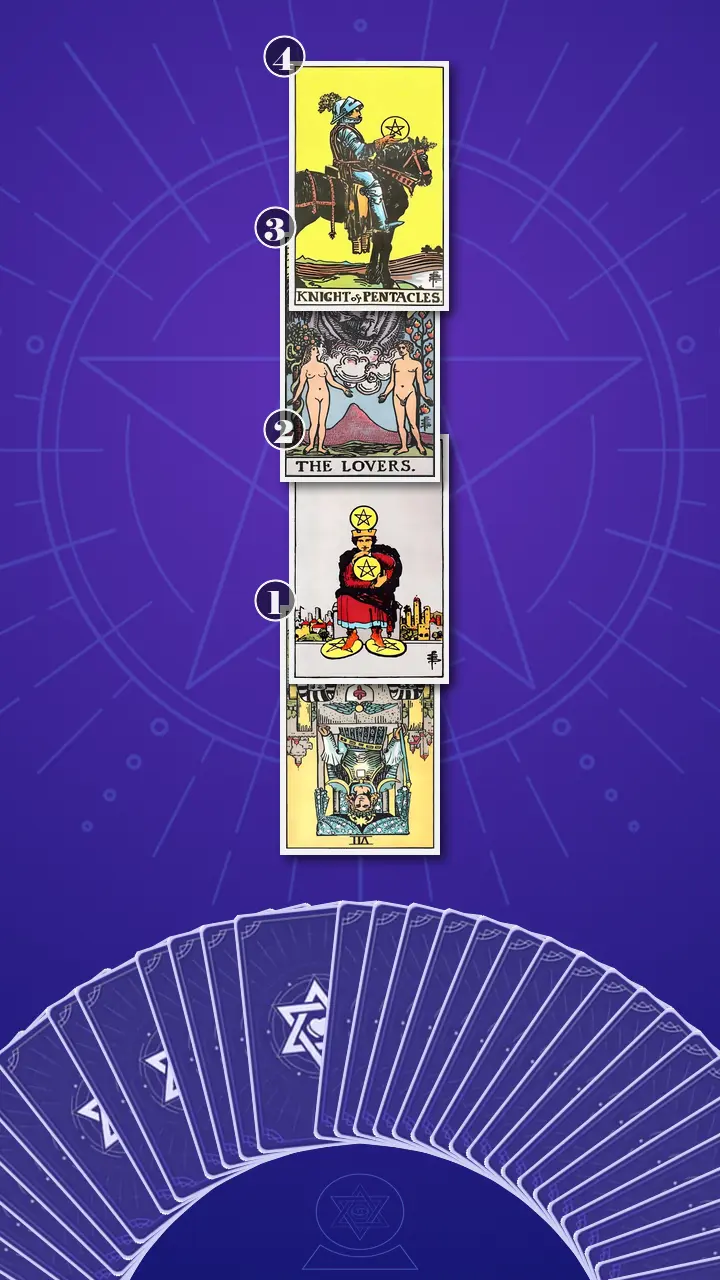
Reading the Split Before the Road
Position 1: The Chariot Reversed and Two Opposing Commands
Now I turned over the card representing the Presenting Pattern: the observable last-step freeze and the divided drive underneath it.
It was The Chariot, reversed.
I pointed to the black and white sphinxes facing away from a shared course. Upright, The Chariot coordinates opposing forces into direction. Reversed, its energy is blocked. The capacity to move is present, but two urgent instructions are cancelling each other out.
“At 11:47 tonight, the portfolio, pricing, and announcement were ready,” I said. “Then your cursor reached Publish, your chest tightened, and your hands went still. One instruction said, ‘Launch the practice you built.' The other said, ‘Do not close off your right to retreat.' Opening competitor tabs let both instructions remain active, so neither had to become the decision.”
I told Alex it resembled receiving two equally urgent Slack messages from stakeholders with opposite priorities and no agreed product principle. More speed would not resolve that conflict. Another productivity app would not supply the missing reins. The blockage came from divided direction, not missing ambition.
“The last time you moved the deadline,” I asked, “what happened in the five minutes before you did it?”
Alex's breathing paused. Their gaze drifted from the card toward the three tabs they had just closed, as though the previous Sunday were replaying behind the screen. Then they gave a short, bitter laugh.
“That's too accurate. Honestly, it's a little brutal,” they said. “I told myself I was doing one last responsible check. The second I moved the reminder to Monday, I could breathe again.”
“That relief matters,” I said. “It shows us why the pattern repeats. Delay is providing something immediately, even while it creates frustration later. We can respect that protective function without allowing it to run the whole project.”
Position 2: The Four of Pentacles and the Price of a Perfect Draft
Now I turned over the card representing the Protective Root: the fear of losing control and the effort to preserve every exit.
It was the Four of Pentacles, upright.
The figure held one pentacle tightly against the chest and pinned two more beneath both feet. I asked Alex to notice the contradiction in the posture. The grip secured what mattered, but it also made walking impossible. Here, Earth energy had hardened into excess control.
“Your password-protected site can remain flawless, flexible, and untouched by clients, payments, or feedback,” I said. “You can keep revisiting prices and Toronto cost scenarios, and for a few minutes that feels like responsible risk management. But the same grip keeps the practice outside your lived week. It cannot receive an inquiry, teach you what people understand, or show you what the work actually feels like alongside your regular job.”
I let my hand rest near the card rather than over it.
“An unpublished possibility can stay perfect; it just cannot answer back.”
As an artist, I recognised the temptation immediately. A film kept permanently in the edit suite can preserve every imagined version of itself. It can also avoid the inciting incident of meeting an audience. At some point, another tiny edit is no longer serving the story; it is helping the creator postpone being in relationship with reality.
I call this Safe-Choice Sabotage Recognition. The phrase does not mean Alex was deliberately undermining themselves. It means a choice that looked purely logical, more comparison, more polish, another Monday, was also functioning as a defence against a necessary inciting incident. The apparently safe plotline preserved control by preventing anything from happening.
“As long as I don't publish,” Alex said slowly, “I can still believe every version is available.”
Their fingers tightened around the cold mug, held for a beat, and then released. A long breath left their chest. I saw recognition arrive with a trace of grief: the unfinished state had protected an ideal future, but it had also kept Alex outside that future.
“Exactly,” I said. “We are not going to shame the grip. Toronto rent is real, financial safety matters, and your plan should respect your job, energy, privacy, and contractual boundaries. We are only asking whether keeping the site private is protecting those realities, or protecting the option never to be seen choosing.”
When The Lovers Turned the Draft Into a Choice
Position 3: Whole-Self Consent at the Commitment Threshold
The room seemed to quiet as I reached for the third card. Even the streetcar noise fell away for a moment. Now I turned over the card representing the Transforming Insight: the perspective that could integrate Alex's competing motives without demanding total certainty.
It was The Lovers, upright.
I showed Alex the two unguarded figures standing beneath one shared presence. I did not read them as desire defeating caution. I read them as two honest motives becoming visible inside one decision. The mountain between them remained; alignment would not make the choice effortless. It would make the difficulty coherent.
At 11:47 p.m., the site was finished, the announcement was drafted, and the cursor was beside Publish. Then Alex's chest tightened, comparison tabs appeared, and next Monday began to look more responsible than tonight. They had been trying to solve that moment by discovering which side was completely right.
I used my Narrative Fork Analysis and treated the two motives as competing plotlines. In the first, Alex wanted autonomy, creative ownership, and the chance to build something in their own name. In the second, Alex wanted stable income, privacy, and room to revise the plan. Neither plotline was false. The problem was that Alex had allowed them to negotiate indefinitely without a shared rule for what the next scene needed to accomplish.
The Lovers supplied that rule: choose a present value and give it a boundary both parts can consent to. Like the alternate lives in Everything Everywhere All at Once, imagined possibilities can multiply until inhabiting one ordinary life feels like a loss. But access to every possible plot is not the same as participation in a chosen one.
I drew two columns on a sheet. Under the first, I wrote, “I want autonomy and creative ownership.” Under the second, I wrote, “I want financial safety and room to change my mind.” Beneath both, I added: “This choice can honour autonomy for four weeks without proving I must be independent forever.”
“Certainty is not the entry fee for commitment,” I told Alex. “A bounded yes can make one value real without turning the choice into a permanent verdict on who you are.”
Certainty is not the price of commitment; choose the value you can stand behind, and let The Lovers' open figures replace divided self-protection with an honest yes.
I stopped speaking.
Alex's breath caught first. Their index finger hovered above the trackpad, then curled slowly into their palm. Their eyes moved away from the card and lost focus, as though they were scanning every postponed Monday at once. A flush rose across their face, but their jaw hardened rather than relaxing.
“But doesn't that mean I was wrong all those times?” they asked, their voice suddenly sharper. “That I wasted months pretending this was about quality?”
“No,” I said. “It means the strategy gave you short-term protection until its cost became larger than its benefit. Seeing that now is not a conviction of the person you were. It is new information for the person choosing tonight.”
Their fist opened. Their shoulders dropped, and their next breath came out with a slight tremor. Their eyes shone, but the release was not simple relief. I also saw the brief, unsteady blankness that can follow when a familiar excuse disappears and a real choice remains.
“Now, with this new perspective, think back to last week,” I said. “Was there a moment when this insight could have made the situation feel different?”
Alex remembered Sunday's launch alert. “I could have said, ‘I'm choosing one public test because autonomy matters to me. I'm not deciding whether to quit my job.' That would have been a completely different click.”
I could see the first crossing in their posture: from contracted apprehension and certainty-seeking to grounded confidence built through bounded, observable follow-through. It was not certainty. It was whole-self consent, still tender and newly responsible, but usable.
The Knight Who Refused a Dramatic Reinvention
Position 4: One Pentacle, One Calendar Block, One Observable Result
Now I turned over the card representing Grounded Action: the bounded, repeatable behaviour through which Alex could integrate the insight.
It was the Knight of Pentacles, upright.
The Knight held one pentacle with steady attention while the horse stood still above cultivated fields. I explained that this stillness was not another freeze. It was balanced Earth energy: deliberate pacing, a known task, and preparation that served completion rather than replacing it.
“This Knight does not ask you to resign, announce an agency, buy expensive software, or build a cinematic launch campaign,” I said. “It asks you to schedule twenty minutes, use three pre-written completion criteria, publish the site, and run one clearly scoped service as a four-week test alongside your regular role. Then you record actual inquiries, costs, time, and energy before changing the plan.”
Alex opened Notes while I spoke.
“Good enough needs a definition, not a mood,” I said. “A mood can change when your cursor reaches the button. A written Definition of Done stays where you put it.”
I suggested three binary criteria: the core pages load, the contact method works, and the pricing language is understandable. Once those were true, the launch block contained no redesign decisions. Evaluation would happen on the review date, not during the final click.
“I can already hear myself deciding the contact form needs one more test,” Alex said, with a small, tired smile.
“Then we make the action smaller and more literal,” I replied. “Test the form once before the block. During the block, your only task is to remove the password and share the live link with one appropriate professional contact. The Knight earns self-trust through completed evidence, not intensity.”
The Chariot's two opposing commands had become The Lovers' two acknowledged motives. The Knight now gave those motives one horse, one pace, and one observable destination.
A Definition of Done for the Next Scene
I gathered the four cards into one storyline. Alex's desire had never been missing. The Chariot reversed showed real momentum split between movement and retreat. The Four of Pentacles revealed why the split persisted: keeping the project unfinished preserved an ideal version, every optional future, and a temporary sense of control. The Lovers replaced the hidden argument with an honest values agreement. The Knight of Pentacles made that agreement practical enough to survive a change in mood.
The cognitive blind spot was treating hesitation as fresh evidence that the plan was not ready. In reality, reopening the decision produced immediate physical relief, and that relief trained Alex to keep moving the deadline. The loop then widened the gap between what they said they wanted and what their week could prove.
The transformation was not from caution to recklessness. It was from protecting possibility to participating in reality, and from waiting for a permanent answer to completing one limited experiment under a pre-set definition of good enough.
I told Alex that the Four-Layer Insight Ladder had done its job once the pattern became specific enough to act on. Tarot had offered the map. The next steps belonged to them.
- Write the Eight-Minute Bounded Yes.At the kitchen table, set an eight-minute timer and divide a page into “What wants movement” and “What wants protection.” Give each side one sentence. Then write: “For the next four weeks, I am choosing to make one design service visible because I value autonomy and creative ownership. Done means the live site is accessible and shared with one appropriate contact. I will review it on the date in my calendar, but I will not renegotiate it tonight.”If eight minutes feels too activating, write only the value. No resignation, major spending, or disclosure of sensitive work is required.
- Make the Protagonist Pivot Action within 24 hours.Before Wednesday at 7:30 p.m., write three binary criteria on a sticky note: core pages load, contact method works, and pricing language is understandable. Book a twenty-minute calendar block. Close competitor tabs, remove the portfolio password, and send the live link to one trusted professional contact.This is my 24-hour creative mandate for leaving the safer plotline: execute one small action from the more daunting but authentic story. If twenty minutes feels impossible, use five and complete only the final binary action.
- Record facts before writing the sequel.Immediately after publishing, note three things: what was completed, what response has actually occurred, and the scheduled review date. At the end of four weeks, evaluate inquiries, time, cost, and energy while keeping the regular role and pre-set budget intact.Leave predictions and identity judgments out of the log. Self-trust gets evidence when a choice becomes observable.

A Week Later, the Link Was Still Live
Six days later, I received a message from Alex with a screenshot of the sticky note beside their laptop. At 7:30 on Wednesday, they had closed the comparison tabs, checked the three criteria, removed the password, and shared the link with a former colleague who sometimes referred freelance work.
No dramatic reinvention followed. No instant client appeared to certify that the choice was correct. One person replied that the offer was clear and asked whether Alex would be open to a conversation the following month. More importantly, Alex had kept the site live without reopening the entire decision.
They slept through the night. Their first thought on waking was, “What if this was wrong?” The question still arrived, but it no longer held the keyboard. They smiled, made coffee, and left the site live.
I did not read that message as proof that tarot had made something happen. The cards had helped us make the competing plotlines visible, but Alex authored the next scene. Their confidence came from one lived commitment they could evaluate, not from a promise that uncertainty would disappear.
When your cursor reaches Publish and your chest locks up, it can feel as if one click will close every exit and expose whether you were ever in control. If that happens tonight, I hope you remember The Lovers standing openly above the Knight's single, practical task: choosing one value for a limited season is not the same as surrendering your whole future.
If your next choice only had to honour one value until a review date, what would be the smallest real yes that lets your life answer back?