Deadline-Triggered Launch Paralysis: One Test Interrupted the Loop

The 11:40 p.m. Loop of Deadline-Triggered Launch Paralysis
If you're a freelance designer or first-time solo founder in a high-cost city, launch anxiety may look like opening the calendar to answer “when?” and ending the night rewriting work you had already called finished. I recognised that loop when Alex (name changed for privacy), a 29-year-old non-binary product designer in Toronto, appeared on my screen with their shoulders almost touching their ears. Their first digital product worked, early users wanted it, and the public release remained trapped behind a definition of done that changed whenever anyone asked for a date.
Alex showed me what had happened at 11:40 the previous night. They had been sitting at the narrow desk beside their bed, their phone warm from an unread Slack message asking whether the product could launch that month. The laptop fan had filled the apartment's quiet; cold tea had left a bitter film on their tongue. They had opened the release calendar to answer, noticed one weak sentence in the onboarding flow, and spent ninety minutes rewriting copy that had already passed review. At 1:10 a.m., the copy was cleaner, the roadmap was longer, and the message was still unanswered.
“Every time someone asks when, I find one more thing that isn't ready,” Alex said. “I do want to launch. I need the income, and I'm tired of talking about this product as if it's permanently coming soon. But a date feels less like a plan and more like someone taking the steering wheel.”
I heard the contradiction clearly: Alex wanted to release the work when it felt ready, but committing under pressure felt like surrendering control over its quality, pace, and meaning. The pressured apprehension sat in their body like a seat belt that had locked across the chest. Each new message pulled it tighter, and the trapped energy escaped through tiny revisions that looked productive without bringing the release any closer.
“I don't think this is a character flaw,” I told them. “I think we're looking at a loop. The finish line moves because delay briefly feels like taking the steering wheel back. Let's use the cards as a mirror for that loop, then see whether we can draw a route through it without asking you to hand your project, your pace, or your judgement over to anyone else.”

Choosing the Switchback Map
I invited Alex to place both feet on the floor and take one unforced breath before I began shuffling. I do not treat that pause as a mystical performance. It is a practical threshold, a way to let the nervous system arrive before the mind starts building another argument.
I chose the six-card Transformation Path Grid · Context Edition, a tarot spread for launch anxiety, deadline avoidance, and creative control. I want to explain plainly why I chose it. Alex's question did not require ten layers of prediction or a dramatic verdict about the future. It required a causal map: what the delay looks like, what triggers it, what need it protects, where leverage already exists, what small action can test the insight, and what sustainable rhythm might follow.
I arranged the cards in two rows. The upper row would trace the pressure-delay-control loop from left to right. The lower row would return in the opposite direction, like a switchback path finding a workable route around a blocked road. The first position would show the observable behaviour keeping the launch suspended. The third would expose the need protected by that suspension. The fourth, the turning point of the whole reading, would show how Alex could recover agency without retreating into another preparation cycle.
This is how tarot works in my practice: not as an authority that chooses for someone, but as a structured surface on which patterns become easier to see. Card meanings in context can separate a genuine product constraint from a pressure-generated condition. Alex would remain free to disagree, pause, or choose a different course at every point.
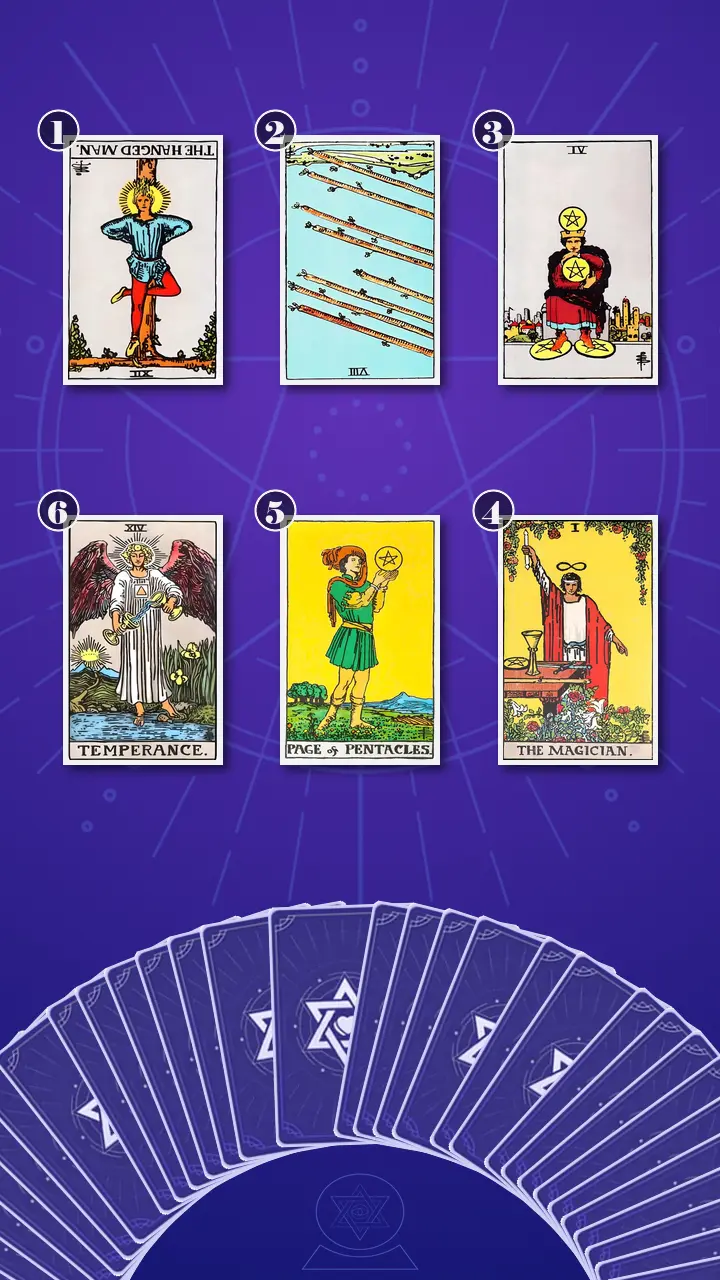
The Pause That Kept Inventing Conditions
The Hanged Man Reversed: Insight Without Release
The first card I turned over represented the observable manifestation of the gap between Alex's intention and the product becoming visible: reopening completed work and postponing release after a date was requested. It was The Hanged Man, in reversed position.
I pointed to the figure suspended by one foot. The halo still shone around the head, while the hands remained hidden behind the body. “This isn't a picture of someone who lacks insight,” I said. “You already know the product is usable. The issue is that insight has stopped becoming movement.”
I brought the card directly back to 11:40 p.m. Alex had opened the release calendar to answer a date request, noticed one imperfect onboarding sentence, and spent ninety minutes rewriting a sequence that had already passed review. The pause had not produced a clearer decision. It had produced another threshold that needed to be crossed before Alex would permit themselves to name a timeline.
In energy terms, the Hanged Man's useful suspension had become a blockage. A purposeful pause creates perspective and eventually changes a decision. This holding pattern created new conditions. Its overcorrection risk was easy to miss: to prove that the delay was responsible, Alex could build an even more exhaustive readiness audit and push the threshold farther away.
“What was the last item you added after someone asked when?” I asked. “Would it materially change whether a user could benefit from the release, or did it make remaining suspended easier to defend?”
Alex gave a short laugh with a bitter edge. “That's so accurate it feels a bit brutal. It was an advanced settings screen. None of the first users asked for it. I was ready until they asked, and then I thought, I need to check one more thing.”
I did not rush to soften the recognition or turn it into blame. “The care is real,” I said. “We're only checking whether the latest expression of that care still serves the work. Preparation is useful when it resolves a defined question. It becomes a holding pattern when it keeps manufacturing questions so the vulnerable action never arrives.”
Alex's fingers stopped rubbing the rim of their mug. Their shoulders stayed raised, but their gaze returned to the card. The defence had not disappeared; it had become visible enough to examine.
Eight Notifications Trying to Land at Once
The next card represented Premature Launch Pressure as the immediate blockage, specifically the way requests for speed triggered contraction rather than coordinated momentum. I turned over the Eight of Wands, in reversed position.
In the upright image, eight staffs travel together across an open sky toward one destination. Reversed, I saw the modern equivalent immediately: a Slack message, two follow-ups, an early-user DM, a meeting reminder, and a typing indicator all pointing towards launch but failing to land as one usable agreement.
I described the sequence Alex already knew. A collaborator asked for a firm date before the test scope had been agreed. Two messages and a user DM followed. Instead of responding with frozen scope and a review point, Alex opened Figma, Notion, analytics, email, and the pricing model. Attention scattered across unrelated improvements while the unanswered request generated more follow-ups.
“They think they're asking for one date,” Alex said, recognising the pattern before I finished, “but my brain hears eight new emergencies.”
The Fire of the Eight of Wands was not absent. It was arriving in excess and becoming a blockage: acceleration without alignment. Pressure could produce activity without producing movement. The more everyone tried to speed the launch up, the more Alex tried to reclaim self-direction by slowing it down. The silence then created the next round of reminders, turning a scheduling issue into a network overloaded by retry requests.
“What did you hear beneath the literal question?” I asked. “Did you hear, 'Can we coordinate?' Or did your body hear, 'We now own your timetable'?”
Alex's jaw tightened. Their eyes moved briefly towards the Slack icon at the edge of their screen. “The second one. Even when I know that isn't necessarily what the person means.”
“Then we don't need to make your collaborators villains, and we don't need to make you disorganised,” I said. “We need language that prevents coordination from being experienced as coercion. Refusing every estimate until all variables are resolved keeps you exposed to more messages. Accepting a premature deadline would ignore your boundary. There is a third option, but the root card needs to show us what that option must protect.”
The Project Held Against the Chest
The third card represented the underlying control-related fear protected by delayed gratification: keeping the launch unreleased preserved ownership of its pace, standards, and evaluation. The card was the Four of Pentacles, upright.
I traced the image for Alex. One pentacle was pressed against the figure's chest, two were pinned beneath the feet, and another was held over the head. Every hand and every step was occupied with keeping possession. The active city waited in the distance.
In Alex's life, the symbolism was exact. The product remained private, every decision remained reversible, and the release date remained unspoken because an unpublished project could not yet be redirected, criticised, or claimed by somebody else's timetable. That enclosure preserved a temporary sense of ownership. It also prevented user behaviour, payment evidence, and real questions from entering.
The Earth energy here was in excess. Healthy Earth gives structure, resources, and boundaries. Clenched Earth turns protection into immobility. It leaves no free hand for experimentation and no unpinned foot with which to move.
“An unpublished project cannot be redirected by others,” I said, “but it cannot teach you much either.”
Alex's breath paused. Their eyes unfocused as if they were replaying the moment they had pulled their finger away from a private-beta publish control in a Queen West cafe. Then the breath left their chest slowly, and their hands opened on the desk.
“If I keep it here, no one can set the pace or judge the final form,” they said. “But I'm also the only person giving it information. And I don't have the information I'm waiting for.”
I nodded. “That is the cost of safety through total enclosure. The card isn't telling you to abandon ownership. It is asking whether ownership must mean keeping the whole project closed, or whether it could mean deciding who enters, what they see, what question they help answer, and when you review the result.”
I also used my Social Clock Decoupling lens here. Alex had been comparing their private first test with polished LinkedIn and Product Hunt announcements that compressed months of confusion into clean launch-day carousels. I asked them to treat those posts as edited case studies, not clocks. A peer's public milestone did not establish Alex's correct season, and build-in-public attention did not entitle followers to admin access over their calendar.
“That lands,” Alex said, with a smile that held both recognition and loss. “I think I've been treating everyone else's launch as evidence that I'm late.”
“Late according to which clock?” I asked. “Your commercial needs matter. Your collaborators' coordination needs matter. But neither has to be confused with a social countdown that turns one contained beta into a permanent professional verdict.”
When the Magician Put Every Tool on the Table
The fourth card occupied the key position. It represented the leverage point that could interrupt the pressure-delay-pressure cycle by restoring self-authored agency and directing existing resources into visible form. On Alex's side of the call, the rain thinned against the apartment window. The room seemed to become quieter around the turn of the card.
I revealed The Magician, upright.
One hand reached upward while the other pointed towards the ground. On the table lay the Wand, Cup, Sword, and Pentacle, a complete working set. I did not see a demand for another tool, feature, framework, or subscription. I saw the current build, release copy, calendar, audience, and feedback method waiting to be directed towards one purpose.
The Magician's energy was balanced and available. This was not unlimited control over how the market would respond. It was bounded agency: control through selecting the scope, audience, evidence, and review point. Alex could stop expanding the roadmap and create one working page containing the current build, a frozen test scope, three to five early users, one learning question, and a readiness review date.
I could see Alex caught inside the familiar 11:40 p.m. equation: a date request meant a premature launch; a premature launch meant losing control; and another round of private revision seemed like the only way to recover authorship. The Magician challenged the equation without dismissing the risk.
I said, “Commitment is not the opposite of control when you author the container: freeze the scope, choose one test, and let evidence answer what more planning cannot.”
You do not need a pressure-free moment or a flawless product before you move; define one bounded release with the tools already on the Magician's table, and let action create the clarity that delay cannot.
I let the sentence remain in the quiet.
For one beat, Alex did not exhale. Their fingers stopped midway between the mug and trackpad, and their eyes lost focus as if the previous month were replaying behind the screen. Then their mouth tightened, not with relief but with a flash of anger. “But doesn't that mean I was wrong this whole time?” they asked, their voice low and rough. Their shoulders were still high, yet one hand opened on the desk. I let the question stand before answering. “It means the strategy that protected your authorship has started charging more than it returns. That isn't a moral failure, and it doesn't erase the care behind the work.” Their eyes widened; colour rose beneath them. A long breath left their chest, almost a laugh and almost grief. Their shoulders dropped, and then they sat very still, slightly dazed by the responsibility that came with having a real choice. Relief had arrived, but it had not removed the risk of being seen.
“Now, using this new perspective, think back to last week,” I invited. “Was there a moment when this insight could have made you feel different?”
Alex looked towards the release calendar. “On Wednesday, when my collaborator asked for a date. I thought I had to give them the final launch or refuse. I could have named a review date for a three-person test. That would still have been mine.”
“A boundary can be a date you author, not a deadline you obey,” I said.
This was where I brought in my Seasonal Energy Diagnostics, not as decoration, but as a way to distinguish two forms of waiting. I have lived sixty-seven winters, and I know dormancy is not failure. A field does not owe a spring harvest in January. But I also know that naming every month winter can become another way to avoid the tenderness of new growth.
For a moment I remembered the Highland kitchen of my childhood, where seed packets waited beside my grandmother's weathered notebook. No one demanded fruit before the frost had passed, and no one kept viable seedlings indoors forever to spare them wind. Readiness was never absolute. It was a relationship between season, conditions, and the next proportionate act.
“Each date message has felt like someone demanding a spring harvest during winter,” I told Alex. “So you defend yourself by keeping the project in permanent dormancy. But your core offer is functional. This is not a bare field. It may be time for a protected test plot, not a full harvest. A small beta can let you meet the real season without pretending the entire crop is ready.”
That distinction moved Alex from pressured withholding and reactive scope creep towards bounded agency. It was a first step, not a personality transformation and not a promise of launch success. The crucial change was that uncertainty no longer had to be solved privately before action. Action could create specific evidence while Alex retained authorship of the container.
I asked Alex to open their existing notes app and set a seven-minute timer. They created a page titled Test Release v1 and wrote only four lines: what was included, what was explicitly excluded, who could access it, and the single behaviour they wanted to observe. I made it clear that they did not have to announce or send anything during the session. If the exercise started expanding into another master launch plan, they were to stop after four lines. If the tension rose beyond what felt workable, they could close the note and return only when they chose.
Alex typed: Included: current onboarding and core workflow. Not now: advanced settings and new pricing tiers. Audience: three early users who already asked. Evidence: can they reach the first useful result without my help?
The timer still had more than two minutes left. Alex stared at the four lines, then moved both hands away from the keyboard instead of filling the remaining space.
“I don't need more tools,” they said quietly. “I need to direct the ones I already have.”
A First Release Small Enough to Teach
The Page and the One-Question Pilot
The fifth card represented the concrete action plan through which the shift could be practised: a limited test release with frozen scope, one audience, and one learning objective. I turned over the Page of Pentacles, upright.
The Page held one pentacle at eye level while the larger landscape waited behind. I saw a student-craftsperson willing to learn from one tangible object rather than someone trying to command every future version at once.
I connected the card to a staged rollout. Alex could mark one stable version with the current date, give three to five consenting early users access, and observe one defined behaviour. Any idea that did not affect the declared question would remain on a post-launch list. The test would be a source of evidence, not a referendum on Alex's competence.
The Earth energy that had been clenched in the Four of Pentacles was now in constructive balance. It had boundaries, a real object, and patience connected to measurable learning. Delayed gratification regained a healthy function because the waiting now belonged to a defined study period rather than an endlessly moving definition of readiness.
“Your first release can be a question, not a verdict,” I said. “Complete this sentence: For this test, the only thing I am trying to learn is...”
“Whether a new user can get to the first useful result without messaging me,” Alex replied. Their voice came faster this time. “Not whether the entire business works. Not whether every price is right. Just that.”
I saw a small drop in their shoulders. Their hands no longer hovered over five different tabs. The Page had narrowed the landscape enough for one next step to become visible.
Temperance and the Release-Review-Revise Rhythm
The sixth card represented the non-predictive integration state: a repeatable rhythm that could balance quality, autonomy, feedback, and visible movement. The final card was Temperance, upright.
I focused on the water moving continuously between two cups without spilling. One foot rested on land and the other touched water. The image did not ask Alex to choose between rigid control and uncontrolled speed. It offered calibration.
In daily practice, Temperance looked like a recurring cycle: freeze one scope, release it to a defined audience, review observed evidence, choose one relevant change, and communicate the next decision point. Feedback could influence the next version without reopening the version already under test. Quality remained protected, but through boundaries and circulation rather than indefinite closure.
Temperance expressed balance in its clearest form. Fire no longer arrived as someone else's urgency. Earth no longer served only as a defensive enclosure. Water carried feedback between versions, while deliberate language supplied the Air that the spread otherwise lacked. A written scope, readiness criterion, boundary update, and review date could no longer remain implicit.
“What review rhythm would let information enter without giving every comment the power to rewrite the current test?” I asked.
Alex considered the cups. “A twenty-minute review after five days. Evidence first, then one next change. Everything else stays in Not Now.”
“And if a genuinely critical issue appears?”
“It can replace something in scope. It can't silently make the release bigger.”
A streetcar bell sounded faintly beyond Alex's window, one clear note travelling through the wet evening. They released a breath. “I can protect quality without holding everything closed.”
I agreed, while reminding them that Temperance was not predicting a smooth launch. It was describing a process they could choose, observe, and adjust. The cards offered a model; Alex would decide whether that model respected the project's real financial, technical, ethical, and accessibility constraints.
The Self-Authored Launch Container
I read the spread as one coherent story. Over the preceding months, date requests had activated a fear that commitment would transfer control. The Hanged Man showed the visible result: insight suspended inside repeated revision. The Eight of Wands showed the immediate trigger: messages meant to create movement arrived as fragmented pressure. The Four of Pentacles revealed the protected need beneath both cards: ownership, security, and the right to define readiness. The lower row did not ask Alex to abandon that need. The Magician turned ownership into selection, the Page turned selection into a modest experiment, and Temperance turned the experiment into a sustainable release-review-revise rhythm.
The cognitive blind spot was not that every open task was unnecessary. Some blockers could be real and material. The blind spot was treating the body's reaction to external pressure as fresh evidence that the product itself was not ready. When a new condition appeared only after someone asked “when?”, Alex had been placing it on the roadmap before checking whether it belonged to the release or to the pressure response.
The transformation direction was specific: shift from withholding the entire launch until total readiness to scheduling one self-defined test release with frozen scope, written readiness criteria, one observable learning goal, and a review date. The launch would become a bounded learning cycle rather than a final verdict or surrender of control.
Three Small Moves, Each With an Edge
I gave Alex three actions. I kept them deliberately small because an oversized recovery plan would have repeated the Hanged Man's overcorrection in more respectable clothing.
- The Winter Dormancy Ritual Before changing anything else, mark the current build with today's date, send any necessary collaborator a brief note that scope is paused until a named review day, and then do nothing to the blocked launch goal for seven consecutive days. Do not polish the build, rewrite copy, revisit pricing, or expand the readiness checklist. Let client work, sleep, food, movement, weather, and unrelated life occupy the week without treating rest as a debt. A genuine security, accessibility, legal, or payment blocker can be recorded as a factual exception. Everything else waits. The purpose is not another disguised delay; it is a time-bounded winter that breaks the link between pressure and compulsive revision.
- The Four-Line Magician Container On the review day, set a seven-minute timer in the notes tool already in use. Write Included, Not Now, Test Audience, and Evidence. Under Included, name the one written readiness criterion that must be true. Add links to the existing build, copy, calendar, and feedback method, then place a review date on the calendar. Reply to the next requester with: “I'm testing [frozen scope] with [audience]. I'll review readiness on [date] and confirm the next step then.” If four lines feel too large, write only Included and Not Now. Do not create a new workspace, redesign the assets, or produce a detailed defence of excluded scope.
- The Page's One-Question Pilot Within twenty-four hours of the review, invite one to five early users who already expressed interest and who understand that the release is limited. Share one stable version through the channel they normally use. Observe one question only, such as whether a new user reaches the first useful result without direct help. After the test window, hold one twenty-minute Temperance review with three columns: Evidence, Change Next, and Not Now. One consenting user still counts. Record observed behaviour and direct words before proposing revisions, and use a one-in, one-out rule so any new launch-critical task replaces an existing one instead of expanding the frozen scope.
“The goal isn't to force yourself to feel fearless,” I told Alex. “The goal is to give fear an accurate-sized container. You retain the right to pause, but the pause needs a purpose and an end. You retain the right to protect quality, but quality control needs written criteria. You retain the right to choose the pace, and choosing a review date is one way to exercise that right visibly.”

Nine Days Later: The Quiet Proof
Nine days later, I received a message from Alex. They had left the product untouched for the full dormancy week. On the eighth day, the four-line note had taken six minutes. They had marked one stable version, sent private access to a single early user, and replied to their collaborator with a review date instead of either a final-launch promise or another silence.
The user had reached the first useful result without help. They had also stumbled over two sentences. Alex recorded both observations under Evidence and resisted reopening the build until the scheduled review.
That night, Alex slept through. Their first thought in the morning was still, “What if I'm wrong?” This time they smiled, opened the review note, and left the frozen version untouched.
I did not take that message as proof that the cards had launched anything. The cards had supplied neither the date nor the courage. Alex had authored the container, sent the access, and allowed evidence to enter. Tarot had made the pressure-delay-pressure loop visible enough for a different choice to become possible.
That was the quiet proof in our Journey to Clarity: not certainty, not a flawless product, and not a grand public announcement. It was movement from pressured withholding towards bounded agency, followed by the first turn of a rhythm Alex could continue, revise, or leave behind by choice.
When a simple “when?” makes your chest brace and sends you back into work you had already called finished, the delay can feel like the only remaining way to keep your standards, pace, and authorship in your own hands. Noticing that the finish line moves after pressure arrives does not mean your concerns are false. It means you can begin separating the project's real needs from the conditions created to recover the steering wheel.
If commitment could be a container you author rather than a steering wheel you hand over, what is the smallest one-question test you would be curious to place on the Magician's table and mark with a review date?