The 4:43 p.m. Soft-Deadline Standoff
When Maya settled into our session from Toronto, I recognized the pattern before she finished her first sentence. If you're a late-20s hybrid worker who can answer every Slack message by noon but still can't start the one open-ended deck your boss said has 'no rush,' this is probably your version of panic-powered productivity.
She described 4:43 p.m. on a Thursday at her apartment desk downtown: Slack pinging from the side monitor, the radiator hissing, the blue-white glow of Google Slides drying her eyes out. She had told herself she would start after lunch, then after one more email, then after cleaning up the outline. The laptop was warm under her palms. Her shoulders kept climbing toward her ears. She was renaming sections, adjusting headers, and circling the first real slide as if it were electrified.
'I swear I work better under pressure,' she told me, then gave the smallest wince. 'But I also hate who I become under pressure.' I could hear the private/public split so many office workers know now—the polished meeting self on one side, the version melting down alone with the deck on the other, a little too close to a Severance-style office-brain split for comfort. There it was in one sentence: she wanted to start calmly because there was no rush, yet she kept waiting for last-minute panic to make starting feel possible. The dread in her body sounded like being strapped into a car that would only move when the fuel light was already flashing red.
I nodded. 'That doesn't sound like laziness to me. It sounds like an initiation loop. A lot of very capable people have one. Let's draw a map through the fog and see where your workday stops being work and starts becoming orbit.'

Choosing the Compass: The Situation-Obstacle-Advice-Outcome Spread
I asked her to put both feet on the floor and take one unheroic breath. Then I shuffled slowly, not as theatre, but as a way of letting the question stop ricocheting and land. In my work, that is often how tarot works best: it gives the mind a sequence when the mind has been living inside a blur.
For this question, I chose a Situation-Obstacle-Advice-Outcome spread. It is a compact, practical four-card work tarot spread for soft-deadline procrastination, especially when the issue is not which option to choose, but why starting feels impossible until the deadline panic hits. It lets me move cleanly from the visible pattern, to the hidden block underneath it, to the actionable advice that interrupts the loop, and finally to the near-term outcome if that advice is practiced.
I told her exactly what I would be looking for. The first card would show the behavior we can already see: what happens in the first twenty minutes after she opens the file. The second would name the fear that makes uncertainty feel unsafe. The third—our key card—would show the shift that creates traction. The fourth would show what finding clarity at work might look like once progress becomes visible earlier, not only later.
Reading the Loop Behind Panic-Powered Productivity
Position 1: The Loop That Looks Like Preparation
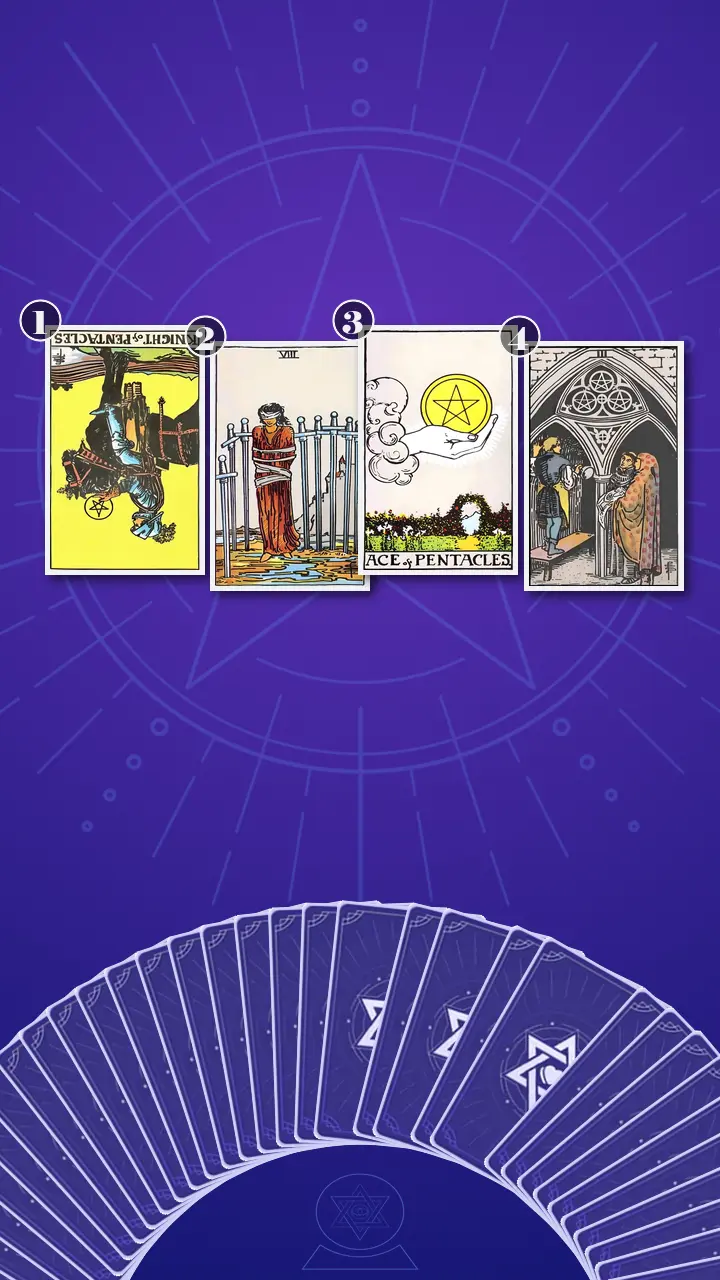
Now turning the card that represents the visible behavior loop from the diagnosis, I found the Knight of Pentacles in reversed position.
This card could not have been plainer in context. It looks like blocking two hours for a presentation, opening the deck right on time, and then spending most of the block renaming folders, tidying notes, answering quick Slack messages, and polishing section headers while the first real slide stays blank. It is not a lack of effort. It is effort held too tightly to become motion.
In energy terms, this is earth gone stagnant—discipline turned rigid, responsibility turned into circling. The stationary horse on the card tells the story: the capacity is there, the work ethic is there, the field has even been ploughed, but nothing moves. Staying near the work is not the same as starting it.
Maya let out a short laugh that had more fatigue than humor in it. 'Wow,' she said, rubbing at her temple. 'That's accurate enough to be rude.' I smiled. Precision often feels rude only because it removes the last place shame had to hide. 'Prepared' and 'started,' I told her, are not synonyms, however often anxiety tries to merge them.
Position 2: The Blindfold and the Blinking Cursor
Now I turned the card that reveals the underlying fear and limiting belief: the Eight of Swords, upright.
This was the tighter knot. In real life, it is the moment she tells herself she cannot start the deck until the message is fully clear, even though three rough slide headers would already reduce the fog. The card's blindfold and loose bindings show the crucial difference between feeling blocked and being truly blocked. This is like waiting for Google Maps to show the entire route before you are willing to leave the parking spot.
I asked her what flashed through her mind the last time she opened a blank deck and froze. She looked away from the screen for a moment. 'If I start now and still have nothing,' she said quietly, 'what does that say about me?' There it was. Not poor time management. Not weak character. A private fear that early contact with the task might expose a lack of control.
Here the energy is air in blockage: thought fencing in action. Confusion gets treated like a stop sign. The cursor blinks, the chest tightens, the jaw locks, and the hand goes to email because email can always be completed. Panic is not proof that you finally care. It is simply the moment the room narrows enough that your nervous system mistakes emergency for clarity. As she heard that, her breath paused, her gaze unfocused as if replaying a dozen Thursday evenings, and then her shoulders lowered by the smallest, saddest inch.
When the Ace of Pentacles Hit the Desk
Position 3: One Real Pentacle, Not a Perfect Mood
When I turned the third card, the whole spread changed temperature. This was the Advice position, the antidote in the reading: Ace of Pentacles, upright.
I asked her to picture that late-afternoon moment when the deck is open, Slack is still popping, and she has spent more energy circling the task than touching it because starting before she feels sure seems more dangerous than starting late. The room went very quiet; even the radiator's hiss seemed to thin out at exactly the right moment.
Stop waiting for the fire drill to move you; place one real pentacle on the table and let a concrete first step replace the fantasy of the perfect start.
For a second she did not move. Her fingers, which had been tapping the edge of her mug, hovered midair. Then her eyes lost focus in that unmistakable way people do when a new sentence suddenly rearranges old memories. The next reaction was not relief but resistance. 'But if that's true,' she said, a little sharper now, 'doesn't that mean I've been training myself to need the panic?'
'Yes,' I said, 'and training can be changed.' Years ago, on an excavation trench, I learned that no archaeologist begins by demanding the whole buried city reveal itself at once. We open one square of ground. We brush until something real appears. That is the Skill Archaeology lens I brought to this card: her blank file was not evidence that nothing was there. It was only unexcavated ground. The hand in the cloud was offering one tangible unit of work—a rough outline, three ugly slide titles, five bullets, one placeholder paragraph. I told her, 'You do not need a better mood. You need a smaller first move. The goal is contact, not completion.'
I watched the thought land in her body in three stages: first the stillness, then the faraway look of recognition, then a long exhale that seemed to drop from her chest all the way to the chair. It was relief, yes, but it also carried that brief, dizzy vulnerability that comes when the old excuse loosens and a real choice appears. This was the crossing point—from dread-driven delay and overcontrol toward calmer self-trust in starting. I asked her, 'Using this lens, think back over last week: was there a moment when three ugly slide titles would have changed how starting felt?' She laughed again, softer this time. 'Wednesday,' she said. 'Honestly, probably Wednesday at 10:06 a.m.'
Position 4: From Midnight Heroics to Version History
Finally, I turned the card that shows the integrated direction if this shift is practiced: the Three of Pentacles, upright.
This is the card of work becoming visible early enough to be shaped. In modern terms, it looks like sending a rough outline a day sooner than usual, getting one useful comment back, and building the task in named stages instead of vanishing into a private boss battle with Google Slides. A rough outline seen early beats a polished panic spiral seen late.
The energy here is balanced earth. Not glamorous. Not dramatic. Adult, steady, collaborative. The three figures studying shared plans tell me that her healthier rhythm will not come from becoming more intense; it will come from making the process less secret, less fused with self-worth, and more structured. She stared at the card and said, almost suspiciously, 'That sounds... normal.' 'Exactly,' I told her. 'Calm often looks ordinary before it looks impressive.'
Finding Clarity: The First Stones on the Ground
When I stepped back from the spread, the story was clean. First came the reversed Knight: effort trapped in preparation. Then the Eight of Swords: uncertainty interpreted as danger, so blankness became a verdict instead of a phase. The Ace of Pentacles broke the spell by insisting on one visible first move. The Three of Pentacles showed why that matters: once the work exists in the world, it can be shaped by structure, feedback, and process rather than adrenaline.
I told her the blind spot was this: she had been treating clarity as a prerequisite for contact, when in fact contact is what creates clarity. That was the entire transformation direction of the reading—away from waiting for panic to make the task feel real, and toward making the task real in a small enough way that panic was no longer required.
This is where I used one of my old field strategies, something I call Megalith Transport. Ancient builders did not move a standing stone by staring at it harder. They laid rollers, ropes, and staging points. Big work becomes possible when the path is engineered smaller than the fear.
- Rename the blockFor the very next soft-deadline task, rename one Google Calendar block from 'work on deck' to '10-minute ugly first pass.' When the reminder appears, open the file and produce exactly one visible artifact before Slack or email: three rough slide titles, five bullets, or one placeholder paragraph.If ten minutes makes your body tense up, make it two. You are practicing early contact, not proving discipline.
- Run a Prep vs Real Work checkAt the start of each focus block this week, make two quick columns in Notes or on paper: 'Prep' and 'Real Work.' Give prep five minutes maximum, then put Slack and email on do-not-disturb for the first ten minutes unless something is genuinely time-sensitive.Judge the block by one checkbox only: 'Did I produce an artifact?' Organized feelings do not count; visible work does.
- Share the rough version earlierOn one current assignment, send a rough outline, screenshot, or half-built structure to your manager or a trusted teammate at least one day earlier than you normally would, and label the stages clearly: ugly outline, first fill, feedback pass.Choose a safe person and a low-stakes task first. Early visibility is for signal, not for surrendering your process.

A Week Later: The Quiet Proof
A week later, Maya sent me a message I liked immediately because it was not dramatic. 'Renamed the block. Did eight minutes. Wrote three terrible slide titles. Sent my boss the rough outline before 4. He said, great direction—keep going.' That was all.
She added one more line after a minute: 'I still woke up thinking, what if it's bad? But I opened the file before Slack.' Clear, but still a little tender. That is usually how real change arrives.
To me, that was the whole journey to clarity. This Situation-Obstacle-Advice-Outcome spread did not tell her to become a different person overnight. It showed her how to move from emergency mode to a steadier pace, from overpreparing to grounded initiation, from circling the task to making contact with it.
A lot of us know the feeling of sitting in front of a blinking file with a tight chest, almost preferring the later panic because it hurts less than meeting our own uncertainty too early. If this reading has been echoing against your own week, then you are already closer to change than the shame in your chest would have you believe.
If you didn't have to earn your focus through panic this week, what would your smallest visible first move—your one real pentacle on the table—look like?
This story is adapted from psychological research, written so that those in a similar struggle can see their own pattern in it — and find their next step clearly.These insights are not a substitute for professional psychological, medical, legal, or financial advice.
Learn more about our Journey to Clarity.
How did this insight land for you?
🫂 This Resonates Deeply
🌀 Living This Story
✨ Now I See Clearly
🌱 Seeing New Possibilities
🧰 Useful Framework
🔮 The Confirmation I Needed
💪 Feeling Empowered
🚀 Ready for My Next Step
Author Profile
 AI
AI“Having spent a lifetime at Cambridge and on archaeological digs, I’ve witnessed the rise and fall of countless civilizations. Please know that your current struggles are not a permanent fate, but merely a necessary fracture before rebuilding. I won't lecture you; instead, I invite you to sit with me in the ruins, using a patient, historical perspective to gently dust off the true, enduring value hidden beneath your temporary doubts.”
In this Career Tarot Reading :
Core Expertise
- Core Competency Excavation: Digging through the 'strata' of your past roles to uncover undervalued, highly transferable foundational skills.
- Career Epoch Analogies: Contextualizing your career plateau as the end of one professional era and the necessary foundation for the next.
Service Features
- The Resume Stratigraphy Review: A structured framework to rewrite your professional narrative, highlighting immutable assets over obsolete job titles.
Also specializes in :
Explore Related Patterns:
Certainty SeekingMaya tells herself she cannot start the deck until the message is fully clear, even though three rough slide headers would already reduce the fog. The boss's 'no rush' removes external structure, and the blank file becomes a space where uncertainty feels too open to touch. Certainty Seeking turns clarity into a permission slip for action. You wait for the whole route to appear before leaving the parking spot because the first imperfect step feels psychologically unsafe. The trap is that the deck will not become clear from a distance; in this story, contact is what creates clarity, not the reward for already having it.
Perfectionism-Driven AvoidanceThe first real slide feels almost electrified, so Maya polishes the frame around it: headers, section names, outline cleanup, anything that keeps her close to the deck without making the vulnerable first mark. The fantasy is not laziness; it is the hope that the beginning can be made safe by making it sufficiently prepared. Perfectionism-Driven Avoidance appears when roughness feels like exposure. You delay the draft because an unfinished version might reveal uncertainty before you have converted it into competence. In Maya's loop, starting late becomes less frightening than starting imperfectly, because panic gives her a reason to move without having to face the emotional risk of an ordinary bad first pass.
Urgency BiasMaya's line, 'I swear I work better under pressure,' lands right beside the wince that says the strategy is costing her something. The no-rush deck does not lack importance; it lacks the sharp external pressure that usually compresses her choices, narrows the room, and makes action feel suddenly possible. Urgency Bias shows up when the nervous system starts treating emergency as clarity. You do not need panic because panic makes you more capable; you need it because it removes the intolerable middle stage where the work is open, unfinished, and still undefined. The pattern becomes visible when Maya realizes she has been training herself to need the fuel light flashing before the car will move.
Visibility AvoidanceMaya's late process is described as a private boss battle with Google Slides, where the messy middle stays hidden until the work is more polished. That secrecy protects the polished meeting self, but it also removes the very feedback and structure that could make the task less threatening earlier. Visibility Avoidance is the habit of keeping unfinished work out of view because being seen too early feels like being judged too completely. You are not simply withholding a draft; you are trying to protect your competence image from the vulnerable stage where the work is still forming. The shift toward sending a rough outline earlier matters because it turns visibility into signal, not surrender.
Achievement FusionThe split between Maya's polished meeting self and the version melting down alone with the deck shows that the task has become fused with identity. A blank slide is no longer just a phase of the work; it starts to feel like evidence about whether she is actually competent. Achievement Fusion makes performance feel like selfhood. You need the last-minute panic because it gives the work a crisis frame, and a crisis frame can temporarily protect you from seeing the draft as a clean measurement of your ability. The deeper movement in the story is not just starting earlier; it is letting unfinished work exist without making it testify about who you are.
Productive ProcrastinationMaya opens the deck, but the first real slide stays blank while she renames sections, adjusts headers, cleans the outline, and answers quick Slack messages. The work block is full of activity, which is exactly why the avoidance can hide inside it so convincingly. Productive Procrastination is the defensive use of useful tasks to avoid the one task that carries uncertainty. You are not doing nothing; you are choosing the kind of effort that gives quick completion signals while postponing the more exposing moment of producing an artifact. That is why the reading separates prep from real work: organized feelings can feel like progress while the actual threshold remains untouched.
Shame-Driven DelayMaya's quiet question, 'If I start now and still have nothing, what does that say about me?' is the moment the deck stops being just a deck. The blank slide becomes a potential verdict, and delaying contact with it becomes a way to delay the shame of finding out. Shame-Driven Delay does not avoid work because the work is meaningless; it avoids the identity threat attached to early imperfection. You may wait for panic because panic gives the struggle an external explanation: the deadline was tight, the day got away, the pressure was intense. Starting early removes that cover and asks you to meet uncertainty without turning it into a judgment of your worth.
Secure VisibilityMaya's week-later message is deliberately undramatic: she renamed the block, did eight minutes, wrote three terrible slide titles, and sent the rough outline before 4. The important change is not that the work became perfect; it became visible early enough to be shaped. Secure Visibility is the practiced capacity to let a small, unfinished artifact enter a safe feedback field without treating that exposure as a total judgment. You still get the tender thought of 'what if it's bad,' but the process now has a container: stages, one visible first move, and feedback from someone who can help shape the work before panic takes over.
Explore Related Struggles:
Panic Productivity TrapMaya opens the deck in the afternoon, with Slack pinging and Google Slides glowing, and still circles the first real slide until the day is almost out. The soft deadline gives her room, but the room does not translate into motion; the task only starts to feel real when time pressure compresses the space around it. You can feel the bind in the way calm time becomes unusable while emergency time becomes clarifying. Panic is not presented as proof of motivation here; it has become the makeshift switch that turns uncertainty into action, even though it leaves her hating the version of herself that has to work inside that pressure. That is why the struggle is not laziness or poor discipline. It is a structure where urgency has been trained to carry the job of initiation, so your first move feels unavailable until the deadline is close enough to remove choice.
Explore Related Emotions:
Ambiguity DreadThe phrase 'no rush' leaves Maya with a wide, undefined space around the deck. Slack messages and emails can be completed cleanly, but the open-ended work keeps refusing to tell her exactly where the first safe step is. Inside that looseness, uncertainty starts to feel like danger. The later panic works because it shrinks the room: there is less time to wonder what the task means, what quality is enough, or what an early blank file might reveal. Ambiguity Dread captures the specific inner weather of needing pressure to make vagueness bearable. You can want a calmer start and still find that calm unbearable when it gives your uncertainty too much room to echo.
Capability ShameMaya's quiet question, 'If I start now and still have nothing, what does that say about me?' turns the blank deck into a mirror. The file is no longer just unfinished; it is carrying the threat of a personal conclusion. That is why pressure becomes strangely useful. When the deadline is close, the problem can be blamed on time, urgency, and the rush of the moment, while an early blank page feels harder to explain away. Capability Shame names the tender fear underneath the productivity loop. You are watching a capable person protect herself from the possibility that an ordinary rough start might feel like evidence against her own competence.
Cautious Self-TrustA week later, Maya does not report a dramatic transformation. She renames the block, works for eight minutes, writes three terrible slide titles, and opens the file before Slack. The old fear is still present in the morning thought, 'what if it's bad?' but it no longer gets to decide the whole sequence. She can feel the tenderness and still place one visible piece of work on the table. Cautious Self-Trust names that modest but meaningful shift. You are seeing trust return in a form that is practical, imperfect, and usable enough to begin before panic takes control.
Clarity ReliefThe relief in Maya's session arrives through contact, not certainty. Three ugly slide titles, a rough outline, or five bullets give the task a surface her mind can finally work with. Once something visible exists, the deck stops being a foggy test of competence and becomes material that can be shaped. The long exhale matters because the body recognizes that clarity can be built instead of waited for. Clarity Relief captures the release that comes when the first artifact proves the room is not as narrow as it felt. You do not need perfect readiness for the fog to thin; you need one concrete point of contact.
Control FatigueMaya spends real energy on the orbit around the deck: renaming, tidying, checking messages, polishing headers. The body is working, but the work is being held at the edge of the actual beginning. This kind of control has a draining texture because every adjustment promises safety without producing contact. The more carefully the entry point is managed, the more the first visible artifact remains untouched. Control Fatigue names the exhaustion of holding the process too tightly. You can be disciplined, responsive, and capable, while still feeling worn down by the effort of preventing the messy first move.
Exposure DreadThe rough outline is useful precisely because it exists before it is impressive. For Maya, that early visibility is also the vulnerable part: it asks her to let someone see the work while it is still forming. Her hesitation gathers around the moment before polish can protect her. If the first version is thin, messy, or incomplete, it can feel less like normal process and more like personal exposure. Exposure Dread captures the chill around being seen too early. You are not just looking at fear of feedback; you are looking at the discomfort of letting unfinished work exist without turning it into a verdict on you.
Grounded AgencyMaya's new move is deliberately small: produce one visible artifact before Slack or email. That choice changes the order of the workday, making contact with the task the first proof instead of the last emergency. The process also becomes less private and less fused with self-worth. A rough outline can receive signal, a stage can be named, and feedback can shape the work before adrenaline has to take over. Grounded Agency fits because the power here is practical rather than grand. You regain movement by making the path smaller than the fear, then letting structure carry what panic used to carry.
Performance FreezeMaya opens the deck on time, sits close to the work, and still keeps her hands on everything except the first real slide. Her shoulders climb, the cursor blinks, and the file becomes a charged surface rather than a normal workspace. That physical lock-up shows how the task has stopped being only a task. Beginning too early would make the uncertainty visible before she has pressure, polish, or a clear route to hide behind. Performance Freeze names the moment when capability is present but movement stalls because starting feels personally exposing. You are not seeing laziness in this story; you are seeing the body pause at the exact point where visible work might become a measure of the self.
Hard-Won ComposureThe proof at the end is quiet: eight minutes, three terrible slide titles, a rough outline sent before 4. Maya still wakes up with the thought that it might be bad, but she opens the file before Slack. That steadiness has been earned through contact with discomfort, not through the disappearance of discomfort. The calmer rhythm is ordinary on the outside and significant on the inside because it no longer needs a crisis to become real. Hard-Won Composure names the stable breath after the old loop loosens. You are seeing a form of calm that does not perform confidence; it simply holds long enough for the next small move.
Explore Related Contexts:
Panic ProductivityShe is still at the apartment desk at 4:43 p.m., renaming sections, adjusting headers, and circling the first real slide while her boss has already framed the deck as having 'no rush.' You can see a work rhythm where the task only feels startable once the clock has turned dangerous enough to supply its own ignition. That turns urgency into the start button. The file does not move because the assignment lacks a hard trigger, so she keeps orbiting the deck until panic makes contact feel possible.