Doing Manager Work Without the Title: From Overwork to a Scope Audit

At 8:47 p.m., the Title Was Still Missing
If you are already leading planning calls, owning the risk log, mentoring colleagues, and absorbing escalations while your title still says project coordinator, I know how quietly the question can take over: Why am I doing project manager work without the title?
Jordan, a 28-year-old non-binary professional in Toronto, joined my video call from their kitchen table on a Tuesday evening. The fridge hummed behind them. Cold coffee sat beside a laptop blowing dry heat across their wrists, and a Slack notification flashed over a half-written note titled 'role scope conversation.' I watched their shoulders rise as they closed the note and answered the message first.
'I am already doing the job,' Jordan said, rubbing one thumb along the edge of the laptop. 'So why does asking for the title feel like asking for a favour? Every time I think I am ready to bring it up, there is another launch or escalation. I tell myself I will ask after that.'
I could see frustrated exhaustion not as an abstract mood but as a phone running too many background processes: the visible system still functioned, yet the battery was draining faster than anyone looking at the screen would know. Jordan wanted the project manager title, authority, and compensation that matched the work, but whenever the gap became visible, they responded by doing more of the work that remained unrecognised.
'The praise feels like evidence for five minutes,' Jordan told me. 'Then it becomes another assignment.'
'I am not here to predict whether your manager will promote you,' I said. 'That outcome depends on people, budgets, power, timing, and choices we cannot control from this table. What I can do is help us examine the pattern without turning it into a verdict on your worth. Let us give the fog a structure and find the part of this situation where your agency still lives.'
I let the silence settle before asking the question that would guide the reading: 'What if the extra proof is not closing the gap, but helping the gap become normal?'

Choosing a Route Through the Maze
I asked Jordan to mute Slack for the length of the reading, place both feet on the floor, and take one slower breath than felt necessary. I shuffled while they held one question in mind: 'Why do I keep doing the next-level job without the title?' The pause was not a mystical performance. It was a way to stop reacting long enough to look.
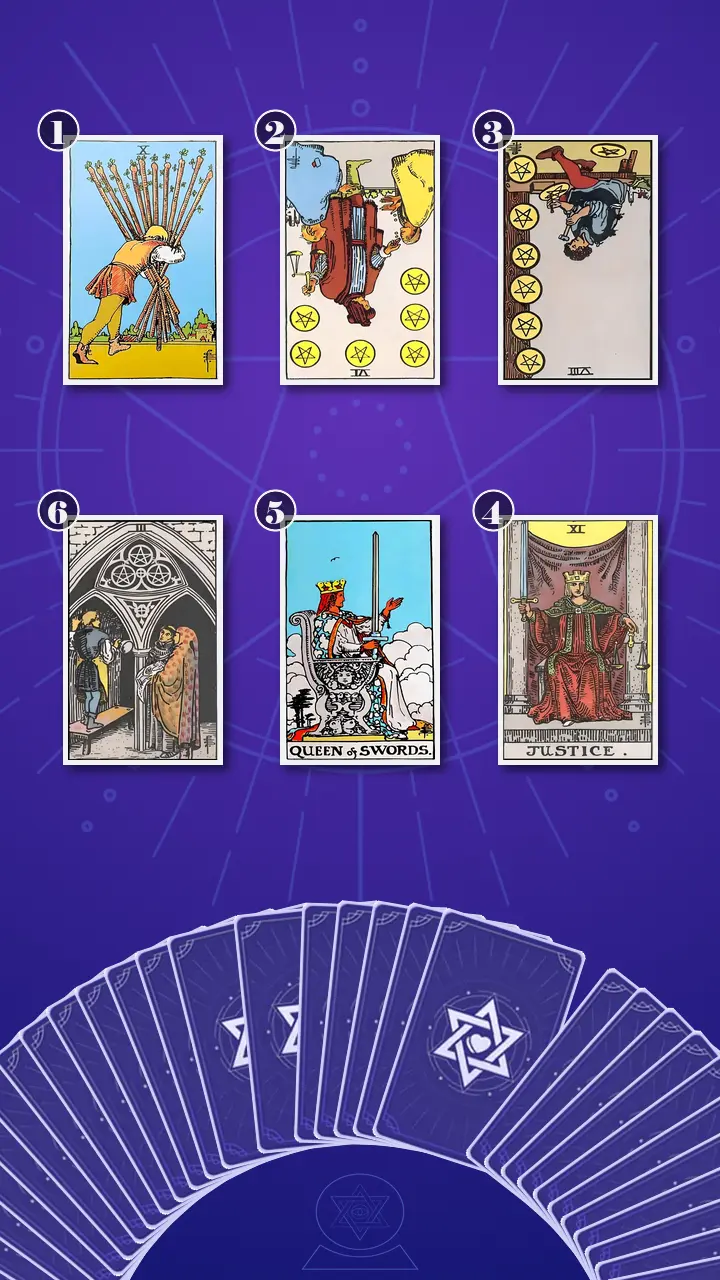
I chose the Transformation Path Grid · Context Edition, a six-card career tarot spread designed to trace a repeating system from symptom to integration. I use tarot as a Jungian reflective tool: the images give subconscious bargains, workplace dynamics, and conflicting instincts a visible form. The cards do not overrule facts. They help organise facts we may be too entangled to compare clearly.
I want to explain why this particular spread mattered. Jordan's problem was not simply a choice between staying and leaving, nor was it only an internal confidence issue. Quiet-promotion burnout is sustained by two forces at once: an organisation receives senior-level labour without formalising the return, and the person performing that labour keeps hoping one more excellent result will make recognition automatic. A smaller spread would have collapsed those forces into a single idea. A larger one would have added breadth without improving the diagnosis.
I arranged the cards in two rows like a folded route through a maze. The first three positions would show the current burden, the structural blockage, and the psychological root. The fourth card would form the hinge: the insight capable of changing the direction of the system. The final two would translate that insight into direct action and a healthier operating standard. This was how tarot could help here, not by announcing Jordan's professional future, but by making the loop visible enough to interrupt.
Reading the Work Loop from the Top Row
Position 1: The Calendar That Blocked the View
Now I turned over the card representing the current symptom: Jordan visibly carrying project manager responsibilities under a coordinator title and treating overload as evidence of readiness. It was the Ten of Wands, upright.
The figure on the card bends under ten bundled wands. The load is impressive, but it blocks the carrier's view of the road. I connected that image directly to Jordan's week: leading planning, resolving escalations, onboarding a new colleague, updating stakeholders, and staying late to protect the launch, all while their official title remained unchanged. The calendar demonstrated competence, but it had become so crowded that Jordan had almost no space to ask whether the work was still producing career progression.
I described the card's energy as Excess: fire that had expanded beyond purposeful ambition into accumulated responsibility. The Ten of Wands was not criticising hard work or asking Jordan to become less capable. It was showing how capability without selection could become a burden dense enough to obscure strategy.
'The sentence under this card sounds like this,' I said. 'I thought carrying all of this would prove I was ready, but carrying it has left me no time to ask where it is going.'
Jordan gave a short laugh, but there was no amusement in it. Their fingers stopped above the keyboard, their eyes narrowed as if mentally opening the week's calendar, and then their shoulders dropped by a fraction.
'That is painfully accurate,' they said. 'Honestly, it is kind of brutal.'
'Let us make sure accurate does not become accusatory,' I replied. 'You did not create the entire arrangement. Your work kept real projects and real colleagues moving. The question is not whether you should have cared. It is which responsibilities genuinely develop you, and which ones mainly make the current mismatch easier to maintain.'
I asked Jordan to imagine showing their calendar to someone who knew only their coordinator title. 'Which planning, decision, mentoring, or escalation duties would surprise that person?' I watched them begin counting on their fingers.
Position 2: Praise on One Side, Terms on the Other
Now I turned over the card representing the structural blockage: an exchange in which more responsibility was granted without a matching title, authority, compensation, or explicit timeline. It was the Six of Pentacles, reversed.
In the traditional image, one standing figure holds the scales and distributes coins. Reversed, the problem is not necessarily that nothing is given. The problem is that one side controls the terms, amount, and timing of the exchange. Jordan described a recent one-to-one in which their manager had called them indispensable and, before the call ended, added another manager-level workstream to the shared notes. Jordan had left with specific accountability but no written change to their job band, decision rights, promotion criteria, salary, or review date.
The card showed a Blockage in reciprocity: an excess of labour supplied in advance and a deficiency of formal return. The appreciation might have been sincere. That did not make it equivalent to a role agreement. I have crossed enough workplace cultures to know that praise can mean genuine respect, habitual avoidance, or both at once. Whatever its intention, undefined praise cannot perform the function of defined employment terms.
'Praise is not a role agreement,' I said.
Jordan's jaw tightened. Their gaze moved away from the cards, stayed unfocused for a moment, and returned to the reversed scales.
'They trust me with the responsibility,' they said. 'So why is the recognition still discretionary?'
'That is the question this position wants kept factual,' I replied. 'In the last one-to-one, what was formally returned for the added scope: title, authority, compensation, written criteria, a decision date, or only appreciation? Naming the answer does not require you to dismiss the appreciation. It requires you to stop using appreciation as a substitute for reciprocity.'
Position 3: The Status Deck That Was Already Done
Now I turned over the card representing the psychological root: the private bargain that flawless output and repeated proof would eventually make recognition automatic. It was the Eight of Pentacles, reversed.
The traditional craftsperson repeats the same pentacle at an isolated workbench while the wider town remains in the distance. In Jordan's life, those repeated pentacles had become status decks, risk logs, rewritten updates, and after-hours messages. Jordan told me about opening a presentation at 10:12 p.m. even though it was already usable, adjusting its spacing, repairing a colleague's section, and checking the risk tracker again. The extra hour barely changed the business outcome. It did postpone the question whose answer Jordan could not control: whether the firm actually intended to formalise the role.
I read the reversal as a mixture of Excess and Blockage. The diligence was real, but its strategic movement had stalled. Refinement offered a controllable task, a quick sense of usefulness, and one more item for an immaculate promotion evidence page. Meanwhile, the page called 'questions for my manager' remained in draft. It was like refreshing the same career algorithm with more evidence even though the filter blocking progression might be organisational rather than personal.
Through a Jungian lens, I offered a hypothesis rather than a diagnosis. Jordan's highly capable professional persona had become protective armour. If every detail was flawless, perhaps no one could expose the quieter fear underneath: 'If I stop carrying this, they might decide I was never ready.' More work reduced that fear for an evening, but the relief kept the larger test unscheduled.
'One more pass feels safer than asking the question that could give me an answer I do not control,' I said.
Jordan's breathing paused. Their fingertips pressed into the tabletop, their eyes shifted as if replaying several late nights at once, and then a long breath left their chest.
'I have been calling it preparation,' they said quietly. 'But some of it is avoidance.'
'Yes, and the distinction matters,' I replied. 'Your competence is not imaginary just because overworking became a defence. We can respect the craft while changing the bargain around it. You are not behind on proof; the terms are behind on clarity.'
When Justice Put the Job Description on the Scales
Position 4: The Question That Changed the System
As I placed the fourth card below the Eight of Pentacles, the refrigerator compressor in Jordan's kitchen stopped. The sudden quiet made the single streetcar bell outside sound unusually clean, like a line drawn through the room.
I summarised the hinge before turning the card: at 8:47 p.m., the risk tracker had remained open beside the half-written role-scope note; a Slack ping had arrived; and one more flawless delivery had won because a controllable task felt safer than an answer Jordan could not control.
Now I turned over the card representing the key trigger: replacing the vague question of whether Jordan had done enough with an evidence-based comparison of actual scope and formal return. It was Justice, upright.
Justice held balanced scales in one hand and an upright sword in the other. I asked Jordan to picture their official coordinator job description beside a factual record of the project manager duties they already performed: delivery planning, risk ownership, stakeholder updates, mentoring, and escalation decisions. The question was no longer 'Have I finally proved enough?' It was 'Which title, authority, compensation, criteria, and review date correspond to this documented scope?'
More unpaid proof is not what the scales are missing; place your actual responsibilities on one side and the title, authority, and compensation on the other, then use Justice's sword to name the gap clearly.
The gap is no longer asking for more proof. It is asking to be named, measured, and discussed.
I stopped speaking. Jordan's breath caught first. Their hand remained closed around the cold coffee mug, their knuckles pale, while their eyes moved between the card and the minimised note on the laptop. Then their pupils widened and the muscles around their mouth loosened. Their eyes became slightly red, but their shoulders did not immediately fall; they sat more upright, as though clarity had added responsibility before it offered relief.
'But does that mean I have been helping them keep it this way?' Jordan asked. The words came out sharper than anything they had said earlier. 'Does it mean I did all of that wrong?'
'No,' I said. 'It means you adapted intelligently to uncertainty, and the adaptation has reached its limit. Your work protected launches, clients, and colleagues. Justice is not putting your past effort on trial. It is asking whether the same strategy still serves you now that the pattern is visible.'
Their grip loosened. Their gaze drifted for several seconds, as if a week of meetings were replaying behind it, and then they released a shaky breath from deep in the chest. I asked, 'Now, with this new perspective, think back to last week. Was there a moment when this insight could have made you feel different?'
'Thursday,' Jordan said. Their voice was quieter now. 'When my manager added the new workstream. I could have asked what it changed instead of treating it as another test.'
I then used the diagnostic framework I call Imposter Syndrome Auditing. It is not a label I place on a person. It is a way to separate three categories that fear tends to fuse together. First, I named the objective competence evidence: Jordan was already coordinating delivery, making operational decisions, handling escalations, and mentoring colleagues. Second, I named the exposure fear: asking for formal recognition might reveal that they were replaceable or that the praise had never been a promise. Third, I named the organisational unknowns: title availability, budget, criteria, decision ownership, and timing.
The audit changed the logic. Jordan's competence was evidenced by work already completed. Their fear was emotionally real, but it was not evidence of incompetence. The organisation's unanswered terms were not proof of personal inadequacy; they were questions the organisation needed to answer. The reading could not guarantee that the answer would be favourable, but it could stop uncertainty from automatically being translated into 'I must work harder.'
I set an eight-minute timer and asked Jordan to reopen the note. They created two columns titled 'Current scope' and 'Formal return' and added only three responsibilities. Beside each one, they recorded whatever title, authority, compensation, criteria, or timing currently existed. I asked them not to polish it, send it, or read confidential details aloud. This was evidence collection, not a commitment to confront anyone. When the timer ended, I asked them to stop.
Justice carried the energy of Balance: evidence without self-erasure, fairness without fantasy, and direct assessment without turning resentment into the only judge. I named the psychological movement I could see beginning: from frustrated overextension and self-doubt to grounded, evidence-based self-advocacy and intentional effort. It was not certainty about a promotion. It was the first separation of professional facts from a fear-based worth verdict.
The Sword Became a Meeting Sentence
Position 5: Direct Without Becoming Hostile
Now I turned over the card representing the action plan: a direct scope conversation, clear requests, and boundaries around additional permanent duties. It was the Queen of Swords, upright.
The Queen held her sword vertically while extending an open hand. I showed Jordan how the two gestures belonged together. The sword represented precision: naming the mismatch, asking for criteria, and distinguishing temporary coverage from permanent scope. The open hand kept the conversation receptive. Directness did not require accusation, and collaboration did not require unlimited agreement.
In modern life, this card looked like a 20-minute role-calibration meeting. Jordan could bring three examples, describe the scope without apologising or inflating it, ask three direct questions, and pause long enough to hear the answers. If manager-level responsibilities could not yet receive matching authority and recognition, Jordan could ask what should be reprioritised instead of silently absorbing everything.
The Queen's air was in Balance: enough analysis to become clear language, but not so much analysis that the meeting stayed permanently in rehearsal. I used my Authority Archetype Integration lens to explain a second point. Jordan's friction was not only about obtaining a better label. They had been asked to carry leadership responsibility while still seeking permission to speak with leadership-level clarity. Integrating authority meant allowing their communication to match the responsibility they already exercised, without pretending to possess decision rights the organisation had not formally granted.
'I can be direct without becoming hostile,' I said, offering the sentence back to them, 'and collaborative without volunteering for unlimited scope.'
Jordan repeated it once. Their first attempt sounded tentative. On the second, their chin lifted and the sentence ended without the upward inflection of an apology.
I gave them practical language: 'I would like to compare my current responsibilities with my role level and clarify title, authority, compensation criteria, and timing.' For the next permanent request, I suggested: 'I can assess this. Which current priority should move, and how will this responsibility factor into the role-scope review?'
'A boundary can sound like a project question,' I said. 'What moves if this moves in?'
Position 6: Work Designed in the Open
Now I turned over the card representing cognitive integration: judging future opportunities by explicit role design, reciprocal recognition, and coordinated responsibility rather than by how much invisible labour Jordan could carry. It was the Three of Pentacles, upright.
The card showed an artisan and two collaborators gathered around shared plans. Skill was visible, but it was not solitary. In Jordan's workplace, this could become a written role matrix showing who owned delivery decisions, who contributed, who approved, what support existed, and when title and compensation would be reviewed. If the formal scope did not change, the same document could identify which duties needed to move elsewhere.
This was upright earth in Balance: effort grounded in an agreed structure. The card did not promise Jordan a promotion. It offered a standard they could use regardless of the employer's response. A stretch assignment could still be worthwhile, but Jordan would evaluate it through ownership, authority, support, recognition, and timing rather than accepting it as another open-ended audition for legitimacy.
'So I am not trying to become less useful,' Jordan said.
'Exactly,' I replied. 'You are making usefulness discussable. Your title is not a verdict on your worth, but the mismatch is still real.'
I watched Jordan look across the full grid. Their shoulders had lowered, though one hand still rested tightly against the table. The remaining tension mattered. Clarity can feel relieving and exposed at the same time because it removes the comfort of pretending that one more deliverable will solve everything automatically. The cards had not chosen an outcome for Jordan. They had clarified the next test Jordan could choose to run.
The One-Page Route Out of Invisible Proof
I drew the cards together as one causal story. The Ten of Wands showed the visible result: overloaded fire and a calendar full of next-level work. The reversed Six of Pentacles showed why the burden remained materially unrewarded: contribution was specific while reciprocity stayed discretionary. The reversed Eight of Pentacles showed how Jordan managed that uncertainty by perfecting and producing more, gaining short-term relief while delaying the conversation. Justice introduced evidence and proportion. The Queen of Swords converted evidence into language. The Three of Pentacles returned the reading to stable earth, where contribution could exist inside explicit roles and shared plans.
I also pointed out that no Cups had appeared. I did not treat that absence as a prediction. I used it as a reflective prompt: disappointment and resentment had repeatedly been converted into labour and analysis before they could be acknowledged as information. Jordan sat with that for a moment and said, 'I am disappointed. I keep calling it impatience because disappointment feels harder to admit.' Naming the feeling softened its control. It did not have to dictate the meeting, but it no longer had to hide inside another late-night task.
The cognitive blind spot was now clear. Jordan had been treating the lack of formal recognition as evidence that more personal proof was required, instead of considering that the missing element might be explicit organisational terms. They had also treated silence as neutral, even though every postponed conversation allowed the expanded scope to become more normal. That did not make the imbalance their fault. It showed where their leverage had been hiding.
The transformation direction was equally concrete: stop proving readiness through unlimited extra work; document the scope already being performed; request explicit title, authority, compensation, criteria, and timing; and ask for reprioritisation before accepting further permanent responsibility. The spread's maze image returned to me. Jordan did not need to run faster through the same corridor. Each documented responsibility could become a thread marking the route out.
'What if I do all of this and they still say next cycle?' Jordan asked.
'Then you ask what criterion remains, who owns the decision, and which date will be documented,' I said. 'You send a short recap afterward. Their answer becomes information for your next choice. The goal is not to force certainty from one meeting. It is to stop paying for ambiguity with unlimited labour.'
I kept the next steps deliberately small:
- The Eight-Minute Justice Audit and Competence Anchor On one workday this week, open a company-approved document and set an eight-minute timer. Make two columns titled 'Current scope' and 'Formal return.' Add no more than three recurring duties above the written coordinator role. For each, note frequency, decision authority, business impact, and any title, pay, criteria, or review date attached to it. I folded my Competence Anchoring Exercise into the same page: add one verifiable outcome beneath each duty, using observable evidence rather than praise, such as a decision made, risk resolved, deadline protected, or colleague onboarded. Tip: Use calendar entries, project plans, and non-confidential deliverables as prompts. Do not polish or send the page. If eight minutes feels too heavy, write one sentence naming one duty and stop.
- The Twenty-Minute Role and Scope Calibration Send the relevant manager a 20-minute meeting request titled 'Role and scope calibration.' Use: 'I would like to compare my current responsibilities with my role level and clarify title, authority, compensation criteria, and timing.' Before the meeting, write three questions: 'Which of these duties are expected at my current level?' 'What specific criteria remain for the project manager title?' and 'What decision date or review point can we document?' If another permanent duty arrives first, ask: 'Which current priority should move, and how will this factor into the role-scope review?' Tip: The minimum version is sending only the calendar request, without attaching a case. If direct refusal feels risky, use the prioritisation question, take time before agreeing, and send a brief factual recap after the conversation.
I reminded Jordan that these were experiments, not commands from the cards. Documentation could reveal a workable path to formal recognition, a need for firmer boundaries, or information that changed how Jordan invested future effort. Whatever the answer, the next move would come from Jordan's judgment. Tarot had made the pattern visible; it had not become the owner of their career.

A Week Later, the Note Stayed Open
Six days later, I received a message: 'I made the three-line audit and sent the meeting invite.' Jordan had slept through the night, then woken with the old thought, 'What if this backfires?' This time, they wrote, the thought felt like a question, not a command.
The meeting had not yet happened, and no title had materialised by magic. The small proof was quieter: when another workstream appeared, Jordan did not answer immediately. They checked the audit, asked what existing priority should move, and kept the role-conversation note open. The manager agreed to discuss the request in the scheduled meeting.
I thought back to the first image of the reading: a person bent beneath bundled wands, unable to see the road. Jordan's journey to clarity had not removed every wand. It had restored enough line of sight to distinguish ambition from unpaid proof, appreciation from reciprocity, and professional evidence from the fear of being exposed.
When being indispensable starts to feel like your only protection against being replaceable, even opening a role-conversation note can tighten your jaw while another late-night task somehow feels safer. I want you to remember that noticing this bargain means it is no longer operating entirely in the dark.
If your actual scope could speak before your self-doubt did, what is the smallest truth it would place in the 'Current scope' column tonight?