Putting the Laptop Away: From Leftover Energy to One Touched Page

At 6:35, Productivity Guilt Ate the Evening
I often recognise the same pressure point in people approaching 30 who work hybrid laptop jobs in London: the day is technically over, but two unanswered Slack messages look like a moral test. Maya joined our video reading from her rented flat a few minutes after 7:20 on a work-from-home Tuesday. Behind her, the laptop fan was still humming beside a mug of cold tea. Blue screen light sharpened the shadows beneath her eyes, and her jaw stayed clenched even after she had closed the lid.
At 6:35, she had clicked out of one spreadsheet, noticed those two messages, and reopened her task list. “I thought, just these two things, then I can switch off,” she told me. By the time she finished, the sketchbook on the kitchen table felt less like an invitation and more like evidence against her. Her arms were heavy, her eyes felt gritty, and exhaustion sat in her body like a phone trapped at three percent while every background process kept running.
“I’m always preparing to have a life instead of actually having one,” she said. “Why do I keep postponing everything until after work, then have nothing left?”
I could see the private contradiction clearly: Maya wanted creativity, friendship, movement, and ordinary weeknights that felt like her own, yet she believed personal time had to be earned by becoming sufficiently complete at work. Productivity guilt extended the workday, after-work collapse followed, and the life she was trying to secure kept being postponed.
“You are not failing at evenings; work is arriving there first,” I told her. “I’m not going to use tarot to predict whether your workload magically disappears. I want us to map the loop, find the point where your choice still matters, and leave you with one experiment that respects your actual energy.”
A Four-Card Ladder Out of the Waiting Room
I asked Maya to silence Slack for the length of the reading, place both feet on the floor, and take one unforced breath while holding her question in mind. I shuffled slowly. I treat this preparation as a transition for attention, not a supernatural performance: it gives the mind a moment to stop reacting and start observing.
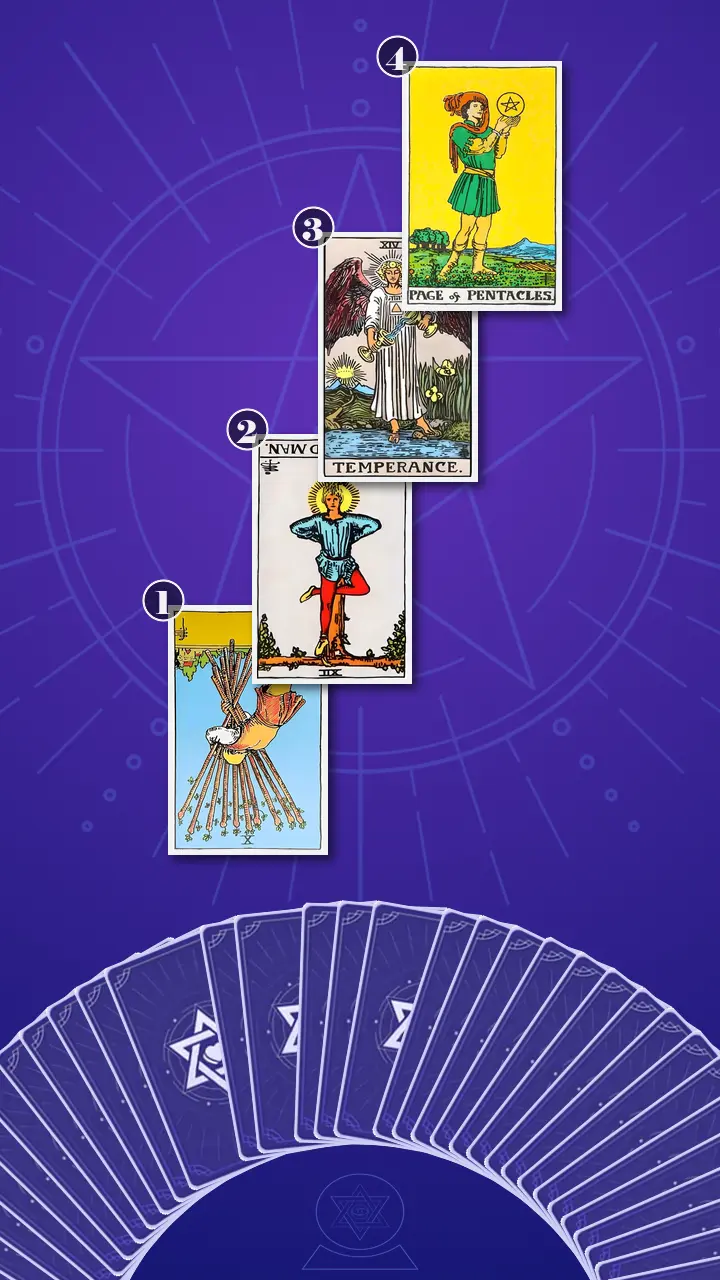
I chose the Four-Layer Insight Ladder · Context Edition, a four-card present-root-transformation-action tarot spread. A Celtic Cross would have introduced more context than this focused pattern needed, while a past-present-future reading could have made a repeating loop look like a fixed timeline. Maya did not need a prediction. She needed to see how the same evening kept rebuilding itself.
I arranged the cards like a short staircase. The first position would reveal the visible behaviour consuming her remaining capacity. The second would expose the private rule keeping that behaviour in place. The third would identify the leverage point, and the fourth would turn that insight into a small practice. This is how tarot works best for me: card meanings in context become an external model of choices, beliefs, and energy allocation that are difficult to inspect while living inside them.
Reading the Weight She Carried Home
Position One: Both Hands Full at 7:20
I turned the card representing the diagnosis-level behaviour behind Maya’s after-work collapse: extending work until no usable personal capacity remained. It was the Ten of Wands, reversed.
I pointed to the figure bent beneath a bundle so large that it blocked the town ahead. In Maya’s life, both hands were metaphorically occupied by Slack messages, open tabs, and low-impact requests. She planned to finish at 6:30, saw two unanswered messages, reopened the list, and finally closed the laptop around 7:20 with heavy arms and screen-fatigued eyes. The extra work briefly made her feel responsible, but it spent the exact capacity she expected to use for dinner, drawing, or movement.
The reversal showed an excess of work-driven fire and a blockage in setting it down. The problem was not insufficient ambition. Maya was carrying responsibility beyond the point where it meaningfully helped, then interpreting her depleted state as a personal failure. It was the opposite of the clean work-self and home-self boundary imagined in Severance: the work had crossed the threshold in her hands, eyes, shoulders, and nervous system.
Her breath caught. Her shoulders rose as if the illustrated bundle had landed on them, then she gave a small, bitter laugh. “That is so accurate it’s almost rude,” she said. “I use up the part of me that was supposed to have an evening.”
“That recognition matters,” I replied, “but the card is not accusing you of causing your exhaustion through weakness. It is showing where your capacity goes. Shame says, ‘Try harder tonight.’ The Ten of Wands asks, ‘What can be put down before both hands are full?’”
Position Two: The Appointment Work Kept Rescheduling
I turned the card representing the psychological mechanism beneath the collapse, especially the rule that personal life must wait until work feels complete. It was The Hanged Man, reversed.
Upright, the suspended figure can represent a purposeful pause and a changed perspective. Reversed here, suspension had become a blockage: Maya already understood that work was open-ended, yet she had not released the condition attached to living. She kept telling herself, “When this launch, quarter, or busy stretch ends, I’ll draw, use the gym membership, and say yes to dinner.” Each temporary condition simply became the next one.
“It’s like sitting in a digital waiting room while work keeps moving the appointment called real life,” I said. “An empty inbox is a finish line that moves while you run.”
I asked what sentence appeared when she pictured closing the laptop with one task still visible. Maya looked away from the screen. Her fingers tightened around the cold mug, then loosened. “If I stop now, it means I’m careless,” she said. After a pause, she added, “And maybe not as competent as everyone thinks.”
I heard the deeper bargain beneath her answer. Staying online protected her sense of professional worth for another hour, but it required her creativity, friendships, and recovery to survive on whatever remained. Insight was already present, like the halo around the Hanged Man’s head. What had been missing was permission to release the bound foot.
When Temperance Began to Pour
Position Three: Two Cups on the Same Tuesday
The room became unusually still as I turned the card representing the leverage point that could loosen delayed living. Even the laptop fan behind Maya had stopped. Rain traced a thin line down her window as Temperance, upright, appeared at the centre of the staircase.
I showed Maya the water moving continuously between two cups, with one foot on solid land and one in water. Temperance did not ask her to choose between being responsible and being alive. Its energy was balance: a measured circulation in which work, basic recovery, and one source of personal meaning could occupy the same imperfect day.
In practice, this could look ordinary. At 6:30, Maya would leave some work unfinished, document the next action and tomorrow’s restart time, then close the laptop. She could eat, change clothes, and draw for ten minutes before deciding whether the rest of the evening was for streaming, more drawing, or bed. The change was not the sudden appearance of more energy. It was reserving a small share before passive recovery made every decision feel expensive.
“Rest does not have to become productive,” I said. “But your whole life cannot live on leftovers.”
I used what I call Macro-Cycle Phase Identification to test whether Maya was facing a temporary low tide or a recurring orbit. A genuinely short workload peak might justify a brief season of reduced plans. But her launches, quarters, shifting requests, and “unusual” busy weeks had repeated for months. The finish condition itself was structurally open-ended.
My Systemic Friction Audit made the next point clearer: Maya had been asking hustle to overpower a system that generated new work faster than completion could create permission. More effort could not end that cycle. It could only move the work boundary farther into the evening. Temperance offered a different intervention: lower work from maximum volume so that food, rest, creativity, and connection could be heard in the same track.
At 6:35, Maya usually closed one tab, saw two unanswered messages, and reopened the task list. By 7:20, her sketchbook remained untouched because choosing anything felt like another assignment. I asked her to imagine changing only one moment: one unfinished task documented for tomorrow, then the laptop closed before the remaining energy disappeared.
Your life does not need to be earned after every task is finished; begin mixing one small source of aliveness into the energy you actually have, like Temperance pouring steadily between two cups.
For a second, Maya did not soften. Her breathing stopped, and her thumb hovered above the rim of the mug. Her gaze slipped past the screen as if she were replaying a line of identical evenings. Then her jaw hardened. “But doesn’t that mean I’ve been doing this to myself?” she asked, her voice suddenly sharp. “That I’ve been wrong all this time?”
“It means you developed a rule that once helped you feel secure and competent,” I said. “London rent, job stability, team expectations, and real workload are not imaginary. I’m not asking you to blame yourself for adapting. I’m asking whether the rule still deserves control of every evening.” Her eyes reddened slightly. She pressed both feet into the floor, opened her hands, and released a shaky breath. Her shoulders dropped, but the new space seemed to leave her briefly unsteady. Clarity had removed an excuse and revealed a choice, which brought relief and responsibility together.
“Now, with this new perspective, think back: was there a moment last week when this insight could have made you feel different?” I asked.
She described a Thursday when a friend had invited her for noodles. None of the remaining tasks had been urgent, but she had declined, stayed online, and later scrolled past the dinner photos while holding a warm phone beside a cold plate. “I could have written where to restart and left,” she said quietly. “I didn’t need to feel fully restored. I just needed to stop giving work first refusal on everything.”
I named the crossing I could hear in her words: this was a first movement from exhausted frustration and guilt about unfinished work toward cautious relief, grounded interest in an ordinary evening, and growing self-trust. Not certainty. Not a total routine overhaul. Just the recognition that energy could be allocated before it became a leftover.
Position Four: One Object, Ten Minutes, No Catch-Up Debt
I turned the card representing the grounded practice through which the insight could become observable. It was the Page of Pentacles, upright.
The Page held one pentacle at eye level, giving a single object full attention. I read this as stable, available earth energy: not mastery, intensity, or a perfect streak, but contact with something real. For Maya, the card translated a vague plan for a better life into one sketchbook, one pencil, one kitchen table, and ten minutes.
Before work on Tuesday and Thursday, she could leave the sketchbook open on the table. After shutdown, she could make marks on one page without requiring a finished drawing, a productive result, or repayment for a missed day. The Page did not ask her to become “a creative person” by bedtime. It asked her to participate in creativity while still tired and unfinished.
Maya glanced toward the sketchbook just outside the camera frame and pulled it closer. Her fingertips rested on the cover. “One object, ten minutes, no catch-up requirement,” she repeated. I watched pressure give way to a small, almost cautious interest. One touched page is more lived than a perfect routine postponed.
The Waiting Room Gets an Exit
I gathered the four cards into one story. The Ten of Wands showed Maya carrying work past its useful boundary. The Hanged Man revealed why she could not set it down: unfinished work had become evidence against her worth. Temperance redistributed limited energy instead of demanding more, and the Page gave that protected share a physical form.
The blind spot was subtle but decisive. Maya had been treating the discomfort of logging off as proof that logging off was irresponsible. I saw it differently: discomfort was evidence that the boundary was unfamiliar. Her personal life had become a project-board ticket permanently parked behind every incoming work request. The transformation was not to clear the board. It was to stop allowing the board to assign every available unit of attention.
When I proposed a 72-hour experiment, Maya raised a practical objection. “What about office days, or when something genuinely urgent lands late?” she asked. I told her that a useful boundary had to respect her contract, commute, safety, access needs, and actual incidents. The experiment needed an exception rule, not fantasy conditions. A late notification alone was not an emergency, but a live customer incident or explicitly agreed deadline might be.
- The 72-Hour Orbital Sync Over the next 72 hours, Maya would set a 6:25 p.m. calendar alert on each available workday labelled “Name tomorrow’s restart point.” At the alert, she would write one sentence in her task tracker: “Next action: ___ at ___ tomorrow.” At her planned finish, she would set Slack to offline, close the laptop, and place it away from the sofa for at least ten minutes. Before the first trial, she would write three genuine after-hours emergencies on a sticky note so guilt could not redefine “urgent” at 6:30. A real incident could override the boundary without making the experiment a failure. The minimum version was documenting one task and closing the app most likely to pull her back in.
- The One-Object Evening Before Tuesday and Thursday’s workdays, Maya would place an open sketchbook and one pencil on the kitchen table. After shutdown, she would put her phone on charge outside arm’s reach, get food or water, and set a ten-minute timer before making marks on one page. She could stop after two minutes, continue, choose intentional rest, or go to bed. She would record only whether contact happened, never the quality of the drawing. Missing a day would create no debt and require no catch-up session. Food, medication, disability access, caregiving, sleep, and genuine exhaustion would always take priority.
I call the first exercise the Orbital Sync Protocol because it pauses forced motion long enough for psychological expectations to catch up with cyclical reality. Maya did not need to escape work’s orbit in three days. She needed evidence that one small part of her life could remain in motion without waiting for the entire system to become quiet. “Protect the first ten minutes,” I told her. “Let the rest of the evening be honest.”
One Touched Page in the Morning Light
A week later, I received a photo of one page crossed by loose pencil lines. Maya had stopped with one task unfinished and drawn for nine minutes. The next morning her first thought was, “What if I fall behind?” She told me she smiled at the thought instead of reopening Slack.
She had tried the experiment twice, not seven times. On one office day, the commute flattened her and she went straight to bed. I considered that part of the clarity too. A sustainable after-work boundary had to make room for intentional rest, variable capacity, and imperfect repetition. Otherwise it would become another colour-coded Notion routine waiting to punish her after one disrupted day.
I did not see Maya’s touched page as proof that tarot had changed her fate. The cards had helped us make the loop visible; Maya had decided where to interrupt it. That was the real Journey to Clarity: moving from waiting for a normal week to participating in the ordinary evening already available.
I know how quietly the old rule can close around a weekday. When stopping feels like proof that we have not done enough, the jaw tightens, the evening shrinks, and the life we hoped to earn becomes the very thing our effort keeps postponing. Simply noticing which cup receives everything first means the pattern is no longer entirely invisible.
If ten quiet minutes of your imperfect evening did not have to prove anything about your discipline or worth, which one object would you place inside Temperance’s second cup and feel curious enough to meet there?