Saving PTO Until It Is Nearly Gone: Making Rest Ordinary

Why PTO Is Saved Until It Is Almost Gone: The 8:47 p.m. Line 1 Spiral
I have learned, across sixty-seven seasons and a life spent listening to people at the edge of their own capacity, that guilt often arrives wearing very sensible clothes. I met Riley (name changed for privacy), a twenty-eight-year-old project operations coordinator in Toronto, just after she had described one such moment.
At 8:47 p.m. on a Tuesday, she had been riding Line 1 southbound with her wet coat folded across her lap. Fluorescent lights buzzed above her. Her phone was warm in her palm. She opened Google Calendar, saw a routine project deadline near the Friday she had tentatively marked as PTO, and dragged the block two weeks forward before anyone asked her to.
"I call it planning," she told me, pressing her thumbnail into the cardboard sleeve around her tea. "But I keep saving PTO for a moment that never arrives. Why does it take an almost-empty balance for rest to feel allowed?"
I could see the workday still sitting in her body: shoulders lifted toward her ears, a chest held tight as though even a full breath might interrupt something urgent. You can call that practical planning, but the body experiences it as permission postponed, like keeping a backup charger untouched while the phone runs on one percent.
"Wanting time off now and believing you need to wait until it is nearly gone are two different forces," I said. "Neither makes you lazy or uncommitted. They tell us there is a rule here worth examining. Let us make a map of it, so the calendar does not get to make every decision for you."

Choosing a Map for PTO Guilt
I asked Riley to place both feet on the floor, take one unforced breath, and hold the question in plain language: Why do I postpone vacation days until depletion makes them feel justified? I shuffled slowly, not as a performance of mystery, but as a pause between the story she had been repeating and the pattern we were ready to observe.
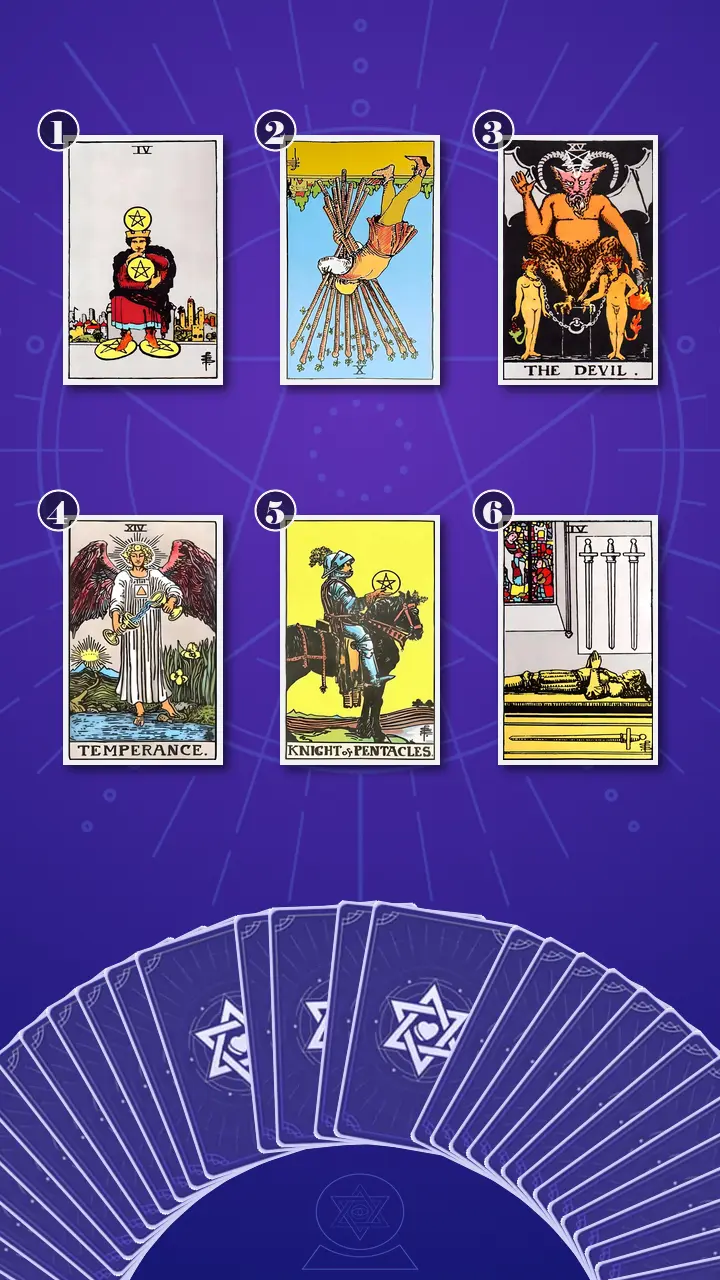
I chose the Four-Layer Insight Ladder · Context Edition, a six-card tarot spread for PTO guilt, work boundaries, and availability anxiety. I use it when the difficulty is not one decision between two options, but a loop: rest is delayed, delay creates strain, strain makes the eventual break appear necessary, and the cycle calls itself responsibility.
The first row would show the visible pattern, its cost, and the belief underneath it. The second would show the transformation, a practical next step, and the way a protected pause might become normal. Tarot does not issue orders or predict a punishment for taking Friday off. It gives us a structured mirror. What Riley chose to do with the reflection would remain hers.
The Held Calendar and Its Weight
Position 1: Four of Pentacles, Upright
I turned the first card. "This is the position of your present pattern: the observable habit of moving PTO, postponing time off, and using depletion as the moment rest finally seems justified. It is the Four of Pentacles, upright."
The seated figure clutches one coin to the chest, balances another on the head, and pins two beneath the feet. I saw Riley's calendar in the image at once: PTO treated like a locked savings account. Every unused day can feel safer because nothing has challenged her reliability. Yet a resource held that tightly cannot do the work it was meant to do. It cannot restore her while it remains untouched.
"The energy here is not bad," I told her. "It is protective Earth energy in excess. You know how to plan, conserve, and anticipate. But the plan has become a grip. You are protecting the balance so carefully that it cannot protect you back."
Riley gave a brief laugh, dry at the edges. "That is so accurate it is almost rude." Her smile disappeared quickly, but her fingers loosened from the tea sleeve. I let the humour make room rather than rushing to fill it.
"When was the last time you moved a PTO date after seeing one deadline or request, before anyone actually asked you to?" I asked. She looked down at the card. "Tuesday," she said. "On the train."
Position 2: Ten of Wands, Reversed
I turned the next card. "This is the blockage and cost: what staying available is asking your body and calendar to carry. It is the Ten of Wands, reversed."
The figure on the card bends beneath a bundle of ten staffs, heading toward a town without being able to see much beyond the load. Reversed, I read this as release that keeps almost happening but never happens cleanly. A routine handoff becomes one more task attached to Riley's name. A Slack message becomes an agreement to monitor the next day. One planned break shifts, then another, until the burden itself seems to be the only proof that she is allowed to set it down.
"I picture a project board where every ticket has quietly been assigned to the same person," I said. "The inner rule is: I can set this down only when the workload proves I had no choice. But relief and over-carrying are not the same thing."
The reversed energy was blocked release, not a failure of character. Each time Riley absorbed one more request, she received a small, immediate relief from the fear of being inconvenient. The longer cost was a jaw that tightened by Thursday evening, a break that began with message-checking, and a calendar with no truly protected space.
Riley inhaled, held it, then looked past my shoulder as if a Thursday afternoon were replaying there. Her hand closed around the cup again before she set it down. "I always tell myself it is just one status check," she said. "Then I feel safer for about ten minutes."
"Being reachable can preserve the feeling of control without preserving your energy," I replied. "The card asks us to distinguish a real coverage need from the reflex to become the coverage plan yourself."
Position 3: The Devil, Upright
I turned the third card. "This is the underlying belief: the private bargain that makes early time off feel risky. It is The Devil, upright."
I never read this card as a verdict, and I said so plainly. In the Rider-Waite-Smith image, two figures stand with loose chains around their necks. The chains matter because they show an attachment that feels absolute while still containing a question: what part of this arrangement is being maintained through repeated participation?
For Riley, the bargain sounded painfully familiar. The green Slack dot becomes a tiny workplace pulse that must not disappear. The phone stays beside the bed. The OOO message says she will have limited access, while another part of her promises that limited does not really mean unavailable. The unspoken contract is: I stay reachable, so nobody can mistake my absence for a lack of commitment.
"It is a little like Severance," I said. "The laptop may be closed, but the work identity still follows you home. This card is not saying you are trapped forever. It is helping us see the terms and conditions that have quietly claimed too much authority."
I sometimes call this part of my work Social Clock Decoupling. In a city full of visible milestones, rolling deadlines, and colleagues who appear permanently online, it is easy to mistake the pace around you for a measure of your worth. But someone else's calendar, response time, or career timing is not a court that gets to decide whether your nervous system may stand down.
Riley's eyes narrowed, then softened. Her phone lay face-up beside her notebook, its black screen reflecting the lamp. "I do not think anybody has explicitly told me I cannot take PTO," she said. "I just feel like I have to keep proving I am not the weak link."
"That distinction is important," I said. "There may be genuine workload and policy constraints, and we do not pretend otherwise. But there is also a belief making every ordinary request feel like a referendum on your value. A clear handoff can be a more accurate expression of commitment than an always-green dot."
When Temperance Pours Between Two Cups
Position 4: Temperance, Upright
The room seemed to quiet as I reached for the fourth card, the turning point of the spread. Outside, rain ticked softly against the window, no longer sounding like an interruption but like something keeping its own steady time. "This is the transformation position," I said. "It shows the shift from rest as a reward to rest as part of sustainable contribution. It is Temperance, upright."
The angel pours liquid between two cups, with one foot on land and one in water. Nothing is hoarded. Nothing is abandoned. The image holds work and restoration in measured exchange.
I asked Riley to picture 8:47 p.m. on that TTC ride: the warm phone, the tight shoulders, the Friday PTO block sliding around another deadline, and the sentence that next week would be easier. The balance remained intact, but her body was already paying for the reserve.
Stop treating an almost-empty PTO balance as proof that you have earned rest; begin mixing work and time off in a steady rhythm, as Temperance mixes the two cups.
Her breath stalled. One finger hovered over the corner of the Four of Pentacles before withdrawing. Her gaze went unfocused for a moment, as though she were watching every moved calendar block stack up behind the present one. Then her mouth pressed into a thin line. "So I have been doing this to myself?" she said, with a flash of anger that was not really aimed at me. "I thought I was being responsible."
I waited while the thought settled. Her shoulders were still high, but not as locked. Her hand opened flat on the table. A little colour rose around her eyes, and then she let out a breath that sounded less like agreement than the release of a long-held brace. "I have been waiting for work to give me permission," she said more quietly. "But work does not have a finish line."
"You were using the tools you had to try to stay safe," I told her. "That deserves understanding, not blame. At sixty-seven, I have watched many people try to force a spring harvest in a winter season. My Seasonal Energy Diagnostics are simple here: your system has been asked to produce, respond, and prove itself without recognising a recovery season. Temperance does not demand that you disappear from responsibility. It asks you to stop making depletion the only acceptable handoff."
I asked, "Now, with this new perspective, can you think of a moment last week when this insight could have made you feel different?"
"Thursday," Riley said. "I could have kept the half-day and written the handoff instead of offering to check Slack." Her shoulders lowered a fraction, and then she looked startled by the space that created. This was not certainty. It was the first vulnerable movement from guilt-driven PTO postponement and availability-based self-worth toward balanced self-trust and an ordinary permission to rest.
The Practice That Carries the Insight
Position 5: Knight of Pentacles, Upright
I turned the fifth card. "This is the action position: the repeatable practice that gives Temperance a place in your actual workweek. It is the Knight of Pentacles, upright."
The knight holds one pentacle while the horse stands still in a cultivated field. I read the stillness as deliberate preparation, not inertia. Riley did not need a dramatic escape, a perfect empty week, or a grand announcement. She needed one clear date, one realistic handoff, and steady follow-through.
"Reliability does not have to mean permanent personal access," I said. "It can mean that the right information is in the right place before you leave. A handoff is not proof that you matter less; it is a way for responsibility to exist beyond one person's nervous system."
The Knight's energy was balanced Earth: grounded, patient, and practical. The card did not promise that a deadline would never land near PTO again. It offered Riley a way to decide in advance what deserved a handoff, what could wait, and what her actual response window would be. That is a sturdier form of influence than quiet availability.
Position 6: Four of Swords, Upright
I turned the final card. "This is integration: what it could mean for pause to become a valid boundary before exhaustion authorises it. It is the Four of Swords, upright."
The recumbent figure rests in a protected room. Three swords hang above, and one lies at the side. The work has not vanished from the world. It has been placed outside the interval. I saw a different kind of structure from the Four of Pentacles: not a locked container around a resource, but a clear room around a person.
"Rest does not have to arrive as an emergency to count as real," I said. "A planned day off can have a beginning, an end, and a stated availability boundary. It does not need to be spectacular. It does not even need to make you instantly refreshed. It only needs to be protected enough that your attention has a chance to come home."
Riley nodded slowly. "A quiet breakfast without Teams would count," she said. "That sounds almost embarrassingly small."
"Small is often how a new rhythm becomes believable," I said. "We are not trying to solve understaffing, unfair workplace expectations, or every rolling deadline with one calendar entry. We are testing whether you can give your own time the same legitimacy you give a project milestone."
The Handoff That Makes Rest Ordinary
When I looked across the whole Four-Layer Insight Ladder, I saw a coherent story. Riley had protected PTO as though it were proof of responsibility, then carried work so continuously that fatigue became its own evidence. Beneath that was the availability-and-worth bargain: being needed felt safer than being visibly at rest. Temperance changed the direction of the story by making work and time off ingredients in the same rhythm. The Knight gave that rhythm a process. The Four of Swords gave it a boundary.
Her blind spot was not that she cared too much. It was that she had treated an OOO status as a reputational risk while treating physical depletion as neutral. The shift was to see regular, smaller periods of time off as part of sustainable contribution, supported by a clear handoff and a communicated availability window.
I offered two small experiments, not rules. Each could be adapted to her employer's PTO policy, team coverage arrangements, and real circumstances.
- Protect one Temperance block.This week, choose one permitted half-day or day off within the next four to six weeks before reviewing every possible future deadline. Put it on the calendar, name one ordinary thing the pause could make possible, and leave the date in place for forty-eight hours.If a full day feels too exposed, use a half-day or a two-hour block. Check workplace rules first, and treat the urge to move the date as information rather than an instruction.
- Use a four-line handoff, then log off.For one recurring task connected to that PTO block, write the owner, current status, next decision, and return date in the tool your team already uses. Send it during work hours, set an OOO message with exact dates and a realistic response expectation, then place the phone face down for the first hour away.Do not build an entire backup system alone or promise indefinite reachability. Use only the coverage route your role and team have agreed to, and notice what changes in your jaw, chest, shoulders, or attention before checking a message.
I named the first experiment a gentle version of my Winter Dormancy Ritual. For forty-eight hours, Riley would not keep re-litigating the PTO date in her mind. She was allowed to notice the guilt, but not required to obey it. Some things recover not because they are pushed harder, but because they are given a season in which they are not constantly asked to prove their usefulness.

A Week Later, the Date Stays Put
Six days later, Riley sent me a short message. She had booked a half-day, written the handoff, and kept her phone face down through breakfast. She still thought about Friday twice, she wrote, but she did not move it.
That was the proof I wanted for her: not a magically empty inbox, not a life without pressure, but one calendar boundary that remained visible while work continued around it. The cards had not created that change. Riley had noticed the old bargain, chosen a smaller rhythm, and let herself practise a different form of dependability.
When your shoulders stay lifted over your keyboard because being reachable feels safer than being rested, you can want the day off and still move it. The fear is not laziness. It is the fear that stopping will make your worth less visible.
If a small, ordinary pause did not need an almost-empty PTO balance to prove it was allowed, which part of your calendar would you quietly want to leave untouched?