The PTO Block That Became a Performance Review
I knew Maya was dealing with more than calendar Tetris when she told me she could coordinate five teams but could not click Submit on an out-of-office request without treating it like a referendum on her career value. At 10:40 p.m. on a Tuesday, she had reopened her laptop at her Brooklyn kitchen table to add another escalation page to a handoff that already named two backups. The fan hummed. Stale coffee left a bitter smell in the room. The keys were warm beneath her restless fingers.
Then an ordinary Friday status meeting appeared on her calendar. Her chest tightened, she deleted the PTO block, and the pressure loosened almost immediately.
“I'll take the time once things calm down,” she told me across my reading table. Her phone rested face down between us, although her fingertips kept drifting toward it. “But I know things never really calm down. I want my work to matter. I just hate the idea that I could take a day off and nobody would need me. What does that say about my role?”
I heard the contradiction clearly: Maya wanted meaningful, sustainable work, yet every opportunity to rest felt like an uncontrolled test of whether her contribution mattered. The anxiety moved through her like a laptop cable pulled tight around her ribs. Beneath it, I could hear the guilt of stepping away, the resentment of always being dependable, and the longing to close the laptop without needing her green Slack dot to prove anything.
“I am not going to tell you that you should just take a vacation,” I said. “And I am not going to use these cards to predict whether your team will need you. I want us to understand why a normal absence has acquired the emotional weight of a verdict. Then we can find one next step that gives you useful information without asking you to overhaul your life.”
I placed the deck between us. “Let's make a map for this particular fog. You remain the person who decides what to do with it.”

Choosing the Ladder for a Fear of Being Replaceable
I invited Maya to put both feet on the floor, take one unforced breath, and hold a single question in mind: “Why does taking PTO feel unsafe even when the leave is approved and the team can cover?” I shuffled slowly, using the movement as a practical transition from reacting to observing. No mysticism was required. We were simply giving her attention somewhere deliberate to land.
I chose the Four-Layer Insight Ladder, a four-card tarot spread for exploring PTO guilt and fear of being replaceable at work. For anyone wondering how tarot works in a session like this, I use the cards as a Jungian reflection tool, not a machine that issues workplace prophecies. Symbolic images can make an unconscious rule visible enough to examine. The value comes from comparing the image with observable behavior, testing the interpretation against lived evidence, and letting the querent decide what is true.
This was the smallest spread that could hold Maya's whole pattern without burying it beneath unnecessary positions. The bottom card would show the presenting layer: postponing leave, overbuilding handoffs, and checking messages while away. The second would reveal the recognition-based fear sustaining those behaviors. The third would identify the perspective capable of interrupting the loop. The final card would translate insight into a concise handoff, shared authority, accepted coverage, and protected time.
I arranged the cards as a vertical ladder. The lower half would diagnose the always-on cycle; the upper half would show how Maya might climb out of it through a deliberate pause and reciprocal ownership. I reminded her that a tarot spread does not prove a diagnosis. It offers a structure through which vague discomfort can meet specific facts.
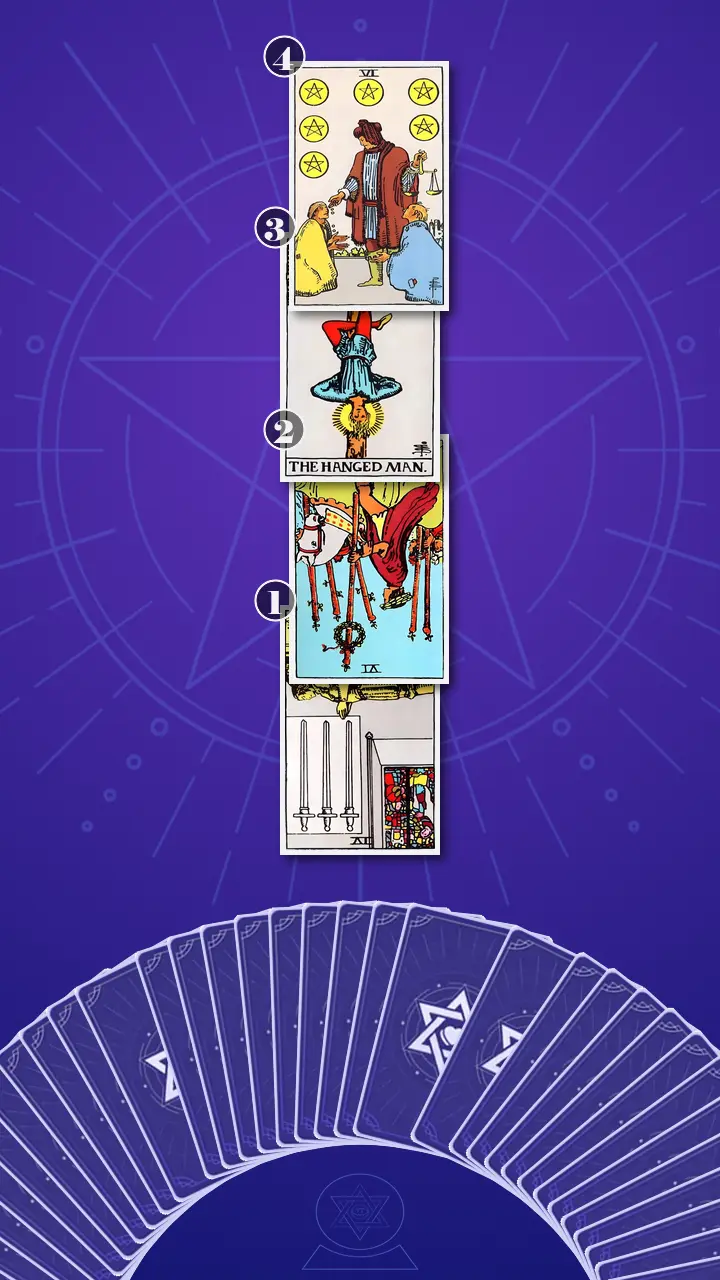
The Sanctuary With Slack Still Open
Position 1: Four of Swords, Reversed
I began with the card representing the presenting layer, the observable PTO behavior currently shaping Maya's experience. I turned it over: the Four of Swords, in reversed position.
In the Rider-Waite-Smith image, a recumbent figure lies beneath three suspended swords inside a sanctuary. The protected space already exists. Reversed, however, its restful Air energy is blocked. The body may stop moving while the mind continues monitoring every open thread. It was an exact image of time off appearing on Maya's calendar without ever reaching her nervous attention.
I brought the card directly into her Tuesday night. At 10:40 p.m., she was technically preparing to take Friday off, yet she was still adding contingencies to a handoff that already named two capable backups. A normal meeting appeared, she removed the request, and her chest loosened. On the rare day she did stay off, Slack and email remained active beside her. The calendar said rest; her attention remained on call.
“The reversed energy is not saying you are bad at resting,” I told her. “It shows a sanctuary that cannot perform its function because vigilance keeps reopening the door. You are not resting if your attention is still on call.”
I asked her to remember her most recent PTO Friday. She described a cold coffee beside a face-up phone and the reflexive reach that followed every vibration. Then she gave a small, bitter laugh.
“That's so accurate it's almost rude,” she said. “The thought is basically, ‘I'm allowed to be off, but I need to stay close enough to prove I'm responsible.’”
I did not rush to soften the recognition. “That thought makes sense inside the rule you have been using,” I said. “If responsiveness is your clearest metric of value, disconnecting will feel irresponsible even when it is appropriate. Our work is to examine the metric, not shame the part of you that learned to survive by meeting it.”
Her fingers stopped tracing the edge of her phone. Her jaw remained set, but I saw the first small gap between the urge to check and the belief that checking was mandatory.
Position 2: Six of Wands, Reversed
I turned over the card representing the root layer, the hidden fear that taking PTO might expose a lack of professional worth. It was the Six of Wands, reversed.
Upright, the card shows a laurel-crowned rider moving through a watching crowd. It carries Fire shaped by victory, confidence, and public acknowledgement. Reversed, that Fire becomes unstable and overly dependent on an audience. Recognition can still arrive, but it does not stay metabolized. The moment the applause fades, another visible win is needed.
I asked Maya about the last launch issue she had rescued. She remembered watching thank-you reactions collect beneath her Slack update and refreshing the thread to see whether her manager had replied. The praise lifted her chest for ten minutes. When the channel quieted, she volunteered for another urgent follow-up, even though her leave was due to begin the next morning.
“It is a tiny victory parade,” I said, “but the parade disappears as soon as the thread goes quiet. Then the private question returns: ‘If nobody is asking for me, where is the proof that I matter?’”
I was careful not to frame ambition, responsiveness, or the wish to be appreciated as character flaws. The blockage was not that Maya cared about doing good work. It was that rapid replies had become a stock ticker for professional worth, while quieter achievements such as preventing repeat problems, clarifying ownership, and helping colleagues act independently did not produce the immediate signal she had learned to trust.
“Being needed is a feeling; building something useful is an outcome,” I told her. “The first rises and falls with other people's attention. The second can remain true while you are offline.”
Maya inhaled, held the breath, and looked past the cards as if replaying a series of late-night rescue threads. When she finally exhaled, her shoulders moved only a fraction, and her mouth formed a rueful half-smile.
“I keep calling it responsibility,” she said. “But I do get a hit from being the one who saves something. And then I resent that everyone expects me to keep doing it.”
I noted the absence of Cups in the spread. “Your feelings have been routed into thinking and working,” I said. “Guilt becomes another handoff page. Resentment becomes another checklist. Longing becomes a Google Flights tab you promise to reopen after the next milestone. Naming those feelings will not solve every workload problem, but it keeps them from being disguised as one more task.”
When the Hanged Man Stopped the Delete Key
Position 3: The Hanged Man, Upright
The room became very quiet when I reached the transformation layer, the position showing the perspective shift capable of separating meaningful contribution from continuous presence. Rain tapped once against the window and then softened. I turned over The Hanged Man, upright.
The figure hangs by one ankle from living wood, yet the face is composed rather than defeated. A halo surrounds the inverted head. In this image, stillness is chosen attention. The Hanged Man does not abandon agency; the figure suspends habitual action long enough to see what constant motion has concealed.
I returned Maya to the familiar calendar sequence and froze it just before deletion. At 10:40 p.m., one more handoff page already existed, two backups were named, a routine Friday meeting appeared, and her chest tightened. Normally she would remove the PTO block, feel quick relief, and wake with the same exhaustion. This time I asked her to imagine leaving the date untouched.
Here I used what I call an Imposter Syndrome Audit. I separated three categories that Maya's fear had collapsed into one. The objective competence evidence was clear: her manager had approved the leave, two colleagues could cover, and her coordination had produced usable systems. The subconscious exposure story said, “If the team functions, I will be revealed as less valuable than I claim.” The testable unknown was much narrower: what, if anything, would genuinely require clarification during one bounded absence?
“The audit does not ask you to argue with your fear,” I said. “It asks you to stop presenting the fear as if it were already a performance report. The Hanged Man turns a pass-fail judgment into an observation point.”
You do not have to remain constantly available to prove your value; choose a bounded pause and assess your role from The Hanged Man's inverted view.
I let the sentence remain between us before adding, “A team that can keep moving while you are off is not a verdict that you do not matter; it may be evidence that your contribution has become durable enough to outlast your availability.”
At first, Maya did not exhale. Her fingers froze half an inch above the phone, and her eyes lost focus as if she were scrolling backward through every time a capable colleague had triggered a hollow drop in her chest. Then her pupils widened and her eyebrows pulled together. “But doesn't that mean I've been getting this wrong the whole time?” she asked, the words sharper than anything she had said so far. I heard anger, then grief beneath it. “It means the strategy gave you short-term safety and now costs more than it protects,” I replied. “That is not the same as saying your past self was foolish.” Her fist loosened one finger at a time. Her shoulders lowered, and her eyes became bright at the edges. The release was not pure relief; it carried the slight dizziness of setting down a burden and realizing she would now have to choose rather than obey it automatically.
I waited until her breathing settled. “Now, using this new perspective, think back to last week. Was there a moment when this insight could have made you feel different?”
Maya remembered sitting beside a Williamsburg cafe window during a previous PTO morning. Sunlight had warmed the table while an espresso grinder cut through the room. She opened Slack and saw the project moving normally. Her thumb hovered over the channel as the thought arrived: “They are fine without me, so maybe I was never that important.”
“What was the observable event?” I asked.
“They made the routine decisions and kept going.”
“And what meaning did your mind add?”
“That I was irrelevant.”
“The first statement is information about the team's capability,” I said. “The second is a verdict about your worth. They felt simultaneous, but they were not the same thing.”
Her face softened. “So the question could be, ‘What did my work help build that kept moving?’ Not, ‘Did anyone panic without me?’”
“Exactly. Absence can be information without becoming a verdict.”
I named the movement I saw taking shape: from anxious vigilance and constant-availability proof toward sustainable self-respect grounded in durable contribution and shared ownership. This was not instant confidence. It was the smaller, more honest shift from compulsive control to curiosity about what a limited period offline could reveal.
The Scales That Moved Authority
Position 4: Six of Pentacles, Upright
I turned over the integration card, the position showing how Maya could embody the new perspective through clear handoffs, shared authority, accepted coverage, and one protected period of PTO. The card was the Six of Pentacles, upright.
A figure holds balanced scales in one hand while distributing coins with the other. Here, Earth energy arrives in balance. Resources move. Help is given and received. The card does not praise endless generosity; it asks whether support and decision-making are distributed in a structure that people can actually use.
For Maya, that meant sending one concise handoff with the current status, the next decision, and the named owner. It meant explicitly allowing that colleague to make a routine decision without checking with her. Most importantly, it meant accepting the coverage by staying out of the channel until the agreed return time.
I brought in a second lens I use, Authority Archetype Integration. Maya's psychological friction was not simply between work and rest. It was between two forms of professional identity. The indispensable individual contributor proves value by personally catching every falling task. The integrated leader creates context, transfers authority, and lets other people's judgment become part of the system. If Maya passed information to a backup but withheld permission to act, she had not really shared ownership; she had only built a remote-control arrangement.
I thought of teams I had encountered across cultures, where the language of leadership differed but the underlying test remained strikingly similar: could authority travel without the original holder supervising every move? The card's scales made that question visible.
“A handoff is not complete until authority moves with the information,” I said. “Coverage is not you abandoning the team. It is the team using the authority you actually transferred.”
Maya looked at the two Sixes in the spread. “So one Six is me trying to collect proof from the crowd, and the other is me letting value move between people.”
“Yes,” I said. “Recognition is not forbidden. It just cannot be the only unit your internal system knows how to count.”
Her shoulders dropped far enough that the collar of her sweater changed shape. She picked up her phone, switched on Do Not Disturb, and placed it face down again. It was only a gesture inside a consultation, not proof of a solved pattern, but it was the first physical rehearsal of receiving support instead of remaining permanently available.
A Two-Hour Experiment in Finding Clarity
I read the Four-Layer Insight Ladder back to Maya as one coherent story. Repeated praise for rescue work had trained her professional algorithm to serve more urgency because urgency generated the most visible engagement. That recognition hunger kept the sanctuary of rest open in theory but inaccessible in practice. The Hanged Man interrupted the loop by turning absence into observation, and the Six of Pentacles grounded the insight in calendars, notification settings, concise context, and transferred authority.
The cognitive blind spot was now explicit: Maya had been interpreting normal team continuity as evidence of replaceability, when it could also be evidence that her judgment, documentation, and coordination had become durable. She had been measuring value through whether someone needed her immediately instead of through what her work made possible over time.
Our transformation direction was equally concrete. She did not need to manufacture certainty before resting. She could shift from proving value through constant availability to testing one bounded absence with a clear handoff, then evaluate the result through durable outcomes. I gave her three next steps, each intentionally small.
- Run a Bounded Absence Test.Before Friday, reserve one ordinary two-hour block or half-day in the calendar instead of waiting for a perfectly empty week. Name one backup, state the return time, write that the experiment is observing what existing ownership and documentation can carry, and schedule Slack and email notifications to pause automatically. Afterward, spend five minutes recording what continued, what genuinely required clarification, and what your prediction got right or wrong.Start with 30 minutes if two hours feels too loaded. Keep one narrow emergency route through the named backup, and put the work phone in a drawer, bag, or different room.
- Send a Three-Line Handoff.In Slack, email, or Notion, write only three headings: current status, next decision, and named owner. Send it to one agreed backup and state one routine decision they may make without your approval. Ask what single piece of context is missing, add only that item, and stop editing.Cap drafting and revision at ten minutes. If the backup lacks capacity, choose someone else or reduce the scope; reciprocal coverage must not quietly transfer overload.
- Use the Competence Anchoring Exercise.Before changing a PTO request, take five minutes and list three work outcomes that remain useful without immediate praise: a recurring problem prevented, a decision clarified, a process improved, or a colleague enabled to act. Beside each outcome, record one verifiable fact, such as a document, result, metric, or completed decision. Read the list before touching the calendar block.Use evidence rather than adjectives. Slack reactions, response speed, and being told you are a lifesaver do not count as the only proof; the exercise anchors self-worth to demonstrated competence and durable impact.
I also named an important boundary around the advice. If Maya's workplace genuinely penalized protected leave, ignored approved PTO, or punished employees who were not continuously reachable, that would be information about the system, not evidence of personal failure. A tarot reading should never turn a structural problem into a private mindset defect.
“This is not pressure to book a trip or disclose why the experiment matters,” I told her. “You are gathering evidence at a scale your nervous system can tolerate. The cards have helped us formulate the question. You decide the block, the boundary, and what the evidence means.”

A Quiet Inbox, and the Proof That Remained
Six days later, I received a message from Maya. She had kept a two-hour Wednesday block on the calendar, sent the Three-Line Handoff, and given her backup authority to make one routine scheduling decision. She paused notifications automatically and left her phone zipped inside her tote.
She told me she spent the two hours in Fort Greene Park while pale sunlight moved across the path. The team made one routine decision without her. Relief came first, then a small ache. The ache did not send her back to Slack.
When she returned, there was one clarification to add to the process and no emergency to rescue. Her message ended, “I still had the thought that maybe they don't need me. But then I looked at what happened and thought, maybe this is something I helped make possible. That felt better. Also scarier, because now I can't pretend checking is my only option.”
I did not read her discomfort as failure. I read it as evidence that the transformation was in progress and still human. The cards had not granted Maya permission to rest or magically changed her workplace. They had helped her separate an observable outcome from a subconscious verdict, and she had supplied the courage, structure, and judgment required to test a different response.
That was the quiet proof of our Journey to Clarity: not a perfectly calm PTO day, but one bounded period in which anxious vigilance did not make every decision. Maya began measuring contribution through what endured, what others could carry, and what authority she had successfully shared. Her work could outlast her availability without erasing her value.
When your chest tightens over an out-of-office message, it may be because you want the rest and also fear that a quiet inbox will say something final about your worth. If that conflict lives in you too, simply noticing the difference between information and verdict means you are no longer standing on the bottom rung of the ladder.
If you left your green dot dark for one bounded stretch of time, what would you be curious to notice about what your work has already made possible?
This story is adapted from psychological research, written so that those in a similar struggle can see their own pattern in it — and find their next step clearly.These insights are not a substitute for professional psychological, medical, legal, or financial advice.
Learn more about our Journey to Clarity.
How did this insight land for you?
🫂 This Resonates Deeply
🌀 Living This Story
✨ Now I See Clearly
🌱 Seeing New Possibilities
🧰 Useful Framework
🔮 The Confirmation I Needed
💪 Feeling Empowered
🚀 Ready for My Next Step
Author Profile
 AI
AI“Having traveled across cultures... I've learned that what we often lack isn't a simple answer, but a moment of being truly understood. I use a Jungian psychological lens to help you deconstruct your subconscious patterns—not to prove anything, but to be the gentle companion who helps you unravel your knots, free of judgment, so you can reconnect with your inner wisdom.”
In this Career Tarot Reading :
Core Expertise
- Imposter Syndrome Auditing: Separating your objective professional competence from deep-seated subconscious fears of exposure.
- Authority Archetype Integration: Diagnosing the psychological friction hindering your transition from individual contributor to leadership.
Service Features
- The Competence Anchoring Exercise: A structural journaling prompt to logically anchor your self-worth to verifiable achievements rather than external validation.
Also specializes in :
Explore Related Patterns:
Defensive OverfunctioningAt 10:40 p.m., Maya adds another escalation page to a handoff that already names two capable backups. After receiving praise for rescuing a launch issue, she accepts another urgent follow-up even though her leave is due to begin the next morning. When you respond to uncertainty by doing more than the situation requires, excess effort can function as a defense against feeling replaceable. Defensive Overfunctioning creates temporary control and visible usefulness, but it also teaches the surrounding system to expect your continued intervention. That helps explain why dependability produces both reassurance and resentment: the role protects your value while consuming the distance you need from it.
External ValidationMaya watches the reactions beneath her rescue update and refreshes the thread for her manager's reply. The recognition lifts her briefly, but when the channel becomes quiet, she volunteers for another urgent task rather than retaining the earlier praise as stable evidence of competence. When your sense of value depends on signals arriving from an audience, reassurance has a short half-life. External Validation turns replies, gratitude, and visible dependence into a professional stock ticker, so silence can feel like falling value rather than the normal end of a conversation. The cycle persists because every new rescue supplies a quick signal without changing the metric that made another signal necessary.
Imposter SyndromeMaya sees approved leave, capable backups, and usable systems, yet she imagines that letting those systems operate will reveal her as less valuable than she appears. During a previous PTO morning, the team makes routine decisions successfully and her mind converts that ordinary continuity into the thought that she may never have been important. When you discount competence evidence but treat independence from you as exposure, absence becomes an involuntary performance review. Imposter Syndrome does not require a real accusation; it sustains itself by interpreting neutral outcomes as signs that a hidden inadequacy has been discovered. That exposure story explains why being offline can feel unsafe even when every observable workplace condition says the leave is legitimate.
Usefulness-Based Self-WorthMaya deletes approved leave because the possibility of not being needed feels like evidence about her role. When the team keeps moving, she does not initially count that continuity as the result of her coordination; she turns it into a verdict that her contribution may be irrelevant. When you use immediate usefulness as the primary measure of worth, constant availability becomes more than a work habit. It becomes a way to keep receiving proof that you matter. Usefulness-Based Self-Worth explains why sustainable systems can feel strangely threatening even when you helped build them, because their success removes the urgent requests your self-evaluation has learned to trust.
Earned Rest TrapMaya says she will take time once things calm down while also admitting that things never really calm down. When an ordinary Friday meeting appears, she deletes the PTO block and immediately feels less pressure, making cancellation feel safer than holding the boundary. When you require complete calm, flawless coverage, or enough prior effort before rest becomes legitimate, the qualification can regenerate indefinitely. The Earned Rest Trap makes PTO contingent on proving that no unfinished demand could possibly question your responsibility. Short-term relief after cancellation reinforces the rule, while the absence of actual time away prevents you from discovering that rest did not need to be earned through total operational control.
Receiving AvoidanceMaya has two named backups, but she continues adding contingencies and keeps workplace channels available during time off. Information has been handed over, yet she cannot fully receive the coverage while she remains positioned to supervise, clarify, or rescue. When you avoid relying on available support, accepting help can feel more threatening than continuing to carry the work yourself. Receiving Avoidance protects you from the uncertainty of another person's judgment, but it also prevents coverage from becoming a real shared resource. Maya's later decision to transfer routine authority and stay out of the channel matters because receiving support requires more than having a backup; it requires allowing that person to act.
Reality TestingMaya is asked to distinguish the observable event, colleagues making routine decisions, from the meaning her mind adds, that she is irrelevant. She then completes a bounded absence and finds one useful clarification, no emergency, and a team that continues using the structure already in place. When you treat a fear as a testable prediction rather than an advance verdict, you can examine what actually happens without demanding that the fear disappear first. Reality Testing gives Maya a way to compare her exposure story with concrete outcomes and revise the interpretation accordingly. The emerging insight is not that every workplace is safe or that no problem will arise; it is that team continuity can be information about durable contribution rather than proof of personal erasure.
Workplace HypervigilanceMaya reopens her laptop late at night, keeps Slack and email active during rare days off, and reaches toward her phone after each vibration. Her body may be away from work, but her attention remains positioned at the workplace door, waiting for evidence that something requires her. When you repeatedly scan for work-related threats or requests, monitoring can feel like responsible preparation even after practical coverage is complete. Workplace Hypervigilance keeps your nervous attention organized around what might go wrong, who might need you, and what silence might mean. Because the scanning itself prevents a genuine period offline, it also blocks the experience that could show you whether constant monitoring was necessary.
Explore Related Struggles:
Availability-Worth FusionAt the cafe, Maya watches her team make routine decisions without her and immediately adds a verdict that she may never have been important. The same conversion happens before leave begins: an ordinary meeting appears, the PTO block disappears, and being present once again supplies the proof that a functioning team cannot give her in that moment. You can become caught in this structure when availability stops being one professional behavior and becomes the evidence on which your worth depends. The useful distinction in Maya's experiment is between what the team can carry and what her work contributed to that capability; seeing those as separate facts allows value to remain real even when nobody needs an immediate reply.
Recognition-Containment SplitThank-you reactions beneath Maya's rescue update lift her for about ten minutes, but she soon refreshes the thread for her manager's reply and volunteers for another urgent follow-up. Recognition arrives clearly; what fails is its ability to remain available as evidence once the audience goes quiet. You can stay trapped in repeated proving when appreciation must be continuously renewed before it feels trustworthy. Maya does not need to reject praise or ambition; she needs additional units of evidence, including problems prevented, decisions clarified, and colleagues enabled to act, so professional value can be retained without another visible rescue.
Monitoring-Safety FusionA routine meeting appears on Maya's calendar, her chest tightens, and deleting the PTO block brings almost immediate relief. On previous days off, keeping Slack within reach performs the same function: each vibration offers a chance to confirm that she is still connected, responsive, and able to intervene. You can become locked into this structure when monitoring is no longer just a work habit but the action that makes uncertainty temporarily feel manageable. The relief is real, yet it keeps absence from producing new evidence; Maya's protected two-hour block creates enough distance to discover that a quiet channel can coexist with continued impact.
Rest-Permission SplitApproved leave sits on Maya's calendar, two backups are named, and yet an ordinary Friday meeting is enough to make her delete the block. Even on a PTO morning, the face-up phone and open work channels keep formal permission from becoming an actual period of rest. You can recognize this split when time off is technically available but still feels conditional on proving that you deserve to use it responsibly. Maya's two-hour experiment does not require perfect confidence; it gives her a bounded way to let permission become behavior and to observe what happens without turning the result into a judgment of her worth.
Responsibility-Authority SplitMaya names two backups and documents the work, but she keeps adding escalation detail and remains close enough to monitor what happens next. The handoff moves information across the team while the practical authority to proceed still feels attached to her presence. You may encounter this split when sharing responsibility feels acceptable but allowing another person to exercise judgment feels like surrendering evidence of your importance. Maya's later decision to authorize one routine scheduling choice makes the transfer observable and limited: responsibility, information, and authority can move together without erasing the contribution that made the handoff possible.
Explore Related Emotions:
Green Dot GuiltMaya leaves her phone face down during the session, but her fingertips keep drifting toward it. On PTO mornings, Slack and email remain active beside her, so the calendar records an absence while her attention continues reporting for duty. The green dot has become more than a status indicator. It acts as visible proof that she is responsible, responsive, and still earning her place, which makes going offline feel morally loaded even after the work has been handed over. You may feel Green Dot Guilt as a sharp internal accusation whenever your availability is no longer publicly visible. Seeing that reaction as a learned measure of value allows you to question the measure without shaming yourself for having relied on it.
Hollow RecognitionThank-you reactions collect beneath Maya's rescue update, and she refreshes the thread to see whether her manager has replied. The praise lifts her chest for ten minutes; when the channel goes quiet, she volunteers for another urgent follow-up. Recognition is reaching her, but it is not becoming durable evidence she can retain. Because public rescue moments are easier to count than prevention, documentation, or shared capability, each burst of praise expires and leaves the original question untouched. You may experience Hollow Recognition when appreciation is visible yet cannot make you feel securely valued once the audience moves on. Distinguishing immediate applause from lasting impact gives you another way to register what your work has already contributed.
Replaceability DreadA routine Friday meeting appears on Maya's calendar, her chest tightens, and she deletes approved PTO even though two capable backups are already named. When the team later makes ordinary decisions without her, she adds a much larger meaning to that observable event: perhaps her role never mattered. Immediate dependency has become her preferred evidence of professional value. Once being needed and being valuable are treated as the same thing, any successful absence can feel less like healthy continuity and more like personal erasure. You may experience Replaceability Dread as the fear that a quiet inbox will deliver a final verdict about your worth. Separating what the team did from what you concluded about yourself creates room to assess your contribution through what endured, not only through who needed an immediate reply.
Usefulness-Based Belonging FearMaya says she hates the idea that she could take a day off and nobody would need her, then immediately asks what that would say about her role. The question is not only whether work will continue; it is whether she still has a meaningful place when no request is directed at her. Urgency has become a recurring form of belonging. If being called upon is the clearest sign that you matter, a capable team can feel emotionally excluding even when its capability reflects the systems you helped create. You may experience Usefulness-Based Belonging Fear as the worry that your place becomes uncertain whenever you stop providing. Naming that condition allows you to examine whether belonging and professional worth can be supported by durable contribution, not only by continuous demand.
Standby Mode AnxietyAt 10:40 p.m., Maya is still adding contingencies to a handoff that already names two backups. Even when she stays off, a face-up phone and every vibration keep her within immediate reach of the workplace. Her body may leave the desk, but her attention never receives a reliable off-duty boundary. It remains positioned beside the next possible escalation, creating a suspended state in which nothing is happening yet she cannot fully settle. You may recognize Standby Mode Anxiety as the feeling of being perpetually adjacent to an emergency. Naming that half-working state makes it possible to evaluate whether availability is genuinely required or whether your attention is obeying a threat that has not actually arrived.
Quiet Self-RespectMaya returns after two hours to one useful clarification and no emergency. Her backup has made a routine decision, and the work has continued through the context, documentation, and authority she deliberately transferred. Her measure of contribution begins shifting from immediate dependency to durable impact. She can acknowledge that another person carried the work without using that fact to erase what her own judgment helped make possible. You may feel Quiet Self-Respect when your value no longer requires constant public confirmation to remain credible. It is not inflated certainty or instant confidence; it is a steadier recognition that your work can matter precisely because it continues to be useful when you step away.
Resentful ExhaustionMaya sits over stale coffee at 10:40 p.m., adding another escalation page to a handoff that is already complete enough to use. She later admits that she resents being expected to save things, even as she keeps volunteering for the next rescue. Dependability gives her a reliable route to recognition, but it also makes recovery feel unavailable and shared responsibility harder to accept. The outward competence and the inward cost continue growing together. You may feel Resentful Exhaustion as the drained anger of being praised for carrying a role you no longer want to carry alone. Taking that feeling seriously can reveal where contribution has quietly turned into permanent emotional availability.
Agency ReliefMaya switches on Do Not Disturb during the consultation and later leaves her phone zipped inside her tote for a two-hour PTO block. She has named a backup, transferred one routine decision, and set a clear return time before stepping away. Those concrete boundaries change the emotional structure of the pause. Availability is no longer treated as an automatic command, and support becomes something she can actively receive rather than supervise from a distance. You may experience Agency Relief as the cautious easing that comes with realizing you still have choices inside a powerful urge. The fear may remain present, but it no longer has to make every calendar, notification, and handoff decision on your behalf.
Bittersweet ReleaseMaya's fist loosens one finger at a time after she sees that checking is not her only option. Six days later, relief arrives first in Fort Greene Park, followed by a small ache that she allows to remain without reopening Slack. Setting down permanent availability removes a burden, but it also removes a familiar source of certainty. The ache belongs to the loss of an old proof system, while the physical easing shows that her attention is beginning to experience another way of being responsible. You may experience Bittersweet Release as freedom accompanied by grief for the strategy that once made you feel safer. Holding both sensations keeps the change honest and lets release develop without demanding instant comfort.
Grounded CuriosityMaya identifies the observable event plainly: her colleagues made routine decisions and kept the project moving. She then separates that fact from the meaning her mind supplied, replacing the question of whether anyone panicked with the question of what her work had helped build. This shift turns absence from a verdict into an observation point. Instead of forcing herself to feel certain, she can compare a prediction with documentation, decisions, and the actual limits of what required clarification. You may feel Grounded Curiosity when a loaded question becomes specific enough to investigate without self-punishment. It preserves your agency by asking what the evidence shows while refusing to let fear write the conclusion in advance.
Defensive ReliefA routine Friday status meeting appears, Maya's chest tightens, and deleting the PTO block loosens the pressure almost immediately. The workload has not meaningfully changed; what disappears is the approaching test of whether anyone will need her. Cancelling leave restores the familiar identity of the available problem-solver before absence can produce ambiguous evidence. The body receives a quick reduction in pressure, which teaches the avoidance sequence to repeat even though the longer cycle remains intact. You may experience Defensive Relief as the convincing calm that follows retreat from an emotionally loaded boundary. Recognizing what the relief is protecting you from helps separate short-term release from a decision that actually supports your needs.
Clarity ShockMaya's fingers freeze above her phone when she considers that team continuity might reflect something she built rather than proof that she is irrelevant. Her first response is sharp: she asks whether this means she has been getting it wrong the whole time, with anger and grief close beneath the question. A long-used rule is losing its authority. Constant availability once supplied quick, legible proof of value, so seeing its cost creates disorientation as well as insight; the old explanation no longer fits, but the new one has not yet become familiar. You may feel Clarity Shock when an accurate distinction rearranges the meaning of years of behavior in a single moment. The discomfort does not invalidate the insight. It marks the point at which automatic obedience can begin becoming an informed choice.
Explore Related Contexts:
Expert Rescuer Role Lock-InMaya coordinates five teams, rescues a launch issue, and then volunteers for another urgent follow-up even though her leave is due to begin the next morning. She also builds handoffs beyond what two capable backups require, preserving a route through which routine work can continue to depend on her intervention. Repeated rescue work has made personal availability the most visible part of her professional role. The team receives fast solutions, Maya receives immediate proof of usefulness, and shared ownership remains harder to observe. You can become locked into the same role when being the person who catches every falling task earns recognition but makes stepping away look like a withdrawal of value. The successful two-hour absence exposes another form of expertise: creating enough context and authority for work to continue without a rescue. That evidence allows you to audit whether your role is valued for durable systems and judgment, or whether urgent dependence has become the narrowest and most costly way your contribution is recognized.
Praise as Performance ContractAfter Maya rescues a launch issue, she watches thank-you reactions accumulate beneath her Slack update and refreshes the thread to see whether her manager has replied. The recognition lasts for roughly ten minutes; when the channel quiets, she volunteers for another urgent follow-up despite leave beginning the next morning. That sequence forms an informal performance contract. Emergency responsiveness produces immediate public feedback, while prevention, documentation, coordination, and colleague enablement remain quieter and therefore easier to discount. You can end up renewing the same contract whenever praise is most available after visible rescue work and least available after your systems operate successfully without you. The contract is not the same as an explicit workplace rule, and the story provides no evidence that Maya's manager requires constant access. Its power comes from repetition and visibility. Mapping which outcomes receive attention allows you to distinguish the recognition economy around your role from the broader evidence of what your work actually makes possible.
PTO AnxietyMaya deletes an approved PTO block when an ordinary Friday meeting appears, even though her handoff already names two capable backups. On the rare occasions when she remains off, Slack and email stay active beside her, so the calendar records an absence that her attention never fully takes. The external decision has acquired the weight of an informal performance review because team continuity is being used as evidence about whether her role matters. You may recognize this context when a routine leave request stops being an employment boundary and becomes a recurring test of whether anyone will notice, need, or remember your contribution. The approved leave, available coverage, and later two-hour experiment show that this test can produce observable information rather than a final judgment. Seeing PTO Anxiety as a specific workplace crossroads lets you examine the evidence around coverage, role design, and recognition without treating the pressure as proof that constant presence is required.