Why Does Anger Land Elsewhere?
See how anger gets redirected toward safer targets, which tarot cards mirror the pattern, and what surfaced across related reading insights.

Displaced Anger
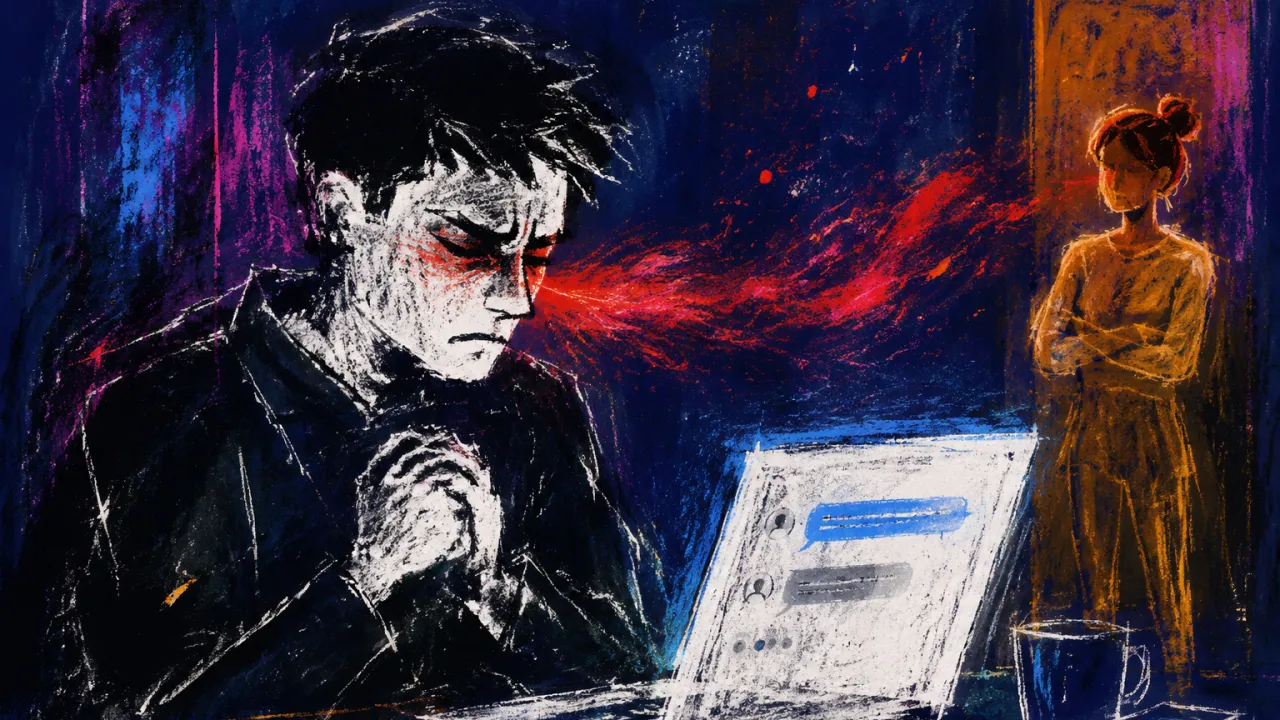
What is this really?
You answer a loaded email with “No problem,” keep your face steady through the meeting, then sound unexpectedly sharp when someone safer asks an ordinary question. You are trying to preserve a higher-stakes relationship, opportunity, or sense of control until the pressure can come out where the consequences feel smaller. Yet the anger you keep out of sight does not disappear: it takes over your jaw, tone, and timing around someone safer, leaving the original exchange untouched while a more trusted connection carries the impact.
Why did it happen?
Earlier, keeping your irritation off your face may have protected a relationship, job, social position, or sense of choice when answering back felt likely to bring consequences you could not comfortably absorb. Now the same unconscious loop keeps the original exchange quiet and waits for a lower-stakes moment to release the pressure, so your shoulders stay lifted, your chest feels busy, and someone safer receives the sharper edge.
How does it feel?
- In a meeting, someone rewrites your point and you press your lips together, nod once, and type “Sounds good” into the chat; later, when your roommate asks whether you took the trash out, your answer comes out clipped. In that second moment, your jaw may set and heat may gather behind your eyes before you notice the tone. You can let the reaction be present without deciding what it means yet.
- When a friend makes a joke that lands badly, you laugh half a beat late, smooth the cuff of your sleeve, and change the subject; later, a partner moves your charger and you correct them in quick, exact sentences. As the words speed up, your shoulders may rise and your chest may start buzzing. It is okay to notice the sensation without forcing it to settle.
- After a tense call, you place your phone face down, walk to the counter, and answer a barista’s routine question in single words while tapping your card twice. Your fingers may feel rigid, your palms warm, and your breathing shallow before you register how abrupt the exchange felt. A pause can stay incomplete; no immediate explanation is required.
- You read a dismissive message in a group chat, hold your thumb above the reply box, and send a neutral thumbs-up; ten minutes later, you type a sarcastic response to an unrelated low-stakes post and reread it before sending. Your eyes may stay fixed on the screen while your chest pulses and your hand hovers. The urge can remain unfinished for a moment, and uncertainty is allowed.
- After ending a difficult conversation with “That’s fine,” you line up the objects on your desk, refold a blanket, and restart a small task when one detail looks off. Even in the quiet room, your shoulders may remain lifted, your hands may move faster, and your chest may feel restless. You can simply register the movement; nothing has to be resolved in that moment.
Displaced Anger in Tarot Cards
When anger is held back with the person who triggered it and released around someone safer, you may recognize the jaw setting and heat gathering behind your eyes. Jungian archetypal theory offers one frame for this defensive redirection. The Tarot Cards below mirror the unconscious dynamics beneath that composed surface; here are the cards connected to the pattern.
Displaced Anger in Tarot Card Reading Insights
When the original exchange stays composed but a safer person receives the sharp edge, others have brought this Displaced Anger pattern into readings. Below are Tarot Reading Insights showing what surfaced when they sat with these cards.