Job Offer Halo Effect: A Drafted Yes Gave Way to One Scope Question

The 10:47 p.m. Job Offer Halo Effect
If you are a Toronto professional who has already drafted the acceptance text before opening the full attachment, the job offer halo effect may be doing more of the deciding than you think.
At 10:47 p.m. on a Tuesday, Jordan appeared in the square of my video call from their Toronto kitchen. The radiator clicked behind them. Blue laptop light sharpened the edge of an unopened role-expectations attachment, and their phone looked warm in their palm as they hovered over a half-written group-chat message: “I think this is a clear win.”
The title was stronger. The compensation could create real breathing room against Toronto rent. The company name would look polished beneath LinkedIn’s “celebrate a new position” prompt. Each time Jordan scrolled back to those lines, their chest rose as if a window had opened. Each time their cursor moved toward the attachment or the blank note titled “Questions Before I Decide,” their jaw set like a door quietly locking.
“What am I overlooking because this offer looks like a win?” they asked. Then they glanced at the group chat and added, “I’m already explaining why it’s a win before I’ve listed what it costs. I need to know whether I want the offer or the version of me it seems to confirm.”
I could feel the speed of the story they had been handed. Their excitement was like a cinema trailer turned up too loud: bright cuts of title, money, recognition, and forward motion, while the full feature—the ordinary Tuesdays, the launch weeks, the decision rights, the evenings—waited unlit behind it.
“Wanting the title, money, or recognition does not make you careless,” I told them. “It makes those benefits worth examining clearly. I’m not here to cool your ambition or tell you whether to accept. Let’s slow the trailer down, look at the production schedule, and draw a map through the parts that haven’t made the highlight reel.”
I made our shared goal explicit: this Journey to Clarity would not end with the cards taking control of Jordan’s decision. It would end with Jordan holding the pen.

Choosing the Compass: A Five-Card Pros & Cons Spread
I invited Jordan to place both feet on the floor, take one unforced breath, and read the question aloud once. I shuffled slowly. The purpose was not to perform mystery; it was to create a clean psychological transition between reacting to the offer and examining it.
I chose the classic five-card Pros & Cons tarot spread because Jordan did not need a sprawling prediction about their entire career. They needed the smallest useful structure for separating five things: the offer’s visible presentation, its genuine benefit, its practical cost, its overlooked psychological pull, and the evidence-based guidance that could integrate them.
For anyone wondering how tarot works in a career decision, I treat card meanings in context as prompts for disciplined attention. The cards do not know an employer’s secret intentions, and they do not replace due diligence. They help make the decision-maker’s current weighting visible: what has been enlarged, what has dropped below the fold, and what question has not yet been allowed into the room.
On my table, I placed the first card at the centre. The benefit would sit to its left and the cost to its right, forming two sides of a scale. The blind spot would hover above the centre, and the final guidance would rest below it like a grounding point. The horizontal line would compare gain with carrying cost; the vertical line would move from hidden attachment to accountable judgement.
I told Jordan that the first position would show why the offer already felt like a verdict. The third would translate its language into the workload of an ordinary week. The fourth would ask what made reasonable questions feel dangerous. The fifth would return the decision to Jordan’s own non-negotiables.
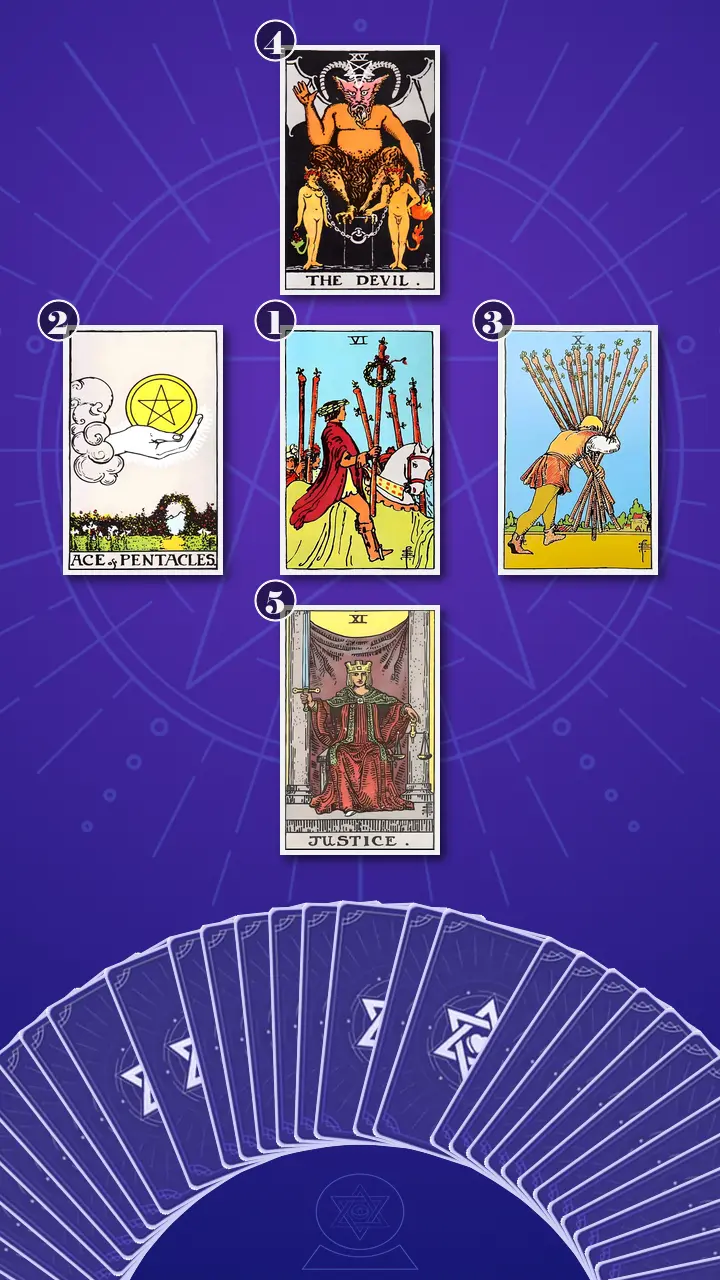
Reading the Headline Before the Fine Print
Position One: The Six of Wands and the Laurel Before the Calendar
“Now I’m turning over the card that represents the diagnostic knot,” I said, “the part of the decision where visible success signals have begun functioning as an initial verdict before the full terms have been examined.”
The card was the Six of Wands, upright.
The rider sat above the crowd with a laurel wreath on their head and another tied to the raised wand. In Jordan’s life, that scene was already playing through a modern screen: a stronger title, recognisable company, better compensation, imagined fire emojis from friends, and a LinkedIn announcement mentally drafted before the day-to-day conditions had been reviewed.
“The laurel is real recognition,” I said. “But it cannot tell us what the role feels like at 4:45 on a launch-day Tuesday. It tells us that the opportunity is attractive and socially legible. It does not yet prove fit.”
Energetically, I read the Six as Excess in the decision process—not an excess of ambition, but an excess of weight placed on public evidence. Jordan’s attention algorithm had learned which parts of the offer delivered the fastest emotional reward, so it kept serving those parts back to them while the less flattering terms fell below the fold.
I had a brief flash of my own work as an artist. A film trailer can contain only truthful images and still create an incomplete expectation through editing. The problem is not necessarily that anything shown is false. The problem is that sequencing can make one interpretation feel inevitable.
“A bright headline is evidence that an offer is attractive, not evidence that it fits,” I said. “When you first opened the email, what did you notice before anything else?”
Jordan did not nod. First their breath caught; then their eyes moved from the card to the unopened attachment; finally they let out a brief, bitter laugh. “The title, then the number, then exactly how I’d tell people,” they said. “That is painfully accurate. Almost rude.”
I smiled without softening the point. “Good tarot can feel precise, but it should never humiliate you. The Six is not accusing you of vanity. Recognition matters, especially when you have worked for it. We are only separating the applause from the contract so that both can be seen.”
Position Two: The Ace of Pentacles and the Value That Survives Verification
“Now I’m turning over the card that represents the offer’s strongest genuine benefit,” I said. “This position keeps scrutiny from becoming automatic rejection.”
The card was the Ace of Pentacles, upright.
A hand emerged from a cloud holding one pentacle above a cultivated garden. Beyond the flowered arch, a long path led toward distant mountains. I read the single coin as one concrete opening—not the whole future, not a guarantee, but something real enough to be tested.
In Jordan’s situation, the Ace translated into written, usable value: base compensation, confirmed benefits, a development budget, defined scope, resources, or authority that could materially improve daily life. It asked them to distinguish those terms from phrases such as “high visibility,” “huge growth potential,” or “fast-paced environment,” which might be promising but still needed operational definitions.
The Earth energy of the Ace offered Balance, but it had been underused. The deficiency was not necessarily in the offer; it was in the amount of grounded evidence currently present in Jordan’s review. An Ace is a seed. Its potential matters, but the surrounding conditions decide whether it grows or consumes every available resource.
“Which benefit would still matter to you six months after the announcement?” I asked. “And what written evidence would prove that it exists rather than merely being implied?”
Jordan looked down for several seconds. Their thumb stopped scrolling. “The money is real, and I don’t want to pretend it isn’t just because I’m trying to be thoughtful,” they said. “But the other thing I want is actual leadership scope. I don’t know if that part is real yet.”
“That distinction is the Ace doing its job,” I said. “We do not have to flatten the entire offer into good or bad. We can protect the genuine seed while checking whether the soil around it is workable.”
I asked Jordan to create two temporary columns in their blank note: Written and Verifiable, and Implied or Still Unclear. Their compensation moved into the first. Leadership scope remained in the second. Their shoulders did not fully relax, but the offer’s glow became more specific, which made it easier to look at without either worshipping or distrusting it.
Position Three: The Ten of Wands and the Tuesday Hidden Inside the Title
“Now I’m turning over the card that represents the strongest cost,” I said. “This position translates the offer into workload, responsibility, boundary demands, and opportunity cost.”
The card was the Ten of Wands, upright.
The figure carried all ten wands in one bundle. The town was close, but the load blocked their line of sight. I watched Jordan recognise the posture before I interpreted it; their shoulders rose slightly, almost matching the card.
I began translating the offer in a split-screen rhythm. High ownership on one side; recurring cross-functional meetings, ambiguous decision rights, and missed-deadline accountability on the other. Visibility on one side; preparation, stakeholder management, and emotional labour on the other. Flexibility on one side; the unanswered question of Slack responsiveness and availability outside Toronto hours on the other.
“The title is visible,” I said. “The Tuesday is the decision. Do not only ask what the offer gives you; ask what it will ask from you every week.”
The Wands energy had moved into Excess. The celebrated fire of the Six had accumulated until momentum became load. This did not mean Jordan was incapable of doing the work. It meant capacity had to be priced before capability was used as an excuse to ignore cost.
“Sometimes the private bargain sounds like, ‘I can carry it if it proves I deserve it,’” I said. “Does any part of that sentence belong to you?”
Jordan’s jaw clenched. Their breathing moved higher into their chest. “I’m already the person who turns everyone else’s mess into a launch plan,” they said. “I facilitate, smooth it over, chase the missing answers, and somehow become responsible for the date. I don’t always get to make the decisions.”
That disclosure gave me the right opening for a lens I call Workplace Typecasting Analysis. I use it to examine how an office ecosystem can repeatedly cast a capable person as the reliable supporting character: the one who translates, repairs, coordinates, and absorbs uncertainty while someone else retains authority and visibility.
“A leadership title can break that pattern,” I told Jordan, “or it can put better costume design around the same role. ‘High ownership’ could mean trusted autonomy with resources. It could also mean being handed every gap between Product, Sales, and leadership. We do not know which one this is yet. That uncertainty is not a red flag by itself; it is a question-shaped space.”
I asked what would verify the difference. Jordan looked at the role description and said, more slowly, “Which go-to-market decisions would actually be mine, which need approval, and who owns a miss when the delay starts outside Marketing?”
As they typed it, their shoulders stayed raised for a moment, then lowered by a fraction. One headline benefit now had a recurring cost attached to it—and, more importantly, a question capable of testing that cost.
Position Four: The Devil and the Question That Felt Forbidden
“Now I’m turning over the card that represents the overlooked psychological factor,” I said. “This is the part of the pattern where attachment to feeling like a winner may make ordinary limits or conditions harder to question.”
The card was The Devil, upright.
I placed it above the centre of the spread. At that moment, Jordan’s laptop dimmed from inactivity, and the bright offer page became a faint reflection of their face. The environment seemed to underline the card’s central distinction: what had looked like an external command might partly be an internal story reflected back.
I clarified immediately that The Devil did not prove deception, toxicity, or a secret trap in the company. In this position, it represented attachment—the salary as financial relief, the title as proof of forward movement, and the brand name as a public answer to every polished promotion post Jordan had watched while wondering whether they were falling behind.
The two figures on the card wore chains, but the loops were loose enough to remove. I read that as Blockage in agency: questions, negotiation, a pause, and a decline were still available, yet the identity attached to the offer made those options feel less available than they were.
“Imagine your hand hovering over the question, ‘How is performance evaluated?’” I said. “Then imagine deleting it and scrolling back to the salary line. The internal script is, ‘If I ask this, I might lose the win.’ But what exactly would you be losing: the role, or the identity attached to it?”
Jordan’s fingers froze above the keyboard. Their gaze lost focus as if I had triggered a replay rather than introduced a new idea. Then their stomach pulled inward, their shoulders released on a long exhale, and they said, “I deleted almost that exact question last night.”
I let the silence remain useful.
“I thought it would make me look difficult,” they continued. “Or like I wasn’t ready for a bigger role. And if they answered vaguely, I’d have to admit that the title might mean being the fixer again.”
“That is the loose chain,” I said. “The question is not whether you can make yourself accept it; the question is whether the terms deserve your consent. Asking does not cancel the achievement of receiving the offer. It separates the offer from the decision.”
Jordan rubbed their thumb once along the warm edge of the phone, then placed it face down. The imagined congratulations had not disappeared. They had simply stopped being the only voices in the room.
When Justice Moved the Spotlight
Position Five: The Scales, the Sword, and a Self-Authored Win
The radiator on Jordan’s side of the call stopped clicking. Somewhere beyond their kitchen, a Toronto streetcar bell sounded once, clean and distinct. I turned over the lowest card—the grounding point and the central antidote of the reading.
“Now I’m turning over the card that represents balanced integration,” I said. “This position shows how you can weigh evidence, consequences, and personal non-negotiables without outsourcing the decision to appearances.”
The card was Justice, upright.
Jordan was still holding the choice as if only two versions of them existed: the ambitious person who said yes quickly and the fearful person who spoiled a good opportunity. Justice offered a third role—the author who could require evidence before giving consent.
The figure sat between two pillars, holding balanced scales at eye level and an upright sword in the other hand. The scales kept the Ace of Pentacles and the Ten of Wands in the same frame. The sword turned a flattering assumption into one precise written question.
The win is not the offer that looks best from the outside. It is the offer whose benefits, obligations, and fit with your non-negotiables remain clear when the spotlight moves away.
I paused, then gave Jordan the sentence at the centre of the entire reading.
Do not let the laurel crown make the decision; name the costs, weigh the evidence, and let Justice's scales define what a win means for you.
Jordan stopped breathing for a beat. Their index finger hung above the trackpad, and their face went still; then their eyes shifted toward the blank note as if the previous week were replaying behind the screen. A quick flash of anger tightened their mouth. “But doesn’t that mean I’ve been doing this wrong—selling myself the win before I knew what it was?”
I did not hurry to convert resistance into relief. “No. It means excitement got the first edit. You still control the final cut.”
Their pupils widened. The shine in their eyes gathered without spilling. One hand slowly opened against the table, their shoulders dropped, and a long breath left them with a slight tremor. “Oh,” they said. “I thought scrutiny would cancel the win. It might be how I find out whether it is one.” A small, almost embarrassed laugh followed, then a moment of blankness that felt newly vulnerable rather than lost. “If the answer is bad, I’ll have to choose.”
“Yes,” I said. “And your choices still include an enthusiastic yes, a negotiated yes, a pause, or a no. Justice does not choose for you.”
I invited them, “Now, using this new perspective, think back to last week. Was there a moment when this insight could have made you feel different?”
Jordan remembered the recruiter describing the role as “high ownership.” They had smiled, said it sounded exciting, and moved on without asking who held decision authority when departments disagreed. “I could have stayed excited and still asked,” they said. “Those weren’t mutually exclusive until I made them that way.”
I was watching the first measurable step from excited certainty and externally reinforced urgency to grounded confidence in a self-authored job-offer decision. It was not total certainty. It was the return of a choice that had briefly felt compulsory.
Justice carried the energy of Balance: impartial discernment, accountability, consequences, and standards authored by the person who would actually live the role. Its balance was not emotional flatness. Jordan could want the money, enjoy the recognition, and hope the offer worked. Justice only required those desires to sit beside the evidence rather than on top of it.
I then used my Leadership Narrative Construction lens. I explained that professional identity is not rewritten merely by placing “Lead” or “Head of” in a LinkedIn headline. A leadership narrative becomes real through decision rights, named ownership, usable resources, visibility attached to authority, and boundaries that prevent strategic responsibility from becoming endless support work.
“Justice is editing the role description at the level that matters,” I said. “Not to make you sound more impressive, but to make the exchange structurally honest. If this role is meant to move you from the backstage fixer to a visible decision-maker, the offer should be able to name the authority, support, and limits that make that shift possible.”
Jordan read back the thought they had typed into their note: “I don’t need to make this look like a win for anyone else. I need to know whether the exchange is fair by my criteria.” Their voice was quieter than it had been at the start, but it no longer rushed.
For the next ten minutes, I asked them to write only three lines: one benefit, one recurring cost that benefit might require, and one question that could verify the exchange. I reminded them that they did not have to decide during the exercise, send the question, negotiate, or continue if the process became too activating. One line was enough. The choice about what happened next remained theirs.
They wrote: Benefit—leadership scope.Possible recurring cost—cross-functional accountability without matching authority.Question—which go-to-market decisions would I own, which would require approval, and who would own delays outside Marketing?
“That feels less like spiralling,” Jordan said, looking at the three lines. “It feels answerable.”
The Justice Offer Audit: Turning Insight into Next Steps
The Story the Five Cards Told
I drew the spread together as one continuous sequence. The Six of Wands showed why the offer arrived as a public victory before it became a private evaluation. The Ace of Pentacles confirmed that real material value could exist inside that glow. The Ten of Wands translated advancement into recurring labour. The Devil exposed the attachment that made questioning feel like self-sabotage. Justice restored a standard independent of applause.
The deeper story resembled the difference between a trailer and a production schedule. Jordan had not been foolishly seduced by a fake image; they had been watching the most rewarding edit on repeat. Their current workplace experience had also taught them to be effective by absorbing gaps, so a more senior title carried the promise of finally escaping a supporting role. That promise made it harder to ask whether the new ecosystem would actually cast them differently.
I also pointed out the elemental pattern. Fire opened the reading as celebrated momentum and reached saturation in the Ten of Wands. The Ace supplied the only suit-based Earth. No Cups and no suit-based Swords appeared, suggesting that emotional motives and precise analytical dialogue would not enter the decision automatically. Jordan had to add them deliberately: What am I trying to prove? and What information do I still need to request?
The cognitive blind spot was not ambition. It was treating positive framing as evidence and treating scrutiny as a threat to the opportunity. The transformation direction was equally precise: test every meaningful promised benefit against one written non-negotiable, one recurring cost, and one clarifying question.
“An offer is a win when its benefits, obligations, and fit can all be named without looking away,” I said. “That definition can still lead to yes. It can also lead to a negotiated yes, a pause, or a no. Our work is to improve the quality and ownership of the decision, not force its outcome.”
Jordan glanced at the response deadline. “I don’t have the energy to build a giant comparison spreadsheet tonight.”
“Good,” I said. “I don’t want one. No colour coding. No immaculate Notion dashboard. Clarity should not become a second job.”
Three Small Moves Before the Reply
- Run the ten-minute Justice Offer Audit. Before replying to the recruiter, open one plain-text document and add five headings: verified benefits, recurring costs, non-negotiables, unanswered questions, and reversibility. Put one bullet under each, then label every major term as confirmed in writing, implied by conversation, or unknown. Tip: Stop after one benefit, one cost, and one question if that is all you have capacity for. The audit is for informed choice, not for proving that the offer is bad.
- Use the Ordinary Tuesday Test. Set a 12-minute timer and translate three headline phrases into weekly realities. Turn “high ownership” into decision rights, meetings, and missed-deadline accountability; “visibility” into preparation and stakeholder exposure; and “flexibility” into actual hours and response expectations. Send the employer one neutral question: “What does a normal week look like outside a launch period, and how often does that change?” Tip: Save the answer beside the relevant term. If the answer is vague, record the vagueness rather than completing the picture with an optimistic assumption.
- Try the Protagonist Reframe Directive. In the next cross-departmental meeting or employer follow-up call, speak within the first ten minutes without apologising for needing clarity: “To assess the leadership scope, I need to understand the decision rights. Which decisions would I own, which would need approval, and who owns a miss across teams?” Ask the question once, then let the silence hold. Tip: If saying it live feels too activating, send the same wording by email. One precise question is enough to interrupt the old supporting-role script.
I told Jordan to notice not only what the employer answered, but how the structure responded to being questioned. A clear answer would create useful evidence. A vague answer would also create useful evidence. Neither response would make the decision for them, but both would be more informative than another hour spent rereading the salary line.

Four Days Later: The Quiet Proof
Four days later, Jordan messaged me: they had sent the scope question, requested 48 hours, and slept through the night. Their first morning thought was still, What if I lose it? “But this time,” they wrote, “I smiled, made coffee, and opened the whole attachment.”
I did not read that message as proof that tarot had uncovered a hidden truth about the employer. The cards had externalised Jordan’s attention pattern, connected intuition with evidence, and provided a structure sturdy enough to hold both excitement and scrutiny. Jordan created the movement by using that structure.
That, to me, is how a five-card Pros & Cons tarot spread can support finding clarity. It does not predict the perfect job-offer decision. It moves the laurel, the seed, the burden, the chain, and the scales into one visible frame so the person living the consequences can choose with open eyes.
I had not handed Jordan a verdict. I had handed back the pen. Their next act was still in production, and that was precisely why it could belong to them.
If an offer makes your chest lift and your jaw tighten at the same time, I want you to remember that you may be standing between the visible win and the private cost—not because you are incapable of deciding, but because part of you wants the decision to remain yours. Simply moving the spotlight is already movement.
If you let Justice take the offer out of the Six of Wands spotlight—without asking the title, salary, or announcement to prove anything about you—which one benefit would you feel curious enough to verify first?