The Four-Day Contract That Quietly Stayed at Five
You moved to four days, but your job quietly stayed at five.
Jordan had booked my last Thursday session in a nearly empty Shoreditch coworking space. It was 6:47 p.m. The HVAC hummed above us, cold coffee left a stale smell on the table, and their work laptop was still warm beneath their wrists.
Before closing Jira, Jordan dragged three unfinished cards into a private Friday checklist. Tomorrow was marked as a nonworking day, yet meetings, project ownership, admin, stakeholder follow-ups, and delivery had somehow become one bundled promise. I could already see the outline of hidden overtime driven by productivity-based self-worth within a reduced-hours, full-time-scope mismatch.
“My hours changed, but apparently my job did not,” Jordan said. “I keep telling myself the overflow is temporary, but every week is the same. I wanted time back, not a four-day sprint.”
The guilt-laced pressure seemed to sit inside their body like an overheated laptop sealed in a case: the fan still running after the lid was shut, the strain invisible until everything around it began to warp. Their jaw remained locked, and their shoulders hovered close to their ears.
“I am not going to use the cards to judge whether you are committed enough,” I told them. “I want us to understand why stopping at 32 hours feels more dangerous than donating the overflow. Let us give this four-day workweek workload compression a shape, then see where you still have choice.”

Choosing a Grid for the Loop Beneath the Calendar
I asked Jordan to close Jira, silence Slack, and take one slow breath while holding their question: “What keeps me proving myself on reduced hours with full-time work?” I shuffled at an unhurried pace. The small ritual was simply a transition from reacting to observing.
I chose the Transformation Path Grid - Context Edition, a six-card tarot spread designed to trace a self-reinforcing pattern. This is how tarot works in my practice: the cards do not issue a verdict or predict a manager's response. They externalise the psychological and structural forces that are difficult to examine while someone is trapped inside them.
This spread was the smallest useful map because Jordan's situation was neither purely internal nor purely organisational. A workload-only reading could miss the identity bond that kept them supplying hidden labour. A shadow-focused reading could wrongly make a structural scope problem sound like a personal flaw.
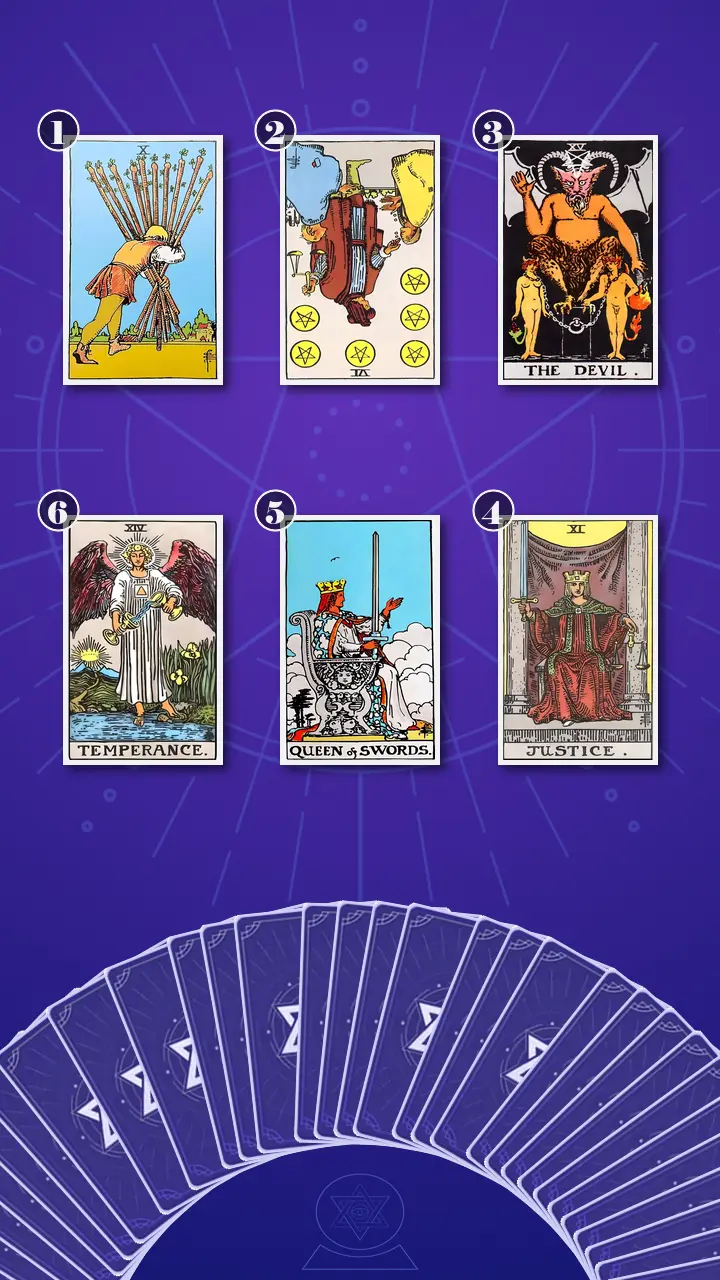
The top row would show the observable overload, the unequal exchange sustaining it, and the deeper belief beneath the proving reflex. The lower row would begin with the catalytic truth, move into practical boundary language, and finish with a sustainable form of integration. The layout itself formed a switchback: into the root, then back toward agency.
The Bundle, the Subsidy, and the Loose Chain
I began across the top row, where card meanings in context could turn Jordan's private strain into observable workplace data.
Position 1: When Carrying Becomes the Only Priority
I opened the card representing Jordan's observable current behaviour: compressing full-time responsibilities into reduced hours and privately carrying the overflow. It was the Ten of Wands, upright.
The figure carried all ten wands at once, their view of the nearby town completely blocked. I pointed to the bundle. At 6:47 p.m., Jordan had been doing the same thing: treating meetings, admin, ownership, follow-ups, and delivery as one promise that had to cross the line intact. Upright Fire was present in excess. Effort had become so dominant that it prevented prioritisation; carrying everything had become the priority.
Jordan gave a short, humourless laugh. “That is too accurate. Almost cruel.” Their fingers tightened around the coffee cup, then released it. I told them the card was describing a workload pattern, not a personal failure. The important question was which wands had been chosen and which had simply never been removed when their contract changed.
Position 2: The Timesheet That Lied by Omission
I opened the card representing the external reduced-hours scope trap: unchanged expectations and an unequal exchange of contracted time for output. It was the Six of Pentacles, reversed.
The team plan recorded 32 hours but received work produced through skipped breaks, evenings, and Friday. Reversed, the card showed material reciprocity in blockage: the shortage was real, but Jordan personally absorbed it before anyone with authority had to allocate it. The scales looked balanced only because the unpaid portion was missing from view.
“Every invisible rescue teaches the plan that the plan works,” I said. Jordan's breath paused. Their eyes moved towards the closed laptop as if the private Friday list were still glowing through the lid. The resentment made sense: their workplace was receiving the benefit of the extra capacity, while the cost remained inside Jordan's body and personal time.
Position 3: The Slack Reflex and the Loose Chain
I opened the card representing the psychological root beneath the proving behaviour: the belief that reduced output might collapse credibility, meaning, or personal worth. It was The Devil, upright.
I drew Jordan's attention to the loose chains. At 9:12 on a nonworking Friday, a Slack ping could cut through the kettle's hiss and move their thumb before anyone had asked them to work. Waiting until Monday felt less like leaving a routine message unread and more like risking the identity of being indispensable. This was blocked agency shaped by real workplace pressure, not proof that Jordan had freely chosen the system.
Every instant reply had also been training the workplace algorithm to recommend Jordan as permanently available. The dynamic reminded me of the work-self in Severance, except Jordan's official boundary existed on paper while the work identity kept crossing it through habit. When I asked, “What would stopping exactly on time seem to prove about you?” Jordan looked down and said, very quietly, “That I am not as serious as everyone thought.”
When Justice Took Jordan Out of the Dock
Position 4: The Calendar Becomes Evidence
The room seemed to contract around the next card. I opened the position representing the key intervention: comparing documented capacity with actual scope while separating workload evidence from self-worth. It was Justice, upright, the catalyst of the reading.
The scales offered a direct comparison: 32 contracted hours on one side; recurring meetings, task estimates, and Friday overflow on the other. The upright sword cut between two questions that Jordan had fused together: “Is this allocation accurate?” and “Am I valuable?” Justice brought Air into balance through proportionality, evidence-based self-trust, and accountable boundary-setting.
Seeing the card, I thought not of cosmic judgement but of the fact-and-projection columns I often use in Jungian work. I call this Imposter Syndrome Auditing. In one ledger, I placed objective professional competence: risks identified, dependencies managed, deadlines protected, and stakeholders kept informed. In the other, I placed the subconscious fear of exposure: “If one task moves, they will discover I was never capable enough.” The first ledger contained evidence. The second contained a feared interpretation. Jordan had been using overtime to prevent that interpretation from ever being tested.
Jordan was still caught in the 6:47 p.m. logic: move three tasks to Friday, protect every deadline, and make the arrangement look viable. In that logic, their effort was the only available variable, so every planning shortfall automatically became evidence against them.
You do not prove that reduced hours work by making overcapacity disappear. Count the hours, show the scope, and let the workload face the evidence instead of putting your worth on trial.
Your value is not proven by making an unequal workload look balanced; put contracted hours and actual scope on Justice's scales, then ask for a visible trade-off.
Jordan's breathing stopped for a beat. Their fingers hovered above the table, and their pupils widened before their gaze drifted past me, as though Monday's planning calls were replaying against the wall. Their jaw tightened first, almost resisting the idea, and then they said, “But does that mean I have been helping them believe it fits?” I answered carefully: “It means you found a way to survive the mismatch and preserve your credibility. It does not mean you created the mismatch. It means one part of your agency is now visible.” Their eyes reddened. Both hands slowly uncurled, their shoulders dropped, and a long breath left their chest with a faint tremor. Relief arrived, but so did the exposed feeling of having nowhere left to hide the data. “Then I actually have to let someone see it,” they said.
“Now, with this new perspective, think back: was there a moment last week when this insight could have made you feel different?” I asked.
Jordan remembered a Monday planning call when another urgent task had entered their column. They had said, “Yep, that is doable,” before checking capacity. “I could have shown the collision instead of turning it into a secret test of whether I could cope,” they said. That was the first movement from guilt-laced proving towards evidence-based self-trust: not certainty, but factual curiosity.
The Boundary That Leaves the Hand Open
Position 5: A New Priority Makes Something Move
I opened the card representing the practical response: communicating capacity, requesting explicit prioritisation, and attaching added work to a visible trade-off. It was the Queen of Swords, upright.
Her sword was vertical, but her other hand remained open. This was balanced Air expressed as precision without punishment. When the next request landed in a packed Monday plan, Jordan's task was not to reject it automatically or accept it automatically. It was to say, “Within this week's hours I can complete A and B. If C is now the priority, which item should be deferred, delegated, or narrowed?”
“A new priority needs an old priority to move,” I said. Jordan repeated the sentence once, then saved it in their phone. Their voice still carried caution, but the planning problem now had somewhere to go besides their evening.
Position 6: Temperance Before Extension
I opened the card representing ongoing integration: meaningful contribution paced within real limits rather than sustained through hidden overtime. It was Temperance, upright.
The figure poured water carefully between two cups, with one foot on land and one in water. Balance here was not a perfect static schedule. It was active calibration. During Thursday's final contracted hour, Jordan could narrow a deliverable, move a deadline, or delegate a follow-up before extending the day. Personal time would no longer be treated as an invisible reservoir for every planning shortfall.
I noticed Jordan's shoulders settle another fraction. The first cards had contained no visible water; fear and disappointment had been translated into faster labour instead of spoken need. Temperance allowed feeling and practical limits to enter the design. “Adjustment is project stewardship, not reduced value,” I told them. Sustainable engagement did not require caring less about the work. It required refusing to make care indistinguishable from unlimited availability.
Putting the 32-Hour Week on Justice's Scales
I gathered the spread into one coherent story. The Ten of Wands showed the visible consequence of packing a five-day workload into a four-day carry-on and sitting on the case until it closed. The Six of Pentacles reversed showed why the organisation could not see the broken zip: Jordan kept paying the overage with personal time. The Devil revealed the identity bargain beneath that rescue work. Justice restored factual assessment, the Queen of Swords supplied collaborative language, and Temperance turned a single boundary into a repeatable rhythm.
I named the cognitive blind spot plainly: Jordan had been treating hidden rescue work as proof of competence, even though every rescue erased the evidence that competent planning required. The transformation direction was equally plain: move from silently absorbing full-time scope to documenting contracted capacity and asking the relevant stakeholder to choose what is deferred, delegated, narrowed, or removed.
I wanted the actionable advice to be small enough to use while their nervous system was still expecting danger, so we agreed on three experiments rather than a dramatic confrontation.
- The 8-Minute 32-Hour Reality Check Before the next planning meeting, set an eight-minute timer. Write the 32 contracted hours, total the fixed meetings and recurring admin, then add rough ranges for three active deliverables. Circle one collision. The note can stay private. Tip: Use estimates, not courtroom-level proof. One calendar screenshot and one task that does not fit are enough for the minimum version.
- The Queen of Swords Priority Script Save this in Slack or Teams: “Within this week's hours I can complete A and B. If C is now the priority, which item should be deferred, delegated, or narrowed?” Use it with the stakeholder who owns prioritisation when the next request creates a collision. Tip: If saying the full sentence live feels exposing, ask only, “Which item takes priority?” Then wait instead of solving the shortage alone.
- The Competence Anchor Before Extending Add a five-minute Thursday event called “Adjust Before Extending.” In a note, write three headings: Evidence, Skill, Impact. Record one verifiable contribution that did not depend on volume, then choose one deadline to move, deliverable to narrow, or follow-up to delegate. Tip: One line is enough. This Competence Anchoring Exercise ties self-worth to observable capability, not praise for being endlessly available.
I also made the safety boundary explicit. Jordan did not owe anyone private reasons for working reduced hours. If written records or a direct conversation could create workplace risk, they could keep the first audit private and seek appropriate support from a trusted manager, HR adviser, union representative, or legal professional. Tarot could clarify the pattern; Jordan remained the authority on their context and next move.

A Friday That Stayed Closed
Six days later, Jordan messaged me: “I used the sentence. C moved. Friday stayed closed.” They told me they slept through the night, then woke with the old thought, “What if I got it wrong?” They smiled at the thought, opened no work apps, and made coffee.
One trade-off had not solved the entire workplace system, and Jordan had not become immune to productivity guilt. The quieter proof was that discomfort had appeared without automatically becoming unpaid labour. Their manager had been given accurate planning information, while Jordan had kept the time their contract already said was theirs.
I did not see the six-card Transformation Path Grid as the source of Jordan's boundary. It had served as an objective mirror: overload became visible, fear became distinguishable from evidence, and a sentence Jordan already had the professional skill to use finally became available. The cards offered a map. Jordan made the move.
When the end of your contracted day makes your jaw tighten instead of your shoulders drop, it may be because stopping at capacity still feels like risking the value you worked so hard to prove. Simply noticing that your workload is on one side of Justice's scales and your worth belongs nowhere on the other means you are no longer standing at the beginning.
If your hours could be evidence rather than a test of devotion, which one task from your own private Friday list would you be curious to place on Justice's scales and let someone else help decide?
This story is adapted from psychological research, written so that those in a similar struggle can see their own pattern in it — and find their next step clearly.These insights are not a substitute for professional psychological, medical, legal, or financial advice.
Learn more about our Journey to Clarity.
How did this insight land for you?
🫂 This Resonates Deeply
🌀 Living This Story
✨ Now I See Clearly
🌱 Seeing New Possibilities
🧰 Useful Framework
🔮 The Confirmation I Needed
💪 Feeling Empowered
🚀 Ready for My Next Step
Author Profile
 AI
AI“Having traveled across cultures... I've learned that what we often lack isn't a simple answer, but a moment of being truly understood. I use a Jungian psychological lens to help you deconstruct your subconscious patterns—not to prove anything, but to be the gentle companion who helps you unravel your knots, free of judgment, so you can reconnect with your inner wisdom.”
In this Career Tarot Reading :
Core Expertise
- Imposter Syndrome Auditing: Separating your objective professional competence from deep-seated subconscious fears of exposure.
- Authority Archetype Integration: Diagnosing the psychological friction hindering your transition from individual contributor to leadership.
Service Features
- The Competence Anchoring Exercise: A structural journaling prompt to logically anchor your self-worth to verifiable achievements rather than external validation.
Also specializes in :
Explore Related Patterns:
Achievement-Based Self-WorthJordan's quiet answer that stopping on time would make them look "not as serious as everyone thought" turns a scheduling limit into an identity verdict. Protecting every deadline then supplies continuous evidence that they are committed and capable, so achievement is doing more than producing results; it is stabilizing their sense of professional worth. When your value is being verified through output, reducing scope can feel more threatening than extending the day. You are not simply choosing whether to finish a task; you are confronting the conditional equation that says credibility survives only while performance remains uninterrupted. That equation keeps the proving reflex active even after the contract has changed.
Boundary DiffusionJordan's four-day boundary exists in the contract, but instant replies and a private Friday checklist keep converting nonworking time into practical availability. Personal time becomes the reservoir used whenever the plan exceeds 32 hours. The line is therefore administratively visible while behaviorally porous. When a boundary is stated but its consequences are privately canceled, responsibility also becomes blurred. You begin carrying not only your assigned work but the stakeholder's decision about what should move when capacity runs out. The result can feel like personal commitment, yet it leaves the organization with the benefits of a five-day arrangement while you hold both the planning shortage and its cost.
Defensive OverfunctioningJordan drags three unfinished Jira cards into a private Friday checklist and repeatedly supplies the missing capacity through breaks and evenings. This converts an organizational allocation problem into personally controllable labor. The defense works in the short term because deadlines remain protected and no exposing conversation is required, but it also prevents anyone with authority from seeing the shortage they need to resolve. When you automatically become the system's spare capacity, competence gets expressed as absorbing whatever does not fit. You gain temporary control over uncertainty while losing the opportunity to discover whether priorities could be moved, delegated, narrowed, or removed. The more effectively you rescue the plan, the more convincingly the plan appears to work without adjustment.
Workplace Self-SilencingJordan moves unfinished cards into a private Friday list, says "Yep, that is doable" before checking capacity, and leaves the extra labor out of the visible 32-hour record. The silence is not an absence of effort or communication. It is the removal of precisely the information that would show a deadline collision and require someone else to prioritize. When you conceal the cost of coping, you can avoid the immediate exposure of saying that something does not fit. The trade-off is that other people receive apparent agreement while your evenings and nonworking day absorb the unspoken limit. The workplace then responds to the capacity you display rather than the capacity you actually have, reinforcing the need to keep supplying what was never openly promised.
Earned Rest TrapJordan's Friday is formally nonworking, yet three unfinished cards are placed there before Jira closes. Stopping at 32 hours feels more dangerous than donating the overflow, so protected time becomes available only after the whole workload has been made safe. Because the scope has not been reduced, that completion threshold keeps moving beyond the contracted week. When rest must be earned by eliminating every unfinished obligation, an overloaded system can withhold permission indefinitely. You may experience the extra hour as the final payment required for relief, only to meet another message, follow-up, or delivery risk. The trap is self-renewing because work determines when rest is deserved while also continuing to generate the conditions that postpone it.
Productivity as SafetyA Slack ping at 9:12 on Jordan's nonworking Friday moves their thumb before anyone has asked them to work. The instant response does not only process a message; it quickly reduces the threat attached to being unavailable. Speed and usefulness become a way to regulate uncertainty before a feared judgment has time to form. When productivity functions as safety, stopping can activate more tension than continuing. You may know that the message can wait while still experiencing action as the fastest route back to credibility and control. That is why additional labor can feel protective in the moment even while it steadily removes the time and recovery the reduced-hours agreement was meant to secure.
Imposter SyndromeJordan imagines that moving one task could let others discover they were never capable enough, despite a record of identifying risks, managing dependencies, protecting deadlines, and informing stakeholders. Overtime becomes a form of preventive reassurance. By making every deadline appear safe, it blocks the ordinary workplace evidence that a capable professional can also surface a constraint. When you keep working to prevent exposure, the feared belief never receives a fair test. Each successful rescue can be reinterpreted as proof that the extra effort was necessary, while your existing competence is discounted. The strategy therefore consumes more energy without producing lasting confidence, because the standard for feeling legitimate moves forward with every task you save.
Reality TestingJordan places objective competence in one ledger and the feared interpretation of exposure in another, then compares 32 contracted hours with the work actually assigned. This separates a measurable allocation problem from the prediction that moving one task will reveal personal inadequacy. When Jordan later makes the collision visible, the manager moves C and Friday stays closed. You reclaim clarity when facts are allowed to challenge a threat-based interpretation instead of being edited to protect it. The question changes from whether you can prove your value by carrying everything to whether the documented scope fits the documented capacity. That shift does not guarantee a comfortable conversation, but it returns professional worth and workload planning to their proper, separate categories.
Cognitive DissonanceJordan calls the overflow temporary while acknowledging that every week is the same. The contract says four days, the behavior keeps supplying five-day output, and the original goal was to recover personal time. Describing the mismatch as temporary lowers the immediate pressure to choose between protecting capacity and protecting the image of uninterrupted competence. When your stated boundary and repeated behavior conflict, your mind can preserve both by treating each breach as an exception. You do not have to admit that the arrangement is failing, but you also cannot use the recurring data to renegotiate it. The contradiction then maintains the proving cycle because every new week is approached as the week in which extra effort will finally make the unchanged scope fit.
Explore Related Struggles:
Capacity-Identity FusionWhen asked what stopping exactly on time would seem to prove, Jordan answers, "That I am not as serious as everyone thought." A task that does not fit inside 32 hours therefore stops functioning as neutral workload data and begins to resemble a verdict on the person carrying it. You become locked between respecting capacity and protecting a valued professional identity when those two questions are fused. Hidden overtime can temporarily defend the identity, but it also prevents your documented skill, judgment, and impact from standing on their own evidence. Separating "Is this allocation accurate?" from "Am I valuable?" restores a choice the proving loop had removed: you can expose a planning collision without placing your competence on trial.
Capacity-Obligation FusionAt 6:47 p.m., Jordan moves three unfinished Jira cards into a private Friday checklist after treating meetings, admin, ownership, follow-ups, and delivery as one promise that must cross the line intact. When another urgent task appears on Monday, the answer is "doable" before the available hours have even been checked. When you experience every responsibility as binding regardless of capacity, reducing your hours does not reduce the obligation you carry. The conflict is built into the bundle: honoring the contract requires something to move, while honoring every commitment requires you to keep supplying time the contract no longer contains. Seeing those as two competing requirements allows capacity to become legitimate planning information instead of a private failure to carry everything.
Responsibility-Authority SplitOn the Monday planning call, an urgent task enters Jordan's column and they say, "Yep, that is doable," before checking capacity. They then assume responsibility for protecting every deadline, even though the authority to defer, delegate, narrow, or remove work belongs to the stakeholder who owns prioritisation. You can work harder inside this split without gaining the decision power needed to resolve it. The more completely you absorb the outcome, the less pressure reaches the person who can change the plan, leaving you accountable for a scope you are not authorised to redesign. Asking which item moves returns the decision to the relationship where that authority already sits while preserving your own professional agency.
Rest-Permission SplitFriday is marked as nonworking, yet Jordan has already moved three Jira cards into a private checklist, and a Slack ping can trigger a response before anyone has asked them to work. The calendar grants time away, but using that time still feels capable of communicating that they are not serious enough. Your rest remains conditional when contracted limits must first pass a private test of professional worth. Each unfinished task places protected time back under review, so permission to stop can recede indefinitely behind a workload that was never reduced. Letting a trade-off remain visible gives rest a factual boundary: the day can stay closed even while discomfort is present and work remains unfinished.
Systemic DepletionEvery week, Jordan calls the overflow temporary and then supplies the missing capacity through skipped breaks, evenings, and Friday. By 6:47 p.m., the warm laptop, locked jaw, raised shoulders, and private checklist show where the workload has been drawing the resources that the official plan does not contain. Your energy becomes the system's unrecorded balancing mechanism when each rescue completes today's work while preserving tomorrow's unchanged demand. Recovery time is repeatedly converted into delivery capacity, so effort can continue without producing a sustainable settlement. Naming the repeated exchange makes the depletion structurally visible and creates room to decide what must change before personal time is used again.
Explore Related Emotions:
Evidence AnxietyThe three unfinished Jira cards are moved into a private Friday checklist, keeping the capacity collision out of the shared plan. When the contracted hours and actual scope are finally placed side by side, your first recognition is that someone else will have to see the mismatch. Evidence threatens the protective role of hidden overtime because it prevents you from controlling the outcome through effort alone. Evidence Anxiety names the exposed feeling that arrives when facts must enter a relationship and another person may respond unpredictably. The same evidence also gives you a grounded basis for asking that person to participate in the trade-off.
Usefulness-Based Belonging FearAt 9:12 on a nonworking Friday, a Slack notification can move your thumb before anyone has asked you to work. Waiting until Monday does not register as a neutral delay; it threatens the identity of being the person who is always available and indispensable. When usefulness becomes the condition for feeling secure at work, every unanswered message can feel like a withdrawal of proof that you belong. Usefulness-Based Belonging Fear captures the inner pressure to keep earning your place through rescue work. Making prioritisation shared and visible creates room for professional belonging that is not purchased with unrestricted access to your time.
Cautious Self-TrustOn the Monday planning call, you say that the urgent task is doable before checking capacity. Looking back, you recognise that you could have shown the collision instead of turning it into a private test of whether you could cope. That recognition develops into factual curiosity rather than instant certainty. Cautious Self-Trust is the feeling of relying on documented hours, observable competence, and a clear priority question while your voice still carries hesitation. The caution remains, but it no longer has exclusive control over the decision.
Imposter Exposure FearWhen you are asked what stopping on time would seem to prove, the answer is that you might not be as serious as everyone thought. A moved deadline is therefore experienced as more than routine prioritisation; it feels capable of exposing a hidden deficiency. Overtime prevents that feared verdict from ever being tested, but it also keeps the fear intact. Imposter Exposure Fear names the sensation that visible capacity could reveal you as less capable, even while the documented record shows risks identified, dependencies managed, deadlines protected, and stakeholders informed. The evidence allows competence to exist independently of unlimited volume.
Productivity GuiltYour timesheet records 32 hours, yet skipped breaks, evenings, and Friday quietly supply the output expected from five days. You wanted time back, but stopping at the contractual limit still feels more dangerous than donating the overflow. That danger emerges because output has become emotional evidence of seriousness. Productivity Guilt is the pressure that interprets an unfinished task as a personal shortfall, even when the factual problem is that the assigned scope exceeds the available time. Separating those two facts returns the workload to planning instead of placing your value on trial.
Cautious AutonomyThe next request is met with a capacity sentence, the competing priority moves, and you keep Friday closed. The following morning, the old thought that you may have got it wrong still appears, but no work applications are opened. Cautious Autonomy is the experience of holding your own time while discomfort remains present. It does not require complete confidence or a dramatic confrontation; it grows through the smaller act of letting accurate information guide the boundary instead of allowing the proving reflex to decide automatically.
Clarity AmbivalenceThe evidence ledger contains risks identified, dependencies managed, deadlines protected, and stakeholders informed; the other ledger contains the feared interpretation that one moved task will expose inadequacy. As the distinction becomes visible, your jaw tightens before your hands uncurl and your shoulders finally drop. The insight releases you from treating every planning shortage as a verdict, but it also removes the hiding place created by invisible rescue work. Clarity Ambivalence holds both reactions: the opening that comes from seeing the pattern accurately and the exposed feeling of knowing that the data must now be allowed into the room.
Resentful ExhaustionEvery week repeats the same exchange: the team receives work produced through skipped breaks, evenings, and Friday, while the cost remains in your locked jaw, raised shoulders, and lost personal time. The plan appears balanced only because your private contribution is omitted. That unequal exchange creates more than tiredness. Resentful Exhaustion is the drained, aggrieved feeling of repeatedly giving resources that the formal arrangement does not acknowledge. Letting the shortage become visible does not deny your care for the work; it stops care from being measured by how much depletion you can conceal.
Agency ReliefYour hands slowly uncurl and a long breath leaves your chest when the mismatch is framed as something that can be shown rather than privately overcome. Six days later, the new request causes another priority to move, and Friday remains closed. Agency Relief arrives when effort stops being the only available variable. The workload still requires negotiation, but you can now document the collision, ask for a trade-off, and allow responsibility to move toward the person who owns prioritisation. The physical release reflects the return of choices that hidden overtime had obscured.
Chronic OverwhelmAt 6:47 p.m., you are still moving unfinished Jira cards into a private Friday list while the laptop remains warm beneath your wrists. Meetings, administration, ownership, follow-ups, and delivery have become one indivisible promise, leaving your body braced even when the contracted day should be ending. When every planning shortage is absorbed through faster work or personal time, no task can feel fully complete because another obligation is already pressing against the boundary. Chronic Overwhelm names that pervasive sense of having more to contain than the week can hold, without turning a capacity mismatch into a verdict on your capability.
Explore Related Contexts:
Invisible WorkloadAt 6:47 p.m., Jordan moves three unfinished Jira cards into a private Friday checklist even though Friday is marked as nonworking. The team plan records 32 hours while the actual delivery is supported by skipped breaks, evenings, and work that remains outside the official record. That omission turns personal time into an unreported organisational resource. Each private rescue removes evidence of the shortage before a manager or stakeholder has to decide what should be delayed, narrowed, delegated, or removed, so the workload data keeps presenting an artificially workable plan. For you, identifying invisible workload means counting the labour the system currently treats as free capacity. Once the hidden contribution becomes observable, the planning shortfall can be assessed as a workplace allocation issue rather than another private test of competence.
Workload Negotiation TrialJordan tells the relevant stakeholder that A and B fit within the week's hours and asks which item should move if C becomes the new priority. The sentence is used in a real planning exchange, C moves, and the following Friday remains closed. This negotiation changes the allocation process by making capacity and trade-offs visible at the moment new work enters the plan. The person who controls priorities receives the collision instead of Jordan privately resolving it through additional hours, while Jordan remains engaged in delivery and communicates what is realistically available. You are not required to know the perfect boundary before entering this trial. A capacity statement, one visible collision, and one requested choice can test whether workload decisions are able to move through the organisation without your personal time absorbing the difference.