Chasing Closure After an Argument: Letting Repair Have a Pace

The Read Receipt: Pushing for Closure Before the Conflict Cools Down
I began by saying to Morgan, “You work in a hybrid product role in Toronto, but after an argument your brain treats the message thread like an urgent design problem: one more follow-up, one more clarification, one more check of the read receipt. That is relationship anxiety after an argument, not a lack of care.”
At 11:40 p.m., I watched Morgan sit on the edge of the bed in their Toronto apartment, a half-finished cup of tea cooling beside them. The tea smelled faintly sweet, the phone felt warm in their hand, and the radiator ticked through the silence while they reread “I need space” and added another paragraph to a reply they had already sent twice.
“I just need us to finish the conversation,” Morgan told me. After an argument paused, they sent follow-up messages, reopened disputed points, and checked the chat between meetings as if a read receipt might finally settle the meaning of the whole relationship. They wanted honest closure, but the moment truth-seeking met another person’s need for a cooling-off period, their body treated waiting like a threat.
I could see the urgency in the tight jaw, the heat gathering across their face, and the restless hand returning to the phone before the previous thought had finished. It was like stirring muddy water faster because clarity felt urgent, only to keep every particle suspended. The desire for repair was real; so was the pressure that turned repair into another demand.
I said, “You want repair, but your body treats the pause like danger. We do not have to dismiss your need for truth, and we do not have to make tonight an emergency. We can look at the pattern clearly, name what it is protecting, and draw a map toward a paced return. That is our Journey to Clarity: not asking the cards to decide your relationship, but using them to help you take your choices back.”

Choosing the Compass: The Four-Layer Insight Ladder
I asked Morgan to place the phone face down, take one slow breath, and hold the question without trying to solve it. I shuffled quietly. The small ritual was a transition into attention, not a supernatural demand for certainty; it gave the nervous system a few seconds in which no message had to be written.
I explained how tarot works in this setting: the cards offer structured images and questions, while the querent supplies the lived evidence. For this reading, I used the Four-Layer Insight Ladder · Context Edition, a four-card relationship conflict tarot spread designed to follow a self-reinforcing loop from its visible symptom into its hidden root, then toward transformation and a grounded action.
I chose this spread because the problem was focused rather than sprawling. A Celtic Cross would have divided one repeating mechanism into ten separate angles, while this four-card structure preserved the useful chain: symptom, root, transformation, integration. The first position would show the post-conflict pursuit itself. The second would reveal what the pause seemed to threaten. The third would offer the capacity that could change the pattern. The fourth would turn that insight into a small repair action that respected both honesty and space.
I also told Morgan, and I tell anyone reading this, that no card could promise reconciliation or predict another person’s response. The value was more practical: the spread could make the hidden feedback loop visible. Morgan would remain the person choosing whether to text, wait, ask, listen, set a boundary, or return later. The cards could illuminate the road, but they could not walk it for them.
When Speed Pretends to Be Clarity
Position 1: The Knight Who Keeps Charging
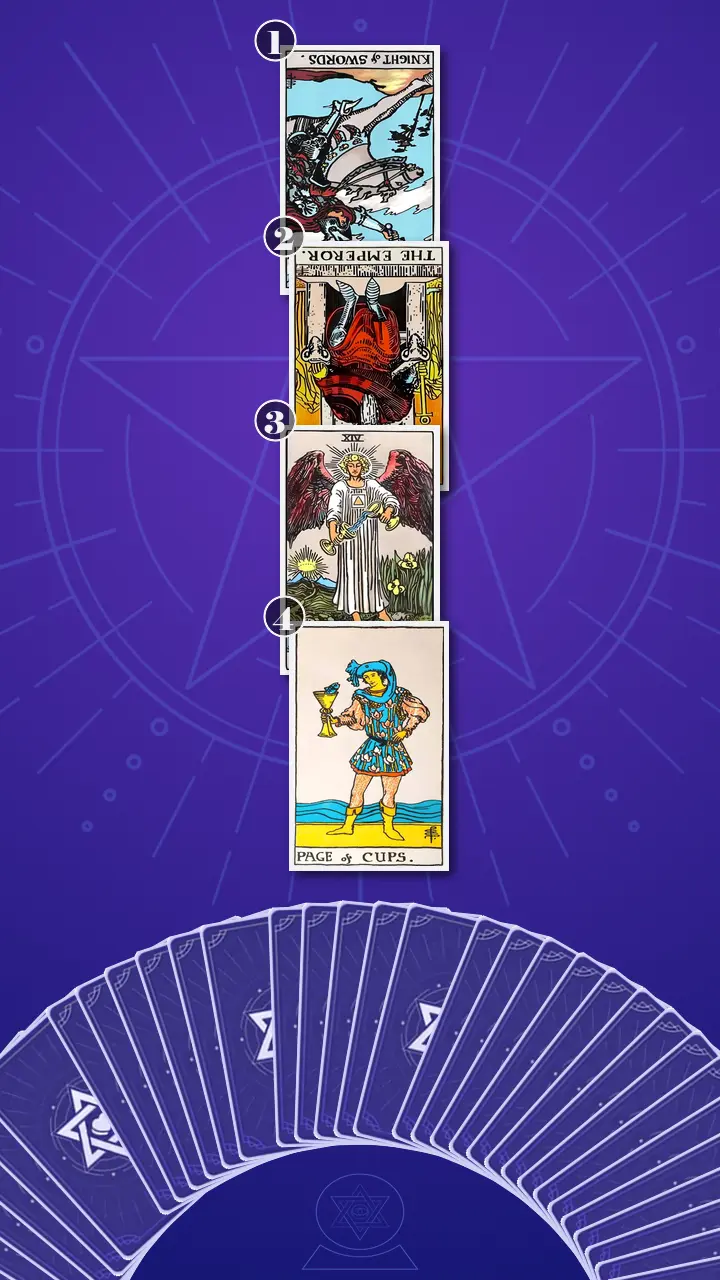
Now turned face up was the card representing “the diagnosis-level symptom: sending follow-ups and pressing for closure while the conflict is still emotionally activated.” This position held the surface experience, the present pattern asking for attention before either person had cooled down.
The card was the Knight of Swords, in reversed position. I pointed to the horse charging at full speed, the raised sword cutting into a turbulent sky, and the trees bent by wind. At 10:14 p.m., after a tense call ended with “I need some space,” Morgan had sent a second text and then a third text clarifying the second. The reversed Knight turned a valid wish to be understood into speed that outran emotional readiness.
This was Air in an overexpressed, poorly timed form: rapid analysis, precise wording, and mental force without enough receptivity around them. More words could be honest and still be badly timed. The issue was not that Morgan’s point had no value; it was that the delivery was moving into a conversation with no receiving capacity yet. I asked, “Before you send another message, does it create shared understanding, or does it mainly make the discomfort of waiting briefly feel more manageable?”
I brought back the late-night scene: a read receipt appeared, the phone was checked again, and a second message became a third. I named the inner operating system underneath it: “If I explain this one more time, they cannot misunderstand me.” Then I placed care beside control. The impulse began in longing for repair, but visible activity was being mistaken for relational progress.
Morgan gave a short, bitter laugh. “That is too accurate,” they said. “It is almost cruel. I am not trying to start another fight. I just cannot leave the wrong version of the story sitting there overnight.”
I did not treat that reaction as resistance or call it needy. I said, “Your wish to be understood is not the problem. The useful question is whether the next sentence has a chance to be received. We are separating valid content from pressured timing, so your honesty has better conditions to do its work.” Morgan looked down at the card, their thumb stopping above the phone for the first time that evening.
Position 2: The Armour Beneath the Project Plan
Now turned face up was the card representing “the hidden fear of losing control over the truth, the relationship, or the eventual meaning of the conflict.” This position showed the underlying belief and protective strategy sustaining the visible chase for closure.
The card was The Emperor, in reversed position. I drew Morgan’s attention to the stone throne, the armour beneath the robes, and the stark red mountains behind the figure. When someone asked for a few hours of space, Morgan opened Google Calendar and began drafting a return time, an agenda, an issue list, and a desired conclusion, then wanted confirmation of all four. A cooling-off period had become a managed project.
The reversed Emperor showed structure becoming control. Morgan was not trying to dominate for its own sake; they were trying to build enough order that the relationship could not slip outside their reach. The deeper fear sounded like this: if the conversation stopped now, the truth might be distorted, the other person might decide what the conflict meant, or the relationship might quietly change while Morgan was unable to intervene.
I asked, “When you hear, ‘I need space,’ what does your mind fear you will lose: control over the facts, reassurance that the relationship is intact, or confidence that repair will still be possible later? Which boundary would genuinely support both people, and which rule is only trying to eliminate uncertainty?”
Morgan’s breath paused. Their fingers tightened around the phone while their eyes went unfocused, replaying old conversations in which silence had felt like a verdict. Then their hand opened, and a long breath moved through their chest. “I turn the pause into a project plan,” they said quietly. “I think I am trying to make sure nobody can leave with the wrong conclusion.”
I remembered my years on Wall Street, where an unclear position could invite another spreadsheet, another scenario, another late-night call. I learned there that more analysis can create the sensation of control without changing the underlying conditions. In a relationship, the same instinct can protect a sincere value while quietly removing the other person’s freedom to return in their own way.
I said, “A pause is not the same thing as abandonment when the return is named. We are not asking you to accept endless silence or erase the need for a real conversation. We are asking whether mutual structure can replace unilateral control.” The space between the two cards began to look less like a dead end and more like a threshold.
When Temperance Slowed the Pour
Position 3: The Two Cups and the Honest Pause
The room grew very still before I turned the third card. This was the position representing “the transformative capacity to tolerate a bounded pause and let honesty reconnect with an accurate sense of timing.” It was also the key card, the antidote to the force gathering across the first two positions.
The card was Temperance, in upright position. I held the image where Morgan could see the liquid moving carefully between two cups, one foot on land and one in water, with a narrow path leading toward distant light. Temperance did not ask Morgan to care less or speak less honestly. It asked them to let emotional readiness become part of what made the truth usable.
In real life, this looked almost unremarkable: write the unresolved issue in one line, agree to reconnect tomorrow at 7:00 p.m., and let the body leave the argument for the evening. This is the practical solution for post-conflict urgency: a mutually agreed, time-bounded pause and scheduled return to hold unresolved concerns without pressuring immediate answers. The pause does not erase the issue. It changes the conditions in which both people will meet it.
I used the diagnostic lens I developed from years of assessing risk, timing, and available resources. I call it a Resource Readiness Assessment: before asking whether a message is true, I ask whether the conversation has the resources to receive it, including attention, breath, willingness, and a mutually named return point. Then I apply Strike Timing Calibration: I look for the node at which decisive action has the best chance of doing its job, rather than treating immediate action as automatically brave. For Morgan, Temperance placed that node after the emotional heat had fallen, not at its peak.
At 11:40 p.m., with tea cooling beside them and the phone warm in their hand, Morgan was not simply searching for a better sentence. They were trying to prevent silence from becoming a verdict. The unfinished thread felt like an open task with no safe way to close it, and urgency had dressed itself as honesty.
You do not have to force truth into an immediate answer; choose a timed pause that lets honesty and inner timing meet, like Temperance pouring slowly between two cups.
For a moment, Morgan’s breath stopped. Their eyes fixed on the stream between the cups as if they were watching an old argument replay in a different order. Their fingers, which had been curled around the phone, tightened once and then opened. The heat stayed in their cheeks, but their shoulders lowered by a fraction. They swallowed; their mouth opened, closed, and then a low breath came from the centre of their chest. I watched relief arrive with a thin edge of vertigo: if urgency was not the same as care, Morgan would have to choose what to do next instead of obeying the alarm. Their eyes shone, not with a guaranteed happy ending, but with the shock of finding room around the problem. “I can care about this and still let the emotional conditions change,” they said. I let the silence stand long enough to become evidence, not abandonment. The phone lay face down, its warm glass slowly cooling against the table. Nothing had been erased. The next sentence simply did not have to carry the entire relationship.
I asked, “Now, use this new perspective to revisit last week. Was there a moment when this insight could have made the next minute feel different?”
Morgan nodded, then looked at the space between the cups. “When I sent the fourth message,” they said. “I could have written the question down and waited. I thought the pause was making the truth less safe, but maybe I was making it harder to hear.”
I offered a ten-minute experiment rather than a promise: write the one unresolved question in a private note, set one realistic return time if none has been named, and leave the follow-up unsent. If the jaw tightened or the urge escalated, Morgan could stop and put the phone down. This practice belonged to ordinary conflict, not situations involving threats, coercion, or safety concerns, where a different kind of support and safety plan would matter.
This was the first meaningful movement from urgent activation toward grounded confidence in paced repair. Closure had not arrived as a final answer. It had become a pace, not a panic button.
The Message That Leaves Room
Position 4: The Page and the Unscripted Reply
Now turned face up was the card representing “the grounded action through which the new insight can be practised and integrated.” This position asked how Morgan could honour the need for clarity without managing the other person’s response.
The card was the Page of Cups, in upright position. I pointed to the unexpected fish emerging from the cup and the Page’s attentive gaze. At the agreed return time, Morgan could send one short message saying that the relationship mattered, name the specific impact they wanted understood, and ask one sincere question such as, “What landed most differently for you?” They did not need to attach the entire argument or demand a particular answer.
The Page brought Water into the exchange as curiosity and receptivity. After the Knight’s pressurised Air and the Emperor’s rigid structure, this was a small, open-hearted message that left room for information Morgan had not scripted. I said, “The goal is not to arrive with a finished verdict. The goal is to create conditions in which the other person’s experience can become information rather than an obstacle.”
Morgan traced the edge of the card with one finger. I saw the familiar urge return, softer but still present, and I asked them to notice it without turning it into an instruction. “I can hear the part of me that wants to prepare the whole case,” they said. “But I also want to know what I do not already know.”
From Insight to Action: The One-Message Return
I gathered the four cards into a single story. The reversed Knight of Swords showed why Morgan kept sending: language moved faster than emotional capacity, and the extra paragraph offered short-term relief. The reversed Emperor showed why the speed felt necessary: a pause seemed capable of taking the truth, the relationship, or control over the story away. Temperance introduced a different kind of agency, in which a mutually agreed, time-bounded pause and scheduled return could hold unresolved concerns without pressuring immediate answers. The Page of Cups carried that pacing into one caring message and one genuine question.
The cognitive blind spot was not a lack of honesty. It was the belief that visible activity always equals progress, and that more explanation can guarantee protection from being misunderstood. The transformation direction was therefore not from silence to speech, or from passivity to pursuit. It was from demanding complete resolution inside the same emotional window to naming what remained unresolved, agreeing when to return, and allowing emotional intensity to settle before deciding what the conflict meant.
I gave Morgan my Strategic Holding Pattern, a tactical micro-plan for the waiting period. Instead of treating the pause as anxious stagnation, Morgan could use it for high-value preparation: identify one question, confirm one return point, check the body once, and remove every unnecessary demand from the next message. The purpose was not to make waiting pleasant or to force a particular outcome. It was to make the pause active, bounded, and chosen.
I added one practical distinction: if the other person had asked for no contact until a stated time, Morgan would let that boundary stand. If the agreed time passed without availability, Morgan could ask once for a new time rather than sending a live-edited essay. A timed pause is a tool for ordinary repair, not a command to tolerate intimidation, coercion, or repeated disregard.
- Catch the first follow-up urgeWhen the first impulse arrives after a conflict pauses, copy the draft into Apple Notes or a paper notebook titled “Return Later.” Write one sentence beginning, “What still needs to be understood is...” Keep the full argument private.Start with two minutes if ten feels impossible. Drafting is allowed; sending is optional. Notice whether your jaw, face, chest, stomach, or hands are carrying the urgency.
- Name one return pointAsk once for a realistic time to revisit the conversation, such as tomorrow at 7:00 p.m., and add that time to Google Calendar. Agree on the pause without attaching a full agenda, required answers, or a desired conclusion.A return time provides structure without pretending to control the outcome. If no contact has been requested until a stated time, respect that boundary and wait.
- Make the return a One-Message ReturnBefore the scheduled conversation, prepare two sentences: one naming why the relationship or conversation matters, and one naming the specific impact you want understood. End with one sincere question, then put the phone out of reach for ten minutes after sending.Leave room for an answer you did not script. Ask yourself, “Does this create shared understanding, or does it mainly make waiting feel less exposed?” If the answer is unclear, leave the note untouched.
A Week Later, the Chat Stayed Quiet
Three days later, Morgan texted me: “I wrote the one sentence, put 7:00 p.m. on the calendar, and left the draft in Notes.” The next morning, they slept a full night, although their first thought was still, “What if this is wrong?” They smiled before reaching for the phone. The uncertainty had not vanished; it had stopped running the entire room.
I saw the first evidence of the emotional transformation I wanted for Morgan: from urgent, control-driven follow-up messaging to grounded confidence in paced repair. They had not solved the relationship or guaranteed the next conversation. They had made one honest choice under different conditions, and that was enough to prove that a pause could contain care without becoming abandonment.
I told Morgan, “Clarity is not always the moment when every answer arrives. Sometimes it is the first moment when you can let the answer arrive at the right temperature. You remain the author of what you say, when you say it, and what you choose to do if the other person cannot meet you.”
When a conflict pauses and your phone goes quiet, your jaw locks because waiting can feel like losing both the relationship and the right version of what happened. I do not treat that response as proof that you are too much; I treat it as a signal that care and fear have become tangled.
If a timed pause could hold your care without making you prove the whole story tonight, what small, unsent truth might you notice before the conversation returns?