When Silence Feels Like Losing Them

See why inconsistent attention can unsettle connection, which tarot cards reflect the bind, and how it appears across reading insights.

Attention-security Fusion
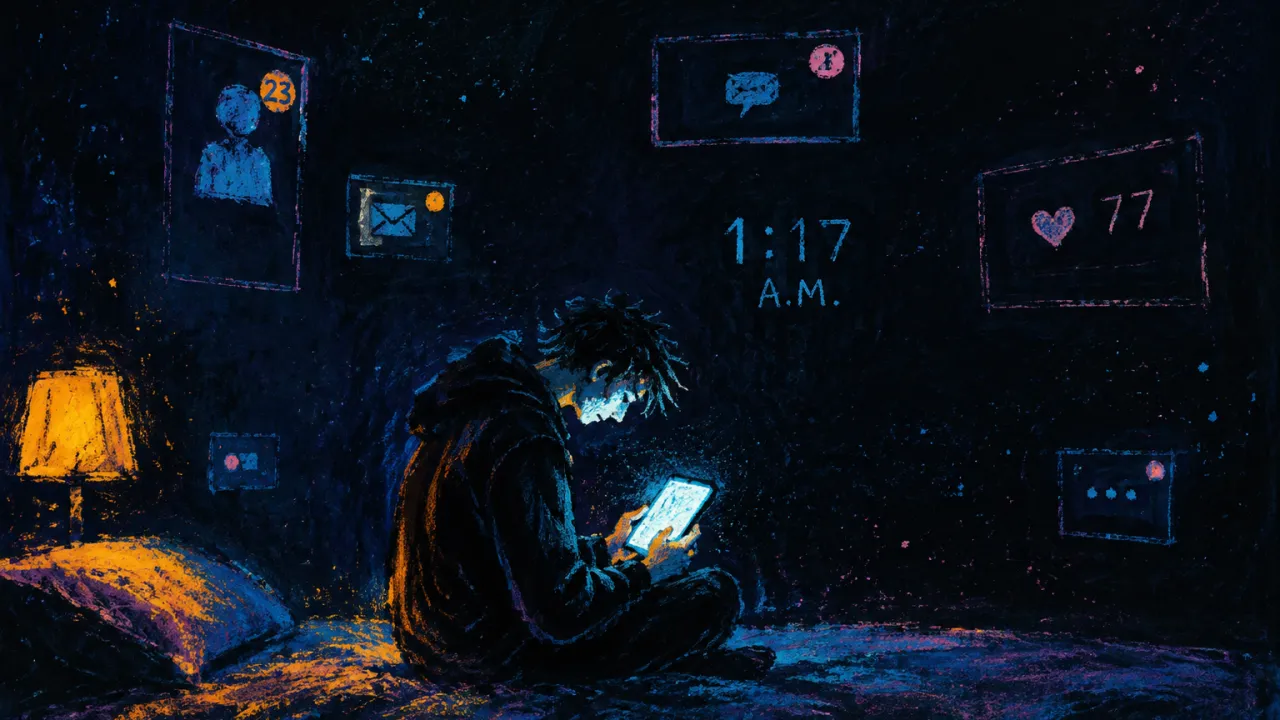
A seated figure enclosed by doorless frames holds a blank cyan-lit phone as amber light stops at the screen.

What does this feel like?

Attention-Security Fusion is the moment another person's attention stops feeling like one part of connection and starts feeling like the thing keeping it alive. You notice it at 11:43 p.m., when your message has been read but the reply never comes: your eyes return to the chat before you have decided to look, your chest draws tight, and your shoulders inch upward as if your body has caught news your mind is still trying to dispute. You tell yourself they may be busy, then check whether they have posted, liked something, or gone online, because every small sign now seems to answer a larger question: Do I still matter to them when they are not actively showing me that I do? When the typing bubble appears, your body loosens before you even know what they are saying; when it disappears, the room seems quieter than it was. A warm reply can restore the whole connection in seconds, but the relief rarely lasts, because the next gap asks you to prove it again. In person, you may track where their eyes go, how quickly they answer someone else, or whether their voice has changed by half a degree, while part of you tries to look relaxed and another part keeps taking measurements. The cost is not simply the time spent checking. It is that your own evening becomes a waiting room, closeness feels available only while it is being visibly delivered, and you can be cared for without being able to rest inside that fact, much like the two figures on the Five of Pentacles, moving through the cold beneath a bright window, near the image of shelter but unable to feel held by it.

What's pulling at you?

You want connection to stay steady when no one is actively messaging, and you also need visible attention before that steadiness feels believable. That leaves you caught between checking for proof that you still matter and wanting a bond that does not have to be re-proven every time the screen goes quiet.

How It Shows Up?

  • At 1:17 a.m., you wake just enough to reach for your phone, and the unchanged chat pulls you fully awake. You reread the last exchange, testing the punctuation for a shift, while your eyes sting, your chest tightens around each breath, and one thumb refreshes the screen although you know nothing new is there. For the next minute, the unchanged screen can remain an unanswered message rather than a verdict.
  • On the sofa, someone close to you glances at their phone and smiles at a message from someone else. Your own smile stays in place, but your stomach dips, your shoulders firm, and your mind begins measuring who receives warmth and who waits, as precisely as the scales in the Six of Pentacles. You can notice the comparison without treating it as the final measure of your place with them.
  • You open a work brief or study document with your phone face-up beside the keyboard, promising yourself you will check after one paragraph. Every vibration pulls your eyes sideways; when it belongs to another app, your jaw sets and your shoulders creep up, while your attention loops between the cursor and the blank chat like the ribbon around the Two of Pentacles. The task can remain unfinished for a moment without the relationship question being settled at the same time.
  • At drinks with friends, the person whose attention matters most becomes absorbed in another conversation, and you keep facing the group while tracking every glance that does not come your way. Your laugh lands half a beat late, heat rises across your face, and your fingertips press into the cold glass as the room starts to feel arranged around who is being noticed. A crowded room does not have to decide your place in the connection.
  • Mid-conversation, the typing bubble appears, disappears, then appears again, and your whole body follows it. Your chest releases when it returns, your shoulders brace when it vanishes, and your hands go still over the phone before a single word has arrived; relief and alarm keep trading places ahead of meaning. You are allowed to notice that quick body shift without asking it to predict what comes next.

Attention-security Fusion in Tarot Cards

Attention-Security Fusion lives in the bind between wanting connection to remain steady and needing fresh signs of attention before that steadiness feels believable. It can register as a tight chest, shoulders creeping upward, and a thumb refreshing an unchanged chat. From an existential perspective, the structural framework concerns what happens when your felt place in a connection depends on being actively noticed. The Tarot Cards below mirror the visible contours of that bind.

The Hanged Man
Upright
A figure hangs by one ankle from a wooden frame, physically suspended while a halo surrounds the still head. During a reply gap, your evening can enter the same suspended state: plans remain available, but action feels premature because the relationship question has not yet been settled by renewed attention. The card's stillness distinguishes waiting from resolution. Nothing in the posture confirms loss, yet time and agency remain held around an external event; the message is expected to release not only the conversation but your capacity to return fully to the rest of your life.
The Devil
Upright
The pair beneath the Devil wear visible chains that connect their freedom of movement to a structure positioned outside themselves. At the level of personal growth, your security can remain similarly outsourced when another person's attention is treated as the final authority on whether you matter and whether the bond is real. The image names the gap between insight and structural change. You may fully understand that a delayed reply is ambiguous while your underlying model still grants attention the power to regulate worth, safety, and connection; the struggle persists because the chain is functional, delivering real short-term relief even as it narrows your freedom.
The Moon
Upright
The path beneath the Moon is visible but incomplete, bordered by instinctive reactions and emerging material from dark water. Inside you, silence can create the same mix of partial evidence, bodily alarm, and unexamined relational memory, making a feared explanation feel clearer than the facts. The card gives uncertainty a boundary: the landscape is obscured, not empty, and its contents are not yet settled. Attention-Security Fusion collapses that distinction by treating the absence of visible attention as positive evidence of danger, turning what is unknown into what feels certainly rejecting.
Four of Cups
Upright
The figure's crossed arms form a closed boundary while cups remain both grounded nearby and actively offered. Internally, reassurance may arrive and produce relief without being integrated into a durable sense of connection; once the immediate contact ends, the evidence becomes strangely unavailable again. The card locates the issue in reception rather than supply alone. Attention can reach you, but if only real-time delivery feels secure, yesterday's warmth cannot remain emotionally present today; the internal cache repeatedly empties and asks the relationship to refill it.
Five of Cups
Upright
The cloaked figure remains turned toward three spilled cups while two full cups stand just outside the current line of sight. Inside you, the missing attention can become cognitively dominant, making prior care feel irrelevant precisely when it would otherwise provide continuity. The bridge and distant building show that the emotional field contains more than the immediate loss, but the posture cannot yet access it. Attention-Security Fusion gives the absent signal disproportionate authority, so your inner account of the relationship is rebuilt around what did not happen rather than held by the full pattern of what has happened.
Two of Pentacles
Upright
The figure keeps two pentacles circling inside one continuous ribbon while unstable ships move across the background. You may keep a study document open and appear to be working, but part of your attention remains attached to the silent chat beside it, treating each vibration as possible evidence that the connection is safe again. The card's balance is active rather than settled: neither object is allowed to rest, and neither demand is fully completed. That structure mirrors the cost of learning while relational security remains externally gated; the material can be in front of you, but working memory keeps cycling back to whether someone has replied.
Four of Pentacles
Upright
The seated figure uses head, heart, hands, and feet to keep four pentacles under direct control, leaving no part of the posture available for movement. At the level of personal growth, your cognitive model may similarly place security in the retention of another person's attention, so every gap feels like a threat to the resource holding the system together. The distant city shows the opportunity cost of this arrangement. When so much awareness is committed to preserving contact, experimentation, concentration, and self-directed meaning receive less room; the challenge is not a lack of discipline but a security model that treats loosening attention as equivalent to losing connection.
Five of Pentacles
Upright
The cold figures beneath the stained-glass window occupy a space where evidence of shelter is present but cannot be converted into felt warmth. Inside you, memories of care may remain available as facts while a current silence dominates the emotional field, making the connection feel absent until attention returns. The card separates what is visible from what can be internally used. That separation names why reassurance has such a short half-life: the last warm exchange does not stay stored as security, so each new gap becomes an empty present rather than one moment inside a continuous bond.
Six of Pentacles
Upright
The standing distributor holds scales above two family-like dependants, placing care inside a structure of unequal access and visible allocation. In a family system, you may watch who receives patience, praise, immediate replies, or emotional availability and use those differences to determine whether your own place is secure. The exchange captures more than simple jealousy: it shows attention operating as a resource controlled within a hierarchy. When belonging must be re-proven through current allocation, even ordinary differences in need or timing can reactivate the fear that family warmth is conditional and that someone else receiving more leaves less for you.
Eight of Swords
Upright
A blindfolded, bound figure stands inside a loose enclosure of swords while water gathers at their feet and a distant structure remains visible. Internally, one unread message can create a similarly narrowed field in which the rejection interpretation feels enclosing, even though the available evidence does not fully close every route. The blindfold names limited access to context, while the bindings show how strongly that missing context can govern movement. Because visible attention has become the authorised proof of security, alternative explanations may be intellectually available but emotionally unusable; the mind remains trapped around the one answer only the other person seems able to provide.
Nine of Swords
Upright
The wakeful figure covers their face while a rigid sequence of swords occupies the dark space above them. Your inner attention can become similarly captured by one missing reply, with each replay of the conversation producing another possible explanation but no explanation that feels final. The card gives shape to a psychological cache that cannot clear itself. Because another person's attention has been assigned the power to confirm safety, self-generated explanations remain provisional; rumination continues until an external signal arrives, and its relief reinforces the same dependence for the next silence.
Page of Swords
Upright
The Page stands under fast-moving clouds with sword raised and gaze turned toward the surrounding field. Your inner system can adopt the same watchful organisation, scanning for minute relational changes and preparing an interpretation before enough context exists to support one. The sword gives this monitoring a cutting, verdict-seeking quality: a typing bubble, delayed response, or slight tonal shift must be classified as safe or rejecting. The result is not ignorance but data saturation, where increased observation makes rest harder because every new cue opens another question about whether the connection remains secure.
Five of Wands
Upright
Five figures raise intersecting wands without a shared direction, turning the space between them into visible competition and friction. In a group, you may experience another person's diverted attention as entry into a contest, tracking who makes them laugh, who holds their gaze, and who appears to receive the easiest warmth. The crossed wands show how belonging becomes harder to feel when attention is treated as scarce. Other people cease to be neutral participants and become comparative evidence, while your own participation splits between joining the conversation and measuring whether you are winning enough notice to remain secure.

Attention-security Fusion in Tarot Card Reading Insights

Attention-Security Fusion also enters readings when people ask whether a delayed reply means the connection itself has changed. The Tarot Reading Insights below gather what surfaced when attention, silence, and security were brought to the cards.
Psychological Struggles Related to Attention-security Fusion