Intense Texting Isn't Lasting Security: Let Follow-Through Earn Trust

When Constant Texting Starts Feeling Like Security
I met Maya (name changed for privacy) over video at 11:40 p.m. on a Tuesday. She was twenty-seven, worked a hybrid, phone-near marketing job in Toronto, and had reached the point where a new Hinge match’s all-day texts made every Teams ping feel like a relationship update.
A half-finished campaign brief glowed behind our call on her warm laptop. The radiator clicked against the silence, the fan hummed, and blue phone light sharpened the tired skin beneath her eyes as she scrolled from last week’s affectionate paragraphs to that day’s three shorter replies. Her thumb hovered over Send.
“When the attention is high, everything feels certain,” Maya told me. “Then it drops, and my chest does this.” She pressed her palm below her collarbone. “So I reread everything, reply faster, or agree to another intense conversation. I know consistency matters, but calm can feel like disinterest.”
Her longing had the physical texture of holding a phone that might become either a doorway or a trapdoor with the next vibration. She wanted lasting relational security, yet she was trying to find it inside a signal that naturally fluctuated.
“Nothing about this makes you foolish,” I said. “Intense attention can feel wonderful, especially when it arrives with compliments, voice notes, and language that makes a shared future seem close enough to touch. We aren’t here to shame that response or decide what this person secretly feels. We’re here to separate what is compelling from what is dependable, then give you enough clarity to choose your own pace.”
I asked her to place both feet on the floor and let her phone rest face down. “Let’s make a map of the fog. The cards won’t make a relationship decision for you. They can help us see the pattern you’re standing inside.”

Choosing a Map That Leaves Motives Private
I invited Maya to take one slow breath while holding the question, “Why do I keep mistaking intense attention for lasting security?” I shuffled at an unhurried pace, using the small ritual as a transition from decoding the latest message to observing the larger pattern.
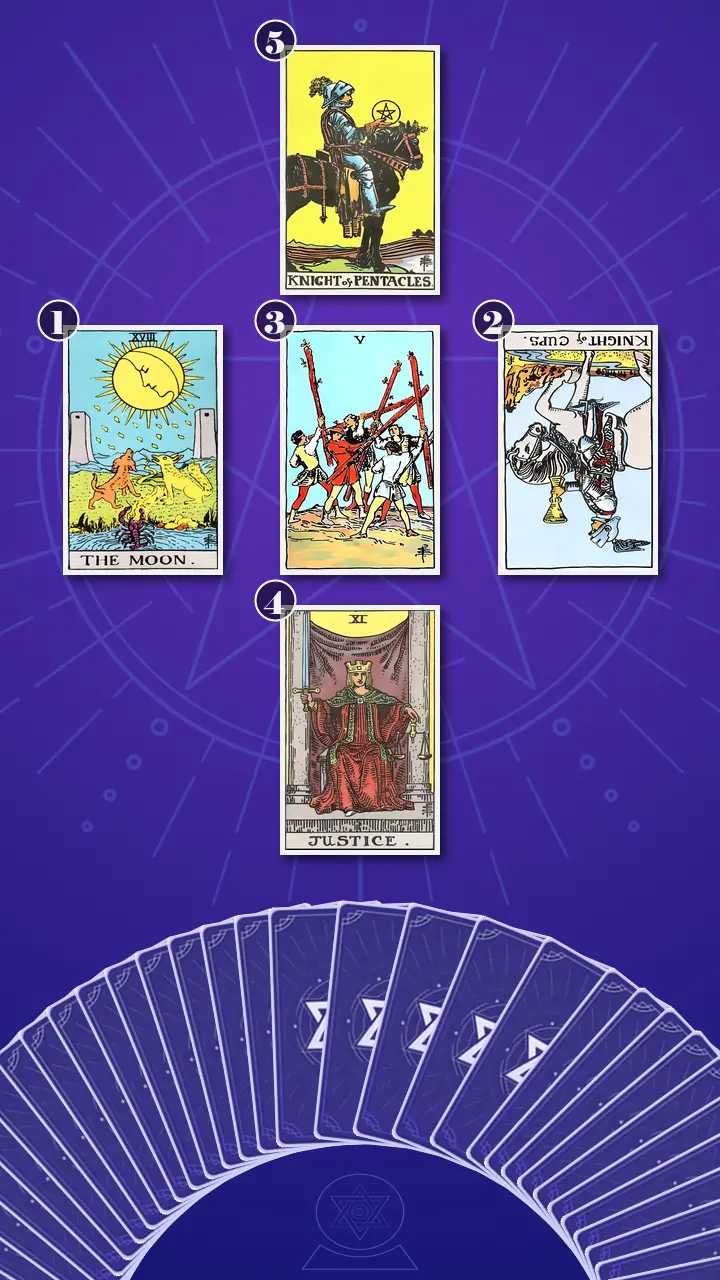
I chose the Relationship Spread · Context Edition, a five-card relationship tarot spread designed to separate projection, observable attention, shared conflict, stabilizing standards, and sustainable pacing. For me, this is how tarot works best: not as surveillance into another person’s private mind and not as a prediction of whether a relationship will last, but as a structured way to examine card meanings in context.
I chose five cards because the question involved two relational inputs and the dynamic produced between them. A larger Celtic Cross would have added layers Maya did not need, while a decision spread would have implied that the cards should choose for her. This layout was smaller and more precise.
I arranged the cards like a balance scale mounted on a vertical spine. The first would show how Maya’s need for reassurance shaped what she inferred. The second would examine only the other person’s observable attention, pacing, follow-through, and response to limits. The centre would reveal what those patterns produced together. Beneath it, the fourth card would identify a stabilizing resource; above it, the fifth would translate that resource into a self-led practice.
“No hidden motives, no verdict about the future,” I said. “We’ll look at what you feel, what you can observe, and what choices remain yours.”
Reading the Path Under Uneven Light
Position One: The Moon and the Story Built Between Messages
“The card I’m turning over now represents how your need for reassurance shapes the meaning you assign to intense early attention, including the urge to accelerate when that attention changes,” I said. I revealed The Moon, upright.
I pointed to the winding path between the distant towers, the dog and wolf responding from opposite sides, and the moon casting light that was real but uneven. “This connection may be real, and your feelings are certainly real. The Moon does not tell me that you invented either one. It says the available view is incomplete.”
I returned to the phone-lit sofa as a split screen. On one side were observable facts: Maya had received affectionate paragraphs for a week; a disagreement had happened; contact had decreased; the replies had become shorter. On the other side was the future her mind rapidly constructed from those facts: perhaps the connection had been secure, perhaps it was now disappearing, perhaps one perfect response could restore it.
“The Moon’s energy appears here as a blockage of visibility,” I explained. “Your intuition is not absent, but hope and alarm are both trying to complete parts of the path that repeated behaviour has not illuminated yet.”
I offered her a sentence frame: “I know they said or did ___, so I am filling in ___.”
Maya looked at the ceiling and answered, “I know they said they could see this becoming serious, so I’m filling in that we already have something stable. And when their replies get shorter, I fill in that I’m losing it.”
One corner of her mouth lifted. A short, bitter laugh escaped before she placed her phone farther away. “That is so accurate it’s almost rude.”
“I hear the sting,” I said. “The point isn’t that your reading of the situation must be wrong. The point is that it is unfinished. Intensity can be real and still not be evidence.”
I watched her breathing slow by a fraction. The distinction had not removed the uncertainty, but it had separated genuine feeling from a conclusion formed under partial light.
Position Two: The Reversed Knight of Cups and the Beautiful Trailer
“The card I’m turning over now represents the other person’s observable pattern of attention, pacing, follow-through, and response to limits,” I said. “It does not give either of us permission to claim access to their private motives.” I revealed the Knight of Cups, reversed.
The knight’s cup was still prominently offered, but the reversal altered the energy around it. “This card carries an excess of romantic presentation alongside a deficiency of established follow-through. That can look like all-day texts, a shared playlist, elaborate compliments, and plans several weeks ahead arriving before either person has seen how the connection handles ordinary routines, inconvenience, or a clear no.”
Maya nodded. The Hinge “together we could” answer had become concert ideas, a weekend away, and joking references to deleting the app before they had established a normal Tuesday rhythm. The attention was genuinely compelling. It was also more like a beautifully edited trailer than a completed season.
“The inner line is often, ‘This sounds committed, so maybe I can stop wondering,’” I said. “But receiving a romantic invitation is different from having an established relational pattern. The offer can be enjoyed without being promoted into a settled commitment.”
I also named the risk of overcorrection. “You don’t need to search #DatingTok for ‘love bombing vs genuine interest,’ choose the most alarming label, and treat every enthusiastic person as deceptive. We are evaluating behaviour, not prosecuting enthusiasm. Are plans kept? Does affection remain when you are not constantly available? Is a slower pace respected? Those questions produce information without pretending we know intent.”
Maya’s fingers stopped rubbing the edge of her phone case. “So I’m allowed to like the playlist,” she said, “without treating it like a mortgage agreement.”
“Exactly. Attention is a signal. Security is a pattern.”
Position Three: Five Wands in a Midnight Text Thread
“The card I’m turning over now represents the central dynamic produced when your reassurance-seeking meets the connection’s accelerated pace,” I said. “It shows the closeness, friction, and intense reunion cycle.” I revealed the Five of Wands, upright.
Five figures raised staffs at conflicting angles, all active and none moving toward a shared target. I saw the modern version immediately: a midnight wall of text with forty emotionally charged replies but no decision, owner, or next step.
“This is an excess of activation and a deficiency of shared structure,” I told her. “Both people can type, clarify, defend, apologise, and express strong feelings. The conversation can end with renewed affection while still leaving no agreement about realistic communication, boundaries, or what either person will do differently next time.”
Maya described the latest argument. At 12:18 a.m., after a long exchange about response times, an affectionate voice note had arrived. The words “I miss you” had lowered her shoulders even while her stomach remained knotted. She had sent a warm reply, and neither person had returned to the original issue.
“At least this much emotion means we both care,” I said, naming the logic of the moment. “But what is actually different tomorrow?”
Reconnection is not the same thing as repair.
Maya’s jaw tightened. Her gaze moved from the card to the dark window behind her screen. “That makes me think of Normal People,” she said. “The reunion feels so meaningful that you almost forget nobody knows how to stop hurting each other.”
“Longing can be emotionally legible without creating practical security,” I replied. “Relief tells you contact has returned. Repair tells you the original problem has been named, responsibility has been taken, and a new agreement can be observed.”
The radiator clicked again, sounding unusually sharp in the pause. I watched Maya press her tongue against the inside of her cheek, as if her body had recognised the distinction before she was ready to say it aloud.
When Justice Put the Pattern on the Scales
Position Four: The Boundary That Makes Evidence Visible
“The card I’m turning over now represents the available corrective resource,” I said. “It can help you distinguish lasting security from emotional intensity through clear standards, reciprocity, respected boundaries, and accountable repair.” I revealed Justice, upright.
The atmosphere changed. Even through a screen, I felt the reading settle. Justice sat front-facing between symmetrical pillars, holding balanced scales at eye level and an upright sword without apology.
“This is balanced energy,” I said. “The scales do not reject emotion; they weigh it beside evidence. The sword is not punishment. It is the clear boundary that prevents chemistry from overruling your own judgement.”
I returned Maya to 11:40 p.m.: the unfinished brief, the affectionate paragraphs beside the shorter replies, the tight chest, and the hovering thumb. I could see the rule underneath it. Slowing down felt less like pacing than risking the whole connection.
Before I became a tarot reader, I spent fifteen years as a perfumer. Looking at Justice, I reached for what I call Intimacy Distance Calibration. In fragrance, projection describes how strongly a scent travels through a room; longevity describes what remains after hours of air, movement, skin, and time. A perfume can announce itself spectacularly in the first twenty minutes and disappear before lunch. Strong projection is real, but it cannot answer the separate question of endurance.
“Early romantic intensity works like a fragrance’s top notes,” I told Maya. “It can be sincere, vivid, and worth enjoying. Security is closer to the dry-down: what remains when novelty softens, ordinary life enters, a boundary creates space, and something difficult needs repair.”
Intense attention is not proof of security; let repeated actions earn trust, as Justice's scales weigh the pattern and its sword protects a clear boundary.
I let the sentence stay in the quiet.
For one beat, Maya stopped breathing. Her fingers remained suspended above the phone, and her pupils widened as though she were replaying several weeks at once. Then her eyebrows pulled together and colour rose across her cheeks. “But doesn’t that mean I’ve been wrong this whole time?” she asked, the words suddenly louder. “Like I created the problem by believing it?”
“No,” I said. “It means the chemistry was real and you assigned it a level of proof it had not yet earned. That is a pattern, not a moral failure. You also did not create another person’s behaviour. We are identifying the part of the pace that you can choose.”
The anger held for another second, then broke into a shaky exhale. Her fist loosened against her knee. Her shoulders dropped, but the release brought a small, exposed stillness with it, as if setting down the need to decode everything had left her briefly unsure what to hold instead. Her eyes shone. “That’s almost scarier,” she said quietly. “Because then I have to let time tell me.”
“Yes,” I answered. “Clarity does not remove responsibility. It gives responsibility a shape small enough to carry.”
Intensity can make you feel chosen quickly; security is what keeps showing up when the pace slows, a boundary appears, and repair is required.
I then used my Boundary Permeability Assessment. “Where does your day end and the connection’s urgency begin? If a change in reply length can repeatedly interrupt your work, cancel dinner, decide when you sleep, and pull more disclosure from you than you intended, the boundary around your time and identity has become too permeable. A healthy boundary is not a locked door. It is a breathable membrane that lets affection in without letting another person’s texting cadence run your whole nervous system.”
“Now, using this new perspective, can you think of a moment last week when this insight might have made the situation feel different?” I asked.
Maya remembered a same-night invitation that arrived on Line 1 between St George and Spadina after several quiet hours. She had started cancelling dinner with a friend because saying no felt like risking the connection.
“I could have checked whether I actually wanted to go,” she said. “I could have kept dinner and offered Saturday. Their response would have given me information, but it wouldn’t have decided my worth.”
I set an eight-minute timer and asked her to open a note titled Security I Can Observe. Under “High-intensity signal,” she wrote: all-day messages, a shared playlist, future plans, and an affectionate voice note after conflict. Under “Repeated evidence,” she recorded what had actually happened around kept plans, reciprocity, limits, and repair. The second column was not empty, but it was much shorter and still unfinished.
She ended with one sentence: “I’d like to take this one plan at a time.” I reminded her that she did not have to send it that night or make a verdict about the relationship. The note was a reality check, not a courtroom sentence.
I named the shift I could see beginning: from anxious pace-matching and compulsive phone-checking toward grounded openness guided by observable consistency. Maya was not closing herself to connection. She was reclaiming her position as an active judge of relational fit.
The Knight Who Let an Ordinary Tuesday Count
Position Five: Building Trust at a Self-Chosen Pace
“The card I’m turning over now represents your growth direction,” I said. “It translates the reading into a self-led practice: maintaining your chosen pace and evaluating consistency over time without forcing a prediction about the relationship.” I revealed the Knight of Pentacles, upright.
The knight held a pentacle steadily in both hands while the dark horse stood still before cultivated fields. Where the reversed Knight of Cups had delivered an emotionally elevated offer, this knight valued what could be repeated.
“This is balanced earth energy,” I explained. “Waiting is not passivity here. It is active observation. The potential has been underused because a calm pace gives you less immediate reassurance than a dramatic peak, but it gives dependable behaviour time to become visible.”
I asked Maya to picture one ordinary Tuesday. She finishes a twenty-five-minute work block before checking the chat. She keeps dinner with a friend. She replies during a natural break rather than mirroring every response time. She accepts one date instead of mapping the next month, and she does not attempt to define the entire relationship after 11 p.m.
“The inner line becomes, ‘This is quieter, but quiet gives me time to see what repeats,’” I said. “You are not playing texting games or manufacturing delayed replies. You are responding when you genuinely have attention available. You do not have to turn chemistry into a verdict.”
Maya rolled her shoulders back and looked at the calendar beside her laptop. “Wednesday dinner stays,” she said. “Even if I get the exact text I’ve been waiting for.”
“That is the Knight of Pentacles,” I replied. “Not a grand promise. One ordinary commitment that remains yours.”
The Blank Space Where Security Can Show Its Work
I looked at the five cards as one connected story. A familiar strategy had taught Maya to treat returning attention as quick relief: The Moon showed how hope and alarm completed missing information; the reversed Knight of Cups gave that projection a beautiful romantic offer; and the Five of Wands turned uncertainty into conflict, expression, and affectionate reunion without shared structure. Justice restored criteria, while the Knight of Pentacles gave those criteria enough time to work.
The central image was simple: Maya had been judging a house’s foundation by the fireworks above it. The display could be real and spectacular, but brightness could not reveal what the structure would hold. Her cognitive blind spot was not wanting affection. It was treating the body’s relief when attention returned as proof that security had returned too. She had also been reading calm as disinterest before calm had enough time to reveal consistency.
The transformation was not from “open” to “guarded.” It was from matching the fastest available pace to maintaining a self-chosen pace while evaluating kept plans, reciprocity, respected boundaries, and accountable repair over time. I gave her three small practices.
- Create Justice’s Three-Standard Note. On Tuesday at 7:30 p.m., set an eight-minute timer and write three personal signs of relational security in your Notes app: for example, plans are kept or responsibly renegotiated, a no is accepted without pressure, and conflict is followed by a specific next step. After the next date or meaningful conversation, spend five minutes recording one high-intensity signal and one piece of repeated evidence in separate columns. Keep the standards personal and descriptive, not universal. The minimum version is one standard and one observed example; close the note if reviewing the interaction becomes too activating.
- Run the Blank Space Protocol for seven days. Choose one breathable space and place it in your calendar: keep Wednesday dinner with friends, protect one twenty-five-minute work block with Focus mode on, or hold relationship-defining conversations before 11 p.m. Reply at your natural rhythm, and when a last-minute invitation does not fit, use one sentence: “Not tonight, but I’m free Saturday afternoon.” This is not a timing game or a test designed to provoke a reaction. The blank space lets you remain yourself while observing whether warmth and respect survive ordinary distance. If a limit is met with pressure, insults, or behaviour that feels unsafe, step away and contact someone you trust.
- Use the Reunion-or-Repair Check. Save this sentence in Notes: “I’m glad we’ve reconnected, and I still want to resolve what happened around __. Are you open to talking about one specific agreement?” After a disagreement, use it only when the conversation feels respectful enough. At the end, record three lines: the issue named, the agreement made, and how you will know whether it is being followed. The five-minute version is simply drafting the sentence. Reconnection does not obligate you to pursue repair immediately, and you do not have to remain in a hostile or circular conversation to prove commitment.
I called the second exercise the Blank Space Protocol because perfume, like intimacy, needs air to develop. Applied too densely, even a beautiful scent can overwhelm the senses until nothing distinct remains. Intentional space does not extinguish attraction. It reveals whether the connection can diffuse without suffocating Maya’s work, friendships, sleep, and independent judgement.
“A boundary gives you data about what the connection can hold,” I told her. “It does not guarantee the answer you want, but it keeps you present for the answer that repeated behaviour actually gives.”

A Week Later, the Quiet Proof
A week later, I received a message from Maya. A same-night invitation had arrived before Wednesday dinner, and she had used the sentence we drafted: “Not tonight, but I’m free Saturday afternoon.” Then she put her phone away and kept her plan.
“My chest still tightened while I waited,” she wrote. “But I didn’t cancel dinner, and I didn’t send three explanations. They said Saturday worked. I know that one reply doesn’t prove everything either. That’s kind of the point.”
That night she slept through, but her first thought on Thursday was, “What if slowing down ruins it?” She told me she smiled at the thought, not because it had vanished, but because it no longer had the only vote.
I did not read her update as proof that the relationship would last. I read it as quieter evidence of Maya’s own change: she had protected one plan, tolerated one stretch of uncertainty, and let one observable response remain exactly what it was. The tarot had provided a map, but Maya had chosen the pace and taken the step.
If a quiet phone makes your chest tighten, I know chasing the returning rush can feel safer than discovering whether a connection can breathe at your own pace. Noticing that impulse is already a little blank space: enough air to hear your standards beside the typing bubble.
If the next burst of attention did not need an immediate meaning, what one base note would you be curious to notice after the top notes fade: a kept plan, a respected no, reciprocal effort, or a repair that actually changes tomorrow?