When Dashboards Decide Your Work

A KPI-heavy workplace context, related tarot cards, and reading insights from people bringing dashboard pressure into a session.

Workplace Metric Literacy
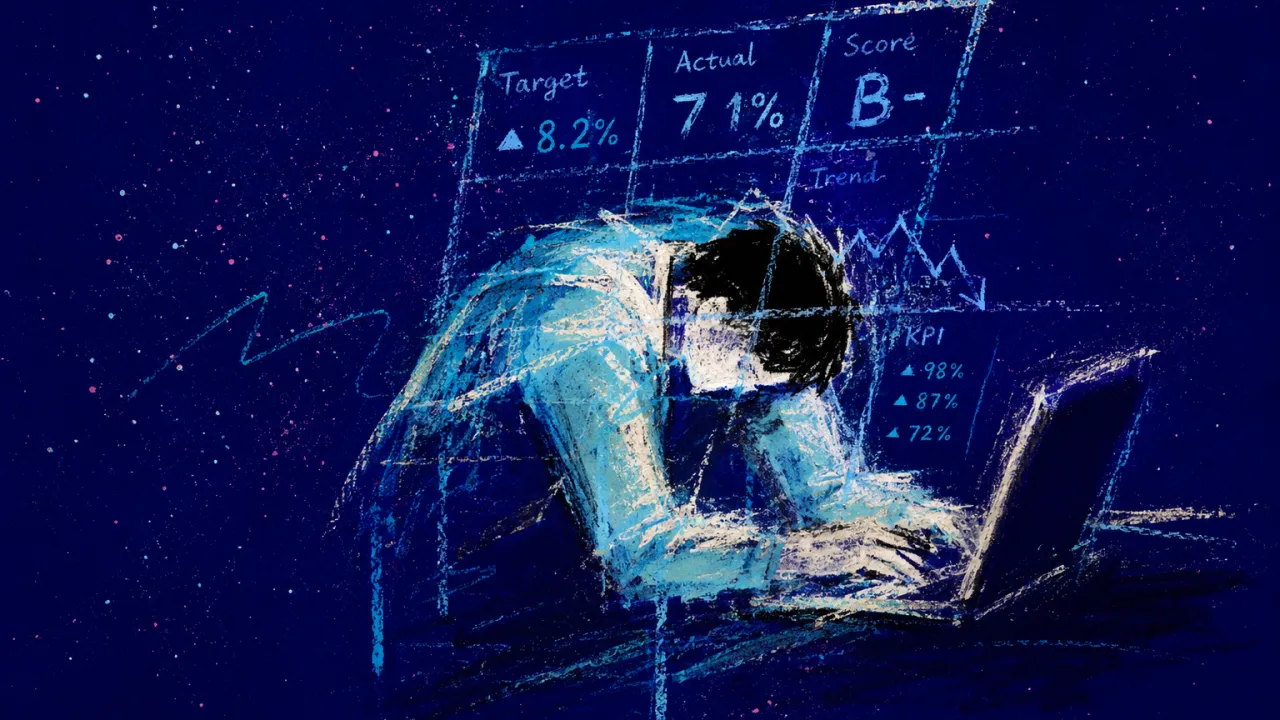
A solitary figure hunched over a laptop as projected grids press into shoulders and wrists, leaving pale scorecard marks

What is this situation?

Workplace Metric Literacy — you step into a meeting, open the shared dashboard, and realize the room is already moving in a language no one properly taught you. The manager points at KPI trends, conversion rates, utilisation numbers, OKRs, retention curves, or velocity charts as if every label is obvious, while the people who understand the formulas speak quickly and the people who do not stay quiet. Your work is no longer judged only by what you made, fixed, wrote, sold, shipped, supported, or carried; it is filtered through cells, graphs, rankings, and moving targets that decide whether your contribution counts. A casual check-in turns into a screen-share where someone asks why a number dipped, and the answer seems to matter less than whether you can translate the chart quickly enough under everyone else's gaze. You start preparing for meetings by rehearsing not the work itself, but the language around the work: which metric proves impact, which figure might be challenged, which dashboard has changed since last week, which target was renamed without anyone saying so. Over time, the office, Slack thread, or Zoom room becomes a place where power sits with whoever controls the definitions, and your shoulders tighten before the spreadsheet even loads, much like the figure on the Two of Pentacles, forced to keep the coins moving while the waves behind him refuse to settle.

Why it's not you?

This is not a personal failure with numbers. It is a workplace that has turned metrics into a gatekeeping language without giving everyone the same map. Unclear formulas, shifting targets, unexplained acronyms, and public dashboard pressure belong to the system around you, not to some flaw in how you think.

Workplace Metric Literacy in Tarot Cards

In Workplace Metric Literacy, the tightness in your shoulders when a dashboard opens is tied to a workplace where numbers decide whose work gets recognized. This is an environmental and structural dynamic: the metrics are not just information, they are part of how authority, attention, and approval move through the room. The cards below do not explain the spreadsheet or tell you how to perform. They simply reflect the shape of the pressure, and these are the Tarot Cards that often mirror this kind of workplace situation.

The High Priestess
Reversed
The partially concealed TORA scroll, the pomegranate veil, and the two pillars place usable knowledge behind a controlled threshold. Reversed, that threshold no longer functions as a protected learning space; it becomes an information barrier, much like a dashboard whose outputs are public while its formulas and assumptions remain available only to authorised interpreters. You can be doing competent work and still be placed outside the language used to certify that competence. The blocked threshold locates the difficulty in information distribution: you are being asked to explain movement in numbers without equal access to the definitions, calculation rules, and historical decisions that produced them.
The Hierophant
Reversed
The enthroned teacher, crossed keys, and two waiting acolytes depict knowledge passing through an institutional hierarchy. Reversed, the hierarchy preserves the code without performing its teaching function: metric fluency becomes an unofficial initiation test, and the keys to definitions remain concentrated with people already recognised as insiders. You encounter that structure when a meeting treats acronyms, formulas, and dashboard conventions as obvious markers of belonging. The social cost is not limited to misunderstanding a number; it is being positioned lower in the room because the group mistakes access to its private language for intelligence, confidence, or professional fit.
Wheel of Fortune
Upright
The lettered wheel turns while figures rise and fall around it, and the four winged readers study their books from the corners. That combination mirrors a reporting system in which targets, rankings, and trend lines keep moving while different stakeholders interpret the same cycle from different reference points. You may prepare against one definition only to discover that the dashboard, target window, or metric name has changed by the next review. Upright, the wheel makes the cycle itself visible: the instability is not proof that your work suddenly lost value, but evidence that evaluation is being routed through a moving framework whose timing and version changes need to be recognised as part of the workplace structure.
Justice
Reversed
The scales compare, the sword formalises, and the throne gives the resulting judgement institutional weight. Reversed, this arrangement unsettles the assumption that a quantified result is automatically objective; every scale still depends on what was selected, excluded, weighted, and named before the comparison began. You are being pushed to separate the value of your actual contribution from the proxy chosen to represent it. That cognitive shift does not dismiss evidence; it reveals that workplace metrics are constructed tools with owners, assumptions, and limits, rather than complete descriptions of competence or impact.
The Moon
Upright
The moonlit path runs between two towers while the dog and wolf react from opposite sides and a crayfish emerges from unsettled water. The route exists, but low light distorts distance and detail, closely matching a dashboard meeting where labels are visible while definitions, causal context, and confidence levels remain unclear. You are expected to speak as though the chart offers daylight certainty, even when the data environment provides only partial illumination. The path remaining visible keeps the ambiguity examinable: the confusion belongs to an under-explained measurement landscape, not to an inherent inability to understand numbers.
Two of Pentacles
Upright
The two pentacles move inside one continuous loop while high waves lift and drop the ships behind the juggler. One coin can hold the actual work and the other its quantified representation, capturing a career environment where delivery no longer counts unless you can keep its KPI story moving at the same speed. You may be competent at the role yet still evaluated on how quickly you translate changing charts under observation. Upright, the figure retains contact with both coins and makes the dual demand observable; the card frames metric fluency as an added professional function created by the workplace, not as an invisible personal deficit.
Three of Pentacles
Reversed
The craftsperson stands beside completed work while two other figures consult a plan inside a formal building. Reversed, the plan is still present but no longer functions as a shared language: reviewers can evaluate from the document while the person doing the work lacks equal access to the criteria being applied. You may arrive with solid output and still discover that the meeting is using a different definition of quality, impact, or completion. The failed collaboration sits between craft and assessment, showing that the bottleneck is not a lack of effort but the absence of a jointly understood metric blueprint.
Six of Pentacles
Reversed
The merchant holds the scales in one hand and distributes coins with the other while two figures wait below. Reversed, the scale remains under one person's control, so access to the resource and authority to define fair distribution become inseparable; workplace metric guidance can be rationed in the same way. You may receive enough dashboard access to be accountable without receiving the formula notes, historical context, or informal coaching available to insiders. The imbalance is therefore infrastructural: the organisation distributes metric literacy as discretionary help rather than as a standard resource required for equitable evaluation.
Eight of Swords
Upright
The blindfold narrows perception, the bindings restrict movement, and the vertical swords turn the surrounding space into a rehearsal chamber with no obvious exit. That visual field resembles the mental afterlife of a dashboard meeting: possible questions repeat in advance, every metric feels capable of becoming a trap, and attention shifts from doing the work to anticipating how it will be challenged. You may carry the meeting into your evenings by rehearsing definitions, checking revised dashboards, and editing explanations before anyone has asked for them. The card keeps the source of that self-monitoring visible in the environment: the mental constraint is being reinforced by an evaluation system that withholds context while demanding instant certainty.
King of Swords
Reversed
The raised sword, carved throne, and front-facing king concentrate interpretation, judgement, and enforcement in one seated authority. Reversed, analytical power becomes one-directional: definitions are announced rather than examined, and the person controlling the KPI framework can move the standard while continuing to present it as impersonal fact. You encounter that imbalance when a manager can rename a target, privilege one dashboard view, or challenge your explanation without exposing the assumptions behind their own. The scene identifies the career friction as governance over meaning, not simply data skill; whoever owns the definitions also controls which account of your work receives institutional legitimacy.
Seven of Wands
Upright
The figure on higher ground grips one wand while six others rise from below, turning the scene into a visible defence under multiple lines of challenge. That geometry resembles the screen-share moment when several stakeholders question one KPI dip and you must protect the reality of the work against rapid, differently framed interpretations. You still occupy ground from which the work can be described, and the single wand gives the defence a concrete point of contact. Upright, the scene does not require automatic agreement with every challenge; it reveals that metric literacy includes holding a definition steady long enough to distinguish an actual performance issue from a contest over framing.

Workplace Metric Literacy in Tarot Card Reading Insights

When Workplace Metric Literacy turns every meeting into a test of whether you can read the numbers fast enough, others have brought that same dashboard pressure into readings. The shift here is from the cards themselves to what came up when people sat with this kind of work environment. Tarot Reading Insights from sessions involving metrics, targets, and unclear scorecards.


Psychological Contexts Related to Workplace Metric Literacy