Perfectionism Keeps the Thesis Open; One Draft Tests the Route
When Thesis Decision Paralysis Looks Like Research
If your Sunday night writing block becomes folder renaming and reference sorting after a classmate posts a polished thesis update, you may recognise the particular mix of perfectionism and comparison fatigue behind the avoidance.
At 10:30 p.m., Maya joined my video call from the kitchen of her shared flat in London. Two thesis outlines sat open beside an untouched Google Doc, and eleven browser tabs glowed across the screen she shared with me. I heard the radiator click through her laptop microphone. She wrapped both hands around her phone as though its warm glass might steady them, while a mug left the air faintly steamy beside her.
“I keep calling it research, but I know I’m circling,” she said. “Every topic sounds promising until I have to commit to it.”
I watched her cursor travel from one outline to the other without landing in either. She wanted to choose a workable thesis direction and make visible progress, but the moment choosing one route meant excluding another, she redirected herself into Google Scholar, Zotero, comparison tables, and the cohort chat. The pressure in her body looked like a metal clasp being tightened one notch at a time: chest held rigid, jaw locked, shoulders edging towards her ears.
Maya was twenty-five, in the final term of a taught master’s programme, and working two days a week as a research assistant to help cover Zone 2 rent. Every writing block already had a price attached to it. Losing one to another literature search did not feel neutral; it felt like watching time drain through a hole she ought to have been clever enough to close.
“If I choose now, I might lock myself into a weak argument,” she said. “And everyone else seems to have an actual title already. I just need one more article before I decide.”
I did not tell her to stop overthinking, trust the universe, or pick whichever topic felt exciting. Those answers would have made a demanding academic decision sound simple and made her caution sound defective. I told her, “Your preparation has been trying to protect you from making an expensive mistake. We’re not going to shame it. We’re going to find the exact point where protection turns into paralysis, then give you a smaller decision to make.”
I use tarot as a structured reflection tool, not as a machine for delivering fixed outcomes. The cards would not identify the one divinely approved research question or guarantee a grade. My role was to help Maya place the loop outside herself, where we could examine its sequence without confusing it with her identity. “Let’s make a map of the fog,” I said, “and find one piece of ground you can actually test.”
Choosing the Shadow Spread as a Working Map
I asked Maya to put both feet on the kitchen floor, let her shoulders lower as far as they naturally would, and hold one question in mind: “Why do I keep avoiding my thesis when I need to pick a direction?” I shuffled slowly while she breathed. The pause was not a mystical performance; it was a transition from reacting to observing.
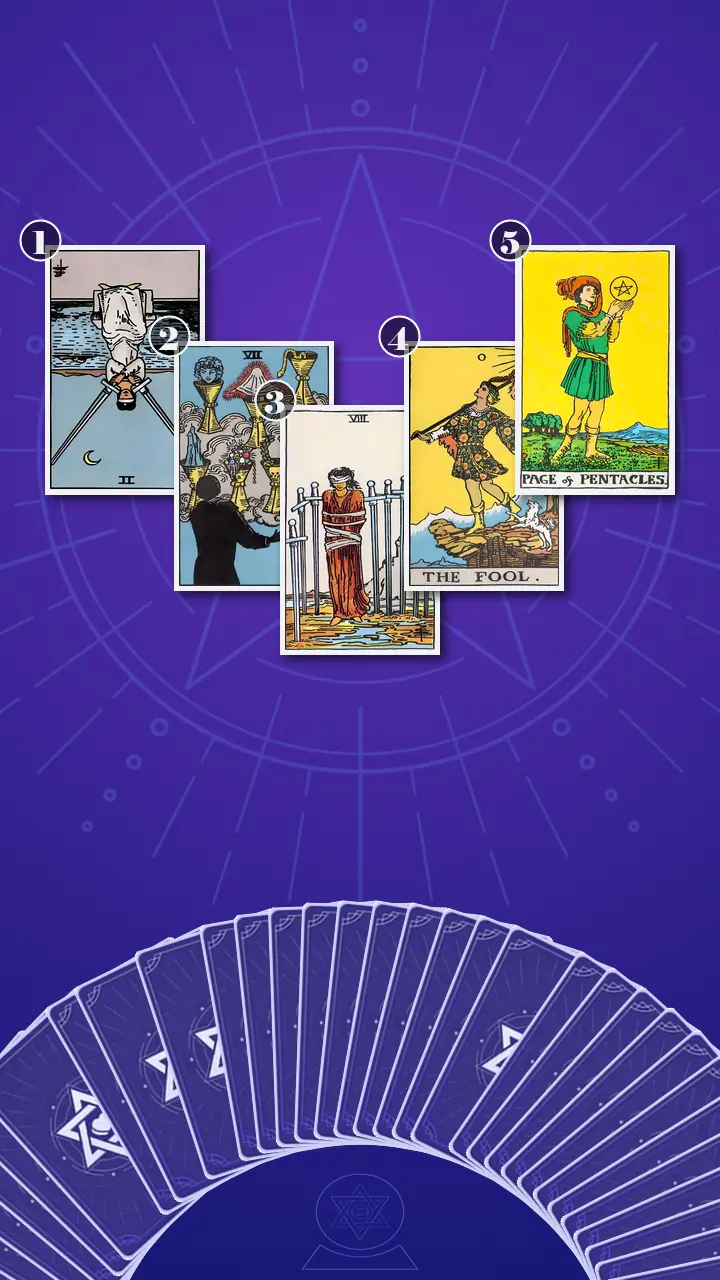
I chose a five-card layout called The Shadow Spread. For anyone wondering how tarot works in a situation like thesis decision paralysis, the value lies in separating parts of a pattern that usually arrive as one overwhelming feeling. A larger Celtic Cross could have explored external influences and long-range possibilities, but Maya did not need ten more variables. She needed the smallest map capable of showing why the choice point triggered avoidance.
I arranged the cards in a shallow V. The first three descended from the visible behaviour into its trigger and hidden fear. The final two climbed towards a reclaimed resource and one practical method of integration. The shape resembled an excavation: I would follow the avoidance down to its deepest rule, then return with something Maya could use at her desk.
I explained that the first position would show what avoidance looked like in observable behaviour. The third would uncover what made a revisable research decision feel personally dangerous. The fourth, our bridge card, would reveal a strength Maya had not yet permitted herself to use. The final position would turn the reading into an action she could complete and review.
This distinction mattered. Card meanings in context do not replace facts, supervision, or academic judgement. They organise the facts already present, make hidden assumptions easier to question, and help a person see where choice still exists. Maya would remain free to test, revise, pause, ask for support, or reject any suggestion that did not fit her reality.
Reading Down Into the Loop
Position 1: The Cursor Between Two Documents
I turned over the card representing the visible expression of Maya’s shadow pattern: the observable thesis-avoidance behaviour in which she switched between outlines, sources, and organisational tasks without selecting a provisional question.
It was the Two of Swords, reversed.
In the Rider-Waite-Smith image, a blindfolded figure holds two swords crossed tightly over her chest while rocky water waits behind her. Upright, the card can portray a controlled pause. Reversed, I read its energy as a blockage aggravated by an excess of comparison. The pause had stopped preserving space for a decision and had become a system for postponing one.
I pointed towards Maya’s shared screen. Two thesis outlines were open side by side, each containing a plausible question and a growing source list. Her cursor hovered between them as she renamed folders, reread abstracts, and tried to establish which route was objectively strongest before placing a working claim in either document. The blindfold was not a lack of intelligence. It was the attempt to avoid seeing the unavoidable cost of choosing: one option would receive attention while the others temporarily would not.
“It’s like leaving two Google Docs open and refusing to type in either because the cursor feels like a contract,” I said. “The decision system looks active, but the one action that could move the project forward remains untouched.”
Maya gave a short laugh, but no amusement reached her eyes. Her breath caught first; then she looked at the folder called “final sources actually useful”; finally, her mouth tightened into a rueful half-smile. “That’s so accurate it’s almost brutal,” she said. “I can spend two hours making everything look ready.”
I kept my answer gentle and precise. “The accuracy is not an accusation. It tells us your avoidance has a recognisable mechanism, which means it can be interrupted. What exact sentence did the organising save you from writing on Sunday?”
She rubbed one thumb along the edge of her phone. “Which question I’m choosing. Even provisionally.”
I nodded. The card was already distinguishing productive research from academically respectable avoidance. Her problem was not that she had no ideas. It was that she had built a rule requiring uncertainty to disappear before an idea could receive a paragraph.
Position 2: Seven Futures in Seven Tabs
I turned over the card representing the trigger that activated the pattern: several plausible thesis directions becoming loaded with imagined rewards, losses, and comparison pressure.
It was the Seven of Cups, upright.
Seven cups float in cloud, each displaying a different promise or threat. I read the card’s imaginative Water as being in excess. Maya’s ability to imagine consequences was useful in research, but it had overflowed its proper function. Instead of helping her form hypotheses, it was converting every topic into an elaborate forecast about recognition, originality, wasted weeks, mediocre work, and academic identity.
I asked her about the last cohort update that had unsettled her. She described scrolling through a Slack thread on the Northern line while a classmate posted a polished title and a clean chapter timeline. Before Maya had tested any of her own questions, one topic had become the impressive thesis, another the sensible but boring thesis, another the impossible thesis, and another the one an examiner might dismiss. Seven browser tabs had acquired seven emotional weather systems.
“You’re no longer comparing research questions,” I said. “You’re comparing full trailers for different versions of yourself.”
The process worked like an algorithm learning that uncertainty would keep her clicking. Each adjacent paper generated another plausible angle; each angle generated another imagined future; and the growing number of options started to look like proof that the answer must still be somewhere in the browser.
“You cannot compare your way into evidence,” I said. “You can compare scope, interest, and available literature. But you cannot discover whether a question produces a viable argument without giving it contact with a draft.”
Maya’s eyes moved towards the cohort chat notification glowing at the corner of her screen. She silenced it, then placed the phone face down. The motion was small and slightly reluctant, as though she were closing a door while still wanting to hear what happened behind it.
I asked, “Which option creates genuine research curiosity, and which one mainly promises relief from other people’s judgement?”
She paused before answering. “The safer one is easier to explain in Slack. The other one is the question I keep thinking about when nobody’s asking me for an update.”
Position 3: The Sticky Note That Became a Verdict
I turned over the card representing the concealed belief beneath the avoidance: the fear that choosing a revisable research direction could become a verdict on Maya’s judgement, capability, and worth.
It was the Eight of Swords, upright.
The card showed a blindfolded, loosely bound figure standing among eight swords. The enclosure looked severe, but it was incomplete; open ground remained visible. I read the energy as blocked Air. Analysis had stopped serving inquiry and had hardened into a rule: no writing until certainty had been verified.
I returned to a scene Maya had mentioned earlier. At 2:15 p.m. in the graduate library, she had placed a sticky note reading “FINAL QUESTION” above her laptop. The air-conditioning hummed, the screen reflected too brightly in the dark window, and her hands hovered over the keyboard. Although she knew research questions could be narrowed, revised, or replaced, the label made one provisional sentence feel like a final submission.
I asked her to complete the thought without making it academically tidy: “If I choose this and it fails, then it means…”
Her throat moved before any sound came out. Her shoulders rose, and two fingers pressed into her opposite palm. “It means I’m not as capable as everyone thinks,” she said. “It means I wasted months because I couldn’t judge the topic properly.”
That was the hidden structure. A normal research risk had become entangled with personal worth. The loose bindings mattered because the thesis did not literally prevent revision. The enclosure was maintained by a protective rule that treated every adjustment as evidence of inadequacy.
As I studied the card, I thought of twenty years of conversations held beside cooling coffee and documents labelled “final” long before they were finished. I have watched tracked changes turn supposedly permanent decisions into better ones. Academic work is built through version history. Yet fear can make a working question feel like a production release that cannot be rolled back.
“A thesis direction is a route you test, not a personality test,” I told her. “If the first route needs narrowing, that gives you information about the route. It does not deliver a character reference on you.”
Maya went very still. Her gaze lost focus as though she were replaying the library scene, then her fingers slowly separated from her palm. Her eyes shone, but her voice stayed analytical. “I know revision is allowed,” she said. “I just don’t seem to feel that it’s allowed when it’s my decision.”
“That gap is exactly what this card is showing,” I replied. “We’re not trying to argue you out of caring. We’re changing the size and meaning of the commitment so your body can experience revision as part of research, not as a confession of failure.”
When The Fool Put One Foot on the Ground
Position 4: A Route Becomes Knowable by Walking
The room seemed to settle before I turned over the bridge card. Even the radiator gave one final click and went quiet. I revealed the card representing Maya’s reclaimed resource: a beginner’s willingness to test one direction before possessing certainty about the final thesis.
It was The Fool, upright.
The figure held a white rose and carried only a small bundle while one foot lifted at the cliff edge. I did not read this as careless commitment. The missing energy had been a deficiency of embodied movement, and The Fool restored it towards balance through beginner’s courage, curiosity, and provisional action. The card asked Maya to move a bounded distance, pay attention, and let experience improve the next decision.
In Maya’s modern academic life, the raised foot became a cursor entering a fresh document. The small bundle became no more than five relevant sources. The open horizon became permission to choose one research question for a 48-hour writing experiment without declaring it final. Like taking one Tube stop towards an unfamiliar neighbourhood, the movement could be intentional without requiring a map of the whole journey.
This was where I used a method I call Syllabus Deconstruction. I removed the enormous, emotionally loaded instruction “choose the right thesis” from Maya’s task list. It was not a workable task; it was a verdict disguised as one. I replaced it with mechanical actions: open one document, type one provisional question, make one claim, attach two pieces of evidence, and stop at a scheduled review point. The Fool’s courage did not need to feel grand. It only needed a landing place precise enough for one raised foot.
I watched Maya glance from the card to the two outlines on her shared screen. She was still trying to solve the whole route from the junction, demanding a final guarantee from information that could only be produced after she moved.
You do not need a guaranteed destination before you begin; choose a testable first step and let The Fool's raised foot turn uncertainty into information.
I let the sentence settle, then made it concrete.
You do not need to know that a thesis direction is right before writing. You need a bounded draft that can show you what the direction can support. The question is a route you test, not a verdict on your worth.
Maya’s breath stopped. Her fingers hovered above the trackpad, and her gaze slipped past the cards towards the dark kitchen window, as if she were replaying every Sunday night she had mistaken delay for diligence. Her pupils widened; colour rose around her eyes. Then came not relief but a sharp flash of anger. “But doesn’t that mean I was wrong this whole time?” she asked, her voice low and tight. I told her no: the loop had been protection, not stupidity, and protection can be thanked before it is retired. Her shoulders dropped by a few centimetres; her clenched hand opened; one unsteady breath left her chest. The release carried a brief blankness too, the vulnerable realisation that a clearer path would ask her to choose. I then asked, “Using this new perspective, was there a moment last week when this insight could have made you feel different?”
“After my supervisor said both questions were viable,” she said. “I treated that as no help. But maybe it meant I had permission to test either one.”
I set a deliberately small experiment while we were still on the call. For ten minutes, Maya would write one provisional question, one possible claim, and one piece of evidence beneath it. She would stop when the timer ended and record one thing the writing revealed. She did not have to decide the whole thesis that night. If a paragraph felt too exposed, she could use 100 words or three bullet points. If the exercise became overwhelming, she could close the document and choose another time. Continuing remained her decision.
She closed nine browser tabs. The remaining document cast less glare across her face, and the cursor began pulsing beside the words “48-hour thesis prototype.” I heard three tentative keystrokes through the call.
“So the choice isn’t certainty versus chaos,” she said. “It’s comparison versus contact with evidence.”
“Exactly,” I replied. “The draft is not proof that you chose well; it is how you find out what the choice can support.”
This was the first meaningful movement from pressured indecision, guilt, and self-doubt towards curiosity and grounded confidence. Maya had not acquired certainty. She had separated uncertainty from self-condemnation and given it a practical job: generate information through writing.
Position 5: One Claim Held at Eye Level
I turned over the card representing practical integration: focusing on one working question, one limited evidence set, and one small draft capable of generating feedback.
It was the Page of Pentacles, upright.
The Page held a single pentacle at eye level while cultivated fields and distant mountains remained in view. I read this as Earth moving towards balance: disciplined learning, focused attention, and judgement built through contact with a tangible object. The wider landscape did not disappear, but the Page did not attempt to hold every field and mountain at once.
For Maya, the pentacle became one concrete research object: one provisional question, no more than five sources, and a 300-word argument containing one claim, two evidence points, and one sentence naming what remained unclear. She would close the comparison spreadsheet and inspect what this draft supported, where it lost traction, and what the next manageable task should be.
“This is the apprentice after the explorer,” I said. “The Fool begins before the whole route is known. The Page pays attention to what the first stretch actually contains.”
I also noted what the spread did not contain. There was no Wands card promising a rush of inspiration. I did not tell Maya to wait until she felt motivated. We would create the missing Fire behaviourally with a short deadline, a visible finish line, and a review time. Momentum would come from completing a bounded task, not from trying to summon the perfect academic mood.
Maya looked down at the line she had just typed. Her lips parted, then closed as she read it again. “It’s rough,” she said.
“Good,” I replied. “Rough is inspectable. Blank is not.”
She nodded once, more cautiously than triumphantly. The cards had not selected her thesis topic. They had shown the sequence through which two viable ideas became seven imagined futures, then eight restrictive rules. The Fool interrupted the sequence with movement, and the Page gave that movement a form she could evaluate.
The 48-Hour Route Test
I drew the reading together as one coherent story. Maya’s careful preparation had begun as an attempt to avoid wasting time and exposing weak judgement. At the desk, that protection appeared as two open outlines, extra database searches, folder organisation, and repeated requests for reassurance. Progress updates and open-ended feedback then loaded each option with imagined praise or failure. Beneath the comparison sat the rule that a capable researcher should know the strongest direction before drafting. Because she withheld the draft, she received no new evidence; because she received no new evidence, the empty page seemed to confirm that more preparation was necessary.
The London-junction image captured the full loop. Maya had been standing on the pavement, trying to inspect every road without walking far enough down one to see what it contained. Her cognitive blind spot was the assumption that additional comparison automatically produced clarity. It did not. Comparison could organise known information, but the missing information lived inside the act she was avoiding.
The transformation direction was therefore specific: move from identifying the perfect thesis direction in advance to choosing one provisional question, testing it in a bounded argument, and reviewing the evidence afterwards. Changing the question after testing it would be research information, not a confession of failure.
Before setting the writing plan, I asked Maya to angle her camera towards the table. I used a second diagnostic lens, Study Environment Auditing, to identify the physical and digital signals consuming her psychological bandwidth. I saw two notebooks, old seminar handouts, the phone beside the keyboard, Slack notifications, the comparison spreadsheet, and tabs from three databases. None was harmful by itself. Together they kept every possible route visually present, so the room repeatedly prompted Maya to reopen the decision.
I converted the cards into three pieces of actionable advice:
- The 15-Minute Desktop Reset Ritual At the start of the next thesis session in the shared-flat kitchen or library, spend exactly 15 minutes clearing unrelated papers, closing Slack and LinkedIn, moving the phone out of reach, and leaving only the two current directions visible. When the timer ends, stop clearing and begin the decision task. Tip: The reset is a runway, not a new form of procrastination. Do not redesign Notion, rename folders, or continue tidying after 15 minutes.
- The Three-Criteria Choice Check Write the two strongest directions on one page. Set a 20-minute timer and score each from 1 to 5 against only genuine interest, evidence already available, and manageable scope. Choose the higher-traction option as the working route for 48 hours, write the review date at the top of the document, and close the comparison table until then. Tip: Do not add a fourth criterion during the timer. The 48-hour choice is a boundary around an experiment, not a promise to finish the thesis on that route.
- The One-Question, One-Draft Rule Create a document titled “48-hour thesis prototype.” Using no more than five sources, write up to 300 words containing one provisional claim, two evidence points, and one unresolved question. After 48 hours, read it once without editing, highlight the clearest sentence, and record what is supported, what is unclear, and what needs narrowing. Tip: If 300 words feels too exposed after a research-assistant shift, write 100 words or three bullet points. Keep the review to 15 minutes and schedule only one next action.
Maya raised an immediate practical objection. “After work, I sometimes don’t have 300 coherent words in me. Even ten minutes can turn into me staring at the screen.”
I adjusted the plan rather than defending it. “Then your minimum version is one question, one claim fragment, and one source pasted beneath it. Five minutes is enough to create an object for tomorrow’s Maya to inspect. If your concentration is gone, stopping is data too. You can reschedule, contact your supervisor or writing adviser, or use academic wellbeing support. The exercise serves you; you do not owe the exercise obedience.”
I asked her to repeat the review rule in her own words.
“One draft, one review, one next step,” she said. “And I don’t reopen the other route before the review date.”
That boundary gave the reversed Two of Swords a healthier container. It avoided both extremes: endless comparison and a panicked one-night ultimatum. It also grounded The Fool’s openness in the Page’s practical discipline. One bounded draft could tell Maya more than eleven open tabs because it would produce evidence rather than another imagined outcome.
The five-card Shadow Spread had done its job when it became unnecessary. Maya now had a 48-hour thesis prototype and evidence review she could use without consulting another card. The map belonged to her, and so did the choice of whether, when, and how to walk the next stretch.

Six Days Later, One Document Stayed Open
Six days later, I received a screenshot: one document, 327 words, and one highlighted claim. Maya had slept through the night, though her first thought on waking was still, “What if it’s wrong?” She told me she smiled, opened the draft, and changed wrong to needs narrowing.
Her prototype had not proved that the entire direction would work. It had shown that one part of the question was too broad, one source cluster had real traction, and a narrower claim made her want to keep reading. She scheduled a supervisor conversation around those findings instead of asking, “Which topic should I choose?”
I noticed the difference in the language of her message. She did not say the cards had solved her thesis. She said, “I finally have something specific enough to disagree with.” That was grounded confidence in its earliest form: not certainty, but trust that she could make a provisional decision, observe the result, and revise without turning revision into a judgement on her worth.
I thought back to the Sunday-night screen with two outlines, eleven tabs, and no sentence willing to bear the weight of being first. The journey to clarity had not ended with a perfect title or a guaranteed destination. It had begun when Maya reclaimed the authority to treat a direction as a working route and let her own draft generate the next piece of guidance.
If your chest tightens over two viable thesis questions and your hand drifts towards renaming a Zotero folder, I hope you remember this: keeping every route open can feel safer than risking a weak draft, but noticing that protective move already gives you a choice you did not have while it remained invisible.
If one thesis question could be a 48-hour experiment rather than a verdict, what small piece of evidence would you be curious to let one bounded draft show you?