Twelve Study-Advice Tabs, One Untouched PDF, Then Three Recall Pages

The 8:10 p.m. Productivity-Procrastination Spiral
If you have ever said, “I have a study plan for making a study plan,” you may know the tab spiral where one evidence-based study video becomes Reddit threads, app reviews, and a page-one PDF that never moves.
At 8:10 p.m. on a Tuesday, Alex (name changed for privacy) joined my video consultation from a small Toronto apartment near campus. They were twenty-two, in their final year, and trying to protect a narrow study window between a full course load and hospitality shifts. A radiator hissed behind them. On their laptop, a difficult course reading occupied the left side of the screen while a five-minute study-method video played on the right; the fan blew warm air against their wrists as another recommended tab opened.
“I sat down to finish this reading,” Alex said. “I told myself I would check one quick thing about active recall first. Now I have twelve tabs, three saved routines, and a new Notion dashboard. The PDF is still on page one.”
I watched their jaw tighten as they looked at the untouched article. Their shoulders had risen toward their ears, and their fingers kept making small, restless passes over the trackpad. The feeling was not a vague cloud of stress. It was more like standing at the edge of cold water while every thumbnail on the screen offered a warmer route around it.
“I genuinely want to study,” Alex told me. “I just need to find the method that will actually work for me. My evenings are limited. I cannot afford to waste one doing it wrong.”
There was the contradiction in one sentence: Alex wanted real academic progress, but beginning without one more piece of advice felt like allowing an imperfect attempt to testify about their ability. Research promised control without exposure. Practice offered useful evidence, but only after the uncomfortable first contact.
I named the pattern only after the scene had earned the name: productivity-content procrastination, caused here by collecting and comparing study advice instead of starting coursework. It was not laziness, and I did not want to shame the intelligence or curiosity inside it. Alex had found a sophisticated way to stay mentally active while postponing the moment their work became visible.
“The tabs are offering relief, not readiness,” I said. “That relief makes sense. It also has a cost. Let us use the cards to map the loop clearly enough that you can decide where to interrupt it. We are looking for clarity, not a verdict about what kind of student you are.”
Choosing the Smallest Useful Map
I invited Alex to place both feet on the floor, take one unforced breath, and hold the question in ordinary language: “Why do I keep collecting study advice instead of starting?” I shuffled slowly, using the movement as a boundary between replaying the problem and examining it. Nothing supernatural had to happen for the pause to be useful.
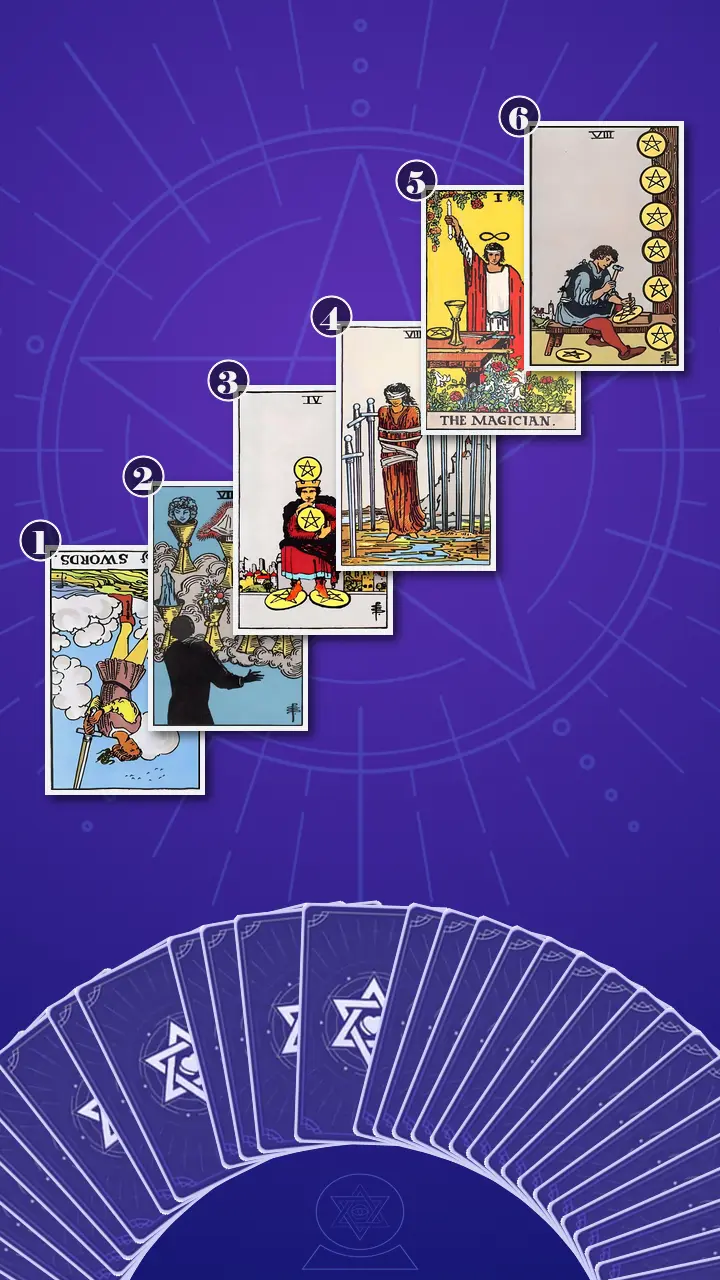
I chose the Four-Layer Insight Ladder - Context Edition, a six-card tarot spread for deconstructing the study-advice procrastination loop. This is how tarot works in my practice: not as a prediction engine and not as an authority that makes a choice for someone, but as an external decision map. The images give us stable objects to examine, making it easier to separate a trigger, a protective response, a fear, and an available action that may otherwise arrive as one tangled feeling.
A larger Celtic Cross could have held the subject, but it would have added more positions than this focused question needed. A simple problem-obstacle-advice spread would have compressed too much. Alex's pattern had several distinct links: uncertainty triggered research; research delivered temporary control; delayed practice increased pressure; and the pressure then appeared to justify more research. Six positions were the smallest useful structure for seeing that complete system without pretending to forecast an academic outcome.
I arranged the cards as an ascending staircase from lower left to upper right. The first card would show the behaviour visible on Alex's screen. The two cards in the root layer would reveal what that behaviour protected and what it cost. A larger space before the fifth card would mark the leverage point, while the final card would show how insight could become a repeatable experiment. The layout did not promise a leap into instant mastery. It pictured a staircase built from small acts.
Reading the Staircase From Tabs to Fear
Position 1: The Sword in the Tab Spiral
I turned over the card representing the observable stuck behaviour: opening, saving, and organising study advice instead of engaging with the assigned work. It was the Page of Swords, reversed.
In the Rider-Waite-Smith image, the Page raises a sword while wind pulls at their hair and clothes. The mind is awake, but the stance is unstable. Reversed, I read that energy here as excess curiosity combined with a deficiency of direction. Alex did not lack mental energy. Their attention simply kept changing objects before any one object could receive sustained effort.
“This is your 8:10 p.m. screen,” I said. “You open one difficult reading, tell yourself you will watch one short video about approaching it, and forty minutes later the PDF is still on page one. Twelve tabs, three saved routines, and a rebuilt dashboard show intense curiosity, but none of that curiosity has been assigned to the coursework.”
I framed the Page's windblown sword as a cursor moving through YouTube recommendations, Reddit threads, StudyTok clips, and half-open templates. The internal line underneath it was painfully reasonable: “I am technically doing something related to studying, so why does the assignment still look exactly the same?”
Alex gave a short laugh, but there was no amusement in it. “That is so accurate it feels a little rude.”
I smiled gently. “Accuracy is not accusation. The card is not calling you unserious. It is showing that a strength - your drive to understand - has become excessive and scattered under pressure. The opposite of scattered is not stricter. It is specific. Building an even more elaborate dashboard would only give the same wind a more expensive container.”
The laugh faded. Alex looked at their tab bar and closed none of it yet, but their restless hand came to rest beside the laptop. That small pause told me recognition had arrived without collapsing into shame.
Position 2: Seven Perfect Futures on One Screen
I turned over the card representing the immediate blockage: multiple attractive methods creating choice overload at the exact moment Alex was expected to begin. It was the Seven of Cups, upright.
Seven cups hovered in clouds, each displaying a different promise. I mapped them to the crowded screen Alex knew: active recall, spaced repetition, colour-coded notes, video summaries, Anki, Quizlet, an elaborate planner, and a study-with-me stream running somewhere behind them all. The energy was an excess of imagined possibility and a deficiency of tested choice.
“Each method looks capable of rescuing the semester before it meets the actual assignment,” I said. “Choosing one then feels like losing the benefits promised by all the others. It is like scrolling a streaming menu for the length of a film. Every unchosen title retains a perfect future because none has had time to disappoint you.”
Alex pressed a hand briefly against the centre of their chest. “The thought is always, if I choose the wrong one, I will waste the little time I have.”
“That fear is grounded in a real constraint,” I replied. “Your post-shift evenings are scarce. But comparison is spending the hour in advance. A study system earns trust by surviving contact with an actual study session, not by looking convincing in someone else's polished Instagram Story.”
I asked which method was simple enough to meet tonight's reading, rather than which method could guarantee the ideal future version of Alex. Their eyes moved from the card to the PDF. “Probably just reading a subsection and trying to write what I remember,” they said. It was not a grand answer. That was precisely why it was usable.
Position 3: The Archive That Could Not Move
I turned over the card representing the loop's protective payoff and cost: collecting information briefly restored control while leaving the study task untouched and increasing later pressure. It was the Four of Pentacles, upright.
The figure clutched one pentacle to the chest and pinned two beneath their feet. I read the Earth energy as over-concentrated: security had hardened into immobility. Alex kept every template, app trial, bookmarked thread, and friend's recommendation available because deleting or ignoring one felt like discarding a possible answer.
“The archive gives you something real for five minutes,” I said. “You feel as if you possess the solution. But saved advice cannot be spent as completed practice. Holding every option makes it harder to place either foot on the next step.”
Alex rubbed the edge of their phone case with one thumb. “When I save something, I get this tiny drop of relief. Then I see how much I have saved, and it feels like another syllabus I am behind on.”
That was the exchange the card exposed: immediate control in return for later pressure. The behaviour persisted not because it worked academically, but because it worked emotionally for a few minutes. I asked Alex to notice that distinction without turning it into another reason for self-criticism.
Position 4: The Permission Rule Behind the Blindfold
I turned over the card representing the underlying fear: that imperfect action might reveal weak ability and reduce Alex's sense of control or worth as a learner. It was the Eight of Swords, upright.
I pointed to three details. The blindfold was the prediction, “A rough attempt will expose what I cannot do.” The loose bindings were the small actions still available. The incomplete ring of swords was the paragraph, question, or rough answer Alex could approach even while discomfort remained. The restriction was emotionally real, but it was not total.
Here, Air had become a blockage. The mind had created an internal permission rule: no beginning until the correct method, sequence, mood, and amount of time were known. The open PDF remained physically reachable, yet uncertainty was interpreted as proof that Alex was not equipped to touch it.
“When you picture writing a weak first answer tonight,” I asked, “what are you afraid it would prove?”
Alex's breathing paused. Their fingers hovered above the trackpad, then curled slowly into their sleeve. Their gaze went unfocused before returning to the card. “That I am in final year and somehow still do not know how to do this,” they said quietly. “That everyone else learned how to learn, and I am still researching the basics.”
“That is the feared verdict,” I said. “But a first paragraph cannot carry that authority unless you give it the job of judging your whole identity. Its proper job is much smaller: showing what you understand, where the gap is, and what question is now specific enough to ask.”
I let the words settle before adding, “Your first attempt is data, not a verdict. Genuine discomfort can be present while a limited action remains available. You do not have to call the path easy in order to notice that one paragraph of it is open.”
When The Magician Gave Every Tool One Job
Position 5: The One-Click Threshold
The radiator behind Alex gave one last metallic knock and fell quiet. I crossed the larger gap in the staircase and turned over the card representing the leverage point: using available tools for one bounded action instead of treating more advice as permission to start. It was The Magician, upright, the key card of the reading.
The Magician's table already held the four suit tools. I translated that table into Alex's minimum viable study setup: the course text, one blank document, a timer, and a pen. The card did not claim Alex possessed every resource they might ever need. It showed enough available capacity for one defined experiment, with room to seek targeted support after the attempt revealed a real question.
The energy here was balanced coordination. Air could define the task. Fire could initiate it. Water could tolerate the discomfort. Earth could leave behind a visible artefact. The missing thing was not another tool; it was a clear job for one tool.
Alex was caught in a familiar equation: at 8:10 the reading and study video sat side by side; forty minutes later, twelve tabs were open, the fan was hot, and page one was untouched. Activity had protected them from failure while guilt kept the search running.
Readiness is not hidden in the next saved post; it grows when you put the tools already on your table into use, as The Magician does.
I paused, then translated the same insight into the smallest possible unit: Readiness is not hiding in the next saved post. It grows when one tool already on your desk produces one imperfect piece of evidence.
For a second, Alex stopped breathing. Their right index finger, which had been circling the trackpad, held still above it; their eyebrows lifted and their pupils widened. Then their gaze slipped past the cards toward the open PDF, as though several Tuesday nights were replaying across the screen. Their jaw worked once. Their shoulders did not relax yet.
“But does that not mean I have been doing it wrong all semester?” they said, sharper than before. “Like I wasted all that time?”
I let the anger have room. “It means the strategy protected you from a feared verdict and charged a high price. That is information, not an indictment. You made the best trade you could see while uncertainty was loud. Now you can choose a different one.”
Their fist loosened inside their sleeve, one finger at a time. A long breath left their chest; their eyes reddened slightly, and then they gave a small, almost disoriented laugh. Their shoulders finally dropped. The relief came with a moment of blankness I recognised: once certainty was no longer the entry requirement, Alex had to own the next move. Clarity had removed one burden and revealed a new responsibility.
“Now, with this new perspective, think back to last week,” I said. “Was there a moment when this insight might have changed how the situation felt?”
Alex looked down. “After my Thursday shift. I wrote one line of an essay answer, hated it, and searched for frameworks until after midnight. If the line had only been data, I could have kept it long enough to see what was missing.”
I felt an old Wall Street memory surface: analysts surrounding an uncertain decision with more reports, as if volume could replace a criterion. The commercial lesson was never that information lacked value. It was that every extra input consumed time and attention, and its return had to be measured against what it changed.
“I use a framework called Academic ROI Auditing,” I told Alex. “Usually I use it to assess the strategic yield of a degree, a major pivot, or a high-investment research direction. Here, we can reduce the unit. Every new study method costs minutes and attention. Its return is not how organised it makes you feel or how polished the creator's dashboard looks. Its return is whether it helps you produce, understand, or revise something in your actual course.”
I gestured toward the Magician's table. “Until a method touches the material, its academic return is untested. You do not need to condemn the advice or delete everything. You need to deploy one existing resource and observe its yield. Think of your hospitality mise en place: the tools on the station become useful when each is assigned to the next ticket, not when they are rearranged for forty more minutes.”
The metaphor landed. Alex glanced at the blank document beside the PDF. “So the document's job could be five terrible recall bullets.”
“Exactly. Within the next ten minutes, method questions can go into a note called Later Review. Recommendation tabs can close. Then you can give one subsection and one blank document twenty-five minutes together. If twenty-five minutes is inaccessible tonight, use five and stop without calling the experiment a failure. You decide whether to continue, pause, or seek clarification.”
This was the central emotional transformation: from anticipatory anxiety and perfectionistic preparation to focused agency and grounded self-trust through direct practice. It was not complete confidence, and it did not require anxiety to disappear. It was one small crossing from waiting for external permission to directing an available tool.
Position 6: Structure That Practices Instead of Restricts
I turned over the final card, representing the repeatable experiment through which the shift could be tested: completing one twenty-five-minute study task before seeking new advice and evaluating the method only after several attempts. It was the Eight of Pentacles, upright.
The craftsperson worked on one pentacle while earlier pieces remained visible nearby. I mapped those pieces to three dated, imperfect study artefacts: a rough recall page, an attempted problem, and a short error log. The card's Earth energy was balanced and grounded. Progress was no longer an imagined perfect system; it was a series of objects Alex could inspect.
I placed the final card beside the Eight of Swords. The repeated number mattered. In the first eight, structure had become restrictive: rules about readiness surrounded Alex. In the second, structure became practising structure: one task repeated long enough to build skill and produce evidence. The desire for order was not the enemy. Its job needed to change.
“I will judge the method after it has met the work more than once,” I said. “One awkward session is not sufficient evidence that the method failed, and it is certainly not evidence that you failed. Three sessions create a fairer review point.”
Alex nodded slowly and began closing tabs. The cursor moved from an “open in new tab” link to the small close icon, then stopped in the first blank line of the document. I did not mistake that one click for a transformed life. I saw it for what it was: a clear, observable change in where attention had been placed.
One Tool, One Task, One Artefact
I drew the six cards back into one coherent story. The reversed Page showed mental energy scattered across advice. The Seven of Cups showed why choosing felt expensive when every untested method still promised rescue. The Four of Pentacles revealed the short-term payoff: saving and organising restored control. The Eight of Swords exposed the deeper fear that rough work might become a verdict on Alex's ability. The Magician redirected existing capacity toward one bounded act, and the Eight of Pentacles gave that act a fair period of repetition.
Alex had been standing in a library reading maps to the same desk without sitting down. The maps were not fraudulent, and some might eventually be useful. The cognitive blind spot was treating possession of information as readiness, while treating the discomfort of practice as evidence of incapacity. The tabs lowered tension briefly, but only contact with the assignment could produce the evidence Alex kept asking advice to provide in advance.
The shift was therefore precise: move from researching the ideal study system to completing one twenty-five-minute study task before consuming new advice. Advice could remain available, but it would become occasional support for a specific problem rather than an entry requirement for beginning.
To keep that shift practical, I introduced The Research Sunk-Cost Audit. The framework does not ask Alex to continue with a method merely because they have already invested time in it, and it does not encourage abandoning a reasonable method after one uncomfortable session. It establishes a review point and asks three commercial questions: What did the method produce? Where did friction appear? What single adjustment does the evidence support?
- The Advice-After-Practice BoundaryOn the next study evening, at home or in the campus library, open one course text and one blank document. Put every new method question into a phone note titled Later Review without opening a search result. Close recommendation tabs, set a twenty-five-minute timer, and give the document one job: hold five rough recall bullets from one subsection.If twenty-five minutes feels inaccessible, use five minutes and stop there. The boundary is behavioural, not moral; essential instructions, accessibility needs, and necessary clarification remain valid reasons to seek information.
- The Three-Session Method TrialUse the same course and basic process for three separate sessions before switching systems. After each block, record only three observations in a plain note: what I attempted, where I got stuck, and what helped me continue. Keep the three dated artefacts together, then spend ten minutes after session three choosing one specific adjustment.One awkward session may trigger the urge to rebuild everything. Place that urge on Later Review and wait for the agreed audit point; the outcome can be keep, adjust, or drop, and none of those choices is a character judgement.
I wrote one sentence beneath the actions and held it up to the camera: One tool, one task, one artefact. This six-card insight ladder had not selected a perfect study method for Alex. It had done something more defensible: shown why the search kept restarting, identified the leverage point, and produced next steps that Alex could test against real coursework.

A Week Later: Three Imperfect Pages
Six days later, I received a message from Alex with a photo of three dated recall pages. The handwriting was uneven. One page contained arrows, crossed-out definitions, and a blunt note reading, “I do not understand this transition.” That sentence had become a targeted question for their teaching assistant rather than a reason to download another complete system.
“I still wanted to search during every session,” Alex wrote. “I put the questions in Later Review. By the third block, I knew what I actually needed help with. Most of the saved advice had nothing to do with that problem.”
Their dashboard was not beautifully redesigned, and the coursework was not magically finished. Alex had simply allowed one method to make contact with the material three times. That was enough to replace imagined certainty with direct evidence.
They added one more line: “I slept properly after the third session. The first thought the next morning was still, what if I chose the wrong method? I laughed, opened the file, and did the next subsection anyway.”
I read that message as the quiet proof of our Journey to Clarity. The cards had not rescued Alex, granted readiness, or guaranteed a result. They had made the avoidance loop visible. Alex supplied the agency by closing a tab, tolerating a rough page, and returning for another bounded attempt.
Many of us know the moment when the reading is open but our hand reaches for another tab, because keeping the search alive can feel safer in the body than letting one rough attempt make our ability visible. Merely noticing that reach before the next click means the loop is no longer completely invisible.
If your next attempt only had to leave one small piece of evidence, rather than prove what kind of student you are, what would you place on your own Magician's table and let yourself make in twenty-five minutes before opening another tab?