Productive Procrastination at the Twelve-Tab Desk: One Evidence Block

The Twelve-Tab Desk: Finding Clarity Beyond Productive Procrastination
I am Hilary Cromwell, and I recognized the pattern before Maya (name changed for privacy) sat down: a second-year university student in Toronto balancing lectures with a part-time service job, opening a study-method video before the assigned chapter on Sunday night and calling it preparation, even though the search underneath it was productive procrastination.
At 8:15 p.m. on Tuesday, her textbook lay open beside a laptop glowing with twelve tabs comparing active recall apps. The apartment fan hummed through the thin walls, her phone felt warm in her palm, and her jaw tightened as she renamed another study folder. She wanted to begin before the evening disappeared, but making the workspace look ready felt safer than finding out whether she could answer the first question.
She looked at me and said, I have a whole folder about studying and almost nothing studied. Then she asked the question that had brought her to my consulting room: why did she keep researching study methods instead of starting?
I watched her fingers move restlessly across the phone even after she had set it down. I did not mistake that movement for laziness. You are not avoiding effort; you are spending effort where it cannot give you feedback. I told her that our Journey to Clarity would not be about finding a magical routine or forcing confidence. We would make a map of the loop, identify what it was protecting, and return the choice to her.

Choosing a Compass in the Shadow
I invited Maya to take three slow breaths and name the actual course task waiting on her desk. I shuffled slowly while she held the question in mind, treating the preparation as a psychological transition from scrolling and comparing into deliberate attention, not as a supernatural test.
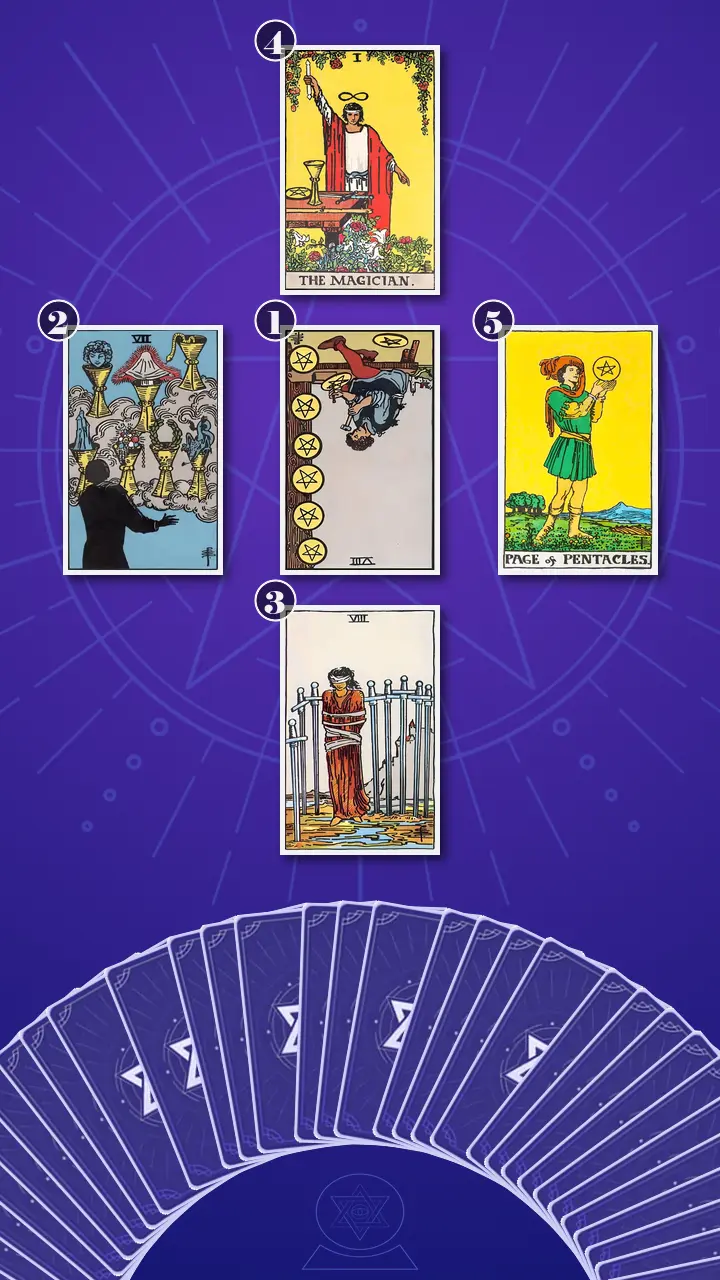
For this question, I chose the five-card Shadow Spread. This is how tarot works in this reading: the cards provide an organised set of images for examining behaviour, protection, fear, agency, and a practical next step. I read card meanings in context, as a non-predictive tool for self-exploration, rather than as a verdict about grades, intelligence, or fate.
The Shadow Spread suited Maya because her visible procrastination was being maintained by a protective research ritual and an untested fear of weak results. The first position would show the study-procrastination pattern currently visible. The second would ask what keeping every method open protected her from. The third would descend to the root belief. The fourth would reveal the capacity she could reclaim, and the fifth would turn that insight into a bounded study practice.
I placed the cards in a cross: the centre for the behaviour she could name, the left side for its hidden purpose, the lower point for the fear beneath it, the upper point for the resource waiting to be used, and the right side for integration. The shape gave us a compass, but Maya remained the person choosing where to walk.
The Workbench That Never Reaches the Page
Position 1: The Visible Pattern
I said, Now turning over is the card representing the visible study-procrastination pattern: repeated method research, planning, and workspace refinement replacing direct contact with course material. I turned over the Eight of Pentacles, reversed position.
In the Rider-Waite-Smith image, an artisan works at a bench while completed pentacles hang in an orderly row. I saw the modern version immediately in Maya's desk: every renamed folder, rebuilt Notion tracker, and saved StudyTok video had become a small finished pentacle. The workbench was busy, but the textbook and practice questions remained untouched.
Reversed, the earth energy was not absent. It was blocked and misdirected. Maya possessed genuine dedication, but she was applying disciplined attention to the architecture of studying rather than to the subject itself. Her effort was real; it simply was not yet producing contact with the material. I explained that the card did not ask her to become more disciplined. It asked her to aim the discipline at a completed output, such as ten questions answered, rather than at a more sophisticated method.
Maya gave a short, bitter laugh and rubbed the side of her jaw. That is a little brutal, she said. I let the sentence stand for a moment before answering. I hear the sting. The card is describing where your effort lands, not making a judgement about your character. That distinction matters. Her shoulders lowered slightly, and she looked at the unopened chapter instead of the laptop.
Position 2: The Options That Stay in the Clouds
I told Maya, Now turning over is the card for the hidden protective function of keeping multiple study methods open. The Seven of Cups appeared upright.
The figure in the card faces seven cloud-borne cups, each offering a different promise. I connected it to the screen she had described: Anki, Quizlet, handwritten notes, mind maps, timed sessions, and several saved templates, all held open as possible futures. She had told me, Every method looks convincing until I try to commit to one. If I choose one, I lose the chance that another system would have worked better.
Here the water energy was excessive and diffuse. Choice proliferation allowed Maya to imagine becoming efficient without receiving present evidence about what she understood. A difficult chapter could trigger another summary, another comparison, or another search for the best study method. The cycle worked like an algorithm feed that served a fresh study system every time the previous one became uncomfortable. Research feels productive because it postpones the one result she is afraid to see.
I asked what the options were protecting her from. Maya stared at the seven cups, then placed her thumb against the edge of the card. Having to see whether I actually know anything, I guess, she said. I noticed the relief and disappointment arrive together: the explanation gave her something solid to recognise, but it also removed the comforting story that one more comparison would solve everything.
Position 3: The Rule Behind the Blindfold
I said, Now turning over is the card for the root belief and core fear sustaining the pattern. The Eight of Swords appeared upright.
I returned us to the desk at 9:40 p.m. in her shared apartment. Her notes, textbook, and practice sheet were within reach. She could feel the chair beneath her legs and hear one roommate washing dishes, yet she kept scrolling through method reviews. The blindfold in the card became the untested rule that she could not begin until she knew the correct method. The loose bindings mattered too: the enclosure looked complete from inside, but an opening remained.
This was air energy in blockage. Thought had stopped being a tool for clear comparison and had become a cage of predictions, self-monitoring, and fear of wasted effort. I said plainly, The thought I need the best method is a prediction, not evidence. One difficult question could produce an imperfect answer, but it could not by itself prove that Maya was incapable of managing university.
I asked her to finish the sentence that seemed to be running the whole evening. Her breath stopped halfway, and her index finger hovered above the phone. Then her gaze went unfocused, as if the same moment had started playing again somewhere behind her eyes. Finally, she swallowed and said, If I start with this and it goes badly, it will prove I cannot manage this properly. I answered, One imperfect session can show what needs learning. It cannot deliver the permanent verdict your fear is asking it to deliver. Her fingers loosened around the phone, though her face still held the ache of having been understood too precisely.
When The Magician Put One Tool on the Table
Position 4: The Capacity to Reclaim
The room grew unusually quiet as I reached for the fourth card. Even the fan seemed to recede behind the sound of the paper sliding across the table.
I said, Now turning over is the card for the constructive capacity Maya can reclaim from the shadow: directing existing tools toward one intentional experiment instead of consuming more options. The Magician appeared upright, and this was the key card of the reading.
The Magician did not offer Maya another system to compare. The raised wand, lowered hand, and four suit tools arranged on the table showed intention becoming practical use. Her textbook, a timer, a blank page, and her own attention were already enough to create a test. Focused agency did not require confidence first; it required a deliberate direction for the tools already available.
I used my Research Bottleneck Analysis here. I do not treat a creative or intellectual block as a personal failure. I treat it as a signal that something deeper needs excavation. I also drew on my signature Academic Stratigraphy, the way I structure fragmented knowledge into a durable framework: surface tabs, hidden choice protection, the root rule about control, then the resource waiting underneath. For one second, I was back on an archaeological dig, separating scattered fragments by layer. The pieces were not useless because they were confused. They needed a structure that made their relationship visible.
The Sentence Beneath the Tabs
At 8:15 p.m. in the small Toronto apartment, Maya has a textbook open, twelve tabs comparing active recall apps, and a jaw that will not unclench. Forty minutes later, the folders are renamed, the first question is untouched, and preparation has quietly become the safer task.
You are not waiting for the perfect tool; choose one tool already on the table, use it on a real task, and let The Magician's focused hands replace endless comparison.
For several seconds, Maya did not move. Her pupils widened, and her fingers stayed suspended over the keyboard. Then she looked down at the blank sheet, and I saw the rule meet a real choice. Her jaw loosened by a fraction. She drew in a breath that trembled on the way out, closed the first comparison tab, and left the textbook visible. The cursor moved from another review video toward the first practice question. Her shoulders dropped, but the release made her sit slightly unsteady, as if setting down a weight had briefly changed her balance. She gave a quiet, disbelieving laugh. I am not waiting for a system to make me capable; I am using one tool to find out what I know. The room remained quiet around that sentence. It was not a burst of certainty. It was the first movement from contracted uncertainty toward curiosity, followed by the vulnerable recognition that action would now create evidence she could no longer avoid. I asked her to treat that vulnerability as information, not as a reason to retreat.
Now, using this new view, was there any moment last week when this insight could have made you feel different?
Maya thought of a dense practice question she had abandoned after two lines. This time she could picture the textbook, a blank sheet, and a ten-minute boundary without imagining that the choice had to govern the entire semester. The Magician had not promised an easy result. He had made the next result available.
The First Pentacle of Practice
Position 5: The Grounded Integration
I said, Now turning over is the card for the grounded integration step: completing one bounded study block, recording the output, and adjusting only after reviewing evidence. The Page of Pentacles appeared upright.
The Page studied one pentacle while the wider field and distant mountain remained in view but secondary. I explained that this was not a demand for mastery or a permanent productivity makeover. It was permission to become a serious beginner: hold one learning task steadily, complete something observable, and let the result teach the next decision.
For Maya, that could mean answering ten retrieval questions, explaining one concept in five sentences, or annotating two pages. The Page's earth was balanced: small enough to begin, real enough to count. It turned the Magician's broad agency into a repeatable experiment. Maya nodded, not triumphantly, but with the careful attention of someone checking whether a new idea could survive contact with an ordinary Tuesday night.
A Map Made of Evidence
When I placed the five cards together, the story became clear. The reversed Eight of Pentacles showed effort trapped in the study system's architecture. The Seven of Cups explained why comparison felt protective: every method could remain a possible rescue as long as none had to face real work. The Eight of Swords revealed the rule underneath, that an imperfect start might expose a loss of control. The Magician reclaimed the ability to direct what was already on the table, and the Page of Pentacles gave that ability a modest, repeatable form.
The repeated Eights linked the problem in an important way. Maya's wish to become competent had turned repetition into a closed loop: repeated setup on one side, repeated self-restriction on the other. The blind spot was treating method selection as a prerequisite for evidence, when evidence could only arrive after a method met a real question. The transformation direction was therefore not from poor discipline to perfect discipline. It was from selecting a perfect method in advance to testing one workable method for a fixed block and evaluating it through completed-work evidence.
I told Maya that the practical solution was a one-tool evidence block, supported by a simple rule: let the next study decision be small enough to test and real enough to count. For an essay task, I offered my Thesis Stratigraphy Framework. It was not another dashboard. It was one page with the course question at the top, one provisional claim beneath it, two supporting points below that, and one piece of evidence under each. The structure allowed the core argument to pierce through intellectual clutter without turning planning into a new place to hide.
- The One-Tool Evidence BlockOn one study day this week, choose one named course task before opening productivity content. Set a 25-minute timer, close the comparison tabs, and use one existing tool. Define a visible output: answer ten practice questions, explain one concept in five sentences, annotate two pages, or use the Thesis Stratigraphy Framework for one essay outline.Tip: Save tempting links in a reversible bookmark folder called Later. If 25 minutes feels too exposed, use 10 minutes and one question.
- The Beginner Evidence LogAfter the block, spend two minutes writing three plain lines in an existing notes app: output completed, point still unclear, and next small step. Use evidence language such as answered 6 of 10 questions instead of judging the session as good or bad. Wait until the next planned block before changing the method.Tip: Keep this as plain text, a sticky note, or a 30-second voice memo. Do not turn the evidence log into another elaborate productivity project.
- The Research-After-Action RuleChoose a daily research window of no more than 10 minutes after the study block. When a new method appears in a group chat or a difficult question triggers comparison, write its name on a parking-lot list without opening the link. At the end of the week, choose at most one idea to test on real coursework.Tip: Set a second alarm for the research window. Options can remain available without managing the next 25 minutes.

The Quiet Proof of a First Block
Four days later, Maya sent me a message: I answered six of ten questions before I wanted to search for another method. I closed the tab and wrote down what the four missed questions showed me. The result was not perfect, and she still felt the familiar pull in her hands when the chapter became difficult. This time, the pull did not decide for her.
A week later, she completed a short retrieval block at the apartment desk while one roommate talked in the hallway. The laptop held one course tab, the phone was face down, and the old question still appeared briefly: what if this is the wrong method? Maya wrote the question in her evidence note, then returned to the next item. The desk was not a monument to control. It was simply being used.
I do not credit the cards with changing her. They gave us a language for separating effort from feedback, options from action, and prediction from evidence. Maya supplied the decision, the imperfect attempt, and the patience to review what actually happened. That is the heart of this Journey to Clarity: grounded confidence begins as curiosity about one completed piece of work.
When I see a study system grow more organised while the body remains tight between wanting to prove itself and wanting to stay safe from proof that could hurt, I remember that noticing the split is already a movement toward clarity.
If you let one small, imperfect study block be an experiment rather than a verdict, what would you be curious to notice first?