People-Pleasing Burnout: Turning Automatic Yeses Into Warm Limits

The 10:48 P.M. Yes: People-Pleasing Burnout After Dark
If a client-facing job already pays you to be responsive all day, but WhatsApp becomes a second shift the moment you leave work, I suspect you will recognise how people-pleasing burnout can begin with one innocent-looking message: “Are you free?”
Alex, a 27-year-old customer success coordinator, sat across from me and described a Tuesday night in their Zone 2 flat. At 10:48 p.m., they had been perched on the edge of the bed with an unfinished dinner cooling beside them, tomorrow’s packed Google Calendar glowing on the laptop. The fan whirred, the radiator clicked, and the phone felt warm in their palm as their shoulders rose towards their ears.
A friend had asked for help the following evening. Alex already knew the cost, but before checking the calendar, their bank balance, or the heaviness in their limbs, they typed, “Absolutely, I can do that.” For five minutes, the notification was gone. By Thursday, so was every open hour.
“It’s easier to say yes now and work out the details later,” Alex told me. “Then, by the time I finally get a night alone, I don’t want to speak to anyone. I mute the chat and feel like a terrible friend.”
I could hear that their exhaustion was not a vague sense of being busy. It was like running customer support with no ticket limit, feeling the system slow under the load, and then blaming the server when it finally went offline. Guilt sat in their throat before every refusal; resentment settled into their arms after every agreement.
The contradiction was painfully clear. Alex wanted to remain reliably connected, but a limit felt as though it might make their friends withdraw. They were trying to secure closeness through constant availability, even when that strategy left them too depleted to experience the closeness they had worked so hard to protect.
“I’m not going to use tarot to decide whether your friends are good or bad,” I said. “And I’m not going to predict that anyone will leave. I want us to examine what happens between the request and your answer. Let’s draw a map of that fog and see where your own information disappears.”

Choosing the Compass for a Friendship Crossroads
I asked Alex to place both feet on the floor, let one breath travel all the way out, and hold the question without trying to solve it: “Why do I keep saying yes to friends until I have nothing left?” I shuffled slowly. I treat this brief ritual as a change of mental gear, not a supernatural performance; it gives an overworked mind somewhere specific to place its attention.
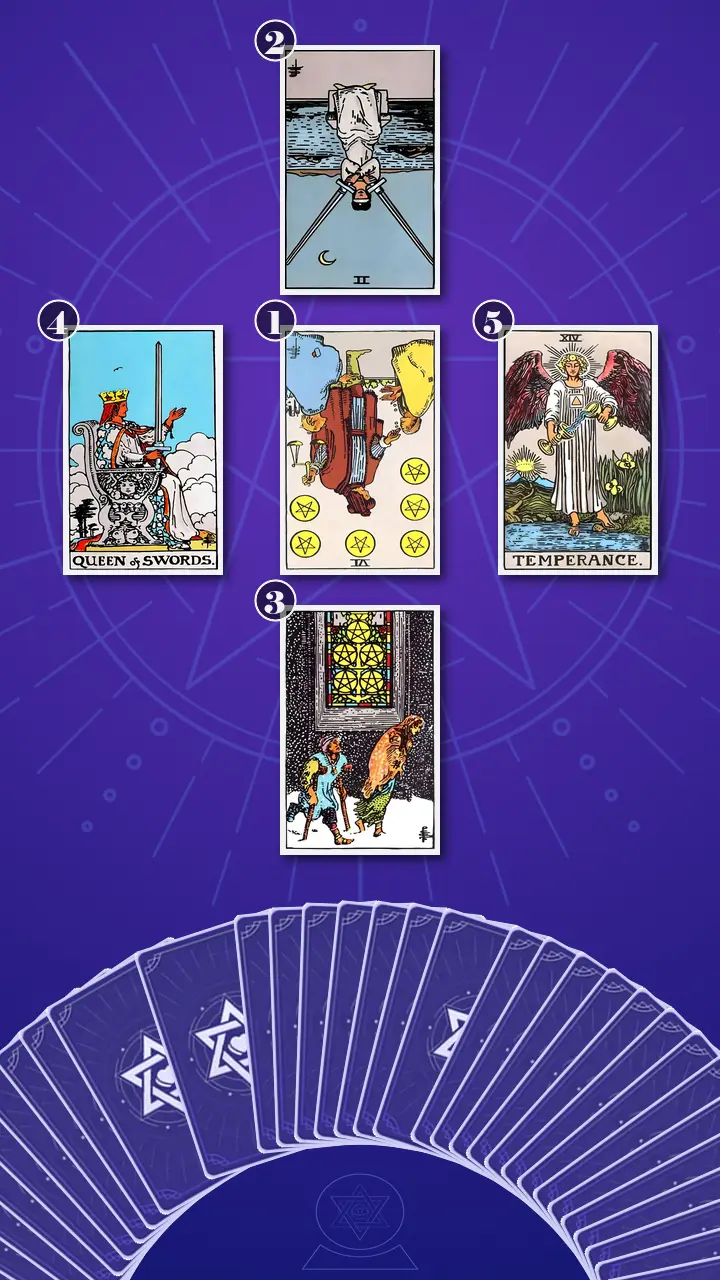
I chose the Five-Card Cross, a focused tarot spread for friendship boundaries and people-pleasing burnout. I use this layout when the issue is not simply a crowded diary, but a relational pattern with a visible behaviour, an immediate decision block, a deeper fear, an available intervention, and a sustainable direction.
I placed the first card at the centre for Alex’s present pattern. The second went above it for the split-second challenge that complicates each request, and the third went below it for the underlying fear of exclusion. To the left, the fourth card would show the guidance Alex could consciously use. To the right, the fifth would show what connection might become once that guidance was practised.
The vertical line would diagnose why the pattern persisted; the horizontal line would move from discernment towards sustainable connection. This is how tarot works at its most useful for me: not as fate, but as a structured way to slow down a fast loop, compare card meanings in context, and turn half-felt signals into information Alex could test in real life.
Reading the Hidden Cost of the Quick Yes
Position One: The Scales Left Off the Calendar
Now I turned over the card representing the present situation: the observable pattern of giving friends time, attention, money, or support until Alex’s own capacity was depleted. It was the Six of Pentacles, in reversed position.
I pointed to the standing giver, the coins moving into other hands, and the scales held above the exchange. Reversed, I read the card as an Excess of outward distribution combined with a Deficiency of measurement. Alex’s generosity was real, but the scales of time, energy, sleep, money, and genuine desire were not being consulted before the resources left their hands.
The card returned us directly to 10:48 p.m. Alex had handed tomorrow’s last open hour to the group chat while their dinner cooled and the overloaded calendar remained visible. Their inner calculation had been, “I can probably make it work. I’ll deal with being tired later.” Personal recovery did not qualify as a commitment, so an unlabelled calendar square was treated as publicly available capacity.
For a second, my mind flashed back to the risk reports I used to read on Wall Street. An exposure did not become harmless simply because nobody had entered the eventual loss on that day’s ledger. Alex’s hidden liabilities were midnight laundry, an unaffordable rideshare, compressed sleep, and the irritation of showing up after the wish to be there had already been spent.
“Your blank calendar square is not public property,” I said. “The imbalance is not that you care too much. It’s that care is being promised before its real cost is measured, and your friends may never see the sacrifice because it remains unspoken.”
Alex gave a short laugh that carried no amusement. “That’s so accurate it feels a bit brutal.” Their thumb pressed into the edge of the chair, then loosened. I watched recognition arrive alongside a faint sting: the latest favour was not the whole problem; the unused scales were.
Position Two: Two Drafts Above One WhatsApp Message
Now I turned over the card representing the immediate challenge: the few seconds in which Alex blocked personal preference and used an automatic yes to end relational uncertainty. It was the Two of Swords, in reversed position.
The blindfold and the crossed blades gave me a precise picture of the blockage. I saw two unsent drafts hovering over the same WhatsApp message. One said, “I can’t tonight.” The other said, “Yes, of course.” Alex could imagine both answers, but they struggled to remain in the discomfort long enough to decide which one was accurate.
Alex described opening a request on the commute home, typing a refusal, deleting it, replacing it with an enthusiastic yes, and watching the notification disappear. Their sequence was painfully efficient: “I don’t want to go. They’ll notice if I decline. Fine, I’ll say yes and solve the rest later.”
I read the reversed card as a Blockage of healthy Air. Thought was not distinguishing capacity from fear; it was running rapid simulations of every possible social reaction. Preference had been blindfolded, while the automatic agreement crossed defensively over the chest and stopped the immediate tension.
“The quick yes solves the notification, not the week,” I said. “What did your body and calendar already know the last time you deleted a refusal?”
Alex looked away from the cards. Their shoulders tightened before they answered. “That I didn’t want to go. And that I hadn’t done laundry, bought food, or had an evening alone in nearly two weeks.” Their jaw shifted as if they were testing the unfamiliar idea that those facts could be allowed into a friendship decision.
Position Three: The Warm Pub Window in the Rain
Now I turned over the card representing the underlying influence: the fear that declining one request could lead to exclusion and prove that Alex did not securely belong. It was the Five of Pentacles, upright.
I drew Alex’s attention to the figures moving through snow while an illuminated stained-glass window glowed nearby. I did not read this as a prediction that their friends would reject them. I read it as an image of the stakes Alex’s nervous system assigned to an ordinary limit.
Alex told me about declining a Saturday pub plan and then standing beside the rain-streaked kitchen window at 8:17 p.m., watching an Instagram Story of the group under warm amber lights. Nobody had criticised the decision. Still, their stomach had dropped as the thought arrived: “If I miss this, maybe they’ll stop asking.”
In this root position, the Five showed scarcity energy operating in Excess. One missed evening became a forecast of permanent exclusion. Evidence from the present was given too little weight, while the imagined warm window became proof that the door was closing. It was like applying London’s rental-scarcity logic to friendship: if Alex did not occupy every available place, somebody else might take it.
“A boundary is information, not a relational attack,” I said. “What exact outcome did you predict after that Saturday no, and what actually happened?”
Alex’s breath paused. Their eyes settled somewhere beyond the table, as though they were replaying the messages that followed. Then they exhaled and said, “I thought they’d stop inviting me. In reality, one friend sent me a meme the next morning, and the group asked if I wanted to come to something the following week.”
I let that distinction remain visible without turning it into a guarantee. A future friend might feel disappointed, reply briefly, or need time to adjust. Alex could not control those reactions. What they could stop doing was treating a feared reaction as confirmed evidence before anyone had been given an honest answer.
When the Queen Put Truth and Warmth in the Same Sentence
Position Four: The Clear Sword and the Open Hand
The room became noticeably still as I moved to the guidance position. The radiator clicked off, leaving a low electric hum beneath the silence. The quiet itself felt like the reply pause Alex had never allowed.
Now I turned over the card representing the specific cognitive and communication shift needed to replace reflexive agreement with a clear, respectful boundary. It was the Queen of Swords, upright, and in this spread she was the antidote.
I contrasted her with the reversed Two. The earlier figure had covered eyes and two blades locked across the body. The Queen faced forward with one sword held upright and one hand extended. I read the sword as, “Here is what is true.” I read the open hand as, “Here is the warmth that remains.”
Her modern-life expression was deliberately ordinary. Alex could leave a non-urgent request unanswered for 30 minutes, check the calendar, energy level, budget, and actual desire, then send: “I can’t do tonight, but I can check in for 20 minutes on Saturday.” No apology essay. No invented emergency. No alternative unless it was genuinely wanted.
This was Air restored to Balance. The Queen did not ask Alex to become detached or reject every spontaneous plan. She used discernment to separate an honest yes from a fear-driven one, then used concise language to communicate the result. Clear is not cold when care remains in the sentence.
At this point, I brought in a framework I call Reciprocity ROI Analysis. It comes partly from my commercial background, but I never use it to reduce friendship to a transaction or demand equal favours after every interaction. I use it to identify the hidden subsidy underneath a relationship: Who is routinely financing connection with lost sleep, extra spending, emotional labour, or recovery crashes? Can care travel in both directions? Can each person give an accurate no without affection being withdrawn as punishment?
The decisive return on a healthy friendship is not perfect symmetry. It is enough mutual recognition that both people can remain whole. If Alex’s quick yes produced resentment, reduced their presence, and ended in a four-day disappearance, then the strategy was creating a poor return for Alex and less honest information for their friends. The Queen’s sword made the cost visible; her open hand kept the relationship invited into reality.
I brought Alex back to the original scene. At 10:48 p.m., dinner was going cold while tomorrow’s calendar glowed on the laptop. Their shoulders were already tight, yet their thumbs had typed “Absolutely” because a quick yes felt safer than leaving “Are you free?” unanswered.
You do not have to spend yourself to earn closeness; choose one honest limit and let the Queen's upright sword separate genuine care from reflexive agreement.
I left a pause around the sentence. Then I added, A clear limit does not cancel care; it stops care from being financed with your sleep, money, and disappearance later.
I watched Alex’s breath stop first. Their fingers remained suspended above the card, and their pupils widened as if the past month had begun replaying behind their eyes: the late call, the moving favour, the dinner they could not afford, the muted chat. Their brows drew together, and a flash of anger crossed their face before their shoulders could soften.
“But doesn’t that mean I was wrong every time I said yes?” they asked, their voice sharper than before. “Like I did all of that to myself?”
“I don’t think ‘wrong’ is useful here,” I replied. “The quick yes protected you from a fear of losing belonging. It worked for a few minutes at a time, until the accumulated cost became larger than the protection. We’re not prosecuting your past self. We’re updating a strategy with better information.”
Their jaw unclenched. One hand opened flat on their knee, followed by a long breath that seemed to leave from somewhere below the ribs. Relief arrived, but it carried a new vulnerability: if a limit was possible, Alex would now have to choose one rather than waiting for exhaustion to make the choice through disappearance.
I asked, “Now, with this new perspective, can you think of a moment last week when this insight might have made you feel different?”
Alex nodded slowly. “The two-hour call. I could’ve said I had 20 minutes. I actually wanted to hear what was happening. I just didn’t want to give the whole night.”
I named the movement I had just witnessed. This was not a personality overhaul or a promise that limits would feel effortless. It was the first crossing from exhausted compliance driven by fear of exclusion towards deliberate, warm boundaries and sustainable reciprocal connection. Discomfort remained, but Alex’s own time, desire, and bodily capacity had re-entered the decision.
Position Five: Temperance and the Week That Does Not Overflow
Now I turned over the card representing the integration potential: the sustainable relational state available when Alex practised measured giving instead of alternating between total availability and total withdrawal. It was Temperance, upright.
I traced the stream of water moving carefully between the two cups. One foot rested on land and one in water, holding practical reality and emotional connection together. I read this as Balance: not a perfect division of every favour, but a pace that could continue without requiring Alex to erase themselves.
In everyday terms, Temperance looked like Alex checking the whole week before accepting plans, protecting one evening at home, setting a clear end time for a support call, and leaving budget and recovery space around a brunch they genuinely wanted. The measured stream moved among work, friendship, money, sleep, and solitude without emptying one container to keep the others full.
“I can care without being on call,” Alex said, trying the sentence aloud. “And I can choose connection without giving away the recovery afterwards.”
I saw their shoulders lower. They did not look euphoric; they looked as though they had finally been shown a week they might realistically inhabit. Temperance offered no fantasy of permanent calm. It offered a repeatable rhythm in which care would not require Alex’s disappearance afterwards.
The Five-Minute Check Between the Notification and the Answer
I gathered the cards into one coherent story. The reversed Six showed finite resources flowing outward without measurement. The reversed Two revealed the blocked decision process that made an automatic yes feel safer than an honest pause. The Five named the fear beneath that block: the imagined cold outside the group’s warm window. The Queen restored clear thought and direct language, while Temperance turned one boundary into a sustainable rhythm.
The spread did not contain a formal past position, so I did not invent a childhood explanation or claim to know where Alex’s belonging fear began. I stayed with what the cards and Alex’s examples could support. Their blind spot was that a friend’s request entered the calendar as valid data, while rest, money, existing plans, and personal preference were treated as negotiable. Predicted rejection was counted as fact; personal cost was not counted at all.
I also noted that no Wands appeared. For me, that absence reinforced how little space Alex’s own desire had occupied. The key shift was therefore practical: stop answering immediately, check available time, energy, money, recovery needs, and genuine preference, then offer a clear yes, no, or realistic alternative. The goal was not less care. It was care chosen deliberately enough to remain warm.
- The Notification-to-Answer BufferFor one low-stakes, non-urgent request this week, set a private 30-minute timer and place the phone face down. Open Notes and write one honest sentence under Capacity, Preference, and Cost. Include time, energy, money, and the next day’s recovery needs before choosing yes, no, or an alternative.If 30 minutes feels too exposing, begin with three slow breaths and one calendar check. The pause gathers information; it does not oblige you to decline.
- The Clear Sword, Open Hand ReplyUse one request currently sitting in your messages and draft: “I can’t do [specific request or time], but I can [realistic alternative].” Omit the alternative when none is genuinely available. For a late call, Alex’s version became: “I don’t have capacity for a call tonight. I can check in for 20 minutes on Saturday afternoon.”Treat the boundary as an answer, not a court case. Keep at most one sincere apology, delete the background essay, and check that the limit still sounds final.
- The Reciprocity ROI Mini-AuditAfter the next three interactions with friends, spend two minutes recording what you freely offered, what support or ease you received, and how your body felt the following day. Add one simple energy note: gave energy, neutral, or needed recovery. Use the pattern to decide future access and pacing, not to grade anyone’s worth.Do not demand perfect equality from each interaction. Look for whether care, curiosity, adjustment, and respect for a clear no can move in both directions over time.
I reminded Alex that none of these actions could control another person’s response. A friend might be disappointed. A reply might be shorter than hoped. The exercise was not to produce a flawless social outcome; it was to give the friendship accurate information and observe what happened next. Tarot had clarified the test, but Alex retained full authority over which request to use, how long to pause, and what boundary to send.

A Week Later, One Quiet Square Stayed Quiet
Six days later, Alex sent me a message. A friend had asked at 9:36 p.m., “Are you free for a quick call?” Alex felt their shoulders rise, but this time they set the phone face down. They checked the next morning’s early meeting, wrote three short lines under Capacity, Preference, and Cost, and waited until the 30-minute timer ended.
Then they sent: “I don’t have capacity tonight, but I can call for 20 minutes on Saturday.” Their friend replied, “Saturday works. Hope you get some rest.” Alex ate dinner while it was still warm. The kitchen light lay softly across an evening that had not been redistributed.
They slept through the night. In the morning, their first thought was, “What if I got it wrong?” Then they noticed the quiet calendar square and laughed once, softly.
I did not read that exchange as proof that every future boundary would be welcomed. I read it as a small piece of reality strong enough to stand beside the fear. Alex had paused, included their own life in the decision, communicated one accurate limit, and remained connected. The cards had not sent the message for them. Alex had.
For me, that was the quiet value of this Five-Card Cross tarot reading for friendship boundaries and people-pleasing burnout. It did not hand Alex certainty about other people. It helped them move from reflexive availability towards deliberate care, where dependable friendship no longer required self-erasure.
If your shoulders tighten at “Are you free?” while your thumbs prepare to type “of course”, I hope you remember what I watched Alex discover: one honest no can feel like a step outside the circle without being a verdict on your place in it. Simply noticing that silent pull between what you think you should give and what you can honestly offer means you are no longer standing at the beginning.
If you let one quiet pause stand between the notification and your answer this week, what truth from your own evening would you place on the Six’s neglected scales before the Queen’s sword turns it into one clear sentence?