A Pointless Thesis Topic, or a Protective No? Reframing the First Step

The Blank Page at 7:32 p.m.
“You open the thesis at 7:30 p.m., change three headings, download two papers, and somehow finish the night with no paragraph,” I said after Maya (name changed for privacy) described the loop that had swallowed most of her post-work evenings.
At 7:32 on a rainy Tuesday, I watched the 25-year-old master’s student settle at the small kitchen table in her London flat after a shift in university administration. Cool laptop light sharpened the tired lines around her eyes. The kettle clicked off, the fan beneath her keyboard whirred, and wet tyres hissed on the street below as she opened the thesis document beside our video call.
Her phone lit up with a cohort WhatsApp message about someone else’s word count. Her hand moved towards it before she caught herself. Her shoulders hung as though a rain-soaked winter coat had been draped across them, and opening the thesis seemed to send a loose stone dropping through her stomach.
“I want the degree finished,” she told me. “But if the topic means nothing to me, every hour on it feels stolen. I keep preparing to write instead of writing. Why do I keep delaying my thesis start when the topic feels pointless?”
I could hear the contradiction clearly: Maya wanted to complete the thesis and move towards graduation, yet beginning felt like consenting to months of effort she could not respect. The disengagement was genuine, but resentment, guilt, and deadline dread had become tangled around it until even one rough paragraph carried the emotional weight of the whole project.
I named the pattern carefully. “This looks less like laziness and more like meaning-driven procrastination. You’re not refusing every form of work. You’re choosing the tasks that let you stay near the thesis without making contact with an unfinished idea.”
I also told her what I would not do. I would not use tarot to declare that she must keep the topic, predict her academic future, or turn her resistance into a frightening omen. I wanted to help her examine what the delay protected, what it cost, and where she still had a real choice. “Let’s tidy the reality on the table,” I said, “and give this fog a map.”
Choosing the Three-Card Bridge
I asked Maya to place both feet on the floor and take one slower breath before touching the thesis or her phone. I moved my coffee away from the deck and shuffled while she held one focused question in mind. The pause was not a mystical test. It was a practical transition from reacting to observing.
I chose a linear three-card Problem-Cause-Solution tarot spread. For anyone wondering how tarot works in a situation like thesis procrastination, I use the cards as a structured mirror. Their images help separate behaviours, emotions, and available responses so we can examine card meanings in context rather than treating them as fixed verdicts.
This was the right spread because Maya’s question contained a specific causal chain. The first position would show the observable blockage: the respectable-looking tasks replacing rough draft text. The second would reveal the emotional withdrawal and fear of losing control over her limited evenings. The third would identify a constructive response that could restore agency without deciding for her whether the thesis scope should stay unchanged.
I placed the cards in one horizontal line. The first and second formed the diagnostic pair, moving from visible behaviour to its hidden driver. The third stood like the far end of a short bridge, not a promised outcome, but a response Maya could choose to test.
The Workbench That Kept Graduation Distant
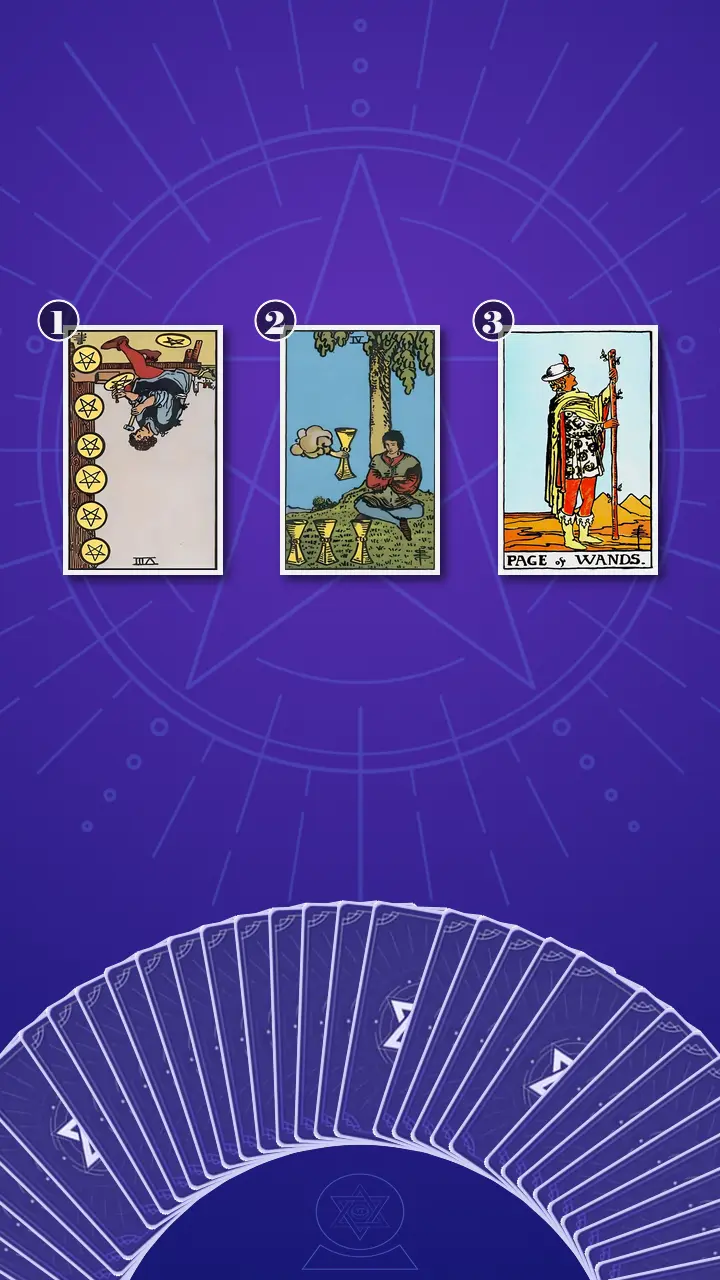
Position 1: Eight of Pentacles Reversed and the Academic Busywork Loop
“The card I’m turning for the observable thesis-start blockage, where academic-looking setup repeatedly replaces rough draft text, is the Eight of Pentacles, reversed,” I said.
I showed Maya the artisan, the hand tools, the repeated row of pentacles, and the town sitting at a distance behind the workbench. Upright, the image can describe patient craft. Reversed here, its energy was blocked and overcorrected. Effort was present, but too much of it had been diverted into preparing, polishing, and controlling the materials rather than making one imperfect piece of work.
I brought the card directly into her Tuesday-night reality. At 7:30 she opened the thesis, corrected heading styles, renamed Zotero folders, downloaded two papers, and checked citation metadata. Her inner bargain was always some version of, “Once I finish organising these references, then I can write the paragraph.” At 9:01, the tools looked orderly and the introduction still contained no new argument.
The image pulled me back to years of coffee-scented conversations in which I had watched capable people become busy around the safest edge of a difficult task. I wrote a short line in my notes: effort present, draft contact absent.
“You are not avoiding all work,” I told her. “You are doing the work that cannot disagree with you. A citation can be corrected. A folder can be renamed. Neither can expose an unfinished thought or confirm that the topic still feels dead.”
Maya gave a short laugh, but there was no amusement in it. “That’s so accurate it feels a bit brutal. I do this during almost every writing block.” Her thumb pressed hard against the edge of her mug.
I slowed down. “The accuracy isn’t an accusation. The card is separating visible effort from actual draft progress. You’ve been working. The question is whether the work you choose at the start of the session is capable of moving the argument.”
I used my Study Environment Auditing lens to widen the workbench. The drain was not only the papers on the kitchen table. It was the open cohort chat, the spotless Notion dashboard, the Zotero folders waiting to be improved, the phone within reach, and the unspoken rule that every citation problem had to be solved before a sentence could exist. Each item made a small claim on her limited psychological bandwidth.
I also warned her about the reversal’s overcorrection risk. An unrealistic all-day writing sprint would be the same pattern wearing a stricter outfit. It could turn panic into several punishing hours, leave her exhausted, and make the next session even harder to approach. The card was not asking for a heroic rescue plan. It was asking for one completed unit of imperfect craft.
Position 2: Four of Cups and the Last Available No
“The card I’m turning for the emotional withdrawal, limiting belief, and fear of losing control over your time is the Four of Cups, upright,” I said.
The figure’s arms were crossed. Their gaze remained lowered towards three unattended cups while a fourth cup was offered from outside the frame they had chosen to examine. I did not read that posture as ingratitude. I read it as protection.
In Maya’s life, the approved topic had become one indivisible block of meaningless labour. Every available option was mentally labelled “more of the same.” Withholding effort gave her a temporary sense that her evenings still belonged to her, but it also stopped her from testing the narrower question that had briefly caught her attention or gathering evidence for a conversation about scope.
The emotional water of this card had pooled into a blockage. Withdrawal was doing a useful job in the short term: it protected Maya from feeling absorbed by institutional work that did not express who she was. But the protection had become excessive. The closed posture kept out the project and the smaller choices hidden inside it.
“When starting feels like consent, procrastination can feel like the last available no,” I said.
Her breathing paused. Her fingers tightened around the mug, and her eyes shifted from the cards to the thesis window on her screen. Then she rubbed the centre of her chest and let out a long breath.
“That’s exactly it,” she said. “If I engage, I’m agreeing that this deserves my evenings. If I refuse, at least the refusal is still mine.”
I told her the refusal made emotional sense. Part-time work, study, rest, friendships, and finances were already competing for the same limited hours. I was not going to romanticise avoidance, but I would not shame the part of her trying to protect ownership of her life.
The problem was that her inner algorithm had learned thesis equals trapped. Like a personal version of Severance, it treated required academic work as something that could consume time without expressing identity. Each time she opened the file, the algorithm served more evidence for disengagement: the title felt dead, her stomach sank, she sorted references, and the empty draft looked more threatening when she returned.
I pointed to the fourth cup. “This isn’t a promise that a hidden perfect topic will appear. It may be a narrower question, a skill you genuinely value, or enough evidence to ask your supervisor about scope. But you can’t evaluate that possibility while the whole thesis is compressed into one verdict: pointless.”
I asked, “The last time you thought, ‘This topic is pointless,’ what did starting seem to commit you to?”
“Every free weekend until the deadline,” she said. After a moment, she added, “And proving I have no control over where my effort goes.”
That answer moved us beneath motivation. Maya did not primarily need another productivity system. She needed to name the resentment, separate one session from permanent consent, and recover a form of choice small enough to be credible.
When the Page Found One Living Question
I looked across the spread and noticed what was absent. There was no Swords card, even though analysis had dominated Maya’s strategy. More thinking, more articles about motivation, and another beautifully designed system were unlikely to unlock a conflict about meaning.
The elemental sequence moved through three clear images in my mind: hands rearranging materials, shoulders folding away from the document, then a gaze lifting towards one live possibility. Blocked earth had led to contained water. The final card introduced available fire.
Position 3: Page of Wands and the Yellow Sticky Note
The rain outside Maya’s window thinned to a soft ticking. A bus sighed at the kerb below, and the yellow of the final card appeared warmer than the blue laptop light around it. I turned over the card that served as the bridge in this reading.
“The card I’m turning for the shift from waiting for total meaning to testing one personally interesting question through a small, time-bounded action is the Page of Wands, upright.”
I drew Maya’s attention to the Page studying the sprouting wand. The figure did not hold a finished map or proof of mastery. The Page had one signal of life, an attentive gaze, and enough fire to investigate. Upright here, that fire was available and balanced as experimental curiosity. It was potential Maya could invoke, not a forecast that motivation would arrive on its own.
Translated into her week, the sprouting wand became one question written on a yellow sticky note beside the laptop. Maya would give herself five minutes to choose an angle with even a mild pull, open a duplicate document, close Zotero and the cohort chat, and explore that question for 25 minutes. She could write 200 rough words containing placeholders such as [source], [check this], and [I’m not sure yet]. Afterwards, she would record whether the test suggested continuing, reframing, or preparing a supervisor conversation.
I could see the old bargain still running: if she wrote, the topic had won; if she waited for certainty, she kept control. The deadline sat behind that logic, turning one paragraph into a referendum on every evening between now and graduation.
This was where I used Syllabus Deconstruction. I stripped the first move of the massive deadline’s emotional voltage and reduced it to a mechanical sequence: duplicate the file, choose one question, set 25 minutes, write rough words, record one scope signal, stop. The thesis could remain complicated. The entry task did not have to carry its entire moral weight.
“You do not have to prove the whole thesis matters before you begin. You only need one question that feels alive enough to deserve the next 25 minutes,” I said. “You don’t have to marry the angle. You can interview it.”
I let the room become quiet before giving her the sentence I wanted her to keep.
You do not need a grand purpose before you start; choose one live question and study it as the Page studies the sprouting wand.
Her breath stopped first. Her fingers remained suspended above the mug, and for two beats her face held the blank look of someone whose usual argument had lost its next line. Then her pupils shifted left, away from me and towards the thesis window, as though she were replaying a memory. Her jaw tightened. “But doesn’t that mean I’ve been doing this wrong for months?” she asked, the words sharper than anything she had said all evening. I told her no. Her protection had made sense, then outlived its usefulness. Anger crossed her face, followed by grief for the evenings already spent. At last her fist opened around the mug. Her shoulders dropped, her eyes shone, and she released a shaky breath that sounded half relieved, half startled. The clarity left a small blankness too. If she could choose the next move, she was also responsible for choosing it.
I asked, “Now, with that new perspective, think back to last week. Was there a moment when this insight might have made you feel different?”
She remembered Saturday morning in the university library. Under the fluorescent lights, one narrower question in her notes had briefly caught her attention. She had dismissed it because it did not make the entire project meaningful.
“I could have tested that question,” she said quietly. “Testing it wouldn’t have meant keeping it.”
“Exactly,” I replied. “A rough paragraph is evidence, not a lifetime contract. You do not need global purpose; you need local curiosity.”
I saw the emotional transformation begin there, not as sudden enthusiasm, but as a small crossing from resentful, comparison-driven avoidance towards cautious agency. Maya still disliked much of the project. What changed was the meaning of beginning. One session no longer had to equal surrender. It could produce information about whether to continue, reframe the angle, or discuss the scope.
Finding Clarity Through a Bounded Inquiry
I gathered the three cards into one coherent account. Over the previous weeks, Maya had been pressing towards graduation while an emotional handbrake stayed on. The Eight of Pentacles reversed showed her hands working at headings, citations, and folders without producing draft contact. The Four of Cups revealed why: starting seemed to hand ownership of her scarce evenings to a topic she resented. The Page of Wands restored a limited resource that did not require forced passion, one personally chosen question and the freedom to treat writing as a reversible experiment.
The cognitive blind spot was the belief that beginning meant agreeing to the whole topic, the whole scope, and every future hour the thesis might demand. That belief made preparation feel responsible and drafting feel dangerous. It also hid the fact that writing could generate the evidence needed to decide what deserved continuation or discussion.
The direction of change was precise: stop waiting for the entire thesis to feel meaningful. Choose one locally interesting question, make brief contact with it, and let the result inform the next academic step. Tarot had not selected that question for Maya. It had helped us externalise the pattern so she could choose with more information and less shame.
I gave her three small actions. None required an all-day catch-up plan, a new productivity app, or a declaration that she suddenly loved the research.
- The 15-Minute Desktop Reset Ritual. Before one post-work thesis session this week, set a 15-minute timer at the kitchen table. Clear everything except the laptop, water, and one yellow sticky note. Put the phone across the room, close WhatsApp and Zotero, and place every citation or formatting urge in a plain note called “Admin Later.” Tip: stop clearing when the timer rings. This is a short runway into drafting, not a new room-organisation project. On a depleted evening, use a five-minute reset.
- The One Live Question Test. Give question selection a five-minute cap. Write the option with the slightest pull on the sticky note, open a duplicate file called “One Live Question Test,” and draft towards it for 25 minutes or 200 rough words. Use placeholders freely and leave Zotero closed. Tip: treat the words as a diagnostic sample, not a quota. If 25 minutes feels too costly after work, use a 10-minute, 75-word version. Stop when the timer ends, even mid-sentence.
- The Scope Signal Check. At the end of the test, write one line: “This made me more curious about...,” “This still feels dead because...,” or “I may need to discuss....” If discussion is the signal, draft three lines for the supervisor: what feels dead, the narrower question tested, and one specific request for feedback. Tip: sending the message is optional, and any scope change must fit programme requirements. The immediate goal is honest evidence. Stop early if the exercise becomes too uncomfortable; even two rough sentences can provide information.
I told Maya to let one live question earn the next 25 minutes. Nothing in the plan required her to pretend the thesis was a calling. It asked only whether one small piece of it deserved a fair test.

A Week Later: 186 Words and One Honest Email
Six days later, I received a message from Maya. She had used the Desktop Reset Ritual, written one question on a yellow sticky note, and opened the duplicate file. She reached 186 rough words before the timer ended. Instead of extending the session into a guilt-driven marathon, she stopped and left herself a restart cue: “Next, I want to test whether this example changes the argument.”
“I didn’t suddenly love the thesis,” she wrote. “But the question wasn’t dead. I sent my supervisor three lines asking whether I could narrow the angle. That felt more useful than another night fixing Zotero.”
She also told me, “I slept through the night, then woke up thinking, what if this angle is wrong? I still had the thought. I just didn’t treat it like an emergency.”
I considered that the quiet proof of our Journey to Clarity. The cards had not written the paragraph, approved a scope change, or guaranteed graduation. They had helped us place behaviour, resentment, and curiosity where Maya could see them separately. She made the decision, ran the experiment, and kept the right to reassess.
When the thesis file opens and your stomach drops, the hardest part may be wanting the degree while fearing that every sentence hands another piece of your limited time to work you never chose to value. If that is your silent tug-of-war, noticing that beginning has become synonymous with surrender already means you are no longer standing at the exact same starting point.
If one rough paragraph were evidence rather than consent, which single live question would you let earn the next 25 minutes?