Feedback Tab Open, Draft Untouched—Then One Fix Became Possible

Finding Clarity in the 8:47 p.m. Feedback Tab
If your browser is full of Google Docs comments, Notion boards, and productivity videos, the most stressful part may be the ten seconds before opening the draft, when revision anxiety makes a practical fix feel like a verdict.
Casey (name changed for privacy), a 24-year-old postgraduate communications student and freelance editor in Toronto, joined my video consultation from the small desk in her shared apartment. It was 8:47 on a Tuesday evening. A buzzing LED lamp washed her face in pale light; the kettle clicked off in the kitchen; her phone looked warm from being held too long. On her laptop, the feedback waited in one Chrome tab while the main draft remained untouched in another.
I watched her colour-code a revision category, move it twice on a Notion board, and then rub the heel of her hand across her forehead.
“I know the first fix would take ten minutes,” she said, “but opening the file makes the whole thing feel enormous. I want to sort it before resubmission gets stressful again, but I keep waiting until the stress is the only thing strong enough to make me start.”
The pressure showed up before the work did: her shoulders climbed towards her ears, her fingers kept changing tabs, and each breath seemed to stop at the top of her chest. It was like hearing a TTC train brake inside her ribs while she was still standing safely on the platform.
“I’m not going to tell you that you’re lazy, undisciplined, or destined to repeat this,” I said. “Tarot cannot revise the document for you, and it does not get to issue a verdict on your ability. What it can do is place the loop where we can both see it. Let’s make a map of the few minutes between receiving feedback and leaving the work, then find the point where your own choice can change the route.”

Choosing a Map for the Loop
I asked Casey to place both feet on the floor, let one breath reach her stomach, and hold a precise question in mind: “Why do I keep delaying the fixes until resubmission becomes stressful again?” I shuffled slowly, using the movement as a transition from mental rehearsal to observation rather than as a performance of mystery.
I chose the Transformation Path Grid (6) · Context Edition. I use this six-card transformation spread when a problem is not one isolated decision but a self-reinforcing system. A simple Past-Present-Future layout could make the issue look like a timeline that will resolve on its own. A Decision Cross would imply competing external options. A Celtic Cross would introduce more context than this compact behavioural cycle required.
The grid was the smallest useful structure for showing how tarot works here: not as fortune-telling, but as an objective pattern-recognition tool. I placed the cards in a 2-by-3 serpentine path. The top row would trace the observable delay, the immediate relief-seeking blockage, and the fear beneath it. The bottom row would turn from that fear into a practical bridge, a repeatable action, and an integrated rhythm.
I told Casey that the eye would move across the compressed top row, then turn down and travel back across the lower row. “We’re not asking the cards to predict whether your resubmission will succeed,” I said. “We’re asking where the old loop tightens, and where you can put your hand on the steering wheel.”
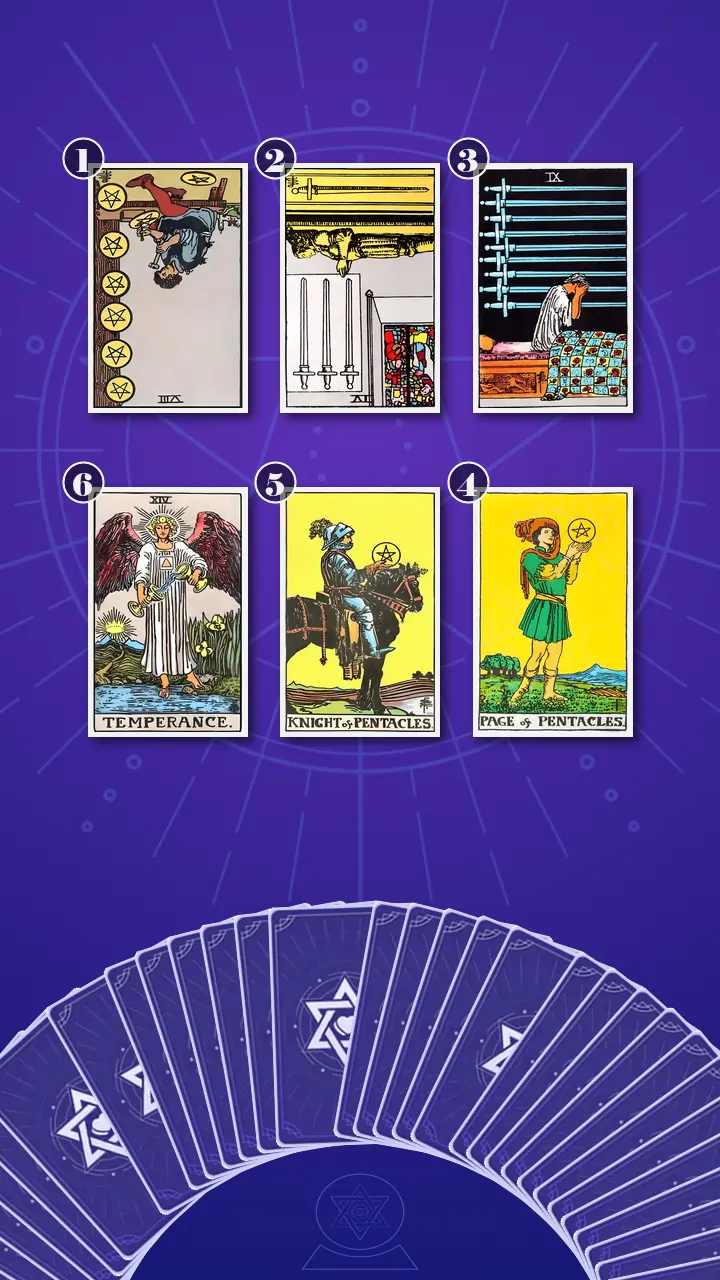
The Top Row: Where Resubmission Stress Learns to Shout
Position 1: The Workbench With One Screw Untouched
Now I turned over the card for the presenting cycle: the observable delay between noticing that the work needs fixing and beginning the first revision. It was the Eight of Pentacles, reversed.
I pointed to the craftsperson, the tools, and the pentacles displayed as separate pieces of work. Upright, this card often carries the balanced energy of apprenticeship, repetition, and improvement through contact with the craft. Reversed, I read it as a blockage: the tools are available and the repairs are identifiable, but the hands keep being diverted before practice begins.
“This is your shared-apartment desk,” I said. “The revision checklist is ready. The folders have been renamed. The Google Docs feedback tab is arranged beside the untouched draft. You read the first comment, then switch to messages, adjust the plan, or research a better revision method. The separate pentacles could be separate repairs, but your mind merges them into one giant test of competence.”
I asked what Casey usually did during the first five minutes after seeing requested changes. She looked towards the browser tabs rather than at me.
“I make a plan,” she said. Then she gave a short, bitter laugh. “That’s so accurate it’s almost cruel. I make an extremely good plan for work I’m not doing.”
I let the laugh settle before answering. “The accuracy is not an accusation. The card is describing interrupted contact, not a defective character. Planning has been useful because it lowers the discomfort for a moment. The question is simply whether it is serving the repair or replacing it.”
Her fingers stopped moving over the trackpad. I asked her to picture the hammer touching only one pentacle. “What is one ten-minute fix that would let the craft resume without requiring an overhaul?”
“The first comment asks for a current example,” she said quietly. “I could add one example. That’s literally it.”
Position 2: The Break That Never Chose an Ending
Now I turned over the card for the immediate blockage: the specific pause or relief-seeking behaviour that makes postponement useful in the moment. It was the Four of Swords, reversed.
The reclining figure appeared to be resting, but the swords remained suspended overhead. I connected the image to a Thursday evening Casey had described: she read a difficult comment, promised herself a fifteen-minute break, checked Instagram and messages, watched several short videos, and looked up an hour later. The apartment had been quiet except for the refrigerator hum, yet the unfinished correction had stayed active in her chest.
“The screen activity changed,” I said, “but the task never left the room. The inner sentence is: I am resting, but I am not away from it.”
The reversed energy did not tell me that rest was wrong. It showed a deficiency of containment: no chosen return time, no defined next action, and therefore no signal that the pause had genuinely begun or ended. The relief was real, but it was brief. The unresolved swords remained in the background while the available revision time contracted.
Casey winced, pressed her lips together, and then released a long breath through her nose. “That’s exactly it. I don’t even enjoy the scrolling. The document is still sort of sitting behind everything.”
“A break becomes easier to return from when it has an ending you chose,” I said. “That does not mean forcing yourself into an endless editing session. It means deciding before the break: I return at 8:30, read one comment, and make one related change. Rest needs a boundary, but so does work.”
I could see the larger system behaving like an algorithm trained on a single metric: reduce discomfort now. Every switch to messages, Notion, or a productivity video gave that algorithm a tiny reward, so it kept recommending the same escape route. The problem was not that Casey lacked enough apps or plans. Her personal algorithm was optimising for immediate relief rather than a calm return.
Position 3: Push Notifications From Imagined Criticism
Now I turned over the card for the underlying root: the fear about what beginning the fixes might say about Casey’s competence, control, or worth. It was the Nine of Swords, upright.
I showed her the figure sitting up in bed with both hands covering the face while nine swords lined the dark wall. The scene closely mirrored what Casey had told me about 12:36 a.m. after a freelance shift: the laptop still open beside her, Instagram dimmed against the duvet, and the resubmission already failing in her imagination before she had reopened the file.
In this position, the Swords did not predict an external disaster. They represented an excess of mental rehearsal. A request such as “develop this section” became a stream of private push notifications: I should have known. What if this proves I’m not good enough? What if the client notices every other weakness? What if everyone else revises calmly and I’m the only person who needs a crisis?
For a moment, I looked at the thin coffee ring inside my cup and remembered two decades of conversations held over marked-up pages and warm mugs. The papers had never contained the whole person sitting across from me. The pain arrived when feedback on one paragraph was made to carry the weight of an identity. That memory kept my voice low and precise.
A revision is a repair, not a referendum on your worth.
I asked Casey to name the exact thought that appeared before she closed the draft. Her breathing paused. Her gaze lost focus as if she were watching a familiar scene replay behind the screen, and then her shoulders lowered by a fraction.
“What if fixing it shows I should have known how to do it properly the first time?” she said.
“Then the thing you are avoiding is not only the correction,” I replied. “You are avoiding the meaning your mind attaches to making it. Let’s separate those two. What action verb is actually in the supervisor’s comment, and what verdict are you adding beside it?”
“The verb is ‘add,’” she said. “The verdict is ‘you didn’t understand the assignment.’”
That distinction mattered. The first was a piece of information about the work. The second was a sentence Casey’s mind had written about Casey. Tarot had not disproved the sentence by magic; it had made the two layers visible enough for her to question which one belonged in the document.
When the Page Held One Fix at Eye Level
Position 4: The One-Fix Bridge
Now I turned over the card for the key transformation: the smallest perspective shift capable of replacing stress-created urgency with early, practical engagement. It was the Page of Pentacles, upright, the bridge card of the reading.
A burst of rain had been rattling Casey’s window through the Nine of Swords. As I placed the Page directly below it, the shower thinned to a few separate taps against the glass. The room on my screen seemed to become quieter around the young figure holding one pentacle at eye level.
I contrasted the two images. The Nine of Swords filled an entire wall with thoughts. The Page held one tangible object in both attention and view. Upright, the Page carried balanced, available earth energy: beginner’s curiosity, practical attention, patience with not knowing, and self-trust built through observable effort.
In Casey’s real life, the Page was not a burst of confidence. It was Casey opening the feedback, selecting one Google Docs comment, and studying it for ten minutes while the rest of the resubmission remained outside the immediate frame. She did not have to perform mastery before starting. Contact with the actual sentence could teach her the next action.
Until then, I could see Casey trying to solve the entire resubmission emotionally before touching one sentence: know the perfect fix, prove competence, and guarantee the outcome. In that frame, the deadline sounded louder than the actual task, and “ready” became a locked gate.
I told her the shift was not from “procrastinating” to suddenly becoming a perfectly disciplined person. It was from waiting for pressure to make the assignment feel real to giving one concrete repair ten quiet minutes of attention.
Do not wait for stress to make the work real; begin with one teachable, measurable fix and study what is in front of you, like the Page holding a pentacle with full attention.
I left a pause after the sentence.
I watched Casey’s breath catch halfway in. Her right index finger froze above the trackpad, and her eyes widened before drifting past the screen, as though she were replaying every night she had built a better Notion board instead of touching the sentence. Her mouth tightened. “But doesn’t that mean I’ve been doing it wrong this whole time?” she asked, sharper than before. Anger arrived first; then her eyes shone, and the anger folded into something sadder. I told her that the old strategy had done a real job: it had protected her from exposure for a few minutes at a time. That did not make her foolish, and recognising its cost did not erase the effort she had already made. Her clenched hand slowly opened against the desk. Her shoulders dropped, but the new clarity left a brief blankness in her face—the slight dizziness of realising that a smaller path was available and that choosing it would now belong to her. She released a trembling breath that sounded almost like a laugh.
I let the quiet hold for another beat, then asked, “Now, using this new perspective, think back to last week. Was there a moment when this insight could have made the experience feel different?”
Casey remembered receiving a comment asking her to add one current campaign example. She had watched two videos about revising academic arguments, reorganised her references, and waited three days before adding a short example that eventually took eight minutes.
“I could have highlighted the word ‘add,’” she said. “I didn’t need to understand the entire resubmission. I needed to learn what that one comment was asking.”
This was where I brought in a diagnostic framework I call Syllabus Deconstruction. I use it to strip the paralysing emotional weight from a massive deadline until only the mechanical task remains. Together, we temporarily removed the grade, the imagined reaction, the resubmission date, and the question of personal worth. What remained was almost plain enough to breathe around:
Action verb: add. Object: one current campaign example. Time boundary: ten minutes. Evidence of contact: one paragraph now contains an example. Next return: check whether the example supports the claim.
Mechanical did not mean cold or inhuman. It meant the task no longer had to carry Casey’s entire identity. The Page’s inner question was not, “How do I prove that I am capable?” It was, “What can this comment teach me?”
“The first fix is a learning act, not a verdict,” I said.
I invited Casey to test the Page rather than merely agree with it. She opened the draft while I stayed with her, copied the first feedback comment into a temporary note, and underlined its action verb. I reminded her that she could stop there. The experiment was contact, not completion.
Her chest rose, held, and then softened as she read the comment again. “It’s asking me to define one term before I use it,” she said. “That’s much smaller than what I thought it said.”
I named the transition carefully: this was one small movement from anticipatory dread and crisis-driven editing to practical curiosity, steady self-trust, and grounded readiness. It did not solve the resubmission. It changed Casey’s relationship with the first available action, which was the only part of the work she could ever begin in the present.
The Lower Row: Progress Without the Crisis Soundtrack
Position 5: The Knight’s Three Reliable Stops
Now I turned over the card for the action path: the repeatable behaviour that could carry the Page’s insight into Casey’s real week before the deadline became alarming. It was the Knight of Pentacles, upright.
I showed her the still horse, the pentacle held steadily in front of the knight, and the carefully worked field. The image did not celebrate speed or spectacle. Its balanced earth energy supported reliability: returning to one bounded task even when motivation was ordinary and no crisis was forcing movement.
For Casey, the modern version was three ten-minute Google Calendar blocks placed around the week she actually had: one after a campus seminar, one before a freelance editing shift, and one on a quieter weekend morning. Each block would hold one category—evidence, structure, or wording—and one clearly limited repair.
“But my schedule changes constantly,” Casey said. “If I miss one block, I’ll decide the whole system has failed.”
I nodded. The practical obstacle mattered more than pretending to be inspired. “Then we do not build a rigid daily identity,” I said. “We build three movable windows. If one is missed, move it once within the same day. No punishment session. No doubling tomorrow. The Knight is reliable because the route can survive ordinary disruption, not because life becomes perfectly organised.”
I compared it to a slow TTC route with dependable stops rather than one dramatic sprint across the city. It might not look impressive on LinkedIn or Instagram Stories, but it would arrive without demanding an all-night overhaul.
Stress can start the sprint, but it cannot be your only calendar.
Casey picked up her phone, but this time she opened Google Calendar rather than her messages. I watched her create three short blocks. The corners of her mouth lifted, not with triumph, but with the cautious expression of someone testing whether a bridge would hold.
Position 6: Temperance Between the Laptop and the Kettle
Now I turned over the card for integration: the sustainable working rhythm and self-understanding Casey could practise without assuming a fixed result. It was Temperance, upright.
I traced the water moving between the angel’s two cups, one foot on land and one in water, and the path continuing towards distant light. Temperance showed balance rather than an excess of effort: practical revision and emotional regulation allowed to coexist, each with a boundary.
In Casey’s apartment, this looked like completing a defined editing block, writing the next repair and return time on a sticky note, closing the laptop, and taking a genuine break. One cup held focused work. The other held recovery. The movement between them mattered more than staying permanently inside either one.
“You do not need a crisis to prove that the work matters,” I said. “You also do not need to make every break productive. The only question is whether the pause helps you return on terms you chose.”
Casey poured the tea that had been waiting since the beginning of our call. I heard water meet the mug through her microphone. She looked at the Page, the Knight, and Temperance in sequence.
“So the goal isn’t to become someone who never wants to avoid feedback,” she said. “It’s to make returning less mysterious.”
“Exactly,” I replied. “Temperance does not promise that feedback will stop affecting you. It shows a rhythm in which discomfort does not have to control the calendar.”
The elemental movement across the full grid was now clear. Earth began as blocked craft in the reversed Eight of Pentacles. Air took over through the restless Four and crowded Nine of Swords. The Page and Knight brought attention back into tangible earth, and Temperance added emotional water without letting it flood the task. No Wands card appeared to demand more intensity. The answer was not a bigger motivational fire; it was a small, repeatable spark of contact.
The One-Fix Bridge: Actionable Next Steps Before the Deadline
I stitched the six cards into one account. Earlier resubmission rushes had taught Casey’s body to treat compressed time as the starting signal. In the present, the reversed Eight showed contact with the craft breaking down; the reversed Four showed an unbounded pause offering short-term relief; and the Nine showed why that relief felt necessary. Opening the file had become emotionally fused with exposing inadequacy.
The pattern was like leaving a small leak untouched until the room flooded, then treating the emergency as proof that repair had always been impossible. The flood was real, but it was not evidence that the first repair had been enormous.
I named Casey’s cognitive blind spot plainly. She had been interpreting late-night urgency as proof that pressure made her work better. The spread suggested a more useful explanation: pressure only became the reliable fuel because ordinary contact with the document kept being postponed. Planning was not fake, and scrolling was not a moral failure; both provided genuine relief. They simply did not complete the repair.
The transformation direction was equally plain: separate feedback from self-worth, replace crisis fuel with curiosity, and schedule a ten-minute first fix within twenty-four hours of receiving feedback. The Page offered one tangible thread out of the maze. The Knight repeated the return. Temperance made room for stopping without disappearing.
Before finalising the plan, I used my Study Environment Auditing lens. Casey’s desk held coursework, freelance files, unopened mail, charging cables, and a phone that connected every task to every other task. None of that caused the deeper fear, and I had no interest in turning a tidy desk into a measure of virtue. But the visual overlap quietly consumed the limited psychological bandwidth she needed for the first comment.
I proposed three small experiments rather than permanent rules:
- The Desktop Reset and Twenty-Four-Hour Return I asked Casey to use my Desktop Reset Ritual at her small apartment desk within twenty-four hours of receiving feedback. She would set a literal fifteen-minute timer, place freelance papers in one tray, move her phone out of reach, and leave only the laptop and one sticky note visible. When the timer ended, she would open the draft, copy only the first comment into a temporary note, underline its action verb, set a ten-minute timer, and make one measurable repair—one example, one tightened sentence, or one direct response. Tip: If twenty-five minutes feels too large, use the two-minute entry: clear one hand-sized patch, open one comment, and underline one verb. Cleaning stops when the first timer rings so the reset cannot become a new form of planning avoidance.
- Three Movable Revision Stops I asked Casey to place three separate ten-minute blocks in Google Calendar for the coming week: one after a campus class, one before a freelance editing shift, and one on a quieter weekend morning. Each block would hold one category—evidence, structure, or wording—and she would record only the number of comments addressed before scheduling the next return. Tip: If a changing schedule disrupts a block, move it once within the same day. Do not create a punishment session or double the next block. The aim is repeatable contact, not proof of perfect consistency.
- The Bounded Break Method I asked Casey to end every revision block by writing one plain-language next action and a chosen return time on the sticky note beside her laptop. Before leaving the desk, she would set a fifteen-minute alarm. The break could include tea, a walk to the end of the block, or one message, but the feedback tab would not travel with her on her phone. On returning, she would read the note first and make only the named repair before deciding whether to continue. Tip: If returning still feels too exposed, reduce the return to reading the sticky note for two minutes. She remains free to stop. A deliberate stop preserves agency; disappearing without a return point leaves the task running in the background.
I reminded Casey that these were tools she could adapt or reject. The cards had helped us locate leverage, but the schedule, boundaries, and definition of enough belonged to her.

A Week Later: The Quiet Proof
Six days later, I received a message from Casey with a screenshot of one resolved Google Docs comment and a small yellow sticky note beside the laptop. Her message read: “I did the desk reset, and the first comment was just ‘add a current example.’ It took eight minutes. I stopped when the timer rang, which felt weird. I went back after class the next day because the note told me exactly where to start.”
She had missed one of the three calendar blocks and moved it to later that evening instead of turning the miss into an all-night punishment. The resubmission was not finished, and she still felt a hot drop in her stomach when another vague comment appeared. The pattern had not vanished. It had stopped being invisible.
She later told me she slept through the night. Her first thought in the morning was still, What if I get it wrong? This time, she smiled, read the sticky note, and made the named repair before the kettle clicked off.
I did not see that as proof that the Page of Pentacles had magically fixed Casey’s life. I saw it as proof that Casey had used the cards as a mirror, separated one task from a verdict, and made a choice before stress made it for her. That was her Journey to Clarity: not certainty, but a first movement from self-evaluation towards practical curiosity and steadier self-trust.
If your feedback tab stays open while the draft remains untouched, and your chest tightens because beginning feels like both a repair and a verdict, noticing that split already means you are no longer entirely trapped inside it. The Page’s pentacle can be one comment held in view, not the weight of your whole worth.
Before your next deadline starts shouting, which single comment could you hold at eye level for ten quiet minutes—and what chosen return would make opening it feel possible?