An Open Upload Page, Four Spacing Fixes, Then One Bounded Pass

The 11:40 p.m. Finish-Line Procrastination Spiral
If you are a final-year student balancing a capstone with part-time work, you may know the exact moment Jordan described to me. Their finish-line procrastination did not look like ignoring a blank document. It looked like working intensely on a nearly completed capstone while avoiding the one action that would make it visible.
At 11:40 p.m. on a Tuesday, Jordan sat at the small desk in their shared Toronto apartment with the submission portal open beside the capstone. The radiator clicked, a mug of cold coffee smelled faintly burnt, and the laptop's palm rest had grown warm beneath their wrists. Jordan adjusted the spacing under a heading for the fourth time while the upload checklist remained untouched.
“I am not stuck on the project itself,” they told me. “I am stuck on calling it finished. Every time I fix one thing, I notice three more things that could be better.”
I heard the conflict clearly. Jordan wanted the relief and professional value of submitting, but a final version would expose the limits of the work. Their finish-line apprehension felt like holding a pen above the final period because ending the sentence would make it judgeable. Their shoulders stayed near their ears, their breath skimmed the top of their chest, and every harmless-looking edit offered a few more minutes of cover.
“You are not stuck on making the capstone,” I said. “You are stuck on letting it become visible. You want to finish, but finishing would make it visible; you want relief, but another edit briefly feels safer.”
I told Jordan I was not there to predict a grade or decide when they had to submit. I wanted us to examine why the final threshold carried so much weight and find a definition of completion they could choose to trust. “Let's make a map of this last-step fog,” I said. “Then you can decide how you want to cross it.”
Choosing the Compass: A Five-Card Shadow Spread
I invited Jordan to place both feet on the floor, take one ordinary breath, and hold the question in mind while I shuffled. I use this small transition to narrow attention, not to manufacture mystery.
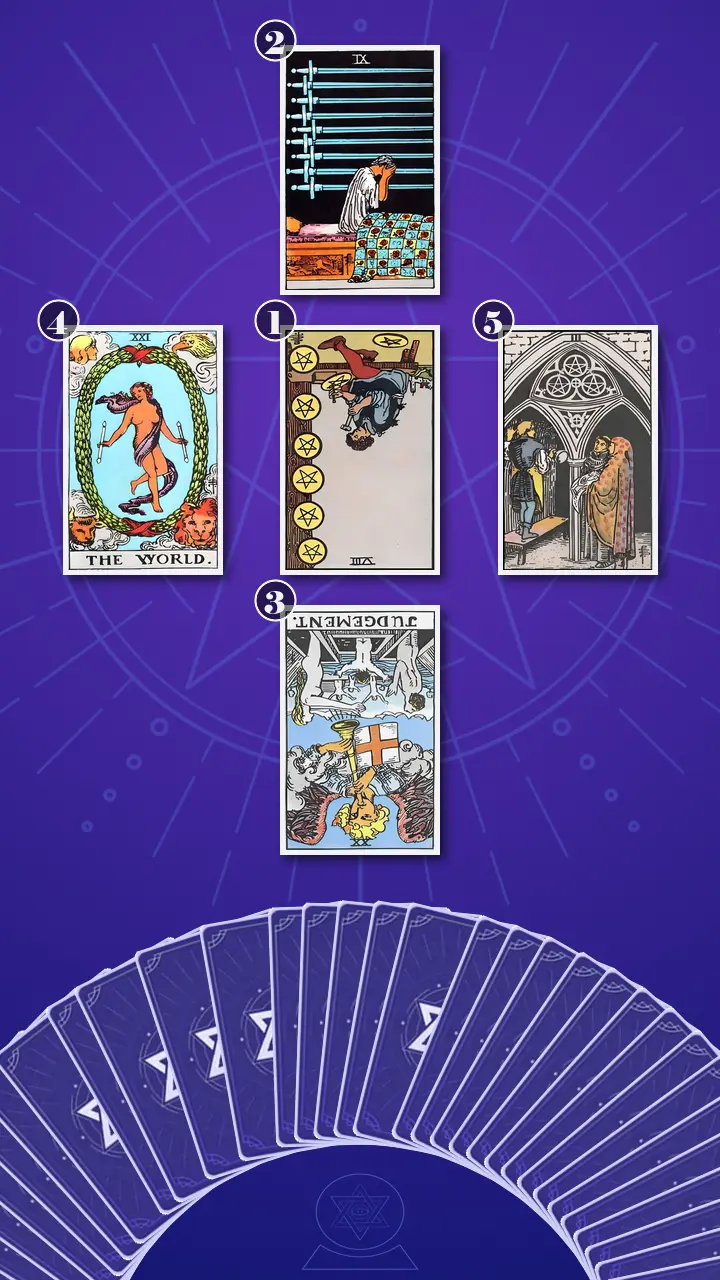
I chose The Shadow Spread, a five-card cross layout for capstone completion anxiety and academic perfectionism. I use this spread when the same behaviour appears at the same emotional threshold, because it separates the visible pattern from its trigger, its buried belief, its hidden resource, and its practical integration. That structure was more useful here than predicting an outcome Jordan still had the power to shape.
I placed the first card at the centre for the repetitive revision loop. The second would show what activated the loop, and the third would uncover the fear beneath it. The fourth would reveal the resource capable of changing the pattern, while the fifth would translate that resource into a concrete handoff. This is how tarot works best in my practice: card meanings in context become an external map of a pattern that is difficult to see while living inside it.
Reading the Vertical Axis of the Last-Step Stall
Position 1: The Workshop That Never Ships
The card I turned first represented the current expression of Jordan's shadow pattern: reopening finished sections and substituting low-impact polishing for submission. It was the Eight of Pentacles, reversed.
I returned to the 11:40 p.m. scene. The portal was open, but Jordan had spent forty minutes changing heading spacing, rechecking compliant citations, and adding polish tasks to a nearly empty list. The capstone remained technically active while the steps that could close it remained untouched. Like an app kept in permanent beta, the project could preserve its imagined perfect version as long as Jordan never released version one.
I read the reversal as a Blockage in practical earth energy, combined with an Excess of precision. The skill was present. The central argument had already been built. But the familiar movement of editing had become safer than the unfamiliar movement of release. The repeated pentacles looked like sections already completed, while the one beneath the artisan's tools resembled the tiny detail Jordan kept treating as permission to reopen the whole workshop.
“The private logic is, ‘I am still working, so I am still being responsible,’” I said. “But the work being repeated is no longer the work that closes the project. Editing can improve the work; it can also postpone being seen.”
Jordan gave a short laugh that carried no amusement. “That is so accurate it is almost brutal.” Their thumb rubbed the corner of their phone, then stopped.
“Accurate does not have to mean condemning,” I replied. “This loop protected you from exposure for a few minutes at a time. We can respect what it was trying to do while being honest about what it costs now.”
Position 2: Push Notifications from a Review That Has Not Happened
The next card represented the near-completion trigger that activated catastrophic mental rehearsal when the capstone became ready to be seen. I turned over the Nine of Swords, upright.
Jordan had told me that closing the laptop did not end the review. At 1:18 a.m., streetlight came through the blinds while they mentally rewrote the introduction in bed. The radiator clicked in the dark, their jaw remained locked, and an imagined evaluator paused over one awkward sentence as if it could invalidate the full argument. The evaluator had not responded, but Jordan was already defending themself.
I read this as an Excess of air energy. Analysis had stopped serving evidence and started generating future criticism in the present tense. The nine swords were fixed to the wall, yet the figure beneath them could not rest. In Jordan's life, that looked like twenty browser tabs left open internally, each containing a different version of what someone might dislike.
“Which concerns are supported by the rubric,” I asked, “and which exist only inside an imagined comment thread where the harshest reviewer has unlimited posting access?”
Jordan's expression tightened. Their gaze moved from the card to the window, and they released a slow breath through their nose. “Most of the things keeping me awake are not in the rubric,” they said. “They are things someone could possibly think.”
I nodded. “Possibility is not evidence. The card is not telling us that criticism will happen. It is showing us how your body is being asked to survive a review that has not happened yet.”
Position 3: When Feedback Becomes a Courtroom
The third card represented the core fear beneath the stall: interpreting evaluation of the capstone as a verdict on personal capability and worth. It was Judgement, reversed.
I asked Jordan to recall their supervisor's message: ‘The central argument is coherent; tighten the final section.’ Jordan told me their eyes had skipped over ‘coherent’ and locked onto ‘tighten.’ One section needed work became the whole project may be weak; then the whole project may be weak became perhaps I am not genuinely capable. An ordinary academic handoff had expanded into an identity trial.
I read Judgement reversed as a Blockage in honest accountability. The trumpet's call should invite work into review, but Jordan heard it as an accusation requiring flawless evidence. Keeping the capstone private delayed that imagined verdict, yet it also kept Jordan inside the courtroom.
My years of sound-energy research came to mind. In a crowded mix, one loud frequency can mask everything around it. Jordan's mind had amplified the word ‘tighten’ until it drowned out ‘coherent,’ completed research, and every section that already met the brief. The correction was real, but its volume was distorted.
“A rubric can assess a project,” I said. “It cannot measure a person.”
Jordan's fingers froze against the phone case. Their eyes lost focus for a moment as if they were replaying the supervisor's message, and then their shoulders dropped by a fraction. “I save the nice feedback,” they said quietly, “but I treat the correction as the honest part.”
“That is the blind spot this card is exposing,” I replied. “Not a lack of ability, but a filtering system that admits every weakness as evidence and treats every strength as provisional.”
When The World Closed the Loop
Position 4: A Wreath Around Work That Is Enough
The room became unusually quiet before I turned the fourth card. Even the radiator seemed to hold its next click. This position represented the transformative resource that could redefine completion as integration and boundary rather than flawless self-proof. The card was The World, upright.
I drew Jordan's attention to the closed laurel wreath. It formed a boundary around a living figure who remained in motion. I did not read that boundary as perfection. I read it as Balance: research, argument, feedback, skill, and acceptable limitation gathered into a coherent whole. Jordan could write a definition-of-done checklist, complete one final pass, close the document, and submit without asking one capstone to represent every future version of their ability.
I returned us to the late-night portal scene. The coffee was cold, the heading already met the style guide, and Jordan's shoulders were raised because staying inside the document still felt safer than releasing it. Their old equation said that an unfinished project preserved unlimited potential, while a finished one exposed a limited self.
This was where my Cognitive Tempo Calibration lens became useful. Jordan's natural study rhythm was not defective; the task had changed while their working tempo had not. Research and revision had been productive beats, but when the work called for a final barline, their nervous system replayed the editing measure. A Focus Disruption Audit made the dissonant chords visible: the upload page, a classmate's ‘submitted!!’ message, and the word ‘tighten.’ Each cue broke the flow because it signalled exposure, not because it revealed missing skill.
“The World is not telling you to work faster,” I said. “It is offering the barline your existing work needs.”
You do not need to make the capstone prove your worth; close the loop around work that meets its purpose, as The World's wreath turns separate efforts into a whole.
I let the sentence remain in the clean pause between us. Then I made the principle even plainer.
Completion is a boundary around work that meets its purpose, not a final verdict on how capable you may become.
Jordan went completely still. Their inhale stopped halfway, and their fingertips hovered above the table as if the body had paused before accepting new instructions. Their pupils widened; then their gaze slipped past the cards, replaying nights spent correcting details that had already passed review. Their mouth tightened before their eyes reddened.
“But doesn't that mean all those nights were pointless?” they asked, the words sharper than anything they had said before. “Like I did this to myself?”
“No,” I said. “It means you found a strategy that briefly reduced the pain of being seen. It helped until its cost became larger than its protection. Understanding that is not a guilty verdict. It is the moment you regain a choice.”
Jordan's fist slowly opened. Their shoulders descended, followed by a trembling exhale that sounded almost like a laugh. Relief crossed their face, but so did a brief, unsteady blankness. “If the work is already enough,” they said, “then the next move is actually mine.”
“Now, with this new perspective, think back over last week. Was there a moment when this insight could have made you feel different?” I asked.
Jordan returned to the supervisor's message. “I could have accepted that the argument was coherent, tightened the final section, and stopped. I did not have to turn one note into a search warrant for the whole document.”
I named the shift I was witnessing: from performance-based finish-line apprehension toward grounded confidence in bounded completion and criteria-based feedback. It was not instant certainty. It was the smaller, more durable recognition that discomfort could accompany closure without proving the work was unready.
Position 5: The Plan Beside the Finished Structure
The final card represented practical integration through a rubric, bounded feedback, one revision pass, and a clear handoff. I turned over the Three of Pentacles, upright.
I pointed to the collaborators holding an architectural plan beside work already built into the structure. Jordan did not need several people to pronounce the capstone generally good. They could ask one permitted reviewer whether three specific completion criteria had been met, make only changes connected to that response, and submit the file. The reviewer and rubric would assess constructed work, not issue a global opinion about the person who made it.
I read the upright earth energy as Balance restored. The Eight of Pentacles reversed had trapped skill in repetitive private polishing. The Three of Pentacles brought that skill back into contact with visible standards, proportionate collaboration, and a defined purpose.
“Ask for a criteria check, not a verdict,” I said. “Quality becomes manageable when the question is limited enough to answer.”
Jordan looked down at the three pentacles and began naming possibilities aloud: clarity of argument, whether the conclusion answered the research question, and whether any required section was missing. Their voice still carried caution, but the sentences had stopped spiralling outward.
A Definition of Done with a Human Pulse
Taken together, the spread showed me one coherent story. Jordan's skill and care had become trapped in a repetitive editing rhythm. Near-completion triggered imagined criticism, and that criticism drew its force from a deeper belief that the capstone would reveal whether Jordan deserved to see themself as capable. The World supplied the underused resource: a boundary around sufficient, integrated work. The Three of Pentacles then grounded that boundary in a rubric, one reviewer, and a limited final pass.
The cognitive blind spot was treating every urge to reopen the document as evidence that more quality control was required. Often, the urge was simply the body registering that the work was about to become visible. The transformation was not from imperfect work to flawless work. It was from submission as a verdict to submission as a bounded handoff.
Jordan frowned when I mentioned a forty-five-minute final pass. “But after a shift, I sometimes don't even have forty-five useful minutes left,” they said. “That is how I end up doing random easy edits.”
I adjusted the plan. My Syncopated Study Session is built for exactly that mismatch: the work is divided into small beats, each with one job, so a tired mind does not have to improvise its way through an emotionally loaded finish line. Jordan could use the full rhythm on a workable evening or the ten-minute version when capacity was low.
- The Syncopated Definition-of-Done Pass At the next desk session, Jordan will place the rubric beside the laptop and set one forty-five-minute timer: five minutes to copy only explicit requirements onto a one-page checklist, thirty minutes for changes linked to those requirements, and ten minutes to mark passed sections closed, export the PDF, and complete the upload steps without reopening them. A visible note will read: ‘This capstone must meet its purpose; it does not have to represent my final potential.’ Tip: Any preference-level improvement goes into a separate ‘future improvements’ note. On a low-capacity evening, use the ten-minute minimum version for file format, required sections, and submission instructions. Jordan decides whether and when to continue.
- The Three-Criteria Feedback Check Jordan will choose one permitted reviewer and send exactly three questions: Is the argument clear? Does the conclusion answer the research question? Is any required section missing? They will schedule one twenty-minute response review and accept only changes connected to those criteria into the final pass. Tip: Use one reviewer, three criteria, and one response window. If contacting someone feels too difficult, read each rubric criterion aloud and record one sentence of evidence that it has been met.
“Neither practice guarantees that no one will suggest an improvement,” I told Jordan. “They do something more useful: they stop hypothetical criticism from expanding the scope forever. You remain the person who chooses the boundary, closes the document, and makes the handoff.”

A Week Later: The Quiet Proof
Six days later, I received a message from Jordan. They had used the ten-minute version after a shift, then completed the full requirement-only pass the next morning. Their note read: “Submitted at 9:14. I left one transition I still don't love because the argument is clear and the requirement is met. I slept through the night. My first thought this morning was, ‘What if it was wrong?’ Then I laughed. It is done, and I am still allowed to get better.”
I did not treat that message as proof that tarot had solved Jordan's life. The five-card Shadow Spread had made the pattern visible and supplied a practical language for it. Jordan made the checklist, tolerated the imperfect transition, and clicked the button. The agency was theirs.
I think many of us feel our shoulders rise and our breath shorten when an upload button turns private effort into something other people can assess. Part of us may still be trying to protect a whole identity by keeping one document unfinished. Noticing that protection does not excuse the stall, but it does mean we are no longer mistaking it for a lack of capability.
So I will leave you with the image that helped Jordan: a living figure inside The World's closed wreath, growth continuing beyond a finished cycle. If your capstone only had to become a complete piece of work while you remained free to grow beyond it, what small requirement, final barline, or closed section might you be willing to trust today?