When an IC Goal Feels Like a Verdict: Letting the Draft Be Data

The Sunday Night Question: Why Do I Keep Avoiding the IC Path I Say I Want?
I remember Jordan arriving with the particular silence of someone who had already rehearsed the explanation several times. As an early-career software engineer in Toronto, they opened the IC Mastery Track after a day of tickets, stand-ups, and reactive fixes, compared three courses, and closed the laptop when the first real practice block appeared. I recognized the pattern immediately: career-development procrastination wearing a professional outfit.
At 7:12 p.m. on a Sunday, Jordan had the roadmap open beside a half-finished dinner in their small apartment kitchen. The laptop fan hummed beneath the buzz of the overhead light, and the trackpad felt warm under their fingers as they highlighted five competencies. The moment one competency required a concrete practice block, they compared learning resources and answered routine Slack messages instead.
Jordan looked at me and said, “I want the mastery, but I keep waiting to feel like the kind of person who deserves it.” They wanted the depth and recognition of an individual-contributor career path, yet kept postponing the visible work that could build it. Their chest tightened like a locked production deploy whenever the goal moved from a private Notion page into a task someone could review. Their hands went searching for another tab before they had even decided what they were afraid of.
I told them I did not hear a lack of ambition. I heard a real desire being protected from measurable proof. I knew something about the weight of uncertainty from my years on Wall Street, but I also knew that a feeling can be vivid without being a verdict. “We can separate the facts from the story your nervous system is adding,” I said. “Let us draw a map of the loop and find one place where you can choose your next move. That is our Journey to Clarity.”

Choosing the Compass: The Four-Layer Insight Ladder · Context Edition
I asked Jordan to take three slow breaths and name the question without trying to make it sound impressive. Then I shuffled the cards slowly. The small ritual was a point of focus and a transition from rumination into observation, not a supernatural test of what Jordan was destined to do.
I chose the Four-Layer Insight Ladder · Context Edition because this was not a neutral choice between two job titles. It was a self-reinforcing career loop: wanting the IC path, encountering the moment when ability might become visible, delaying, feeling brief relief, and then using the lack of evidence as a reason to doubt the path or themselves. This six-position career tarot spread lets me trace behavior, trigger, underlying belief, hidden payoff, transformative bridge, and grounded next step in a compact causal sequence.
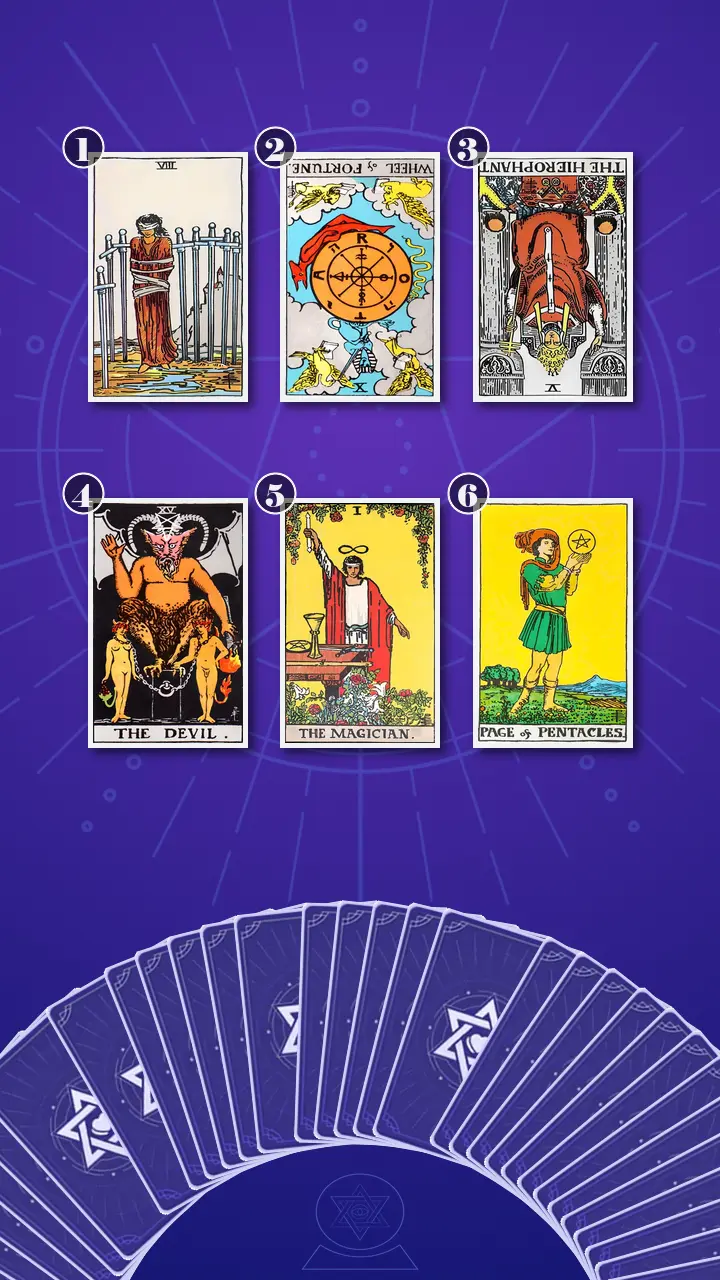
For anyone using tarot as a career reflection tool, that structure matters. The first position shows the present situation and the visible avoidance. The second identifies the repeating trigger. The third reaches the borrowed rule underneath it, while the fourth reveals what the delay pays for in the short term. The fifth is the transformative bridge, and the sixth turns insight into a reviewable piece of practice. I wanted the cards to function like an objective cognitive map, with Jordan retaining every decision.
The Blindfold Beside the Open Door
Now I turned over the card representing the present situation: reveal the concrete avoidance behavior and contracted emotional energy described in the diagnosis, especially postponing IC mastery tasks while continuing to say the path was desired. It was the Eight of Swords, upright, whose standard meaning is the present situation or visible issue.
In the Rider-Waite-Smith image, the blindfolded figure and crossed wrists create the impression that thought has become a prison. In Jordan's life, the scene was exact: on Sunday evening, the IC Mastery Track looked like a narrow corridor with no safe first step. The roadmap was open, the competencies were visible, and the laptop was already set up, but the blindfold was the assumption that beginning only counted if the first attempt proved credibility. Closing the plan and answering routine messages created the sensation of being trapped while leaving several small routes into practice untouched.
Upright, the Air energy was not absent; it was over-constricted. Analysis, comparison, and self-evaluation had become a blockage around action. I asked Jordan, “Which part of this is an observable fact? Which part is a conclusion you could test with one small assignment?” I was not asking them to deny the difficulty. I was asking them to stop treating every assumption as a fixed wall.
Jordan did not nod. Their fingers froze over the card, their breath paused, and their eyes drifted past me as though replaying the highlighted competencies on the kitchen screen. Then a short, bitter laugh escaped. “That is too accurate,” they said. “Almost cruel.” I let the recognition stand without turning it into shame. “We do not have to call it cruel or wrong yet,” I said. “We can call it specific.”
The Wheel That Kept Replaying the Same Ticket
Now I turned over the card representing the repeating trigger: identify the cue that activates the Repetition Compulsion, such as a development task, feedback request, or career conversation that makes IC ability visible. The Wheel of Fortune appeared reversed. Its standard meaning is an immediate influence or recurring condition affecting the present.
The reversed Wheel did not predict bad luck, and it did not say that Jordan was trapped by fate. It showed a blockage in movement, an autoplay queue that started whenever a development task, a manager's question, or a specialist promotion post made the IC path consequential. The sequence was familiar: compare options, revise the plan, delay the first action, feel a brief drop in pressure, and later call the missing progress a personal trait.
I pointed to the wheel's turning figures. “Each new opportunity feels like a brand-new crisis,” I said, “but the response has already been rehearsed. The useful question is not why you are still this way. It is what happens in the five minutes before the loop completes.” Reversed Wheel energy was cyclical rather than balanced, but a cycle can be observed before it turns again. That changed the problem from an identity defect into a pattern with an interruption point.
Jordan rubbed their thumb along the card's edge. “It happens before every development conversation,” they said. “I tell myself I need a better framework first.” I watched their shoulders lower slightly, not from relief exactly, but from having one vague accusation replaced by a sequence they could actually track.
The Rubric That Became a Gatekeeper
Now I turned over the card representing the underlying belief: surface the Limiting Belief or borrowed definition of credibility that turns the IC Mastery Track into a judgment of self-worth. The Hierophant appeared reversed. Its standard meaning is the root belief, underlying influence, or source of the issue.
Jordan had opened the formal IC competency rubric and read it as a gatekeeper's scorecard. Officially impressive work, the right mentor, and a polished specialist reputation seemed necessary before the path could count as legitimate. The rubric could have been a syllabus for choosing one skill, but the reversed Hierophant showed a blockage around authority: Jordan was letting an imagined professional tribunal decide when their learning was valid.
“The formal structure is not the enemy,” I said. “A mentor, a rubric, or a review can give you useful information. The borrowed rule is the problem: I must already look credible before I can claim the path.” This was not a call to reject feedback or every established system. It was an invitation to use a structure as a map rather than a score for personal worth.
Jordan's jaw tightened. They looked down at the crossed keys on the card and said, “I think I have been waiting for permission without admitting that is what I am doing.” I heard the longing beneath the sentence: they wanted specialist depth to be taken seriously, but they had made the first claim so final that even asking for an example felt like requesting a verdict.
The Loose Chain of Immediate Relief
Now I turned over the card representing the maintaining bargain: show the short-term relief and long-term cost that keep the avoidance cycle active after the limiting belief has been triggered. The Devil appeared upright. Its standard meaning is a hidden attachment, maintenance factor, or consequence within the pattern.
The Devil's upright energy was an excess of attachment to immediate relief. I described the modern version plainly: Jordan closed the competency rubric, opened Slack, finished a familiar Jira ticket, and felt the pressure drop within seconds. The private thought was, “At least nobody can judge work I have not shown.” The relief was real. So was the cost: by the end of the week, there was still no draft, no specific feedback, and no practice-based evidence to replace the fear.
The chains in the image were visibly loose. I connected them to a private career document or an unshared Git branch: the goal remained technically available, but keeping it untested prevented anyone from responding to real evidence. “Keeping potential untested protects your image and starves your evidence,” I said. “The chain is not your desire for mastery. It is the safety of never submitting that desire to feedback.”
Jordan's shoulders rose, their hand moved toward their phone, and then stopped. I saw the recognition travel through three small changes: a tightening in the chest, a blank stare at the familiar card, and a slow exhale that loosened their grip on the phone. “I get relief tonight,” they said, “and then I have to explain the same lack of progress next month.” I named The Devil as the major blockage, but never as a moral failure. It was a bargain that had once offered protection and had become too expensive to keep renewing.
When the Magician Turned Potential into Evidence
The room grew quieter when I reached the center of the lower row. I moved the first four cards slightly together, then turned the fifth card face up as the visual hinge between the closed loop and the path beyond it.
The Workbench Already on the Table
Now I turned over the card representing the transformative bridge: identify the key shift from proving readiness to running a small, observable IC mastery experiment that builds self-trust. The Magician appeared upright. Its standard meaning is the resource, intervention, or perspective that can change the pattern by converting insight into deliberate action.
The raised wand, direct gaze, infinity symbol, and four tools on the table gave me a precise translation. Jordan did not need a new personality before starting. They already had an IDE, a codebase, documentation, a calendar, technical knowledge, and at least one person who could review a bounded draft. Upright Fire was focused agency: not frantic effort, not a dramatic reset, but the deliberate arrangement of available resources around one useful act.
I used my signature lens, Strategic Path Valuation, at that moment. In my former Wall Street life, I learned to assess competing directions by long-term return, scalability, optionality, and the quality of the evidence behind a position. I do not use that logic to reduce a human life to a spreadsheet. I use it to separate a macro-direction from one imperfect attempt. The IC path could not be evaluated honestly while every small experiment remained unmade. One twenty-minute technical draft could provide more information about fit, energy, and learning value than ten additional research tabs.
I put the modern workbench in front of Jordan: the IDE, calendar block, GitHub repository, documentation, and one chosen reviewer. Then I asked, “I keep waiting to feel credible, but what could I make observable with what I already have?” The desire to prove an identity was larger than the task required. The next move was smaller: choose one competency, one tool, one bounded output, and one question.
Jordan had been trying to become fully credible before doing anything that might measure them. The roadmap glowed at 7:12 p.m.; course tabs multiplied; the laptop fan hummed. Desire was real, and so was the body's retreat. This was the loop, not a character verdict.
You do not need to keep the IC path protected as an untested possibility; use The Magician's tools to create one real piece of evidence through deliberate practice.
For one second, Jordan's breath stopped. Their fingers hovered over the edge of the card, eyes widening, then their focus slipped past me as if the Sunday kitchen had opened inside the reading room. I watched the memory land: the highlighted competencies, the warm trackpad, the familiar hand reaching for Slack. Their jaw tightened. “But if I make the work visible and it is average, doesn't that mean I was wrong about myself?” The question carried a flash of anger, not at the card but at the years spent treating preparation as protection. I let the silence stay kind. Then their fist loosened, their shoulders dropped by a fraction, and a long breath moved through their chest with a small tremor at the end. Their eyes grew bright without becoming dramatic. The room's electrical hum seemed to recede. They looked at the four tools again, less like props and more like items they could touch. Relief arrived beside a brief, dizzying blankness: a clear path still required their choices.
“Now, use this new perspective to revisit last week,” I said. “Was there a moment when this insight could have made you feel or act differently?”
That was the first step from protecting untested potential through research and delay to building grounded self-trust through small, observable individual-contributor mastery experiments. The Magician did not promise Jordan a promotion, a perfect draft, or a permanent answer. The card offered a different sequence: practice first, information next, identity revised through lived evidence. An IC path is a practice, not a personality test.
The Single Pentacle of Proof
Now I turned over the card representing grounded integration: translate the key shift into one practical learning action that can be completed and reviewed within the current week. The Page of Pentacles appeared upright. Its standard meaning is the next step, practical application, or integration of the reading.
The Page held one pentacle at eye level and looked at it with concentration, not performance. I read the upright Earth energy as balance through patience and tangible learning. For Jordan, the whole IC Mastery Track had to become one reviewable artefact: a focused refactor, a short architecture explanation, a test case, or a five-minute technical walkthrough. The learner position was not evidence of inadequacy. It was a legitimate stage of accumulating evidence.
“You are allowed to be a learner whose evidence is still accumulating,” I said. “Complete one small piece, ask one precise question, and record what the work teaches you.” Jordan reached for their phone and opened the calendar. The movement was modest, but it was different from opening another course. I wrote one line beneath the card: “Let the draft be data, not a verdict.”
Finding Clarity in the Space Between Research and Practice
I laid the six cards out as a causal story. The Eight of Swords showed how the visible task became a narrow corridor. The reversed Wheel showed the same comparison-research-delay-relief sequence returning whenever IC ability might become visible. The reversed Hierophant named the borrowed career rule that credibility must come before practice. The Devil revealed the short-term bargain that maintained it. Then The Magician supplied the bridge from thought to action, and the Page of Pentacles gave that action a small, repeatable shape.
The blind spot was not that Jordan lacked a plan. It was treating a lack of practice-based evidence as evidence of a lack of ability. They were also treating uncertainty about the first draft as uncertainty about the entire IC path. My reading did not tell Jordan whether individual-contributor mastery was their destiny, nor did it frame management as failure or specialist work as morally superior. It showed how to explore a chosen direction without turning one result into a life sentence.
I used Sunk Cost Decoupling to keep the future clean. We separated the time Jordan had already spent, the education and courses they had completed, the status they had gained, and the imagined reputation they wanted from the next decision. None of those past investments had to force an IC commitment. None of them could disqualify Jordan from learning. The next experiment could be chosen on its usefulness, not as a defense of everything that came before.
Then I brought in my private communication framework, The 5-Year Horizon Stress Test. I asked Jordan to imagine the long-term ROI, learning value, energy, and scalability of continuing toward IC mastery alongside the possibility of a different route, without using LinkedIn applause as the metric. But I narrowed the immediate decision to something humane and measurable: within 72 hours, choose Hold or Pivot only on the experiment's size, competency, or audience. Hold the test if it remains useful; pivot the test if the format is wrong. Do not make a five-year hypothetical into another research tab.
These were the next steps I gave Jordan. Each one was deliberately small enough to create information before confidence arrived.
- Log the loop before it completesFor the next seven days, keep a note titled IC loop. Whenever a roadmap, feedback request, 1:1, or specialist promotion post triggers the urge to delay, record the cue and the exact escape action, then complete one 20-minute IC practice in the current codebase before opening more research tabs.Use a five-minute outline as the minimum version. Review the note on Friday for the repeated cue, not for a score on motivation.
- Turn the rubric into a mapChoose one competency from the IC Mastery Track and send a trusted colleague a two-sentence Slack message: “What would a small, competent example of this look like in our codebase?” Add their answer to the rubric as a learning reference, then use it to select one practice task for a single work block.Treat the request as information gathering, not approval seeking. If a live conversation feels too exposed, ask for one comment on a draft instead.
- Run the 72-hour Hold-or-Pivot experimentWithin 72 hours, apply The 5-Year Horizon Stress Test to the direction without deciding your entire career. Then block one 20-minute calendar slot, use the IDE, documentation, and repository already available, and produce one bounded artefact for one chosen reviewer: a technical note, small refactor, test case, or five-minute explanation with one precise feedback question.Decide the time limit, output, and reviewer before beginning. Label the file draft for feedback and let an average first attempt be information about the next revision.
These actions put agency back where it belongs. The cards gave Jordan a way to notice the pattern, but Jordan would decide whether to hold, pivot, revise, or eventually change direction. Tarot can clarify the question; only the person living the career can choose the experiment and interpret the evidence.

A Quiet Proof, Not a Personality Verdict
Four days later, Jordan texted me: “I gave the error-handling note twenty minutes, sent one question to Priya, and found it was average, not catastrophic.” On Sunday, pale Toronto light filled the kitchen. “What if I’m wrong?” still arrived, but their hand opened the draft before another tab.
I told Jordan that this was finding clarity in its first, honest form: not certainty about an entire professional identity, but a grounded willingness to let practice teach. The journey had moved one step from protecting potential to testing it, and that step belonged to Jordan.
When the IC path starts feeling like a verdict on whether you are credible enough, notice the tight chest, the hand reaching for another tab, and the way protecting an average first draft can leave you farther from the evidence you want. Noticing that sequence is already a change in position.
If one small, visible practice could be information rather than a verdict, what part of the IC path would you feel quietly curious enough to try this week: one competency, one draft for feedback, or one question to a trusted reviewer?