One Red Overdue Label Became the Whole Term, Then She Looked Again

When One Missed Deadline Becomes the Whole Term
“You’re a third-year Toronto student balancing a full course load with service shifts, and your Sunday Scaries begin the second Brightspace shows one red Overdue label.” I said that to Alex at the start of our consultation, and her expression changed before I had finished the sentence.
She had described 8:43 p.m. on the previous Sunday in a rented bedroom near Toronto’s 506 streetcar line. The radiator clicked beside her desk. Yesterday’s coffee smelled sour in its mug, and the laptop cast a cold blue square over her notes. She saw the red Overdue label, felt her throat tighten and her shoulders drop, then closed the tab before reaching the two assignments that were still open.
“Why do I keep writing off the term after one missed deadline?” she asked. “I tell myself I’m being realistic, but then I stop checking the portal, miss the next thing, and suddenly the whole semester looks impossible.” The contradiction was precise: she wanted to recover the term, yet treated the first missed deadline as proof that the term was already lost and avoided the very attempts that could have restored momentum.
I could hear the shame in the way she kept rubbing one thumbnail over the other. It seemed to sit behind her tongue like a hot coin: painful to hold, impossible to swallow, and briefly less visible when the laptop closed. The relief arrived first, but underneath it were discouragement and guilt, already gathering around the next deadline.
“I’m not going to tell you that every consequence can be undone,” I said. “An overdue label may have real academic consequences, and course policies matter. But we can separate what the portal actually says from what fear is predicting. Let’s draw a map of the pattern, find the point where it turns, and make our Journey to Clarity small enough to begin.”

Choosing a Compass for the Deadline Cascade
I invited Alex to take one slow breath and name the question she wanted the cards to examine. Then I shuffled at an even pace, treating the movement as a transition into attention rather than a mysterious test. The cards gave us something concrete to look at while her mind moved away from the red label and back toward the whole field of information.
I chose the Transformation Path Grid (6), Context Edition, an original six-card tarot spread designed for academic deadline recovery, avoidance, and sustainable re-engagement. The structure suited this problem because Alex was not choosing between two external options. She was caught in a self-reinforcing system: one missed deadline became a verdict, the verdict produced recovery avoidance, and the resulting assignment deadline cascade seemed to prove the original judgment correct.
For anyone wondering how tarot works in a reading like this, I use it as a reflective tool. The cards do not predict Alex’s grades, override a late-submission policy, or decide whether she should contact an instructor. They give symbolic form to behaviours, assumptions, and possibilities that are often difficult to see while shame is narrowing the frame.
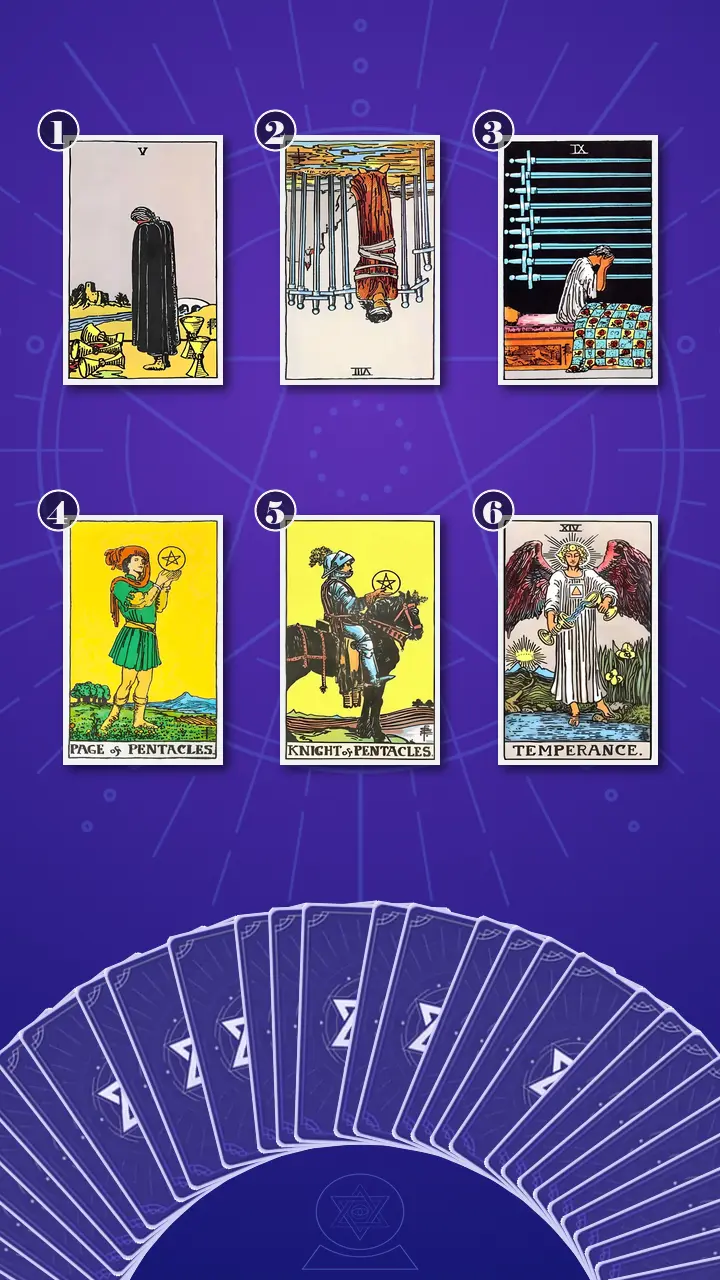
I laid the cards in a two-by-three grid. The upper row would show the visible shutdown, the immediate blockage, and the mental root beneath it. The lower row would show the catalyst, the practical action, and the sustainable stance that could integrate the insight. The layout gave us a sequence without pretending that the future was fixed: current condition, blockage, root, catalyst, action, integration.
“We’ll begin with what happens after the label appears,” I told Alex. “Then we’ll examine the rule you are assuming without checking, the fear that keeps the rule in place, and finally the smallest form of re-entry that does not require a perfect academic comeback.”
Reading the Map: The First Three Squares
The Cups She Never Scrolled To
Now turned, the card representing the observable shutdown after the first missed deadline was the card in the upper-left position: closing the learning-management system, overlooking the next tasks, and mentally writing off the term.
It was the Five of Cups, upright.
I asked Alex to look first at the bowed figure in the black cloak and the three cups spilled across the foreground. The image held the exact emotional weight of her Sunday night: one submission was genuinely missed, and the disappointment deserved to be acknowledged. But the figure’s attention was so completely fixed on the loss that the two upright cups behind her disappeared from view. In Alex’s life, those standing cups were the quiz and paper she could still see if she kept scrolling.
This was the Five of Cups as selective attention. The Water of disappointment was not wrong; it had simply become excessive. Curiosity and practical inventory were in deficiency. The bridge in the distance suggested a possible return, not a guaranteed rescue. I wanted that distinction to remain honest. A bridge can exist without promising that every consequence on the other side will vanish.
“The sequence sounds like this,” I said. “I see one loss, I feel the whole term close, and I stop looking for contrary evidence.” I connected it to the familiar modern version: filtering an LMS dashboard to show only Overdue items and then assuming the hidden Upcoming tab must be empty.
“What is still available to you after this setback?” I asked. “What is the smallest fact you could verify today, before deciding what the term means?”
Alex did not nod. First, her breath paused and her hand froze halfway toward her phone. Then her eyes moved away from me, as if a private screen had opened and replayed the moment she stopped scrolling. Finally, she gave a short, bitter laugh. “That’s too accurate,” she said. “Almost a little cruel.”
“I can see why it lands that way,” I replied. “The missed assignment is real. I’m not asking you to call it good or pretend it has no consequence. I’m separating the loss from the conclusion built around it. The card is not judging you for looking down. It is showing me where the rest of the picture went.” Her fingers loosened around the phone, though she still kept it face down.
The Swords Around the Unasked Question
Now turned, the card representing Recovery Avoidance as the immediate blockage, including the way shame makes recovery information feel inaccessible, was the card in the upper-center position.
It was the Eight of Swords, in reversed position.
The blindfolded figure and the ring of swords reminded me of an LMS screen surrounded by red badges, unread announcements, and imagined policy restrictions. Alex spent ten seconds in Brightspace, assumed the late policy offered no route, pictured her classmates as impossibly far ahead, and exited without opening the syllabus or asking one factual question. The problem was not that every option was secretly available. The problem was that prediction had been allowed to decide which options were worth verifying.
In reversed position, the energy was a blockage beginning to reveal itself. The bindings were still experienced as tight, but the card invited examination of whether each restriction was factual, inferred, or simply unknown. The reversal did not promise freedom, and it did not mean Alex should delete every reminder or force herself into an unrealistic catch-up plan. It showed a possible loosening through inquiry.
“An Overdue label is a fact. ‘The term is over’ is a forecast,” I said. “Those two sentences have been standing in the same place in your mind, but they do different jobs.”
I suggested two columns on paper: Verified in the portal and What I am predicting. The first column might contain a penalty, a closed submission link, or a confirmed deadline. The second might contain the belief that an instructor would judge her, that every late option was gone, or that classmates’ progress proved her own recovery was impossible.
Alex’s chest tightened visibly. Her shoulders rose toward her ears, and she pressed her thumb into the edge of the table. Then she named the rule she had been treating as fact. “I keep telling myself the late policy won’t matter,” she said. “But I haven’t actually read it.”
“That is a useful fact in itself,” I said. “You have found the unasked question. You do not have to send it today, explain your whole life, or ask for a special outcome. You can first decide whether the question belongs in the factual column and whether you want an answer.”
The Night Watcher Who Called Rehearsal Preparation
Now turned, the card representing Defensive Pessimism as the root mental ritual beneath the shutdown was the card in the upper-right position.
It was the Nine of Swords, in upright position.
The seated figure holding their head beneath the row of swords brought us back to 1:36 a.m., when Alex lay in bed replaying the missed deadline while the next assignment remained untouched. She had imagined another late submission, another disappointing grade, another instructor or mentor deciding she was incapable. By morning, the private rehearsal had become a daytime decision not to open the next task, because no submission felt safer than another visible result.
This was an excess of Air: thought moving so repeatedly that repetition began to feel like evidence. Defensive pessimism presented worst-case rehearsal as preparation, but the rehearsal was not producing a next action. It was giving shame more airtime while protecting Alex from the immediate possibility of being evaluated again. The short-term relief was real; so was the long-term cost.
“You are not only avoiding the workload,” I said. “You are avoiding another visible verdict.” I let the sentence sit between us. “If you predict every bad outcome, maybe none of them can surprise you. If you do not submit, there is no new grade to judge. That can feel protective, but it also hands the next ten days to the prediction.”
This was where I used one of my signature lenses, Draft Paralysis Deconstruction. Through my Jungian psychological lens, I treat perfectionism here as a subconscious defense mechanism designed to protect the person from academic criticism. The unopened draft is not proof of laziness or indifference. It is a shield: no instructor can find a weak paragraph in a document that never enters the room. I also showed Alex the cost of the shield. It prevents criticism for a moment by preventing contact with learning, feedback, and any evidence that a small imperfect return might be possible.
Alex went quiet. I watched her eyes settle on the Nine of Swords, then lose focus as she remembered a late night of rehearsing failure. “I thought I was preparing myself,” she said. “But I was repeating the same scene until not trying felt like the responsible option.” Her mouth tightened, and she looked down at her hands. “That’s hard to admit.”
“It is hard because the strategy was trying to protect something important,” I said. “Your wish to be capable and respected is not the enemy. We are only asking whether this particular protection still serves you when it turns one miss into a cascade.”
When the Page of Pentacles Looked at One Thing
The Bridge Out of the Red Badge
Now turned, the card representing the smallest concrete piece of information or work that could interrupt the Assignment Deadline Cascade before another deadline was lost was the card in the lower-left position.
It was the Page of Pentacles, in upright position, and the room seemed to become quieter around it. The radiator stopped clicking. From outside, a streetcar bell sounded once and faded, leaving the Page’s concentrated gaze on the single pentacle unusually clear.
The Page is the bridge in this spread: curiosity, teachability, grounded self-trust, and the willingness to begin before certainty is available. His attention is not on the entire mountain of work. He is looking directly at one object. In modern life, that object might be one rubric bullet, one due date, one available quiz, or one factual question copied into a blank document.
Alex was still trying to make certainty a condition of re-entry. It was Sunday night in miniature: the red Overdue label had tightened her throat, the portal had closed, and the two live assignments had vanished behind a conclusion she had not tested. She wanted proof that opening the next task would not expose her again.
Stop treating Recovery Avoidance as protection from another failure; like the Page studying the pentacle, examine one requirement and take one measurable step before deciding what the term means.
A missed deadline can have consequences without becoming your identity; recovery starts when you verify one next step before fear writes the ending.
For a moment, Alex’s pen hovered above the paper. Her inhale stopped at the top of her chest, her pupils widened, and her fingers tightened around the pen as if the sentence had physically interrupted them. Then her gaze went unfocused. I watched her replay Sunday night: the red label, the closed tab, the unverified assumption that the next attempt would expose her. Her mouth parted. “I can inspect one requirement without promising I can save everything,” she whispered. A flash of anger followed. “But what if I do that and it still goes badly? Doesn’t that mean I was wrong to trust myself?” I waited rather than argue. Her jaw softened first. Her shoulders lowered a fraction, then her fist opened on the table. The breath that left her was shaky, almost embarrassed, but it made room for a second one. “I’d have information,” she said, quieter now. “That is different from a verdict.” The relief was real, but it carried a brief, dizzying blankness: clarity had removed her old excuse and left her responsible for choosing the next small move.
“Now, use this new perspective to remember last week,” I said. “Was there a moment when one verified requirement could have made the situation feel different, even if it could not have erased the missed deadline?”
Alex looked at the blank page. “The first rubric bullet,” she said. “I could have copied it down. I didn’t need to know whether I could save the whole term. I needed to know what the next assignment was actually asking.”
I named the second signature lens I use with students, Performance Anxiety Decoupling: logically separating core self-worth from assignment results, peer comparisons, and mentor evaluations. The Page of Pentacles did not offer Alex a guaranteed grade. It gave her a way to collect task-level evidence without turning that evidence into an identity-level sentence. This was the first movement from shame-driven withdrawal and defensive pessimism toward fact-based curiosity, bounded study returns, sustainable pacing, and steadier self-trust.
“Recovery does not begin with certainty,” I said. “It begins with one verified next step. The Page is not asking you to prove that you are brilliant. The Page is asking you to become present with one learnable thing.”
The Still Horse and the Five-Minute Doorway
Consistency Without the Heroic Catch-Up
Now turned, the card representing a bounded, repeatable study behaviour rather than an all-or-nothing catch-up demand was the card in the lower-center position.
It was the Knight of Pentacles, in upright position.
The Knight’s horse is still. He holds the pentacle steadily, and the cultivated field beneath him does not look dramatic or fast. That was precisely the point. For Alex, recovery could become one contained study block after class or a service shift: read the rubric, outline one section, stop at a defined time, and record what moved before planning the next return.
The energy here was balanced Earth: patient, responsible, and repeatable. It directly interrupted the Assignment Deadline Cascade because it replaced the fantasy of a single academic comeback burst with contact that could happen again. The Knight did not demand that Alex erase the first miss. He asked her to return to the sequence.
Alex shook her head. “Twenty-five minutes sounds reasonable until it’s after a closing shift,” she said. “Then even opening the document feels like I’m agreeing to a whole night.”
I appreciated the practical objection. “Then the minimum version is five minutes,” I said. “Open the file, write the heading, or list three sources. Decide the stopping point before you begin. A return block is not a promise to finish the assignment, and stopping when your capacity is used is not failure.”
Her shoulders dropped slightly. I saw her replace the imagined all-nighter with a small timer, one that could end without a dramatic conclusion. “Returning once counts,” she said, testing the sentence. “I don’t have to erase the miss tonight.”
“Exactly,” I said. “Consistency here means returning, not never slipping.”
Holding the Miss and the Remaining Work Together
Now turned, the card representing a sustainable stance toward setbacks, measured pacing, and continued engagement with the term as a sequence of tasks was the card in the lower-right position.
It was Temperance, upright.
I drew Alex’s attention to the angel pouring between two cups, with one foot on land and one in water. The image held disappointment and practical effort in the same frame. In her life, the two cups were the actual remaining deadlines and the limits created by classes, paid shifts, sleep, travel, and current capacity. A sustainable plan would not pretend that the missed deadline had no cost. It would refuse to let that cost define every task that remained.
Temperance brought balance rather than an instruction to endure more. Its water-and-land imagery integrated feeling with practical pacing. The Knight’s steady work could continue, but it had to be measured, adjustable, and honest. “What amount of work can you sustain this week while leaving room to revise the plan?” I asked. “Not the amount that would look impressive on a perfect recovery calendar. The amount that can coexist with your actual life.”
Alex looked at the six cards as a connected grid. Her shoulders relaxed, and she let out a breath that sounded less like surrender than a decision to stop arguing with reality. “I can accept that the first assignment may carry a penalty,” she said. “I can also check the next two deadlines instead of turning that penalty into the status of the whole term.”
I nodded. Temperance was not a promise of a clean slate. It was a working stance: disappointment can remain true while participation continues. The path toward finding clarity was becoming visible because she no longer required the entire term to be resolved before she was allowed to take one step.
From the Deadline Cascade to a Live Sequence
When I read the six cards together, I saw a coherent system rather than a character flaw. The Five of Cups showed the visible moment: one missed submission became the centre of the frame. The reversed Eight of Swords showed how Recovery Avoidance converted unknowns into restrictions. The Nine of Swords revealed the older mental ritual beneath them: worst-case rehearsal offered short-term protection from surprise, then justified withdrawal. The Page of Pentacles interrupted the loop with one concrete object of attention. The Knight of Pentacles made that attention repeatable, and Temperance placed it inside a week that also contained work, rest, consequences, and changing capacity.
In Alex’s mind, the term had become a row of fallen dominoes, with the first missed deadline treated as the instant the entire sequence ended. But a deadline cascade can also be understood as a sequence of separate events. Some pieces may already have consequences. Some may still be live. The practical question is not whether the first domino can be made to have never fallen. The practical question is which piece remains upright, what information is available, and where a small return can change the next movement.
The cognitive blind spot was not simply poor planning. It was the belief that a plan only counted if it could guarantee a successful catch-up, and that any new attempt would function as a public test of capability. That belief made avoidance feel like control. The key shift is smaller and more demanding in an honest way: stop declaring the term lost, run a recovery protocol, inventory the remaining deadlines, identify one support or clarification, and start the smallest next task within twenty-four hours.
I explained that the Transformation Path Grid (6), Context Edition, was useful because it kept agency with the person looking at it. It could help Alex notice, test, and revise. It could not decide whether a late option existed or guarantee an academic outcome. The cards had given her a language for the pattern; she remained the person who chose what to verify, whom to contact, what to disclose, and when to stop.
The One-Page Recovery Protocol
I translated the reading into three low-threshold next steps. I wanted each one to produce either information or bounded contact with the work, not another performance review disguised as productivity.
- The Inner-Critic Mute ProtocolOn one evening this week, set a ten-minute phone timer, open one course in Brightspace, and make two paper columns titled Verified in the portal and What I am predicting. Record the next two deadlines, one available task, and one factual recovery question. The purpose is to mute the inner critic long enough to collect data, not to force a positive conclusion.If the full portal feels too activating, check a syllabus PDF, a calendar screenshot, or one trusted classmate’s confirmation. Stop after one verified fact if needed; you do not have to send a message during those ten minutes.
- The One-Requirement Re-entryOpen the nearest upcoming assignment rubric and copy one required section into a blank document titled Next Verifiable Step. Spend up to ten minutes naming the first action in a verb, such as find three sources, outline the introduction, or answer question one. This lets the Page of Pentacles replace an identity-level judgment with one observable requirement.Use the five-minute version when shame is loud: open the rubric, read one bullet, and close it after writing the bullet down. The step still counts even if it reveals a penalty or a question that needs clarification.
- The Bounded Return BlockSchedule one twenty-five-minute block at a library desk, campus study area, or home desk after a class or service shift. Name the task before starting, write a stopping point such as three sources listed or introduction in bullet points, and record what moved, what remains, and the next optional return time when the timer ends.Do not turn re-entry into an all-night punishment sprint. Stop when the written condition is met, leave room for sleep and work, and revise one unrealistic block after forty-eight hours instead of declaring the entire recovery plan failed.
If Alex chose to send a message, I suggested keeping it factual and optional: “Hi, I missed [item]. Could you confirm whether [specific option] remains available and which upcoming requirement I should prioritise?” The message did not need a confession, a promise, or a request for an exception. It needed one clear question, and the decision to send it remained hers.
The Quiet Proof of Returning
Four days later, I received a message from Alex while I was making tea between consultations. “I did the ten-minute inventory,” she wrote. “The first assignment has a penalty, but the next quiz is still open. I copied the first rubric requirement and sent one question about Friday’s paper. I’m not caught up, but I’m looking at the actual list now.”
She had sent the factual question, then sat alone in a campus café with a hot tea. She felt lighter and oddly uncelebratory. The next morning, “What if I’m wrong?” arrived first; she opened the calendar anyway and smiled at the smallness of that choice.
I did not read her message as a miraculous rescue or as proof that every academic consequence would disappear. I read it as the first visible evidence of a different sequence. The portal was still allowed to contain difficult information. The term was still unfinished. Alex had simply stopped asking one deadline to answer for all the others.
That is what this Journey to Clarity meant in practice: moving from shame-driven withdrawal and defensive pessimism toward fact-based curiosity, one-requirement re-entry, bounded study returns, sustainable pacing, and steadier self-trust. Tarot did not become the authority in the room. It helped Alex hear the part of her own intelligence that had been buried beneath the need to be certain before beginning.
When one red Overdue label makes your throat close and your shoulders sink, it can feel safer to declare the whole term finished than to risk another attempt seeming to decide whether you are capable enough to be respected. Yet noticing that reflex is already a change in position: the label is in view, but it is no longer the entire landscape.
If the term could remain an unfinished sequence instead of becoming a verdict, which single instruction, date, or factual question might you feel curious enough to look at first?