Hiding Behind the Camera: Join One Group Photo Before the Body Check
When Body-Image Anxiety Makes the Camera Feel Like a Verdict
“You keep volunteering to take the group photo at gallery nights and weekend trips, telling yourself, ‘I am happy to take it,’ while body image anxiety makes standing in the frame feel riskier than staying behind the phone.” I said this to Jordan (name changed for privacy), a twenty-seven-year-old non-binary junior visual designer in Toronto, when they first sat down with their coat folded over their knees.
At 7:18 p.m. on a Saturday at a Queen West restaurant, I watched Jordan reenact the moment with their phone held out toward the table. They adjusted the frame so no one’s shoulder was cut off beneath the warm pendant lights. The room smelled of hot chips and citrus, glasses clinked against the wooden table, and their chest tightened when a friend waved and said, “You should get in this one.”
Jordan told me, “If I am in the photo, everyone will notice what I notice. I need to find the safest angle before I step in. It is easier to be useful than visible. Other people get to keep the memory, while I have to manage how I appear in it. Maybe I can join once my body looks different.”
I heard the contradiction clearly: Jordan wanted to join group photos and be visibly included, yet feared that seeing or being seen in an ordinary image would turn appearance into evidence of worth, acceptability, and belonging. Body shame sat in their chest like a smoke alarm wired directly to the camera shutter. One imagined flash, and their shoulders braced, breath thinned, and the phone rose between them and the people they had come to see.
I did not call that a failure or tell Jordan to simply feel confident. I said, “That role is protecting you from a real sting, even though it is also taking you out of the memories you are helping create. We can understand the protection without letting it run the whole evening. Our Journey to Clarity is to draw a map of the pattern, then let you decide which small crossing feels right.”

Choosing the Four-Layer Insight Ladder for Fear of Being Seen
I invited Jordan to place both feet on the floor, take one comfortable exhale, and focus on the precise question rather than trying to produce a particular answer. I shuffled slowly. For me, this is a psychological transition, a way to gather attention, not a mysterious test or a promise about the future.
When I explain how tarot works in a body-image reading, I describe the Rider-Waite-Smith images as structured mirrors. My Jungian lens lets me use the figures, symbols, and relationships on the cards to inspect subconscious patterns and ordinary behavior. The cards do not predict how Jordan will look, what a friend will think, or whether an image will feel flattering. They give us a disciplined language for noticing assumptions that can otherwise feel like facts.
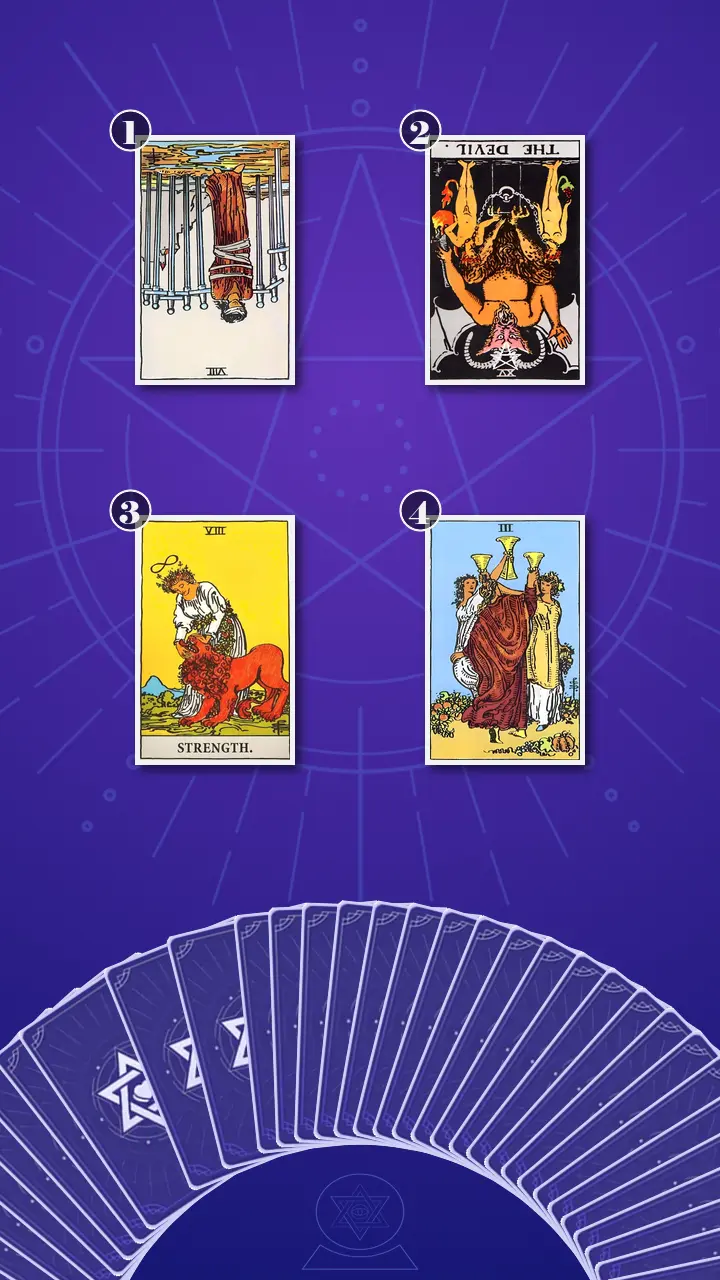
For this question, I chose the Four-Layer Insight Ladder · Context Edition. A decision spread would be less precise because Jordan was not comparing two external options. The real work was to trace an inner mechanism from the visible enclosure, to the belief beneath it, to the quality that could meet the belief, and finally to one relational action.
I told Jordan, “The first position shows the current-state enclosure, the photographer role and the self-monitoring it protects. The second identifies the underlying attachment, the appearance rule that makes belonging feel conditional. The third is the key transformation, the resource that can stay close to discomfort without obeying it. The fourth gives grounded integration, a practical way to bring your presence into the shared memory.”
I placed the four cards in a compact two-by-two ladder. The upper-left card named what everyone could see. The upper-right card reached underneath it. The lower-left card would become the bridge, and the lower-right card would show what the bridge looked like in a real room with real friends.
Reading the Map from the Phone to the Circle
Position 1: The Enclosure That Looks Like Help
“Now turning over the card representing the current-state enclosure, the observable habit of taking every group photo and staying outside the frame, I find the Eight of Swords, in reversed position.”
The blindfold and crossed swords immediately gave me a concrete image for Jordan’s experience. I connected the card to that Queen West table, where the phone gave them a job, a frame to control, and immediate relief from being seen. “If I control the camera, I do not have to risk the camera seeing me,” I said. “The phone becomes a Do Not Disturb sign. It keeps the picture organized, but it can also keep the invitation from reaching you.”
I read the reversed energy as a blockage beginning to loosen, not as an instant release. The excess was camera control: adjusting everyone’s shoulders, rehearsing the safest angle, and keeping every possible flaw under surveillance. The deficiency was not beauty or confidence. It was permission to participate before a visual review. The loose ropes and open space in the card suggested that the enclosure felt powerful without being an external fact that could never be questioned.
I asked, “At the next dinner, birthday, or gallery night, what changes in your breath and shoulders when you move from holding the phone to standing inside the frame?” I wanted the question to name the protective pattern without shaming the person who relied on it. The immediate relief of staying behind the phone was real. So was the later loneliness of opening a shared album and finding everyone present except the person who took most of the pictures.
Jordan gave a brief, bitter laugh. “That is too accurate,” they said. “Almost cruel.” Their fingers tightened around the phone, then loosened when they set it on the table. I answered, “The card is describing a strategy, not issuing a verdict about you. The phone can be a tool without becoming a shield.”
Position 2: The Paywall Called Acceptable
“Now turning over the card representing the underlying attachment, the belief sustaining the current pattern, I find The Devil, in reversed position.”
I asked Jordan to take me into the private review session that often followed a social night. They described opening an Instagram carousel on the TTC, tapping their PRESTO card earlier that evening, then pinching the screen over their stomach, jaw, arms, and the line of their shirt while the train brakes squealed. The shared album or tagged photo had begun as a record of a birthday. Within seconds, it had become a comparison screen.
The chains in The Devil became an appearance rule: “Your brain is acting as if an acceptable angle is the entry fee for belonging.” Jordan looked down. I continued, “The bargain underneath the checking seems to be, ‘If I can control how I look, I can avoid rejection. If I cannot control it, the picture will prove something about my worth.’ What rule did the image supposedly prove?”
The reversed energy showed the attachment becoming visible enough to renegotiate. The major blockage was body-worth fusion, the learned link between physical appearance and the right to be seen. The excess was checking, comparing, asking for another retake, and treating a normal camera angle as a membership test. The possible release was not a rigid ban on mirrors, photos, clothes, or ordinary self-care. It was the ability to label the rule instead of mistaking it for a command.
Jordan’s thumb stopped above the screen. “I can join once my body looks different,” they said, more quietly this time. I asked them to name one recent checking behavior without turning the observation into another reason for self-criticism. They told me about zooming into one tagged photo three times and comparing their posture with a friend’s polished outfit carousel. Their mouth pulled into a small, tired line.
“A photo can hold a moment without grading a body,” I said. “The question is not whether you are allowed to care about an image. The question is whether the image gets to become the authority on whether you belong.”
When Strength Kept the Choice in Their Hands
Position 3: The Lion and the Unsent Verdict
The room seemed to draw in its noise around the lower-left card. “Now turning over the card representing the key transformation, the inner quality that can meet body judgment without obeying it, I find Strength, in upright position.”
The woman in the Rider-Waite-Smith image does not wrestle the lion into submission. Her open hand rests gently against its mouth, and the infinity symbol above her head suggests a steadiness that does not need to make a spectacle of itself. I connected that image to the moment a friend says, “Get in this one,” and Jordan hears, “I hate this angle.” Strength does not demand that the thought disappear. It asks whether the thought has to make the social decision.
The upright energy was balance, a regulated form of courage rather than forceful body correction. I said, “You can notice the inner critic and still place both feet on the floor. You can feel the first flash of judgment and hand the phone to a trusted friend. Self-trust is not the same as liking every photograph. It is the ability to remain connected while an uncomfortable thought is present.”
This was where I used two of my signature lenses. I call the first one Persona Fatigue Diagnosis. It audits the massive energy drain caused by maintaining an artificial social mask when a group role no longer matches the person carrying it. I was not using the phrase as a clinical diagnosis. I was looking at the cost of performing The Useful One, the person who arranges everyone else’s visibility while treating their own as a problem to solve.
Through Group Archetype Decoding, I asked which unconscious role had taken possession of the phone. I named it as The Caretaker of the Frame, a variation of the familiar Caretaker archetype. Jordan had become excellent at making room for everyone else. The group might be loving and entirely unaware of the cost. The role could still be a role, rather than Jordan’s identity.
My mind flicked through the kitchens, studios, and transit platforms where I have sat with people translating themselves for a room. Across cultures, this archetype changes its clothes. Sometimes it organizes the birthday, remembers everyone’s dietary needs, or keeps the group chat moving. Here, it held an iPhone at the perfect crop. The costume changed, but the energy drain came from the same quiet question: who gets to exist when I am no longer useful?
I asked Jordan, “What if the camera skill is yours, but the rule that says you must stay behind it is not? What would it look like to acknowledge the role, thank it for keeping you safe, and take your hands back?”
Before I gave the central sentence, I asked Jordan to picture 8:47 p.m. on the TTC: the phone warm in their palm, shoulders up by their ears, and the shared album open to the one photo they joined. Their thumb zoomed for a verdict while the people beside them were still part of the evening.
I let that image settle, then offered the bridge I wanted them to carry:
Stop treating appearance as the entry ticket to the group, and use Strength’s gentle hand as a model: acknowledge the body judgment without letting it hold the phone, choose one ordinary act of participation, and let belonging be lived rather than visually proven.
After a quiet pause, I gave the central delivery in a simpler form:
You do not need to make your body acceptable before joining the photo. You can notice the inner critic, keep your choice in your own hands, and let participation happen before the image receives a verdict.
For one beat, Jordan froze. Their breath stopped halfway in, pupils widening; their fingers hovered at the edge of the card and their shoulders stayed raised as though the phone were still between them and the group. Then their gaze slipped past me. I watched the TTC scene replay in the unfocused look: blue-white album light, thumb over stomach, friends still laughing. Their jaw tightened, and anger arrived before relief. “But doesn’t that mean I was wrong every time I stayed out?”
I kept my voice quiet. “No. It means the photographer role protected you, and protection can be thanked without being given the steering wheel. We are testing a choice, not grading your past.”
The reply reached them slowly. Their mouth, which had tightened, parted; the fist against their knee loosened one finger at a time. Their shoulders dropped a fraction, and a breath left their chest with a tremor. Their eyes shone, not because body judgment had vanished, but because it no longer occupied the whole room. For a moment they looked almost dizzy in the new space, as if clarity had removed a familiar wall and left a blank stretch of floor.
I asked immediately, “Now, use this new perspective to remember: was there a moment last week when this insight could have made you feel different?”
Within ten minutes, I invited Jordan to open the Notes app and write one appearance rule they often obeyed: “I must find my safest angle before I can join.” Under it, they wrote one neutral social action: “Hand the phone to a trusted friend and step into one ordinary shot.” I reminded them that they did not have to upload, share, or remain in the frame. If the exercise became too intense, they could pause, change the task, or stop. Participation remained a choice.
That was the bridge in the spread. The emotional transformation was beginning to move from anticipatory body monitoring and the protective photographer role toward compassionate visibility, self-trust, and shared participation with less appearance-based self-surveillance. Jordan did not have to cross the threshold feeling fearless. They only had to notice that discomfort could travel with them without holding the phone.
“You do not need an acceptable angle to enter the circle,” I said. Jordan placed one palm flat on the table, as if practicing the open hand from the card.
Position 4: The Circle That Does Not Need a Perfect Thumbnail
“Now turning over the card representing grounded integration, the practical relational behavior that can carry the transformation into ordinary life, I find the Three of Cups, in upright position.”
The three figures raising their cups gave the photo back to the group. I described Jordan handing the phone to a friend, standing beside the people they came to see for one unedited picture, and returning attention to the conversation instead of beginning a private body review. The flowers and harvest at the figures’ feet made the image feel abundant without asking anyone to be the most attractive person in the frame.
The upright energy was balance through reciprocal participation. I compared the group photo with an iMessage or WhatsApp group chat. No single person is the entire content of the conversation, and no one has to manage every frame for the exchange to matter. A private body review turns one image inward until it becomes a verdict. A public memory is made together through voices, laughter, clinking glasses, and the ordinary fact that each person was there.
I asked, “At one specific gathering this week, what small relational choice would let you contribute your presence as well as your camera skills?” The Three of Cups was not a command to be photographed every time. It did not erase the right to say no, ask for privacy, or leave a picture that feels wrong for reasons Jordan chooses. It simply offered a different default: the phone can pass from hand to hand.
Jordan looked from the Three of Cups to the Eight of Swords and smiled without trying to widen it. “Connection is part of the picture,” they said. Their shoulders were not completely relaxed, but their attention had moved from their stomach and jaw to the people represented by the three raised cups. That shift was small enough to practice and real enough to matter.
Belonging Before the Body Check
When I set the four cards beside one another, the sequence answered why the pattern had become so persistent. The reversed Eight of Swords showed the visible enclosure: holding the phone brought immediate relief and kept Jordan out of the frame. The reversed Devil exposed the hidden agreement beneath that relief: an acceptable angle, body size, or outfit had become the supposed price of entry. Strength supplied the available resource, a calm hand that could let the thought speak without handing it control. The Three of Cups translated that resource into a shared behavior.
I told Jordan that the protective photographer role had not appeared because they were shallow or incapable of friendship. A body-related thought triggered a scan for flaws; taking responsibility for the photo restored control; that control lowered the sting for a moment; the absence from the image then reinforced the feeling that visibility was unsafe. The camera had become a locked gate in Jordan’s imagination, while the cards showed a threshold that could be approached by choice.
The cognitive blind spot was mistaking immediate relief for proof that avoidance was necessary. I named the transformation direction plainly: move from trying to earn permission to be visible by looking acceptable toward treating participation and belonging as available before appearance is evaluated. That did not mean forcing a smile, banning a retake, or pretending every image would feel easy. It meant placing social choice beside body judgment instead of underneath it.
I translated the reading into actionable advice and small next steps. Then I introduced The Mask Detachment Protocol, my boundary exercise for separating core identity from group expectations without rejecting the group or turning discomfort into a new performance. Before an event, Jordan could spend five minutes writing what The Caretaker of the Frame was trying to provide and what Jordan personally wanted to experience. The purpose was to recover some baseline social energy and choose a role, rather than automatically becoming one.
- Label the appearance rule.When the urge to find a safer angle appears at one gathering this week, open the Notes app for up to ten minutes and write the rule as a sentence beginning, “I am acting as if…” For example: “I am acting as if I must look smaller before I can join.” Under it, choose one neutral social detail to return to, such as who is laughing or what song is playing.Do not debate the rule for an hour or turn the exercise into another test. Use the five-minute version, and pause or stop whenever you choose.
- Detach the photographer mask.Before a birthday, gallery night, work event, or weekend dinner, spend five minutes with The Mask Detachment Protocol. Write one thing the group may expect from The Photographer and one thing Jordan wants as a whole person, then text a trusted friend: “I want to be in at least one photo tonight. Can you remind me to hand over the camera if I start automatically taking every shot?”Give the friend a simple role: remind, take one picture, and avoid body-based feedback. The practice is choice, not forced exposure, so saying no remains available.
- Try one ordinary photo.At the next low-stakes dinner or weekend gathering, hand the phone to that trusted friend and say, “Can you take one with me in it? Just an ordinary shot, and please do not comment on my body.” Step into the group with both feet visible, let the group decide whether another picture is wanted, and stay in the conversation for ten minutes before checking the image.Set a phone timer if that makes the ten-minute no-review boundary easier. There is no requirement to upload, share, pose again, or keep looking at the picture.
I reminded Jordan that a small experiment should create room, not a new standard for performing bravery. A practical retake for lighting or group timing could still be a practical retake. A choice to leave the frame could still be a valid boundary. The new question was simply whether the choice came from Jordan’s present wishes or from an appearance rule that had been accepted without a conscious yes.

A Week Later, the Quiet Proof
Five days later, I received a message from Jordan while I was between readings. “I passed the phone at a friend’s dinner,” they wrote. “One picture. I waited ten minutes. I still noticed my angle, but I stayed for the story, and I remember the ridiculous dessert instead of only my stomach.”
They also told me that the next morning their first thought was still, “What if I chose wrong?” They made coffee, named the friend beside them, the music playing, and the dessert everyone had laughed about, then let the shared album remain closed until after breakfast. The answer was not a perfect picture. It was a little more room around the discomfort.
I read the message twice. The cards had not altered Jordan’s body or guaranteed that every future photograph would feel comfortable. They had helped make a hidden rule visible, and Jordan had chosen what to do with that knowledge. That is what finding clarity looked like here: not solving a body or winning an argument with an inner critic, but returning attention to a life that was already happening.
I told Jordan, “The spread gave us a map, but you made the crossing. The person asking the question remains the author of the next moment. Strength did not make the image prove your worth; it helped you keep the choice in your own hands.”
When someone says, “Get in this one,” your shoulders may brace around the phone and your breath may go shallow because an old appearance rule is asking your body to look acceptable before it lets you count as part of the memory.
If one imperfect image could be a record of being with people rather than a verdict on your body, what small detail of the evening, the clink of glasses, a friend’s laugh, or the ridiculous dessert, would you want to stay with first?