When "Security" Needs Proof: Replacing Tests with Direct Requests

The Loyalty Test Hidden Inside “All Good”
I began with the sentence that had brought the whole pattern into focus: “You can spend an entire hybrid workday calmly managing customer escalations, then lose sleep over one unanswered text from the person who is supposed to feel safest.”
Jordan (name changed for privacy) sat across from me the following evening, their phone face-down beside one restless hand. At 11:47 the night before, they had seen an Instagram Story of their best friend laughing at an Ossington bar after saying they were busy.
Jordan described the radiator clicking in their west-end Toronto apartment, the blue-white screen making the room feel colder, and the phone growing warm against their palm. They had typed “Guess you were not actually busy,” deleted it, sent “All good,” and reopened the chat four minutes later to see whether their friend could hear the accusation hidden inside those two words.
“Why do I keep testing my best friend’s loyalty when I already know it makes everything worse?” they asked. “I want to feel secure, but if I stop checking, I’m scared I’ll find out the friendship was never secure at all.”
I watched their jaw tighten. The fear of being replaced seemed to sit behind their sternum like a smoke alarm calibrated to scream at steam: the body prepared for a fire before the available evidence could show whether anything was burning.
“The visible behaviour is a loyalty test,” I said, “but the request underneath it is much softer: ‘Please show me I still belong.’ I’m not here to shame that request, read your friend’s private mind, or predict whether they will always choose you. I want us to use tarot as a clear reflective tool. We’ll separate what happened, what fear added, and what you can choose next. Let’s make a map for the fog without pretending the map controls either person.”

Choosing a Map That Would Not Read Their Friend’s Mind
I asked Jordan to place both feet on the floor, take one ordinary breath, and hold one question in mind: “What happens inside me between the first uncertain cue and the loyalty test?” I shuffled slowly. The pause was not a mystical performance; it was a transition out of the notification stream and into sustained attention.
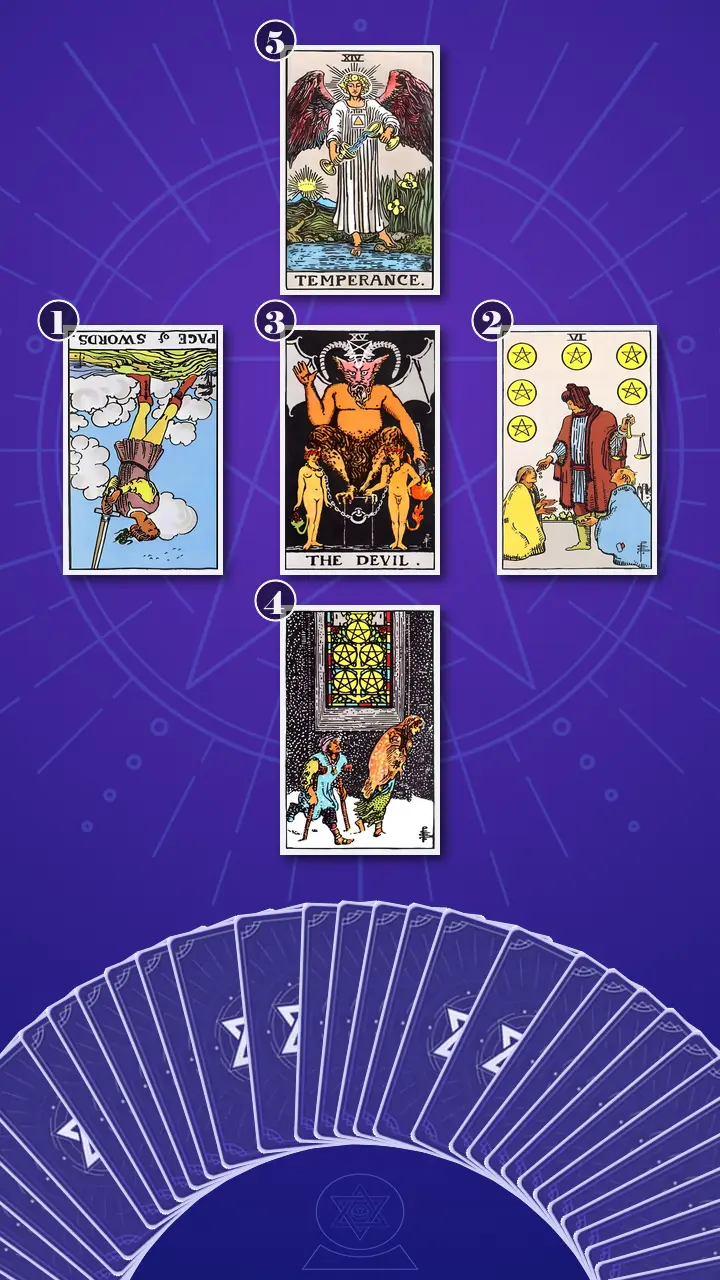
I chose the Relationship Spread · Context Edition, a five-card friendship tarot spread designed for relational dynamics without claiming access to another person’s private thoughts. A larger Celtic Cross would have added layers Jordan did not need. A purely internal shadow spread would have missed how reassurance, pressure, reciprocity, and boundaries move between two people.
I placed the cards face-down in a cross. The left position would show Jordan’s current behavioural stance: monitoring, withdrawing, and communicating indirectly. The right would separate observable reciprocity from feared assumptions. The centre would identify the repeating relationship cycle. The card below would reveal the fear supporting that cycle, and the card above would offer a self-directed practice rather than a predicted outcome.
From where I sat, the arrangement looked like a bridge supported by a deep foundation and pointing toward a beacon. I told Jordan that card meanings in context work best when each position answers a precise question. We were not asking, “Is your friend loyal?” We were asking, “What are you doing with uncertainty, what evidence exists, and where do you still have agency?”
Reading the Friendship’s Hidden Architecture
Position 1: The Watchtower in the Chat Window
Now I turned over the card representing Jordan’s current behavioural stance in the friendship, specifically the monitoring, indirect messages, and withdrawal used to test loyalty. It was the Page of Swords, reversed.
I pointed to the Page’s sideways gaze, raised sword, and wind-tossed landscape. Upright, the Page’s Air can support curiosity, alert observation, and honest questions. Reversed here, that energy was both overextended and blocked. Jordan’s perceptiveness had become a sentry searching incomplete digital signals for a verdict, while the words that could clarify the situation stayed trapped behind sarcasm or silence.
The card returned us to 11:47 p.m. Jordan had seen the bar Story after hearing their friend was busy, reread the afternoon chat, inspected timestamps, typed an accusation, deleted it, and sent “All good” so their friend would have to detect the hidden complaint. It had the pace of a social-media investigation montage, except the clues could not support the certainty Jordan’s nervous system demanded.
I gave the sequence a voice: “The fact is that they are at a bar and have not answered me. My mind immediately turns it into ‘They lied because they prefer those people.’ Now I want to go cold before I can be blindsided.”
Then I drew a hard line between information and interpretation. “A late reply is data; the ranking story is an interpretation. The disappointment may be real. The conclusion about your entire place in the friendship is still a conclusion.”
Jordan did not nod. They let out one short, bitter laugh and pressed a thumb into the edge of the table. “That is so accurate it feels a little brutal. I tell myself I’m being observant, but I’m basically assembling a case.”
“I can see why observation feels protective,” I replied. “It promises that you will notice rejection before it can surprise you. The card is not criticising your capacity to notice. It is asking whether that capacity is gathering useful information or demanding certainty from signals that cannot provide it.”
Position 2: The Scales Beyond a Single Ping
Next I turned over the card whose role was to separate observable evidence of the friend’s reciprocity from Jordan’s feared assumptions, without pretending I could know the friend’s unspoken motives. It was the Six of Pentacles, upright.
The scales mattered more than any single coin. This was balanced Earth energy: not perfect symmetry, not a tally of who sent more memes, but a grounded review of time, honesty, practical support, respected boundaries, and repair. One late reply could remain painful without being promoted into the sole measure of the friendship.
I asked Jordan to imagine opening Notes the morning after the Story and reviewing the previous six weeks rather than the previous six minutes. They named two plans their friend had initiated, a check-in after a rough customer escalation, an admitted mistake, and a call their friend had promised and completed. Jordan also named one real occasion when they had been left out of a plan that mattered to them.
“If I zoom out,” Jordan said slowly, “I can see that they show up. If I stay inside this one ping, all I can see is that they did not pick me tonight.”
I sometimes use a framework I call Clique Power Dynamics to distinguish anxious comparison from a genuine pattern of exclusion, micro-aggression, or implicit ranking inside a friend group. I explained that the Six of Pentacles was not instructing Jordan to dismiss every hurt as insecurity. If the pattern showed repeated secrecy, public devaluation, one-sided emotional labour, or concerns that were never repaired, those observations would deserve weight. In Jordan’s account, however, one painful data point was repeatedly erasing a much larger record of mutual care.
“Trust is a pattern, not a push notification,” I said. “The scales let care and disappointment remain visible at the same time.”
Jordan’s breath left their chest in a longer stream. Their hand moved away from the phone, and their gaze travelled back over the examples they had just named. The disappointment had not disappeared, but it was no longer the only thing on the table.
Position 3: The Reassurance Contract with a Rising Price
I turned over the central card, representing the self-reinforcing dynamic Jordan brought into the bond: uncertainty led to a test, pursuit produced brief reassurance, and the amount of proof required rose the next time. It was The Devil, upright.
I clarified the boundary of the interpretation immediately. “This card is not declaring your friend toxic, and it is not condemning you as a bad friend. It is showing a compulsive contract.”
The Devil’s energy appeared as excess attachment becoming a blockage. Jordan withheld a reply until their friend asked whether something was wrong. The pursuit brought immediate relief. Then Jordan studied the wording, wondered whether the concern sounded strong enough, and needed another test after the next ambiguous interaction.
I traced the loop on the table with one finger: trigger, loaded message, urgent reassurance, temporary relief, higher proof threshold. “The inner monologue becomes, ‘It worked because they chased me, so why do I already need to know whether they’ll do it again?’”
As an artist, I thought of a scene in an editing suite. If I repeatedly cut from a neutral pause to a suspicious close-up, I can teach an audience to hear danger in silence. Jordan’s internal edit had repeated so often that ordinary gaps now arrived with a suspense soundtrack already attached.
I pointed to the loose chains around the figures’ necks. “The chain feels compulsory, but the image preserves a choice at the level of the next message. You may not control the first surge through your chest. You can still interrupt what happens between the surge and the send button.”
Then I said the sentence the card had been building toward: “The proof worked for an hour; the pressure stayed in the friendship. A loyalty test asks for reassurance while making honesty harder.”
Jordan went quiet. Their eyes dropped to the chains, and their fingers curled once before loosening. “That’s the part I hate,” they said. “I create distance just to see whether they’ll close it. Then even when they do, I start grading how quickly they came after me.”
“What did the last reassurance change,” I asked, “and for how long?”
“My body calmed down,” they said. “Maybe for the evening. It didn’t change what I believed the next day.”
The Devil had not predicted a doomed friendship. It had made the bargain visible enough for Jordan to renegotiate their participation in it.
Position 4: Outside the Bright Rectangle
I turned over the card representing the underlying fear that a moment of distance meant exclusion, replacement, or the loss of relational safety. It was the Five of Pentacles, upright.
In this position, the Pentacles energy appeared as felt deficiency and scarcity. I showed Jordan the two figures moving through snow beneath an illuminated window. In their modern life, that window had become the bright rectangle of an Instagram Story: warmth, laughter, and connection were visibly happening nearby, while Jordan experienced themselves as standing outside.
Jordan gave me another scene. At 6:42 p.m. in a Queen West grocery queue, a group-chat joke had revealed that someone else heard their friend’s personal news first. The scanner beeped, their damp coat smelled like rain and pavement, and the basket handle pressed into their palm. Their stomach dropped. Months of initiated plans, honest calls, airport pickups, and repaired misunderstandings disappeared behind one thought: “I have been moved outside.”
I put the hidden monologue into words: “They are inside; I am outside; if I do not make them choose me now, this must be where I belong.” I did not argue with the fear or use the Six of Pentacles to cancel it. The broader evidence of care could be real, and the present sting of exclusion could also be real. The work was to stop turning the second into proof that the first had never existed.
At that moment, the radiator in my room gave a hollow knock. Light from a passing streetcar moved across the window behind Jordan, briefly brightening the glass and then leaving it clear again. The environment seemed to echo the card: a glimpse of warmth could activate longing without defining where Jordan belonged.
Their throat moved before they spoke. Their eyes shone, but they did not look away. “I thought I was angry because I wasn’t first,” they said. “I’m actually terrified that I’m not inside at all.”
“That fear deserves to be named without ridicule,” I said. “But one friendship cannot safely carry the entire burden of proving that you belong somewhere. The loyalty test has been trying to turn one person’s availability into an emergency supply of belonging. That is too much pressure for you and too much power for a single unread message.”
When Temperance Let Both Cups Breathe
Position 5: Closeness Without Collapse
The room became unusually still before I turned over the final card. This position defined Jordan’s self-directed integration practice: direct requests, tolerance for separate lives, and trust assessed through patterns instead of tests. The card was Temperance, upright, the key card and antidote of the reading.
I focused on the liquid moving between two distinct cups. Neither cup swallowed the other. One foot rested on land and one in water, holding observable reality and emotional truth together. This was balanced energy: differentiation, emotional pacing, direct communication, and proportionate trust. Closeness could connect two lives without collapsing them into one.
In ordinary terms, Temperance looked like two people keeping separate calendars while maintaining a reliable channel between them. After a trigger, Jordan could wait twenty minutes and write: “I felt left out when I saw the Story, and I noticed I started telling myself I had been replaced. I could use some reassurance; are you free to talk tomorrow? No need to reply tonight.” They could let the request matter without demanding that tonight settle every future moment of distance.
I asked Jordan what character they normally played in their group. Their mouth twisted into a reluctant smile. “The chill one,” they said. “Also the unpaid therapist. I’m allowed to have a crisis after everyone else is done.”
This was where I used my Sidekick Syndrome Diagnosis, a deliberately theatrical diagnostic metaphor rather than a clinical label. A tight-knit group can box someone into a useful role: the comic relief, the fixer, the therapist, the person who supposedly needs nothing. No one has to assign that role maliciously for it to become restrictive. Jordan had helped maintain the “unbothered sidekick” character because asking plainly for reassurance felt like breaking character. The loyalty test became an off-camera stage direction: Jordan would go silent, hoping their friend would perform the correct response without Jordan having to speak the vulnerable line.
Temperance offered a different script. Jordan did not need to stop being perceptive or caring. They needed to resign from the part that required their needs to remain invisible.
I returned us to 11:47 p.m.: the bar Story, the warm phone, the tight chest, and “All good” waiting to be decoded. Jordan was still caught in the demand to make one charged night answer the whole friendship before uncertainty had time to settle.
Security is not the proof you can pull from someone on demand; it is the pattern you can observe while both people remain free to have separate lives.
I let the first sentence settle. Then I brought the image down to the central instruction of the reading.
You do not need to tighten the bond until neither person can move; practise measured closeness and honest requests, like Temperance pouring between two cups without collapsing them into one.
For one beat, Jordan’s breath stopped. Their fingers stayed suspended above the face-down phone, and their pupils widened as though the sentence had interrupted a private replay. Then their brows drew together. Colour rose along their cheekbones, their shoulders lifted, and they crossed their arms tightly over their chest. “But doesn’t that mean I was wrong the whole time?” they asked, their voice sharper than it had been all evening. I let the anger have room before answering. “It means the strategy once promised protection and is now charging more than it gives back. That is not the same as saying your need was wrong.” Jordan’s eyes lost focus as the distinction moved through old message threads in their memory. Their jaw trembled once. Their arms uncrossed, their fingers opened, and their shoulders descended on a long, unsteady exhale. “Oh,” they said, almost inaudibly. Relief arrived first, followed by a blank, vulnerable pause. Then came the responsibility hidden inside clarity: “If I ask directly, they can actually say no.”
“Yes,” I said. “A request makes room for a real answer. That can feel riskier than a test whose result you helped manufacture. It also gives you more honest information, and it lets your friend respond without first being placed under pressure.”
I leaned forward just enough to keep my voice gentle. “Now, using this new perspective, think back to last week. Was there a moment when this insight might have made you feel different?”
Jordan remembered seeing their friend active on WhatsApp during a crowded Line 2 commute. They had drafted “Never mind, clearly you’re busy,” while the train brakes squealed and someone’s takeaway coffee filled the carriage with a burnt smell. “I could have written, ‘I’m feeling a little left out today. Could we check in tomorrow?’” they said. “I still would have been scared, but at least I would not have made them solve a puzzle.”
I watched Jordan look again at the two cups. The fear had not vanished. What had changed was their relationship to it. This was the first step from hypervigilant proof-seeking toward differentiated closeness grounded in direct communication and proportionate trust. They could feel the need, name it, tolerate an interval, and then evaluate the friendship through what repeatedly happened rather than through one result extracted under pressure.
Rewriting the Scene Without Erasing the Hurt
I gathered the spread into one coherent story. Jordan’s workday already trained their attention around response times, Slack alerts, customer escalations, and small changes in tone. In the friendship, that useful vigilance had become the reversed Page’s threat scanning. Prior loyalty tests then taught the Devil’s loop that pressure could produce short-term relief. The Five of Pentacles supplied the emotional fuel: if the friend was unavailable, Jordan feared they had not merely lost access for an evening but lost their place altogether.
The Six of Pentacles showed the resource Jordan’s fear kept obscuring: a broader, observable pattern of care, repair, disappointment, boundaries, and follow-through. Temperance reorganised all of it. The scales became evidence, the loose chains became a choice point, and the cups became dialogue. I also noticed the absence of Wands. Jordan did not need a dramatic confrontation or a friendship-wide verdict that night. The missing Fire could be supplied by one modest act of courage: a direct sentence.
I named the cognitive blind spot plainly. Jordan had been treating mind-reading as proof of intimacy and immediate pursuit as stronger evidence than freely chosen consistency. Their need for reassurance was not the blind spot. The blind spot was believing that a hidden need created a fair loyalty exam.
The transformation direction was equally plain: move from creating loyalty tests to naming the need directly, and let repeated, observable behaviour carry more weight than one charged notification. That did not require Jordan to accept neglect, excuse a recurring boundary violation, or stay in a friendship that repeatedly failed to repair. Tarot did not take away their discernment. It gave their discernment a cleaner set of inputs.
The Role Resignation Act and the Next Honest Line
I turned the insight into three deliberately small actions. I called the communication pivot The Role Resignation Act: Jordan would stop performing the character who was always fine and expected others to decode the script. They would state one feeling and one request without punishing, demanding, or pretending not to care.
- Open a Twenty-Minute No-Test Window. At the next digital trigger, open Notes and write one line under each heading: Fact, Story, Need. For example: “They have not replied for three hours.” “I am telling myself I have been replaced.” “I want reassurance and a time to reconnect.” Set a twenty-minute timer and postpone only the loaded message, not the feeling. If twenty minutes feels impossible, use five. Keep the phone in the room if putting it away raises the pressure. If the exercise increases distress, close the note and return later with only one Fact and one Need.
- Run the Pattern-over-Ping Audit Once This Week. Review the previous six weeks and record three observable examples of mutual care or repair, plus one unmet concern that still deserves a conversation. Then ask: “Is tonight a single painful moment, or part of a repeated pattern I can name with dates and examples?” Keep the note qualitative and short. It is context, not a competitive scorecard. Do not use evidence of care to override a repeated pattern that genuinely harms you.
- Perform the Role Resignation Act with One Direct Request. When the timer ends, speak to the friend rather than to the loyalty test: “I want to be direct instead of acting like I’m fine. I felt left out when I saw the Story, and I could use some reassurance. Are you free to talk tomorrow? No need to reply tonight.” Send it only if and when it reflects what you actually want. The low-energy version is: “I felt left out. Could we check in tomorrow?” A request is not a demand; your friend retains their schedule, and you retain the right to notice how they respond over time.
I reminded Jordan that the purpose was not to become perfectly relaxed, stop needing reassurance, or force every friendship concern into an anxiety framework. The purpose was to create enough space for the real concern to become visible. A direct answer, a delayed answer, a repair attempt, or a repeated failure to engage could all become usable evidence. Jordan would decide what that pattern meant for their life.

A Week Later, the Message Had No Trap
Six days later, I received a message from Jordan. Another Story had landed heavily after 10 p.m. Their chest had tightened, and the sarcastic draft had appeared almost automatically. This time, they opened Notes first.
They wrote: “Fact: I was not invited, and I have not asked why. Story: I have been replaced. Need: reassurance, context, and a time to talk.” They waited twenty minutes, then sent their shorter Role Resignation Act: “I felt left out when I saw that. I don’t want to be passive-aggressive about it. Could we talk tomorrow? No need to reply tonight.”
Jordan took a thirty-minute walk while the message remained unanswered. Their friend replied the following morning and agreed to talk after work. The conversation did not resolve every tension, but Jordan heard context they could not have discovered from a viewer list, and they named the exclusion without turning it into an ultimatum.
Jordan slept through the next night. Their first waking thought was still, “What if I’m wrong?” This time, they smiled, labelled it Story rather than Fact, and got out of bed.
I did not see that as tarot magically fixing a friendship. I saw Jordan make one different choice inside a familiar scene. The cards supplied images and structure; Jordan supplied the pause, the honest sentence, and the courage to receive real information.
That was the clarity offered by the five-card Relationship Spread · Context Edition: not certainty about another person’s mind, but a movement from hypervigilant proof-seeking toward closeness that could contain truth, boundaries, separate schedules, and mutual choice. Jordan remained the author of the next act.
When one unread message makes your chest tighten, the hardest fear may not be only that your friend has chosen someone else. It may be that, without immediate proof, you do not belong anywhere securely at all. I would want you to remember Temperance’s two cups: the connection remains visible, but neither person has to disappear into the other.
If one ordinary gap did not have to decide your place in the friendship, what honest sentence could you quietly allow to travel between those two cups?