The 8:07 AM Comment Spiral
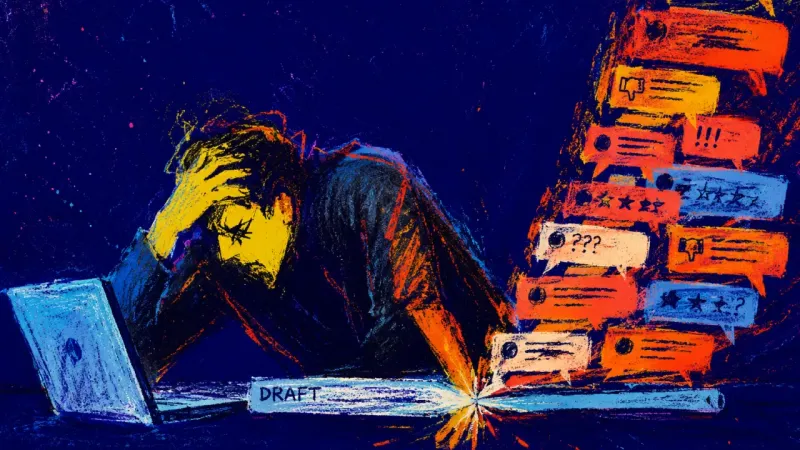
'I can hear the comments before I even open the file,' Jordan told me, and I knew exactly what she meant. It was 8:07 on a grey Tuesday in her London flat: the kettle had just clicked off, the laptop glow was cold, and the Google Doc was already swollen with red bubbles before the first sip of coffee. Her shoulders crept up toward her ears as her thumb hovered over Refresh, as if the cursor itself might accuse her.
She works as a content strategist at a startup, so her day lives in Slack, Google Docs, and review meetings that leave more notes than decisions. What she wanted was a clean, finished draft; what she feared was that any visible rough edge would trigger a fresh round of critique and expose incompetence. In that moment, the shared doc felt less like a tool and more like a live audition.
It had the texture of trying to breathe through a scarf made of static: tight chest, tense shoulders, and the restless urge to reopen the file even when nothing new could possibly have appeared.
I told her, gently, 'A comment is not a verdict. Let's see what pattern is actually running here, and draw a map instead of arguing with the fog.'

Choosing the Energy Diagnostic Map
I asked Jordan to put her phone face down, take one slower breath, and let me shuffle without rushing the silence. That small pause matters. It is the difference between reacting to the thread and actually seeing it.
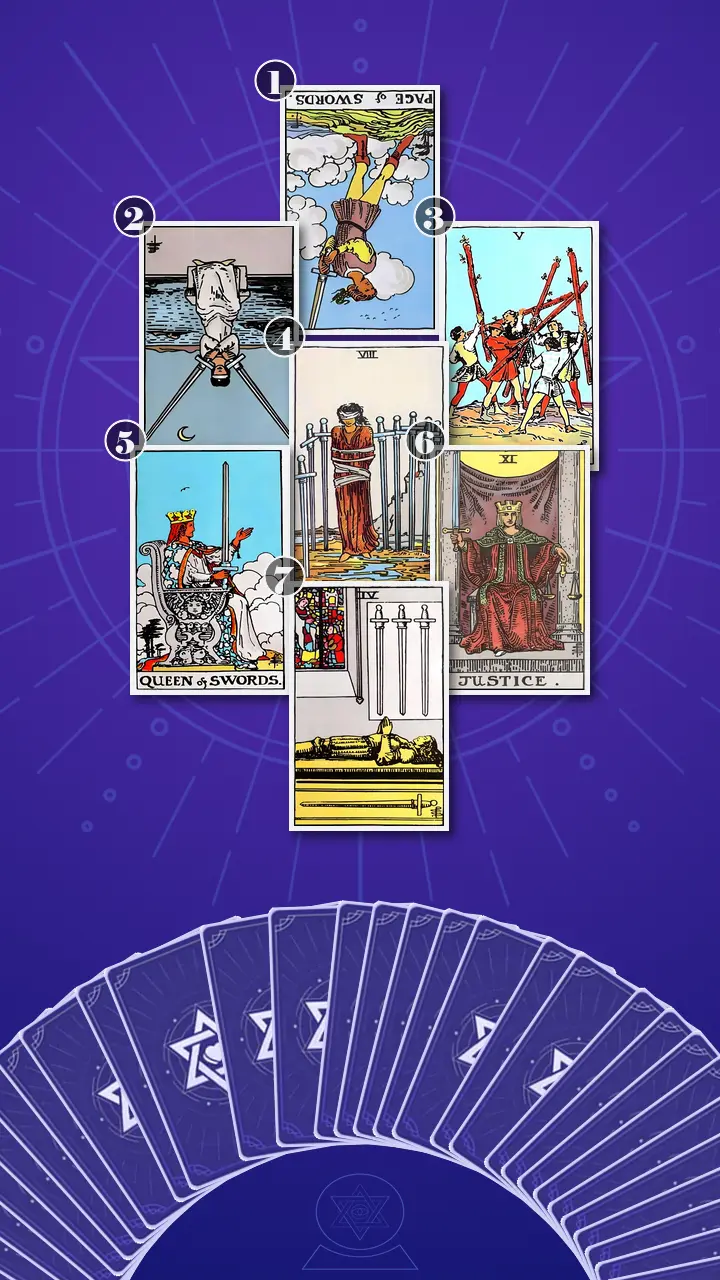
This is how tarot works for me in a case like this: not as a fortune machine, but as a structured way to see where the loop is feeding itself. I did not reach for a broad life spread. I chose a custom seven-card Energy Diagnostic Map because this question is a live review cycle, not a personality quiz. I wanted the layout to trace the surface habit, the inner split, the outside pressure, the hidden cage, the resource already available, the pivot that changes the logic, and the first practical pause.
Card one would show me the visible behaviour. Card four would show me the belief that turns a comment into a trap. And card six would be the hinge: the place where a fair standard can replace panic.
Reading the Map: The First Whisper
Position 1: The Cursor That Won't Settle
Now I turned over the first card, the one for visible surface pattern and reactive behaviour: Page of Swords, reversed.
The modern-life version of this card could have been lifted straight from Jordan's morning: the doc open before coffee, comments refreshed like a live feed, every tiny wording change read as if it were a hidden performance review. In reversed form, this is Air with no landing gear. Too much scanning. Too little sorting. It is the part of the mind that treats motion as safety.
You refresh, you re-read, you answer before the question has even settled, and the thread stays alive because your nervous system refuses to let the file be only a draft.
Jordan gave a short laugh that had more vinegar than humour. 'That is me,' she said. 'That is painfully me.' Her mouth twisted, and she looked away from the table for a second as if the card had caught her in the act. I nodded. Even the laugh had the shape of recognition. The first useful move, I told her, is to slow the response long enough to separate the actual question from the noise around it.
Position 2: The Hand Half-Raised
Next I turned over the second card, the internal push-pull between replying and stepping back: Two of Swords, reversed.
Its modern-life scenario was almost too exact. You are at the kitchen counter with half a coffee, staring at whether to reply now or let the note breathe, and the indecision itself is draining the battery. One part of you wants the thread to stop; the other wants to stay available so nothing can be called unresolved.
Reversed, this is the crack in a stalemate. The swords are no longer held in perfect balance, which means the body starts paying the cost. Jordan's fingers tightened once around her mug, then loosened. 'If I don't answer, it feels like I'm being careless,' she said, and I could hear the hidden rule underneath it: protect the draft, but also protect yourself. The problem is that anxiety is a terrible project manager.
I told her the card was asking for one grounded criterion, not one more opinion. If a note does not change the brief, the facts, or the audience fit, it does not need to steer her day.
Position 3: The Three-Voice Arena
Position three, the external pressure around the doc, was Five of Wands upright.
Three teammates editing the same paragraph in three different directions is not sabotage; it is friction without a shared brief. One wants shorter, one wants more context, one wants a different tone. In isolation each note makes sense. Together, they turn the doc into a miniature arena, and every ping feels louder than the issue itself. It had the energy of a kitchen scene in The Bear, except the heat was all in the notifications.
Jordan exhaled through her nose and gave me the smallest nod. 'That's exactly it,' she said. 'Nobody is wrong, but the thread gets bigger anyway.'
This is why the spiral feels personal even when it is not: the environment itself is producing more commentary than closure.
Position 4: The Locked Room
When I turned to position four, the room went very still. Eight of Swords, upright.
The modern-life translation here is brutal in its accuracy: at 10:38 PM in a small London flat, the draft is still open and your brain is treating one imperfect line like evidence that the whole thing is weak. You keep staring at the page because the real feeling is not unfinished; it is trapped. The cursor is blinking, the file is editable, and yet the mind has already put bars around it.
This is the browser-refresh habit turned into a cage: badge count, cursor hover, rereading tone in punctuation, drafting a defence before the question is even clear. The swords are real enough to sting, but most of them are self-made.
The echo landed hard. Jordan's first reaction was physical: a tight swallow, then a small twitch in one shoulder. After that came the recognition, sudden and uncomfortable; her eyes dropped to the table as if she were replaying her own evenings in real time. Then the release, a thin breath that sounded almost annoyed.
'Yes,' she said quietly. 'That is the loop.'
I did not soften that too much. Some cages only open when you admit you built them for safety.
Position 5: The Clear-Edged Hand
Position five was the resource already in her hands: Queen of Swords, upright.
If Page of Swords reversed is the messenger who cannot stop running, Queen of Swords is the editor who knows the difference between a useful correction and a personality test. Her modern-life scenario is simple: step back, return once the adrenaline has dropped, answer the actual question, trim the extra context, and watch the thread lose some of its grip.
As an archaeologist, I have seen this kind of clarity before. A conservator does not strengthen an artefact by polishing it until the surface disappears; she preserves the line that matters and removes the noise around it. That is Queen of Swords energy: clean judgment without self-defence.
I had the peculiar thought that this was not so different from excavating a Roman threshold. You do not dig faster because the outline is uncertain. You slow down, brush carefully, and let the shape tell you what it is.
Jordan's shoulders lowered by a fraction. 'So I don't need to explain the explanation?' she asked, half-laughing.
'Exactly,' I said. 'The clean sentence is not cold. It is respectful.'
When Justice Finally Spoke
Position 6: Justice, Upright
By the time I reached position six, Jordan had stopped fidgeting but was still carrying the old script: I need to make this airtight before anyone sees it. If I miss something obvious, I will prove I am not as sharp as they think. That was the old engine humming under the table, the one that turned a document into a test.
You do not need every comment to agree before you move; let Justice's scales weigh what matters, and make a clean call from there.
For a second she did not speak. Her eyes stayed on the card, then moved to the notepad where I had drawn two columns: blocker and preference. The courtroom atmosphere of the thread seemed to drain out of the room. Her mouth parted, then she let out a long breath that seemed to come from deeper than her chest. Her shoulders slid down. One hand, which had been curled into a fist since she sat down, opened flat on her knee.
'Oh,' she said, very quietly, and the word carried both relief and a little anger. Not at me. At the amount of energy she had spent pretending every note deserved equal weight. Justice did not ask her to ignore people; it asked her to sort. Is this about the brief? the audience? the deadline? If not, it can be parked. That was the feel of the card: not a verdict against her, but a standard that finally made the room breathable.
In my mind I saw Themis at the edge of a crowded archive, weighing evidence instead of personalities. That is the mythic archetype here: not the punishing judge, but the one who restores proportion. And proportion is what a shared-doc review spiral has been missing all along.
Then I asked her to look back at last week and name one moment when that rule would have changed everything: one comment, one Slack ping, one late-night rewrite that could have waited. She closed her eyes for a beat, and when she opened them the old panic had lost its shine.
This was the step from anxious vigilance and self-doubt toward calm discernment and bounded collaboration. Not perfection. A boundary. A comment is a sorting prompt, not a verdict.
Position 7: The Pause That Lets the Thread Go Quiet
Position seven was the practical landing point: Four of Swords, upright.
The modern-life translation is almost comically simple: the laptop finally closes, notifications go quiet, and the doc is allowed to be unfinished until tomorrow. In a review spiral, that is not laziness. That is neurological first aid.
I told Jordan to build a real pause into the loop: close the doc for twenty minutes before any reply, walk or make tea, and then return once, not ten times. If she needed a physical cue, I suggested a small clay disc beside the keyboard, something she could touch while naming the exact question before she typed. That was my Clay Disc Meditation in plain clothes: a tiny calibration ritual that tells the body the room is still safe.
The nod she gave me then was smaller than the exhale after Justice, but steadier. Four of Swords always looks unglamorous to people who confuse motion with progress; to me, it looks like the moment the nervous system remembers it does not have to stand guard all night.
From Verdict to Working Draft
What the spread showed me was a loop with a very specific logic. Page of Swords reversed keeps checking the file like a live feed. Two of Swords reversed cannot choose between answering and retreating. Five of Wands keeps the review environment noisy. Eight of Swords turns that noise into a prison. Queen of Swords gives the discernment she already has. Justice sets the rule. Four of Swords closes the loop long enough for the whole thing to settle.
The cognitive blind spot was easy to name once the cards lined up: Jordan had been treating every comment as evidence of her competence. That is the false premise. The transformation direction is much cleaner. Stop treating every comment as a verdict. Sort feedback by relevance. Let the thread end when the work is ready enough for this round.
In other words, the doc does not need more defence. It needs a criterion. The thread is not the work, and the review cycle is not supposed to last forever.
I gave her three small moves, and I built them the way I would label finds in the field: one inscription, one pause, one star map. The old-school version of me likes a rule you can hold in your hand.
- Inscription Affirmations — the Comment Triage FilterOn the first reply pass, write the exact question each comment asks, then label every note as must-fix / park / preference. Keep a small card beside your keyboard that says A comment is not a verdict, so you are sorting the thread rather than auditioning for approval.If the labels feel too blunt, add one parking-lot note and move on. Start with one document and one review window.
- Clay Disc Meditation — the Bounded PauseClose the doc for 20 minutes before sending any reply. Hold a smooth coin, coaster, or small clay disc, take four slow breaths, and let your shoulders drop before you reopen the file once, in one pass.The pause is not avoidance if it has a return time. If the urge to reopen spikes, wait it out before touching the tab.
- Celestial Tracking — the One-Line Reply RuleBefore you type, orient yourself by three fixed stars: the brief, the audience, and the deadline. Reply only to comments that change one of those three, and answer the question asked rather than the tone you think is hiding underneath it.Trim one explanatory sentence from each reply. If you catch yourself writing a defence brief, stop and rewrite from the exact question up.
The point was not to become less careful. It was to become more exact about where care belonged. Clarity is a boundary, and a clean boundary makes collaboration easier, not colder.

A Quiet Proof at the End of the Week
Four days later, Jordan sent me a message from a desk near King's Cross. She had written the exact question beside each comment, parked the preference notes, and closed the doc after one review window instead of living inside it. The surprising part was not that the draft became flawless; it was that the evening did.
She told me she made herself a tea, sat by the window, and let the laptop stay shut while the train rattled beneath the street. It was a small, almost stubbornly ordinary proof, but I could hear the change in it: less flinching, more authority, and just enough looseness to breathe. That is how a Journey to Clarity usually looks in real life. Not a cinematic breakthrough. A working draft that finally behaves like a working draft.
We all know that moment when a tiny comment bubble makes your chest go tight, because the visible rough edge on the page suddenly feels like proof that you are not as reliable or in control as everyone thinks. If this draft only needed to be good enough for this round, what would tell you it is safe to close the tab for now?
This story is adapted from psychological research, written so that those in a similar struggle can see their own pattern in it — and find their next step clearly.These insights are not a substitute for professional psychological, medical, legal, or financial advice.
Learn more about our Journey to Clarity.
How did this insight land for you?
🫂 This Resonates Deeply
🌀 Living This Story
✨ Now I See Clearly
🌱 Seeing New Possibilities
🧰 Useful Framework
🔮 The Confirmation I Needed
💪 Feeling Empowered
🚀 Ready for My Next Step
Author Profile
 AI
AI“Having spent a lifetime at Cambridge and on archaeological digs, I’ve witnessed the rise and fall of countless civilizations. Please know that your current struggles are not a permanent fate, but merely a necessary fracture before rebuilding. I won't lecture you; instead, I invite you to sit with me in the ruins, using a patient, historical perspective to gently dust off the true, enduring value hidden beneath your temporary doubts.”
In this Personal Growth Tarot Reading :
Core Expertise
- Cognitive Paradigm Excavation: Treating your current growth bottleneck as the necessary collapse of an obsolete intellectual era.
- Core Philosophy Stratigraphy: Identifying which foundational beliefs must be carried forward to your next life stage and which must be left in the past.
Service Features
- The Paradigm Shift Manifesto: A rigorous intellectual exercise to definitively articulate the new governing laws and core values of your next life chapter.
Also specializes in :
Explore Related Patterns:
Compulsive CheckingJordan opens the Google Doc before coffee, sees the red bubbles already swelling, and hovers over Refresh as if the cursor itself might accuse her. You can see the behavior operating as a safety ritual: scan the file, reread the thread, check the badge count, and stay visually close to the source of threat so nothing can catch you off guard. The problem is that checking gives the body a brief illusion of control while training the mind to treat the doc like a live alarm. Each reopen keeps the feedback loop emotionally hot, so the file stops being a working draft and becomes something you have to monitor in order to feel safe.
Feedback DefensivenessJordan reads every tiny wording change as if it were a hidden performance review, and she starts drafting a defense before the actual question has even settled. You are not just reacting to edits in that state; you are reacting to the imagined judgment behind the edit. That is the defensive mechanism underneath the spiral. Feedback stops being information about the work and becomes evidence about the self, so the mind tries to protect competence by explaining, justifying, and answering tone instead of content. The thread stays alive because the reply is no longer only a reply; it has become a case for the defense.
Boundary DiscernmentJordan looks at the notepad with two columns, blocker and preference, and the courtroom atmosphere of the thread begins to drain out of the room. You are watching a boundary appear in cognitive form: only feedback that changes the brief, the audience, the facts, or the deadline gets to steer the day. That boundary does not reject collaboration; it makes collaboration usable. Instead of treating every comment as equal, you sort by relevance and restore proportion. The shift is from auditioning for approval to applying a standard, which lets the document become a working draft again rather than a measure of your worth.
Imposter SyndromeJordan fears that any visible rough edge will expose incompetence, and the shared doc starts to feel less like a tool than a live audition. You can hear the core belief in the old script she carries: if I miss something obvious, I will prove I am not as sharp as they think. The cognitive distortion is the fusion of one imperfect work object with the whole self. A comment on the draft becomes a verdict on credibility, so ordinary revision feels like the moment everyone might discover you were overestimated. That is why the red bubbles land with such force; they are being read as exposure, not collaboration.
PerfectionismJordan is still carrying the script that the draft must be airtight before anyone sees it, and one imperfect line at 10:38 PM starts to feel like evidence that the whole thing is weak. You can see care turning into a control strategy when every rough edge becomes proof that reliability is at risk. This is not simply high standards. The perfectionistic defense tries to prevent shame by removing every possible target before other people can comment, but a shared doc is built for visible incompleteness. The more you treat every note as equally urgent, the less proportion you have, and the draft becomes impossible to finish because it has to protect your image as well as meet the brief.
Explore Related Struggles:
Identity Verdict LockThe shared doc is already swollen with red comment bubbles before Jordan has taken her first sip of coffee, and the fear is named plainly: any rough edge could expose incompetence. Later, the same logic returns at night when one imperfect line starts to feel like proof that the entire draft is weak. The file becomes more than a draft. It turns into a witness stand where every note seems to testify about whether you are sharp, reliable, and in control. You are not only deciding whether to change a sentence; you are trying to stop a comment from becoming a verdict on your competence. That is why the spiral keeps tightening. The more energy you spend defending the work from judgment, the more the review space feels like judgment itself. Clarity begins when a comment can return to its proper size: a piece of input, not a sentence passed on who you are.
Feedback DisconnectionThree teammates are editing the same paragraph in three different directions: shorter, more context, different tone. None of the comments has to be wrong for the whole thread to become unusable. The problem is that the feedback has lost its shared measuring stick. When every note arrives without a clear relationship to the brief, the audience, or the deadline, the document stops giving you signal and starts giving you volume. You are left trying to metabolize all of it, even though the real missing piece is not another opinion. It is a criterion. Feedback Disconnection is the point where comments no longer behave like guidance. They become floating demands, each tugging on the work from a different angle. The clean move is to reconnect feedback to standards before you let it steer your day.
Monitoring-Safety FusionJordan can hear the comments before she opens the file. Her thumb hovers over Refresh, the doc is checked like a live feed, and replies start forming before the question has even settled. The body is treating motion around the document as protection. That protection has a cost. Each refresh looks like control, but it keeps the nervous system tied to the thread and teaches the file to feel unsafe unless it is being watched. You get a brief hit of relief from checking, then the same checking makes the next bubble feel more urgent. The pattern is not carelessness or lack of discipline. It is a loop where monitoring has fused with safety. The way out is not to stop caring about the draft, but to stop using vigilance as the proof that the draft is under control.
Boundary CollapseThe file is present at 8:07 AM in the kitchen glow and still present at 10:38 PM in the flat. The draft follows Jordan across the day through badge counts, cursor hovering, rereading punctuation, and the restless urge to reopen the tab even when nothing new could have appeared. The boundary does not disappear all at once. It dissolves through small acts that look responsible: one more refresh, one more reply, one more check before bed. You start living inside the review window because leaving it feels like risking carelessness. Boundary Collapse names the moment the tool no longer stays inside the task. The shared doc becomes a room that keeps expanding until it touches the body, the evening, and the ability to stop. A clean boundary does not make collaboration colder; it gives the work a shape that people can actually finish.
Responsibility-Authority SplitJordan wants the thread to stop, but another part of her stays available so nothing can be called unresolved. She is carrying the emotional responsibility for closure while the review space gives her competing standards and no clean hierarchy. That split makes every comment feel like something she must personally absorb, reconcile, and answer. You end up responsible for everyone else's input without feeling entitled to decide what actually changes the work. The result is effort without authority: more replies, more explanation, more carefulness, but not more closure. The blocker and preference columns matter because they restore the missing lever. They let you hold responsibility without surrendering judgment. In this pattern, authority is not dominance over the team; it is the right to sort the work by the standards the work actually serves.
Explore Related Emotions:
Clarity ReliefJordan's eyes move from the Justice card to the notepad where two columns have been drawn: blocker and preference. You can feel the room change when every note no longer has the same weight. The standard is concrete enough to hold the thread. Is this about the brief, the audience, or the deadline? If not, it can be parked, which means the comment does not have to become a verdict, a defense brief, or another late-night rewrite. Clarity Relief names the release that comes when the fog becomes sortable. Her shoulders slide down, her fist opens, and the review cycle becomes breathable because the work now has a criterion instead of an endless demand for self-protection.
Feedback DreadThe Google Doc is already swollen with red bubbles before the first sip of coffee, and Jordan says she can hear the comments before she opens the file. You meet the feedback before it is readable, as pressure in the room, a cold screen, and a thumb hovering over Refresh. Because the draft is treated like a live audition, each note stops being only information and starts carrying the possibility of exposure. Feedback Dread names that charged anticipation, where critique has not fully arrived yet but the body is already braced as if it has. The feeling is not about hating feedback in general. It is about the moment feedback loses proportion and becomes a signal that something about your work, or your reliability, is about to be judged before you have had a chance to sort what the comment actually asks.
Grounded AgencyJordan writes the exact question beside each comment, parks the preference notes, and closes the doc after one review window instead of living inside it. You can see agency return through a practical act of sorting. The brief, audience, and deadline become fixed points. They give her a way to make a clean call without ignoring people, overexplaining herself, or treating every preference as an emergency. Grounded Agency fits because the shift is not about becoming less careful. It is about locating where care belongs, then acting from that boundary. The document does not need more defense; it needs a criterion Jordan is allowed to use.
Imposter Exposure FearWhat Jordan fears is that any visible rough edge will trigger a fresh round of critique and expose incompetence. You can hear the hidden rule beneath that fear when she later says that missing something obvious would prove she is not as sharp as people think. The draft is no longer allowed to be a draft. It has become a test of whether the capable version of Jordan can survive contact with other people's comments, which makes each imperfect line feel too revealing. Imposter Exposure Fear names the specific inner weather of being seen mid-process and imagining that the unfinished parts will be mistaken for the whole truth about you. The comment spiral intensifies because the work is being reviewed, but the self feels like it is being inspected.
Verdict DreadJordan has been treating every comment as evidence of her competence, and the line that lands hardest is simple: a comment is not a verdict. You can feel why it lands, because the document has stopped behaving like a working draft and started feeling like a courtroom. When every note seems to weigh who you are rather than what the paragraph needs, the review cycle becomes impossible to metabolize cleanly. You are no longer sorting feedback by relevance; you are waiting for each bubble to decide whether you are careful enough, sharp enough, or safe from being found lacking. Verdict Dread fits the emotional logic of the spiral because the real threat is not the comment itself. The threat is the inner conversion of ordinary feedback into a ruling on your worth, which keeps the thread alive long after the practical question has been answered.
Caged RestlessnessAt 10:38 PM, the draft is still open, the cursor is blinking, and the file is editable, yet the mind has already put bars around it. You are not locked out of action; you are locked into a cycle that keeps demanding one more look. One part of Jordan wants the thread to stop, while another part wants to stay available so nothing can be called unresolved. That split creates movement without exit, a restless pacing inside the same digital room. Caged Restlessness captures the feeling of being technically free to close the tab while internally unable to leave it alone. The pressure does not produce clean action; it produces circling, rereading, and a trapped urge to defend the work before the actual question is clear.
Cognitive OverwhelmThree teammates are editing the same paragraph in three different directions, while Slack, Docs, and review meetings leave more notes than decisions. You can see how the problem becomes less about one bad comment and more about too many signals arriving without a shared filter. Each note may be reasonable in isolation, but together they crowd the page until the draft has no stable center. The mind keeps scanning because it has not been given a clean way to separate blockers from preferences, facts from tone, and useful corrections from ambient noise. Cognitive Overwhelm belongs here because Jordan is not simply busy. She is trying to process competing inputs while also protecting the meaning of the work and the meaning of herself inside it, which makes the review thread feel larger than the paragraph it is supposed to improve.
Hypervigilant AnxietyJordan's shoulders creep toward her ears while her thumb hovers over Refresh, and she feels the restless urge to reopen the file even when nothing new could possibly have appeared. You are watching the body turn a document into something that has to be monitored. The repeated checking is not neutral productivity. It is a guard posture translated into laptop behavior, where the next comment could arrive at any second and the safest position seems to be constant readiness. Hypervigilant Anxiety names that state of staying on alert inside a low-level workplace loop. The thread keeps its grip because your attention is trying to prevent surprise, even when the actual work would be better served by stepping back and returning once.
Pattern Recognition CalmThe map names the loop with unusual precision: checking the file like a live feed, getting stuck between answering and retreating, absorbing noisy external input, and turning the whole thing into a cage. You can feel the spiral lose some of its force once it has a shape. Before the pattern is named, the thread feels like fog. After it is mapped, each part has a place, which lets Jordan separate the actual question from the noise around it. Pattern Recognition Calm is the steadiness that comes from seeing the system instead of arguing with every symptom. The comments are still there, but they no longer have to occupy the whole room because the loop can be traced, interrupted, and handled in sequence.
Guilt-Free RestThe laptop finally closes, notifications go quiet, and the doc is allowed to be unfinished until tomorrow. You can feel how ordinary that sounds, and how significant it is after a day where the thread kept acting like it had a claim on the whole evening. Jordan does not abandon the work; she gives the pause a return time. That distinction matters because it lets rest become part of the process rather than proof that she is being careless. Guilt-Free Rest names the small but decisive permission to stop standing guard over a draft that is already good enough for this round. The tea by the window, the laptop staying shut, and the evening becoming livable again show the body learning that closure can be temporary and still be real.
Explore Related Contexts:
Design by Committee TrapThree teammates are editing the same paragraph in three different directions: shorter, more context, different tone. No single comment has to be unreasonable for the document to become difficult; the pressure comes from competing preferences being placed into the same workspace without a shared brief to rank them. That is the structure of a Design by Committee Trap. The external problem is not feedback itself, but a collaboration setup where every stakeholder can steer the draft while no one standard decides what counts as done. You are not just dealing with comments; you are dealing with an ungoverned review arena. The spiral keeps growing because the document is asked to satisfy multiple invisible audiences at once. Once the review is re-anchored to the brief, the audience, and the deadline, the draft can stop absorbing every preference as if it were a command.
Review Criteria Black BoxThe review meetings leave more notes than decisions, and inside the Google Doc every red bubble arrives with the same visual weight. A blocker, a preference, a tone concern, and a genuine audience-fit issue all appear as comments, so the tool gives Jordan no built-in way to tell what must change and what can be parked. This is a Review Criteria Black Box: the rules of evaluation exist somewhere in the room, but they are not visible enough to guide action. You end up responding to volume instead of priority, because the review system has not separated decision-making from commentary. The shift happens when Jordan uses a visible standard: brief, audience, deadline, plus the labels must-fix, park, and preference. That does not remove collaboration; it restores proportion, so the document can move forward without needing every comment to become a verdict.
Work Chat FirehoseJordan's day lives in Slack, Google Docs, and review meetings, and by 8:07 AM the document is already swollen with red comment bubbles. The issue is not one message; it is a whole work channel ecology where comments, pings, and meeting residue keep arriving before the previous round has turned into a decision. That places the story inside a Work Chat Firehose. The external pressure comes from the speed and volume of digital workplace signals, especially when collaborative tools make every note feel current, visible, and waiting for response. For you, the pattern is easy to miss because it looks like normal teamwork from the outside. Structurally, though, the firehose turns review into constant monitoring: the file is refreshed like a live feed, the badge count becomes a pressure point, and the actual work gets crowded by the management of incoming signals.
Evaluation Pressure LoopJordan wants a clean, finished draft, but any visible rough edge feels as if it could trigger critique and expose incompetence. The shared doc stops behaving like a working file and starts behaving like a live audition, where even a small wording change can look like a hidden performance review. That is an Evaluation Pressure Loop. The external stage of review has become loaded with professional judgment, so each comment seems to ask for more than a revision; it appears to test reliability, sharpness, and control. For you, the useful distinction is that a comment is not automatically an assessment of competence. Once feedback is sorted by relevance rather than emotional charge, the draft can return to being a draft, and the review cycle no longer has to function like a silent appraisal system.
Always On AvailabilityThe doc is open before Jordan's first sip of coffee, and it is still open at 10:38 PM in her London flat. The same work surface follows her across the day, turning a review thread into something she keeps checking even when nothing new could reasonably have appeared. This is Always On Availability as an external work condition. The pressure is not simply that she cares about doing a good job; the digital review system makes availability feel like proof of responsibility. If the tab is open, the self-monitoring continues. The practical importance is that the loop needs a real boundary, not just a better reply. Closing the doc for one review window interrupts the workplace expectation that a visible comment deserves instant attention, and it gives you a way to treat feedback as scheduled work rather than an all-day summons.