Perfect-Timing Procrastination: The First Test Before You Feel Ready
The Sunday-Night Gate That Never Opens: Waiting for the Right Time
I recognised the Sunday Scaries version of waiting the moment Alex (name changed for privacy) sat down across from me: the week already looked crowded, so a course, an application, and a personal project had been moved to next month before Monday had even started. This was perfect-timing procrastination dressed as responsible planning, the kind that leaves a career crossroads looking busy but untouched.
At 11:47 p.m. the night before, Alex had kept a course application, a portfolio file, and Google Calendar open side by side. Blue laptop light washed the creased duvet; the radiator ticked in the quiet. Alex changed "Start this week" to "Start next month," closed the lid, and felt the jaw release for one breath before pressure returned to the chest. A former colleague's LinkedIn promotion had been waiting in another tab, bright as a small accusation.
"I want to direct my life," Alex told me, "but I keep waiting for the right time. I need one quiet month before I can do anything properly." I heard the central contradiction clearly: the desire to resume and direct life was pulling one way; fear of acting before the conditions felt right was pulling the other. Apprehensive longing sat in the room like a train idling in a tunnel, full of motion that could not yet reach the platform.
I did not hear laziness or a character flaw. I heard a tight jaw, held breath, comparison fatigue, and a mind trying to calculate a risk-free starting point. "Let us give the fog a map," I said. "The cards will not choose your future or demand a leap. I will use them as a clear, external pattern-recognition tool, and you will decide what fits, what does not, and what happens next. Our Journey to Clarity starts with finding out what the waiting is protecting."
Choosing a Compass for a Career Crossroads
I asked Alex to place both feet on the floor, let the shoulders drop as far as they comfortably could, and hold the question without trying to solve it. I shuffled slowly. The small ritual was not a request for hidden forces to take control; it was a psychological transition from scrolling, comparing, and calculating into observing one pattern at a time.
I chose a five-card Shadow Spread. When people ask how tarot works in a situation like this, I explain that the images give an external shape to an internal pattern. The recognised RWS symbols do not predict an unavoidable outcome. They help us separate behaviour from its root, protection from its cost, and fear from the next choice that remains available.
I told Alex that this spread suited the question because the question was about inner excavation rather than a prediction or a comparison between two defined external options. The five positions would show the visible delay, the fear beneath it, the short-term benefit of maintaining it, the truth being avoided, and a practical way to integrate the insight. It was the smallest structure that could distinguish a purposeful pause from indefinite delay without turning timing into an outside verdict.
I pointed to the centre card first, which would name the behaviour Alex was calling preparation. The lower card would reveal the buried mechanism that kept both feet still. The card to the left would show what waiting protected in the short term. Then the upper card would bring the avoided truth into awareness, before the final card translated that truth into grounded next steps.
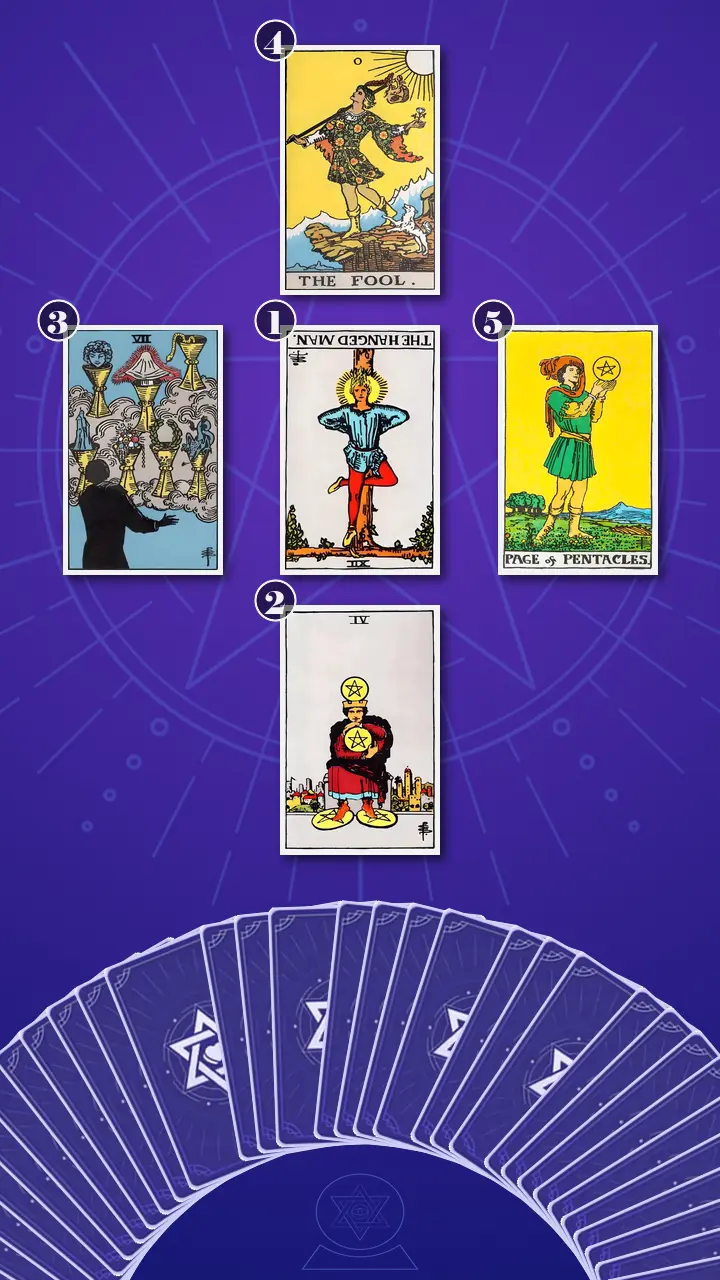
Reading the Map Behind the Delay
The Paused Gate: The Hanged Man Reversed
I began at the centre. "Now turned is the card representing the diagnosis-level behaviour: repeatedly rescheduling meaningful action while calling the delay preparation for the right time."
The Hanged Man, in reversed position.
The suspended figure's bound foot and illuminated head immediately brought me back to Alex's Sunday-night scene. At 11:47 p.m., the application, portfolio, and calendar were still open, but the only thing that had changed was the date. Alex had done intense mental work while the physical action remained untouched, like a Notion task marked planning while its due date was dragged from one month into the next.
Reversed, the card showed a blockage in reflection and a deficiency in movement. A chosen pause can create perspective when it has a question, a purpose, and an end point. This pause was no longer producing new information. It was an endless holding pattern that let Alex remain mentally close to change without being exposed to the feedback that change would bring. Waiting had become a choice while still pretending to be the space before one.
I recreated the inner monologue I had heard in the room: "I am not avoiding it; I am just waiting until work settles down, until my energy is better, until I can give it my full attention." I then placed the laptop scene beside a familiar image from Severance: a competent part of life kept separate from the part that was meant to receive the benefit. Alex's attention was being consumed, but the personal life waiting beyond the screen remained inaccessible.
Alex did not nod. First, the fingers froze around the mug and the breath stopped halfway in. Then the gaze slipped past my shoulder as if replaying the changed calendar heading. Finally, Alex gave a short, bitter laugh. "That is too accurate," Alex said. "Almost rude."
I smiled gently. "I am not asking you to condemn the pause. I am asking whether it is still teaching you anything. If every new week produces the same research and the same moved date, the preparation may be protecting you from the first visible preference. Waiting becomes a choice when the deadline keeps choosing for you."
The Locked Resources: Four of Pentacles Upright
I moved to the card beneath the centre, the position that reveals the mechanism-level root fear: the fear that an imperfectly timed choice could threaten Alex's sense of control over personal direction.
The Four of Pentacles, upright.
The figure clutched one pentacle against the chest while two more fixed the feet to the ground. I saw calendar space, money, identity, and optionality being held with the same tight grip. Alex had told me about the trial class that cost less than a typical night out, then described opening the banking app, checking next month's rent, and calculating every possible follow-on cost until the affordable experiment felt like a threat to the entire future.
The energy here was excess rather than absence. Caution was present, but it had become rigid preservation. It was protecting the current arrangement so thoroughly that none of the preserved time, money, or skill could support movement. A reversible application was being treated as though it could make a career direction permanently wrong. A rough portfolio page was being asked to prove professional competence before another human had even seen it.
I heard the hidden sentence beneath the calculations: "If I choose this and it goes badly, I will have proved I cannot direct my own life." The Four of Pentacles did not shame that fear. I knew that rent, fatigue, unstable work, access needs, and limited energy are real. The question was narrower: was Alex using practical boundaries to make an experiment safer, or using practical concerns to prevent any experiment from happening?
Alex's chest tightened. The jaw set again, and one thumb pressed hard into the side of the phone before releasing. "Keeping my options open feels safer than finding out one of them is wrong," Alex said.
"That makes sense as protection," I replied. "But protection can change jobs. Caution can hold the edges of a small test without locking the door on every form of contact with reality. The safer question is not whether the whole path is guaranteed. It is what one bounded encounter needs in order to remain yours."
The Perfect Futures in the Browser: Seven of Cups Upright
I turned the card to the left, the position that identifies the short-term protective payoff of keeping every possible future untested and avoiding the grief or exposure involved in choosing.
The Seven of Cups, upright.
Seven cloud-borne cups rose in front of a shadowed figure. I translated them into the browser window on Alex's phone: an evening course, a role listing, an Eventbrite workshop, a creative project, a possible city, and several versions of a future that looked beautiful because none had yet met an ordinary Tuesday, a real budget, or a difficult first session.
The card's water energy was diffuse. It multiplied emotional possibilities while withholding the grounded evidence that could distinguish them. Saving every option let Alex feel close to change without facing the trade-offs of a real choice. It preserved not only the options but the self-image of someone who could still become any of them. The cost was decision fatigue, another night of research, and no lived information.
I asked Alex to finish the sentence that the card seemed to be holding: "As long as I have not chosen, I have not lost any version of my future." The silence that followed was not empty. It held the bittersweet appeal of a streaming browse where every unchosen show can remain perfect because no story has actually been watched.
"Clarity is not always a prerequisite," I said. "Sometimes it is the receipt from participation. A real encounter may make an option less attractive, but that is not failure. It is information the saved tab could never provide."
Alex looked down at the phone, where four saved opportunities were still open. The shoulders lowered by a fraction, then lifted again. "I think I like them more when they are possibilities," Alex said. "Once I choose, one of them could become ordinary."
"Yes," I said. "And ordinary can still be workable, interesting, or wrong for you. The relief of keeping every cup untouched is real, but it is not the same as freedom when no cup is allowed to meet your life."
When The Fool Opened the Gate
The Exposed Beginning: The Fool Upright
I reached for the card above the centre. The room seemed to quiet around my hands. Even the traffic beyond the window thinned to a distant hush, as though the street itself had stopped asking Alex to produce a finished answer.
"Now turned is the card representing the disowned truth and key transformation: a meaningful beginning requires tolerating uncertainty and the visible incompleteness of being a beginner."
The Fool, upright.
The Fool stood near a cliff edge with a small bundle over one shoulder, a white rose in hand, and a dog close by. I did not read the image as a command to leap blindly. The approaching foot showed movement; the dog showed awareness; the small bundle showed that the first encounter required less luggage than the imagined future had demanded.
The Fool's energy was an available balance: openness, beginner's courage, experimental agency, and a willingness to learn through direct experience. Alex might not have been waiting for objectively better timing. Alex might have been avoiding the vulnerable identity of being visible while new, uncertain, and incomplete. Sending one application, booking one introductory session, or sharing one rough portfolio page would not settle the next six months. It would let reality answer one question.
This was the point where I used my signature Cognitive Spiral Mapping. I drew the loop on a clean sheet: ideal conditions, more research, a revised date, brief relief, returning pressure, and another round of research. Then I marked the Four of Pentacles as the gravity well, the obsolete habit that pulled every intention back toward protection. The Fool did not erase that gravity. The Fool supplied the orbital slingshot: one honest, reversible action could change the direction of the next orbit without demanding a permanent escape from caution.
I let the silence hold for a moment, then said the deeper truth directly.
You may not be waiting for the right time. You may be waiting to skip the exposed, imperfect beginning that every real direction requires.
I placed one finger beside the Fool's small bundle and gave the practical instruction its own space.
You do not need a guarantee before you begin; choose one honest, reversible step, like The Fool approaching the open path with only what the first part of the journey requires.
At 11:47 p.m., the application, portfolio, and calendar were still open. Alex had moved Start this week to next month, closed the laptop, and felt brief relief followed almost immediately by familiar pressure in the chest.
Alex's breath stopped first, and the hand holding the mug hovered above the saucer. Then the late-night scene seemed to replay behind the eyes: the blue duvet, the moved date, the tiny relief that had lasted only until the chest tightened again. Alex's fingers closed around the mug, released it, and rested flat on the table. The jaw worked once, as if trying to argue with the sentence, and the gaze dropped to The Fool's approaching foot. A flush touched the face; the shoulders lowered, but not all the way. I heard a small breath leave the body, followed by a careful, almost embarrassed laugh. The relief had a thin edge of vertigo because clarity removed the excuse of waiting and returned responsibility to a human scale. I reminded Alex that becoming a beginner was not a failure and that a reversible test could be stopped. The hands opened. Streetlight moved across the card like a narrow path.
"Now, with this new perspective, think back to last week," I said. "Was there a moment when this insight could have made you feel different?"
Alex looked at the portfolio file on the laptop. "When I almost sent the rough case study to a colleague," Alex said. "I told myself I needed to make it useful before anyone could see it. Maybe I was more afraid of looking new than of the file being wrong."
"This is not a sudden transformation into certainty," I said. "It is a crucial step from contracted waiting and fear of visible beginnerhood toward experimental agency, real-world curiosity, and grounded self-trust. The new sentence is not I know the path. It is This can be data, not destiny."
The Single Object of Study: Page of Pentacles Upright
I turned the final card to the right, the position that translates the transformation into one bounded, practical experiment capable of rebuilding self-trust through real feedback.
The Page of Pentacles, upright.
The Page held one pentacle at eye level in a cultivated green field, with distant mountains behind. The image narrowed the seven imagined futures into one concrete object of study. It did not ask Alex to abandon ambition or pretend that every opportunity was equally safe. It asked for a scheduled task, a tangible deliverable, and a plain record of what happened.
The earth energy was now workable rather than rigid. The same practical instinct that had become the Four of Pentacles' locked door could become structure: one calendar block, one limit on cost, one exit condition, and one question worth testing. The Page was the Apprentice, not the finished expert. That identity made room for feedback without treating feedback as a verdict on worth.
I asked Alex which saved option could receive thirty minutes without being promoted into a permanent life decision. Alex opened the course application and pointed to the first unfinished section. The hand no longer hovered over the close button. It rested beside the trackpad.
"I can complete one section," Alex said. "I cannot promise that I will enrol, pay, or continue."
"That is exactly the distinction," I said. "A promise can be small and still be real. Make the step small enough to teach you without owning you."
The Orbit Expansion Strategy: Finding Clarity Without a Verdict
From the Bound Foot to Workable Ground
I placed the five cards where Alex could see the whole sequence. The Hanged Man's foot was bound. The Four of Pentacles pinned both feet beneath coins. The Seven of Cups lifted every future into the clouds. The Fool brought one foot toward the threshold. The Page stood on workable ground with one pentacle held at eye level.
The cards told a coherent story. Alex's present delay was not caused by a lack of desire or intelligence. Intense planning had become a way to avoid the exposure of choosing. Control preserved time, money, identity, and optionality, while the Seven of Cups kept each imagined future bright and untested. The avoided truth was not that Alex needed a dramatic reinvention. It was that every meaningful direction begins with an incomplete version of the self becoming visible. The integration response was practical contact, not more analysis.
I named the cognitive blind spot plainly: treating waiting as neutral. Each moved date felt like a refusal to choose, but deadlines, expired listings, sold-out events, and other people's decisions were already producing real outcomes. Alex was also treating certainty as a condition to receive rather than information to generate. The transformation direction was therefore specific: move from waiting for total readiness to completing one reversible, 30-minute action on a specific date this week.
To make that direction usable, I introduced my private communication tool, The Orbit Expansion Strategy. I asked Alex to map the current orbit in the centre of the page, draw one small outward arrow for the first encounter, and mark three boundaries around it: time, cost, and exit. The goal was not to force escape velocity. The goal was to give caution a container, so the experiment could gather momentum without taking ownership of the whole future.
I offered the following actionable advice and kept each next step deliberately small. Personal finances, energy limits, privacy, accessibility, safety, and the right to decline remained part of the method, not obstacles to be argued away.
- Choose one bounded orbitOn Monday at 6:30 p.m., sit at the kitchen table, open one saved course application, set a 30-minute phone timer, and complete only the first unfinished section. Completing that section does not commit you to enrolling, paying, announcing a career change, or continuing.Use the minimum version if the full task feels too large: open the relevant page and complete one field. Stop when the timer ends. A small action still counts if it produces contact with reality.
- Set the gravity limits firstBefore starting the selected course, project, or trial, write one line in Notes naming the maximum time, maximum cost, and exit condition. Before Wednesday evening, send one two-sentence email to the organiser or hiring contact asking the single question that determines whether the trial is workable.Keep the boundary humane and specific, such as 30 minutes, no new spending, and free to stop afterward. If the experiment exceeds your actual capacity, resize it, replace it, or decline it without calling that failure.
- Record data, not destinyAfter the 30-minute action, write three plain lines: what happened, what felt easier or harder than expected, and what question is now more specific. Schedule another bounded session only if the real experience creates enough curiosity or relevance to justify one.Do not turn the evidence note into another elaborate productivity system. The minimum version is a voice note saying, "After trying this, I know..." Stopping because the evidence is clear is also a form of direction.
I reminded Alex that the absence of Swords and Wands in this spread mattered. The answer was not another intellectual framework or a heroic burst of effort. It was a simple discernment rule and contained action. The Fool supplied willingness at the threshold; the Page supplied continuity. Together, they changed caution from a locked door into a structure that could support learning.
That is how the five-card Shadow Spread becomes useful in context. It does not tell Alex which course, role, relationship, or project will be right six months from now. It shows the sequence that keeps every option hypothetical, then offers a way to replace imagined certainty with lived information. The decision remains Alex's. The cards only make the pattern easier to see.

A Small Proof in Daylight
A week later, I received a message: "I completed one section and sent the organiser one question." Alex sat alone in a cafe with tea cooling, pleased but not transformed. The next morning, "What if I am wrong?" still arrived. This time, Alex smiled and kept the calendar date.
I saw the first evidence of the emotional shift there: not confidence replacing every doubt, but contracted waiting making room for curiosity. Alex had moved from observer to beginner to apprentice, and the movement remained reversible. The card had not selected a future. Alex had gathered one piece of information and retained the right to decide what came next.
I ended by telling Alex that clarity may arrive less like a gate announcement and more like a receipt from participation. The work is not to become fearless before beginning. It is to build enough self-trust to begin, evaluate, stop, revise, or choose again without asking one imperfect choice to define an entire life.
When you keep moving the date with your jaw tight and your breath held, it can look like protecting your future while quietly protecting yourself from the moment an imperfect choice makes your direction visible.
If one choice could be a small experiment rather than a verdict on your future, which tiny part of it, one saved course tab, rough screen, or unanswered invitation, would you feel curious to meet?