Calling an Abandoned Plan a Sign: Naming Loss Before Meaning

When Spiritual Bypassing Makes a Broken Future Look Like a Sign
“You are twenty-nine, working a fixed-term creative-tech contract in Toronto, and an old shared-calendar reminder is hitting just as you try to act normal about a future that no longer exists,” I said. Maya (name changed for privacy) sat across from me with both hands around a mug she had stopped drinking from.
At 11:40 p.m. on a Thursday, an old reminder had lit up her phone in her apartment. I could picture the refrigerator hum, the scrape of streetcar brakes beyond the window, and the warm blue screen reflected in her fingertips as she screenshotted the date and opened a Notes folder titled “Signs.” She pasted in a quote about divine timing before the phone had even cooled.
“Calling it redirection sounds better than saying it broke my trust,” she told me. The three-month budget was still unopened. So was the application tracker for her life after the contract, because changing the numbers would make the old future materially, undeniably gone.
I watched the feeling move through her body like a trapdoor opening beneath a carefully arranged room. Her stomach dropped, then restless energy pushed into her calves, her thumbs, her search bar. She could explain why the plan ended, but she could not yet say what it cost.
“Meaning-making can be protective and still keep grief waiting,” I said. “I am not here to take away your spiritual language or force a bleak interpretation. We can use the cards as a reflective tool, look at the evidence with care, and make enough room for the truth and for your next choice. Let us draw a map through this fog together.”
The Grid at the Edge of the Closed Road
I asked Maya to put both feet on the floor, take one unhurried breath, and hold the question without trying to improve it. I shuffled slowly. The pause was a psychological threshold, a way to move from the spinning feed in her head into a shared examination of the problem, not a test of whether the universe had hidden an answer in the deck.
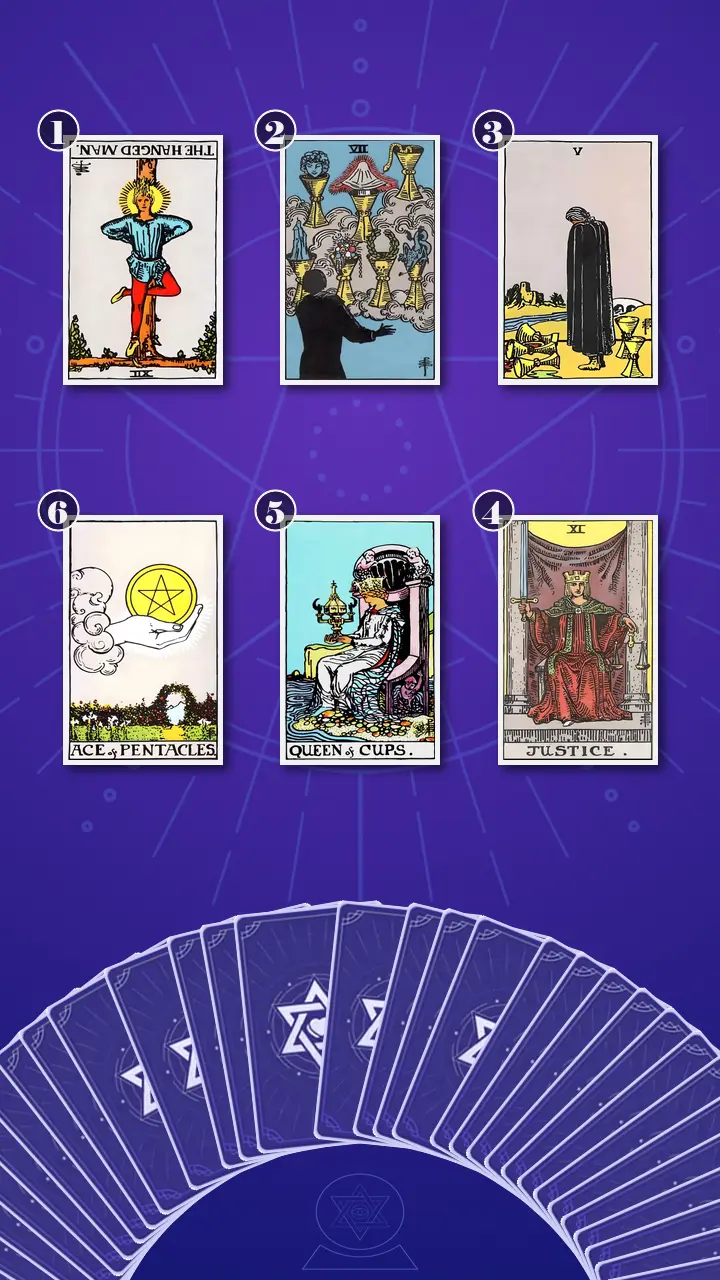
For this reading, I chose the Transformation Path Grid · Context Edition, a six-card tarot spread designed to map a repeating loop rather than predict an outcome. The question is why an abandoned plan gets called a sign instead of being grieved, so I need to see where the loop begins, what keeps it alive, what it is protecting, and where a small intervention can return choice to the present.
I explained the method to anyone reading along with us: this is how tarot works in context. The card meanings are not verdicts about Maya’s future. They are images that help us compare a felt pattern with observable life. The six cards move through visible suspension, symbolic projection, underlying grief, factual discernment, emotional containment, and grounded agency.
The first position would show the observable present-state symptom, where waiting and grief had become suspended. The second would reveal the primary blockage, the attractive interpretations that made non-movement feel meaningful. The third would take us to the underlying root. Beneath that, the fourth card would offer the catalyst, the fifth an actionable practice, and the sixth a practical integration point.
“We are not asking, ‘What was this destined to become?’” I told Maya. “We are asking, ‘What do I know, what did this cost, what do I hope it means, and what can I choose now?’”
The Pause That Started Calling Itself Wisdom
The Hanged Man Reversed and the Unopened Budget
“Now I am turning over the card for the observable present-state symptom: how you keep action and grief suspended by treating prolonged waiting as meaningful surrender,” I said.
It was The Hanged Man, in reversed position.
The image showed me the precise tension in the card meanings in context. The figure is suspended, but the halo around his head can make the pause look enlightened. In Maya’s life, that looked like appearing reflective and open to perspective while the three-month budget, recruiter email, and housing options remained untouched. At 9:15 p.m., she could add another elegant explanation to the “Signs” note, but the cursor in the housing row still blinked behind it.
Reversed, the energy was blocked suspension: an excess of reflection and a deficiency of movement. A pause that once helped her survive the shock had become a rule that every ordinary next step must wait for a symbolically perfect reason. The living wooden frame in the card mattered to me. Life was still growing around her, but she had mistaken staying inverted for receiving new information.
I asked, “When you tell yourself, ‘One more insight, then I can move,’ what new information has actually arrived?”
Maya did not nod. She gave a short, bitter laugh, froze with her fingers above the mug, and looked at the floor. “That is almost rude,” she said. “I have been calling this waiting because waiting sounds less embarrassing than being stuck.”
“I do not hear embarrassment in the card,” I said. “I hear a strategy that once protected you. We can respect what it did without letting it run the whole next chapter. Reflection is useful when it changes the way you see or the choice you make. If no new evidence is arriving, we can call the pause what it is and give it a small boundary.”
Seven Cups in the Recommendation Feed
“Now I am turning over the card for the primary blockage: the attractive interpretations and symbolic explanations that maintain spiritual bypassing and keep the betrayal-closure lock intact.”
It was Seven of Cups, in upright position.
Seven of Cups is fantasy, projection, and a collection of emotionally persuasive possibilities that cannot all be tested. I connected it to the ride home after a friend’s engagement carousel appeared between dark streetcar-window reflections. Maya had saved posts about rejection as protection, divine timing, attachment, astrology, betrayal, and reinvention. Each one offered a different version of fairness. None told her whether to update the budget, set a boundary, apply for a role, or archive an old calendar entry.
The energy here was excess: imagination had expanded into an algorithmic cloud, while discernment and practical choice were in short supply. It was like a streaming homepage offering seven beautifully packaged versions of the same ending. Selecting another one created the sensation of movement, but it did not change the route. The feed had learned that reassurance kept her scrolling.
“Maybe this one will finally make it fair,” Maya said, repeating the sentence I had heard beneath several of her explanations. I asked, “Which saved interpretation has changed a boundary, a budget line, an application, or one honest sentence about what happened?”
Her chest tightened. She turned her phone face down, then reached for it again before stopping herself. “None,” she said. “They make me feel better for about five minutes. Then I am still here, looking for the one that explains why I trusted someone who was not safe to build with.”
I let the silence stay ordinary. I did not tell her to stop believing in synchronicity, and I did not reward the most comforting theory. I said, “A hopeful interpretation is not the same thing as evidence. We can leave meaning open while asking whether a story helps you make a responsible choice today.”
The Three Cups That Had Actually Spilled
“Now I am turning over the card for the underlying root: the specific grief, disappointment, broken trust, and lost future beneath the need to call the abandoned plan a sign.”
It was Five of Cups, in upright position.
This card did not ask Maya to become grateful for what remained. It showed a figure in a black cloak facing three spilled cups while two full cups stood behind them. I saw the order clearly: first, acknowledge the spill; later, notice the resources. The two standing cups did not cancel the trust, time, identity, location plans, and expected future that had been lost.
I invited her to set the words “sign,” “lesson,” and “redirection” aside for one minute. “Try the sentences you have been protecting yourself from,” I said. “Start with ‘I lost’ or ‘I miss.’ No explanation has to follow.”
Maya’s breathing paused. Her eyes moved past the card as if a private scene had started playing somewhere behind my shoulder. Then her hand tightened around the pen and slowly released it.
“I lost trust,” she said. “I lost months of effort. I lost the place I thought I would live. I lost the version of myself I expected to be by now. I miss who I thought I was becoming. I miss having a future that did not need a footnote.”
The last sentence came out rougher than the others. I watched her shoulders lower, though her mouth trembled with the vulnerability that followed relief. “Calling it a loss does not make it meaningless; it makes the cost speakable,” I said. “You are allowed to name something unfair without deciding that your life is empty or that the time meant nothing.”
When Justice Put the Story on the Table
Justice and the Sentence That Changed the Question
The room seemed to narrow around the next card. Even the traffic beyond my window softened, and a thin strip of rainlight rested across the table like a level line.
“Now I am turning over the card for the key trigger for change: separating observable facts, emotional costs, personal interpretations, and present responsibilities so closure no longer depends on a perfect explanation.”
It was Justice, in upright position.
Justice brings truth, accountability, discernment, and proportionate evaluation. The upright sword separates categories cleanly; the level scales refuse both self-punishment and comforting distortion. I asked Maya to picture a notebook page divided into four headings: “What happened,” “What it cost,” “What I hope it means,” and “What I can choose now.”
In the first column, she could record the breach of trust and the end of the shared plan. In the second, she could name the lost time, money, location, identity, and expected future. In the third, she could keep spiritual meaning, if it continued to matter, without quietly moving it into the evidence column. In the fourth, she could decide from current income, Toronto rent, contract uncertainty, values, and available support.
As an artist, I have learned that an unfinished film can become trapped in one painful scene when the editor keeps searching for a hidden reason inside the footage instead of deciding what the next shot needs. That was my signature lens, Hero’s Journey Alignment. I saw Maya at the classic Refusal of the Call, not as a supernatural diagnosis, but as a useful story pattern: she was standing at the threshold of a new act and asking the old plot to authorise her movement. The refusal had protected her from admitting the previous future was closed. It did not have to become her character forever.
The reminder appeared, her stomach dropped, and within seconds she searched for the version of the story that made the betrayal feel ordered. The explanation brought relief, but the budget, the application, and the difficult sentence remained exactly where she had left them. She was trying to solve the ending before allowing herself to feel its cost.
The ending is not healed by turning it into guidance; tell the truth about what was lost, choose the next grounded step, and let Justice's balanced scales hold grief and meaning without confusing them.
For one beat, Maya’s breath stopped and her fingers hovered above the notebook. Her pupils widened as if a light had switched on behind her eyes. Then her gaze went unfocused, and I saw the old calendar reminder return across her face, not as an omen, but as a date connected to a home, a trust, and a version of herself. Her jaw tightened; she swallowed; her shoulders lifted toward her ears before dropping a fraction. The hand that had been gripping the pen opened slowly, leaving a pale crescent in her palm. When she spoke, her voice was almost soundless: “I can know what happened without knowing what it means forever.” A shaky exhale followed, part relief and part the dizziness of discovering that no cosmic explanation was about to carry her across the room. I let the quiet hold.
“Now, use this new angle to remember last week,” I said. “Was there a moment when separating fact from hoped-for meaning could have changed what you did next, even slightly?”
She looked at the four imagined columns, then at the unopened notebook page in front of her. “When I saw the reminder, I could have written ‘the plan ended’ before writing ‘this is redirection,’” she said. “I might still have cried. But I would not have spent forty minutes trying to make it fair.”
This was the first real movement in the emotional transformation: from protecting a coherent future through spiritual meaning-making toward naming grief accurately and making a grounded present-tense choice. It was not certainty. It was a clean distinction, and a distinction gave her somewhere to stand.
A Cup with a Lid, Not a Flood
Queen of Cups and the Fifteen-Minute Container
“Now I am turning over the card for the actionable practice: containing and witnessing grief directly before extracting lessons, assigning destiny, or rushing into a replacement identity.”
It was Queen of Cups, in upright position.
The Queen studies a closed, ornate cup beside moving water. Her energy is balanced emotional containment: the feeling is given attention and a boundary, rather than being denied, spilled across the whole evening, or converted into a polished lesson. For Maya, that meant a private fifteen-minute window beginning with “What I miss is...” and excluding explanations about why the ending had to happen.
“I can feel this without turning it into my whole identity or my whole night,” I said. “A container with a lid is not a dam, and it is not a flood. It lets the feeling exist without asking it to run your entire day.”
Maya glanced at the timer on her phone. “What if fifteen minutes is too much? What if I open the door and cannot close it?”
“Then use three minutes and one sentence,” I replied. “Drink water, wash your face, or walk to the end of the block when the timer ends. The practice is witnessing, not forcing catharsis. You can stop at any point, and you do not need to contact the person connected to the breach to make your grief valid.”
She wrote the prompt down. Her hand still shook slightly, but the movement had changed from frantic searching to deliberate marking. I saw her make a small note beneath it: “Body first, story later.”
The First Walkable Part of the New Route
Ace of Pentacles and the Thirty-Day Beta
“Now I am turning over the card for the integration point: one grounded, testable commitment that lets you build an off-script path without denying the original plan’s value or loss.”
It was Ace of Pentacles, in upright position.
The Ace offered one pentacle in the foreground, a garden path beneath an arch, and mountains that remained distant and incomplete. Its energy was grounded and available: a practical seed, not a promise of a replacement future. I connected it to one thirty-day experiment based on present evidence, such as updating the budget, replying to one recruiter, attending one industry event, or trying one solo plan with a fixed cost and review date.
“This does not have to be your new destiny,” Maya said, almost testing the sentence. “It can be data.”
“Exactly,” I said. “The next step does not have to redeem the ending. It only has to show you something about what is workable now. You remain free to continue, revise, or stop after you review the evidence.”
I also pointed out what was absent. There was no Wands card in the grid, no demand for a dramatic comeback, instant passion, or reinvention montage. The sequence moved from emotional water into Justice’s separating sword, back into the Queen’s contained water, and finally into the earth of the Ace. Feeling and fact needed grounding before inspiration could be trusted not to become another bypass.
When I asked which seed felt possible, Maya did not reach for the most impressive option. She circled the budget. Her shoulders remained slightly raised, but she had stopped waiting for the perfect story to make a small action worthy.
The Four Columns That Put the Story Back on the Ground
When I placed the six cards in order, the reading told a coherent story. The Hanged Man reversed showed a visible pause that had outlived its usefulness. Seven of Cups filled that pause with explanations, each one offering brief relief from betrayal and uncertainty. Five of Cups revealed the actual spill: trust, time, identity, and an expected future. Justice supplied the leverage point by separating what happened from what Maya hoped it meant. Queen of Cups made room for the feeling inside a chosen boundary, and Ace of Pentacles turned that honest contact into one measurable experiment.
The cognitive blind spot was not that Maya cared too much about meaning. It was the assumption that painful and meaningful could not coexist, or that she had to decide what the loss meant before she was allowed to take a practical step. She had been treating interpretation as a prerequisite for movement. The shift was to interpret the ending only after feeling it, name one concrete loss, and choose from present evidence.
That is the heart of this six-card Transformation Path Grid tarot spread for abandoned future grief and grounded next steps. It does not promise that the new path will be perfect, that the betrayal will become acceptable, or that a sign will arrive to make the whole story fair. It gives the mind a structure sturdy enough to hold grief without letting grief make every decision.
To help Maya take the reading out of the room, I used my Character Bible Directive. I asked her to write the exact psychological and behavioral specifications of the future self she wanted to begin embodying now, not a fantasy version who never hesitated. Her future self could name a body signal before searching for meaning, check evidence before making a claim, and take a bounded step while uncertainty remained. That made the next act behavioural rather than merely inspirational.
Small Steps for Finding Clarity
I kept the plan deliberately small. Maya did not need to solve her career, housing, grief, or five-year future in one sitting. She needed a few actions with clear edges, low stakes, and enough reality in them to produce information.
- Make the Fact-Cost-Meaning-Choice checkOn one evening this week, sit at the kitchen table or a library desk for ten minutes and write one sentence under four headings: "What happened," "What it cost," "What I hope it means," and "What I can choose now." Keep the breach of trust and the end of the plan in the fact column, and keep spiritual interpretation in its own column.Use one sentence per heading as the minimum version. Do not perfect the account or turn it into a courtroom argument. Stop if it becomes too exposing; the aim is enough accuracy for one current choice.
- Open the No-Lesson Grief ContainerChoose a private fifteen-minute window, set a timer, and write only sentences beginning with "What I miss is...", "What hurt is...", or "What I am angry about is..." When the timer ends, close the journal and drink water, wash your face, or walk to the end of the block.If fifteen minutes feels too exposed, use three minutes and one sentence. You do not have to produce a breakthrough, forgive anyone, or explain why the ending was necessary. Feeling is the task; the closing ritual is the boundary.
- Plant one Thirty-Day Grounded SeedOpen the postponed three-month budget for exactly ten minutes and update only known figures: current contract income, Toronto rent, fixed bills, and available savings. Then choose one reversible thirty-day experiment, such as sending one portfolio link, researching one neighbourhood, or trying one solo plan. Use the Character Bible Directive by writing how your future self checks the evidence, names uncertainty, and acts in a small way. Add a review date and ask, "What did this show me?"Cap the time, cost, and commitment before you begin. The smallest version is opening the document, changing one number, or drafting an email without sending it. Do not ask whether the experiment is a sign; let it be data you can evaluate and revise.
“You do not need a final explanation to make a present-tense choice,” I told Maya. “The meaning can keep developing, or it can remain unfinished. Your decision does not have to wait for the story to become beautiful.”
A Small Reply That Was Not a Verdict
Four days later, Maya texted me from a Toronto Public Library table. She had drawn the four columns, written the loss without adding a lesson, changed one housing number in the budget, and scheduled a Tuesday review. She had also sent one portfolio link to a recruiter. None of those actions claimed to know what her whole life meant.
Three days later, she slept a full night; at breakfast, her first thought was still, “What if I’m wrong?” She smiled, opened the recruiter email, and answered it anyway. The uncertainty had not vanished, but it no longer held the reply button hostage.
I read her message twice. The small evidence mattered because it belonged to her, not to the cards. Justice had not delivered cosmic closure. The Queen of Cups had not erased the ache. The Ace of Pentacles had simply placed one seed in reachable soil, and Maya had chosen whether to touch it.
That is my Journey to Clarity: not replacing grief with certainty, but moving from a protected explanation toward accurate loss, contained feeling, and grounded openness. The querent remains the author of the next act. Tarot can illuminate the pattern, but Maya was the one who picked up the pen.
When your stomach drops at an old reminder and your hand reaches for one more explanation, it may be because admitting that the future is gone feels dangerously close to admitting that your trust, effort, and hope meant nothing. Naming it as a loss does not make it meaningless; it makes the cost speakable.
If meaning did not have to be settled today, what is one small present-tense choice you might become curious enough to test: one line in your own four-column Justice page, one fifteen-minute container for what you miss, or one thirty-day seed?