Sending One Proposal: From Career Timeline Doubt to Direct Feedback

The 10:45 p.m. Spreadsheet
If you are a late-twenties freelancer in Toronto who can finish a genuinely good day of work and still open a salary-comparison spreadsheet at 10:45 p.m., you may know Career Timeline Anxiety less as a crisis than as one more column labelled "just checking."
I met Alex, a 29-year-old non-binary freelance product designer, in my Toronto studio a week later. Their laptop was open between us: a Figma file on one side, and a spreadsheet titled "Next Two Years" on the other. Alex told me that, at 10:45 p.m. on Tuesday, they had closed a design session that felt unusually absorbing, opened the spreadsheet, added another freelance-versus-salary column, and left an almost-finished proposal in Drafts. The laptop fan had whirred against the radiator's intermittent clicks while blue light dried their eyes.
"I know this life feels like mine, but I still want proof that it counts," Alex said. "The moment I relax, I start wondering whether I have stopped progressing."
I understood the contradiction. Alex had left a predictable salaried track for autonomy and meaningful client work. The income was workable but variable, so this was never a fantasy about ignoring money. The sharper question was why an unconventional career that felt like theirs became suspicious whenever a former coworker posted a promotion or someone asked what came next.
Self-doubt moved through the scene like a drawstring pulling tight around their ribs: relief loosened the knot for one evening, then social-clock comparison yanked it closed, sending their hand back to the spreadsheet and leaving the proposal untouched.
I said, "I hear how much is real here. We can respect the financial questions without letting conventional milestones become a verdict. I am not here to predict your future or talk you into a leap. I want to use the cards as a structured cognitive tool, then hand the pen back to you. Our Journey to Clarity begins by asking what your lived day already knows."
As an artist, I see lives as films still in production. Sometimes feeling stuck means staying in a painful scene a little too long. A life can fit before it becomes easy to explain, I told Alex, and the Four-Layer Insight Ladder waiting on my table would help us find the next scene without pretending the whole plot was settled.

Choosing a Staircase Out of the Fog
I asked Alex to place both feet on the floor, take one slow breath, and name the question without improving its wording. I shuffled at an ordinary pace. The small ritual was a psychological transition, a way to move attention from the open tabs and back into the room, not a performance of supernatural certainty.
Today I was using the Four-Layer Insight Ladder, a four-card spread designed for an inner conflict that has begun to stall practical movement. This is how tarot works in this room: the images give a visible structure to thoughts, sensations, and assumptions that can otherwise stay blurred together. The cards do not issue a verdict about whether a freelance life will succeed.
I chose this spread because the decisive tension was internal: Alex felt ownership and relief, then feared that an unconventional path without familiar milestones was unreliable. The resulting healing stagnation was clear, while a timeline spread would have suggested a past-to-present sequence the question did not provide. The Four-Layer Insight Ladder is the smallest structure that preserves the whole movement: visible symptom, underlying standard, transformative key, and grounded practice.
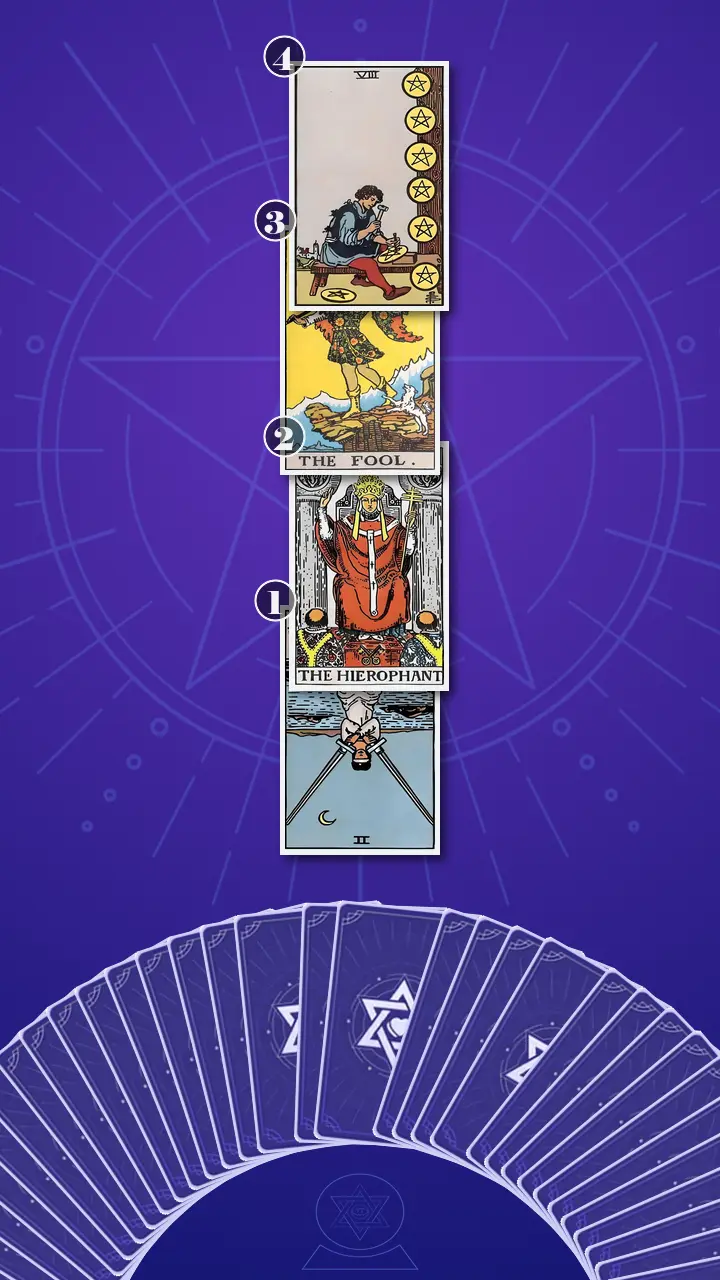
I explained the four positions to Alex and to anyone reading along with us. The bottom card would show where a settled choice was being reopened and where the next action was waiting. The card above it would reveal the standard quietly deciding whether the life counted. The wider gap before the third card marked the bridge into curious self-trust. The top card would turn that insight into repeatable, reviewable work.
Reading the Map Beneath the Tabs
The Crossed Swords Above an Unsent Proposal
I began at the bottom. "The position I am reading now presents the current symptom: reopening choices and delaying the next step whenever your off-script life begins to feel settled." I turned over the Two of Swords, in reversed position.
The modern scene was exact. It was 10:45 p.m. after a satisfying design session. Alex had an almost-finished proposal in Drafts, but opened the "Next Two Years" spreadsheet, a salary report, two job boards, and a group chat instead. Each source introduced another definition of progress. The original evidence, that the work had felt good and the proposal was viable, became harder to hear beneath the effort to eliminate uncertainty.
In the card, the blindfold became attention blocked by dashboards and comparison tabs. The crossed swords over the chest mirrored the defensive posture of holding two incompatible career standards at once. The water behind the figure was important too: feeling had not disappeared; it was simply being kept outside the decision. Reversed, the air of the Swords was excessive and congested. Thought kept moving, but it was moving in circles. Comparison can make you feel prepared while quietly keeping you still.
Alex gave a short, humourless laugh. "That is too accurate. Almost rude."
I kept my voice level. "The card is not calling you incapable of deciding. It is showing what happens when planning stops being a tool and becomes reassurance checking. You can make careful plans for money, contracts, and risk without asking another spreadsheet to tell you whether your relief is legitimate."
For a second, I watched Alex's breath pause and their index finger hover above the phone. Their eyes lost focus, as if replaying a LinkedIn promotion and the unsent proposal at the same time. Then a chest-deep "Yeah" escaped; their shoulders stayed raised, but their hand moved away from the phone. Recognition was not comfort yet, but the loop had acquired a shape.
The Teacher Between Two Pillars
For the second position, which reveals the root of the inner conflict and the standard used to judge whether a personally fitting life is legitimate, the card was The Hierophant, in upright position.
I connected it to the scenes Alex had described at brunch near Ossington and on the TTC. A friend mentioned a promotion, another talked about viewing condos, and someone asked what came next. Alex knew what worked in their daily life, but trusted what could be named in public. Their flexible schedule, healthier pacing, and meaningful projects were measured against salary bands, promotion titles, employer benefits, home-ownership timing, and a five-year ladder designed for salaried work.
The Hierophant was not an enemy. The seated teacher between the pillars can represent useful instruction, financial standards, professional ethics, and chosen structure. But when the kneeling acolytes become a picture of Alex asking conventional milestones for permission, the card reveals the problem. Familiar categories had become the final authority over a life whose progress was showing up through sustainability, client fit, recovery time, and the desire to return to the work.
I asked, "Which standards genuinely protect your money, time, consent, or wellbeing, and which ones mainly make your life easier for someone else to explain?"
Alex's mouth opened, then closed. Their thumb traced the edge of the card, and the polished brunch answer fell away. "I trust the title more than I trust the ordinary evidence," they said. Outside my studio, a streetcar bell sounded once and disappeared into traffic. I let the silence stay long enough for the distinction to become theirs.
When The Fool Refused the Five-Year Defence
The Open Edge, Not a Verdict
The third card changed the room. I paused before turning it, and even the traffic beyond the window seemed to recede. The position I was about to read identified the key transformation: replacing total certainty and outside validation with curious self-trust and direct experience. I turned over The Fool, in upright position.
The modern translation was the café near Queen and Spadina: a finished proposal beside a blank email, the espresso machine hissing, cold air entering with every customer, and Alex's cursor hovering over Send. The proposal had acquired an impossible assignment. It was no longer just a scoped project with clear terms and a fee; it had been asked to prove that freelance work would remain viable five years from now.
The Fool offered movement without a guarantee. The cliff edge was uncertainty, the small bundle was the limited information this one proposal actually required, and the attentive dog represented practical alerts: contract terms, bodily feedback, scope, cash flow, and the right to review. This was not reckless escape. It was alert participation. The energy shifted from blocked air into mobile air, enough movement to reconnect thought with experience.
Through my Hero's Journey Alignment lens, I recognised the classic Refusal of the Call before a major character evolution. Alex had already left the old route, but a part of them was still standing at the threshold, waiting for the new life to receive institutional approval. I did not mean a destined plot or a command to leap. I meant that the hesitation had become a scene in the story, not the character's permanent identity.
I also used Vision Actualization to locate the limiting narrative that kept Alex outside the next stage. The sentence sounded like this: "I am not ready until I can explain the entire path." I helped rewrite it as: "I am ready to test one defined part of this path, with clear terms, real limits, and a review date."
The Sentence That Changed the Weight of the Email
At 10:45 p.m., after a design session that felt focused and genuinely good, Alex had opened the Next Two Years sheet. The laptop fan hummed, their chest tightened, and one unsent proposal had begun carrying the impossible job of proving their entire future.
Stop treating the unmapped road as evidence that you are lost; take one alert, self-chosen step, as The Fool does at the open edge, and let direct experience become your guide.
For a beat, Alex did not inhale. Their fingers held still above the keyboard, then curled against their palm. Their eyes went past the card, replaying the proposal, the promotion post, and the old office calendar. The first visible feeling was not relief but anger. "But does that mean I was wrong before?" they asked, their voice suddenly sharp. I kept my hands on the table. "No. It means the checking protected you when uncertainty was new. It does not have to run the rest of the film." Their jaw worked once. A blink brought moisture to their eyes; a longer exhale moved through their chest. Their shoulders lowered by a fraction, and the fist in their lap opened finger by finger. The room seemed to widen as rain ticked against the window. "I can know what this email can teach me," Alex said, slower now, "without making it defend everything." The relief carried a brief, light-headed blankness: no spreadsheet to obey, no perfect forecast to produce, only responsibility for the next choice.
I asked, "Now, with this new perspective, can you look back at last week and find a moment when this insight might have made you feel differently?"
I named the crossing clearly: from contracted self-doubt and comparison paralysis toward grounded confidence built through lived evidence. The Fool had not handed Alex a future. The card had changed the question from "Can I prove this whole life is safe?" to "What can this one conscious step teach me?" That was curious self-trust in practice, with uncertainty still present and no performance of certainty required.
The Workbench with One Piece Finished
The fourth position grounded the shift in a repeatable response to healing stagnation: completing one bounded action and using lived evidence rather than comparison to assess the path. I turned over the Eight of Pentacles, in upright position.
Here the scene moved from tabs to hands. At the end of three workdays, Alex would record one finished unit: a proposal sent, a client flow completed, or an invoice followed up. Beside it, they would note fit, energy, income relevance, and skill growth. On Friday, they would review those three entries before opening LinkedIn, salary reports, or long-range planning documents.
The craftsperson at the workbench did not need a dramatic milestone to establish progress. One pentacle under the mallet and chisel was enough to receive attention, while the ordered pieces nearby showed how confidence becomes visible through repetition. This was balanced earth energy: the Fool's openness given durable form. The answer was not to reject structure, but to choose a structure that produced evidence instead of demanding permission.
I watched Alex open Notes and type, "This week does not certify the path; it gives me one more piece of real information." Their hand moved slowly, but it moved. Self-trust grows from reviewed experience, not repeated rehearsal.
Borrowed Structure, Real Next Steps
When I placed the four cards together, the story became coherent. The old salaried track and the visible milestones around Alex had supplied a familiar template for adulthood. The reversed Two of Swords showed that template turning into a late-night reassurance loop. The Hierophant revealed why the doubt intensified after a good day: personal alignment weakened the old authority, so the mind tried to restore control by asking for more public proof. The Fool opened a different relationship with uncertainty, and the Eight of Pentacles showed how to make that freedom responsible through completed, reviewable work.
Alex's blind spot was not a lack of planning. It was treating explainability as validity and treating relief as suspicious. They had been using a corporate performance-review template to evaluate a freelance practice, then reading every blank field as failure. The transformation direction was precise: move from validating the entire life against conventional milestones to testing one personally meaningful next step and reviewing what the experience actually shows.
I told Alex, "Useful structure is still welcome. An emergency-fund floor, a clear contract, a tax deadline, and a review date can protect you. They do not have to decide whether your identity or your life counts. Borrow structure, not permission."
To make the insight actionable, I offered three small experiments. None required Alex to abandon practical planning, promise a permanent identity, or know the next five years.
- The One-Proposal Fool ExperimentBefore noon on one workday, I asked Alex to choose one proposal or client email that was already substantially complete. From their usual email client, they would set an eight-minute timer, make only accuracy-critical edits, write three lines beside the draft - the step, what it can realistically test, and what it does not have to prove - then send it. Afterward, they would keep the Next Two Years spreadsheet, salary-comparison tabs, and job boards closed for 24 hours, recording any urge to reopen them without treating the urge as an instruction.Keep the boundary practical: do not send work that is factually incomplete, financially unsafe, or outside the agreed scope. Choose one reversible step with a clear cap. The minimum version is writing the three-line note and scheduling the send.
- The One-Pentacle Progress LogAt the end of three workdays, Alex would spend three minutes recording one completed unit of work plus four observations: fit, energy, income relevance, and skill growth. On Friday afternoon, they would review only those entries before opening LinkedIn, salary reports, or long-range planning documents. Then they would schedule one repeatable unit for the following week, such as one proposal, one portfolio case-study section, or one invoice follow-up, in a 25-minute calendar block.Keep the log descriptive rather than persuasive. It does not have to prove the week was successful. If four observations feel heavy, record one finished action and one sentence about what it showed.
- The Character Bible DirectiveI asked Alex to spend 12 minutes making two columns on one sheet: "Standards that protect me" and "Standards that only make me easier to explain." They would add no more than three items to each, then write a short Character Bible for their future self, with exact psychological and behavioral specs: protects a real financial floor, sends one bounded proposal, reviews direct feedback, and can say, "I am testing the next stage through client work this quarter, and I am not committing to a five-year answer yet." Alex would embody one line of that future self's behavior the same day.Use the practical test: does a standard protect money, time, consent, or wellbeing, or does it mainly improve the story's appearance? Stop after one protective standard and one explanation-only standard if the exercise starts becoming another master plan.
I reminded Alex that a tarot reading could organise attention, expose a hidden standard, and suggest an experiment, but it could not make the decision on their behalf. The evidence would come from Alex's completed work, financial safeguards, energy, and direct experience. They were the author of the next act and the person allowed to decide what the evidence meant.

The Quiet Proof of a Sent Proposal
Three days later, I received a message from Alex with a screenshot of the Notes entry. It read, "One proposal. It can test this client's fit and the scope of my week. It does not have to prove freelance work will make sense forever." Alex had used the eight-minute timer and sent the email. The client replied with two ordinary questions about scope, and Alex answered them instead of turning the exchange into a referendum on their career.
That evening, Alex sat alone in a cafe after sending it. The action felt lighter, but fear stayed; they checked the calendar, closed it after a minute, and ate dinner while the answer remained unfinished.
I did not call that certainty. I called it the first visible evidence of grounded confidence: a small action completed while uncertainty was still in the room. The Journey to Clarity had not delivered a perfect map. It had helped Alex stop walking back to someone else's map and begin reading the road beneath their own feet.
When a life finally feels like yours but cannot be translated into familiar milestones, the relief can tighten in your chest as if enjoying it without five-year proof might mean losing control. I have learned to treat that tightening as a moment to listen, not a verdict. A life can fit before it becomes easy to explain.
If your next step only had to teach you something, rather than justify your whole life, what small experiment would you feel curious enough to imagine trying, one that asks you to carry only the light bundle this moment requires?