The Familiarity Safety Loop: From Comparison to One Honest Question

The Familiarity Safety Loop at 3:18 p.m.
At 3:18 on a Sunday afternoon, Alex joined my video call from the kitchen table of her small Toronto apartment. I watched her add a fourth comparison column to a Notion page already holding three possible next steps, then minimise it and queue a comfort-show rewatch. The radiator clicked through my speakers. She lifted a mug, sniffed the cold coffee, and winced at its faintly burnt smell. Her phone had been in her palm so long that, she told me, it felt warm.
“I want to explore something more creative,” she said. “But the moment an actual opportunity appears, I research it until it feels irresponsible. Then I go back to my normal job and feel relieved. A few hours later, I’m frustrated with myself again.”
I could see the familiar sequence in her restless hands, clenched jaw, and the pause before every sentence about change. Her anxiety looked less like ordinary nerves and more like trying to read a TTC route map while her rib cage had become the closing train doors. Curiosity was pointing toward a new line; her body was already bracing to miss it.
“So you want to discover what is beyond the routine,” I said, “but as soon as the unknown asks for contact, the familiar starts sounding like proof of safety. I’m not going to tell you to quit your job, take a dramatic leap, or trust a card more than your own judgment. Let’s use the cards to make the pattern visible, then find one next step small enough to produce real information.”
This was the journey I wanted to take with her: not from caution to recklessness, but from decision fatigue to grounded clarity. I wanted to help her see where the old scene kept repeating, then gently hand the pen back.
Six Cards Laid Across the Gap
I invited Alex to take one slow breath and hold a precise question in mind: “Why do I keep choosing familiar options over the unknown?” I shuffled slowly, using the movement as a transition from scrolling and comparing into focused attention. There was nothing supernatural she had to perform correctly.
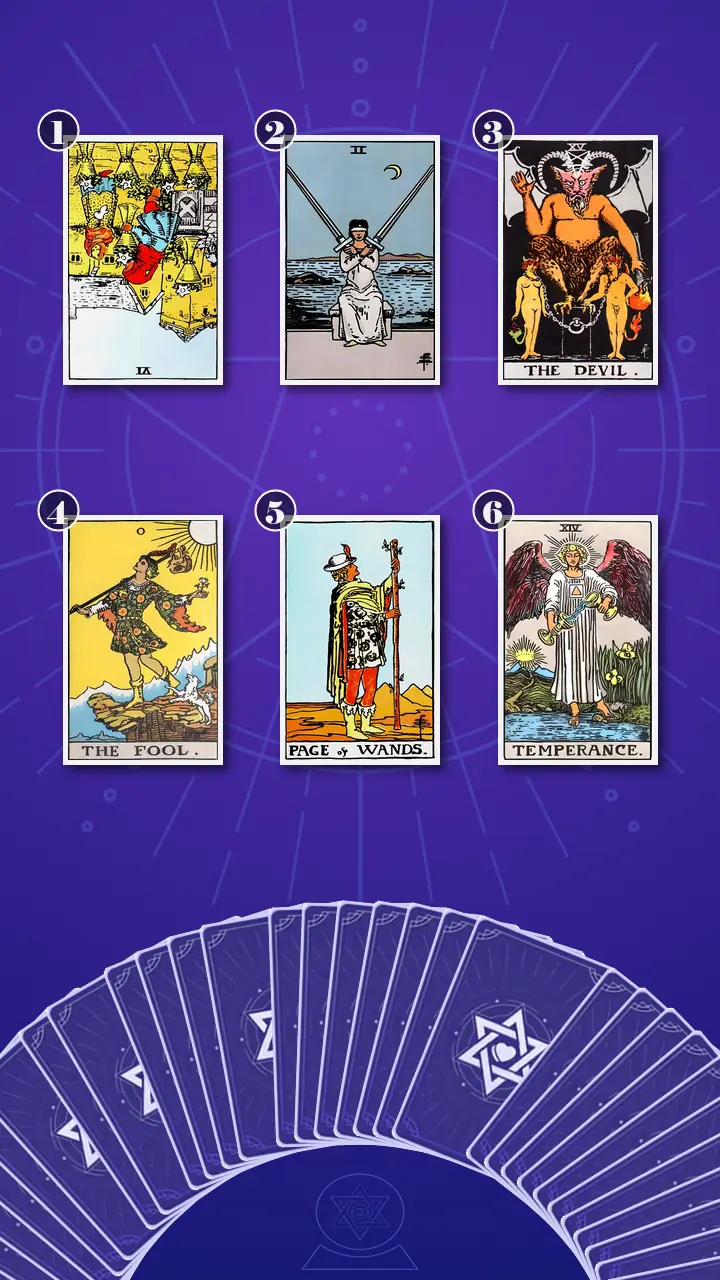
I chose the Transformation Path Grid (6) · Context Edition, a six-card Transformation Path Grid tarot spread for understanding why familiarity overrides curiosity. I use this diagnostic-to-transformation structure when the real issue is not which external option will “win,” but why the same selection process keeps making the known option win by default.
The top row would show the visible pattern, the inner conflict, and the learned attachment beneath it. Directly below, the second row would show the interruption, the practical experiment, and the way new evidence could be integrated. The fourth position, the catalyst, would be the hinge between repeating the old script and gathering firsthand information.
This is how tarot works in my practice. The cards do not issue a verdict or predict the correct career. They place symbolic images beside observable behaviour so we can examine card meanings in context. Alex would remain the decision-maker throughout. The spread was a map of her process, not an authority over her future.
I also noticed that the spread contained no Pentacles. I took that as a practical instruction for my own reading: grounding would need to be supplied consciously through timers, reversible choices, clear boundaries, and written observations. The unknown did not need to become harmless, but it did need a sensible container.
The Upper Row and the Routes Already Rehearsed
Position 1: Six of Cups Reversed and the Old Plan
I began with the position representing Alex’s visible current pattern: the research, reassurance-seeking, and retreat into familiar options that shaped the question. I turned over the Six of Cups, in reversed position.
I pointed to the flower-filled cups and the enclosed village. In Alex’s life, the image looked like reopening an old career plan on Sunday as soon as a creative possibility appeared. She reread the reasons her current role had once made sense, put on the series whose plot turns she already knew, and felt her body soften when the new possibility disappeared from view.
The reversed energy showed a Blockage around memory. Past experience was not merely supporting the present; it was being allowed to overrule evidence the present had not yet produced. Stable income, transferable skills, and a dependable routine were real resources. Repetition, however, was being mistaken for current proof that the same choice still fit.
“Familiar is not the same as safe,” I told her. “It is simply the route you have rehearsed. Which part of your routine truly supports you, and which part survives because you already know how to perform it?”
Alex gave one short, bitter laugh instead of nodding. Her fingers tightened around the mug before she set it down. “That is so accurate it’s almost cruel. I keep calling it a careful decision when I haven’t tested anything.”
“Accurate does not have to mean accusatory,” I said. “This routine helped you build stability and competence. We are not putting it on trial. We are checking whether an old support has quietly become the only scene you permit yourself to shoot.”
Her jaw stayed tight, but her hands became still. I saw the first distinction land: respecting what had protected her did not require treating it as permanent.
Position 2: Two of Swords and the Message That Stays Unsent
I moved to the position representing Alex’s inner conflict and unknown-option anxiety: the mental bind that made comparison feel safer than direct experimentation. I turned over the Two of Swords, upright.
I traced the blindfold, the crossed blades held over the chest, and the water waiting behind the seated figure. In modern life, this was Alex keeping the course page, the old plan, and a Slack draft open at once while refusing to click the one action that could create firsthand information. She could ask three friends whether a stretch assignment sounded risky, but their reassurance could not tell her what doing the work would feel like.
The energy here was Blockage in Air, the realm of thought and judgment. Analysis was not excessive because Alex cared too much about facts. It became excessive when it protected her from the facts that only contact could provide. The blindfold preserved her from exposure, but it also prevented the unfamiliar option from becoming anything more than an imagined threat.
“The inner script sounds responsible,” I said. “It says, ‘I am still researching, so I am being careful.’ But the process keeps two browser windows open while leaving the useful link untouched. What specific piece of information were you waiting for the last time you researched an opportunity but did not test it?”
Alex inhaled and held the breath high in her chest. Her gaze moved away from the cards as if she were replaying Monday morning. “I wanted to know whether I would like the creative team’s actual day-to-day work. I could have asked the person who messaged me. I asked everyone except her.”
I let the contradiction remain visible without shaming it. She wanted control, yet her method excluded the one action that could update the evidence. The familiar option did not have to defeat the new one. It only had to wait until decision fatigue made another week of routine feel merciful.
Position 3: The Devil and the Bargain Beneath Relief
I reached the position representing the repetition compulsion beneath Alex’s choices: the learned bargain that turned familiarity into a substitute for safety and control. I turned over The Devil, upright.
I told Alex immediately that I did not read The Devil as a threat, a moral judgment, or a prediction. I centred the loose chains around the two figures’ necks. The pattern had real force because it offered an immediate reward, but the image still preserved the possibility of examination and choice.
In Alex’s life, the bargain sounded like, “At least I know how this works.” She would decline an unfamiliar invitation or leave a creative message unanswered, feel her shoulders drop, and interpret that relief as evidence that she had chosen wisely. The familiar job, routine, or social script reduced exposure to regret today while quietly postponing information and agency tomorrow.
“Every option feels safer after you have rejected it,” I said. “Not necessarily because rejection revealed the truth, but because the uncertainty stopped making demands on your body.”
I thought of the recommendation algorithm behind a streaming app. If every comfort-show rewatch is counted as positive engagement, the system keeps serving the same story and calling it preference. Alex’s internal algorithm was treating relief as a five-star review. It could not register the curiosity that returned later because curiosity had never been given comparable screen time.
The dynamic was an Excess of conditioned attachment combined with a Deficiency of direct experience. I asked, “What does the familiar choice give you within the first hour, and what does it quietly cost over the next month?”
Her fingers hovered over the edge of the table, then curled inward. After a long pause, she said, “It gives me control for the evening. It costs me the chance to learn whether I could handle more than I think.”
I watched her shoulders rise at the admission and then loosen by a fraction. Naming the bargain did not force her to break every routine. It returned the right to renegotiate the terms.
When The Fool Walked Into the Unfinished Scene
Position 4: The Catalyst at the Cliff Edge
I moved to the position representing the key shift: the quality that could interrupt the loop and make a bounded encounter with the unknown possible. The radiator on Alex’s side clicked once and went quiet as I turned over the central card, The Fool, upright.
I brought the card closer to the camera. The cliff was visible, but so were the white rose, the alert little dog, and the light bundle. The Fool was not sleepwalking into danger. The figure travelled with awareness, existing resources, and a companion capable of signalling when attention was needed.
For Alex, this looked like booking one trial class, arranging one exploratory conversation, or testing a different workflow for a defined period. She did not need to promise a career change. She did not need to pretend the edge was harmless. She could decide the duration, identify the stopping point, keep her stable income, and allow one experience to answer one question.
The needed energy was a measured increase in openness, not an excess of impulsivity. The Fool restored a quality that had been Deficient: beginner’s mind. Alex’s inner operating system had been repeating, “If I move before I know enough, I am being careless; if I never move, I never get new evidence.” The card did not erase the first concern. It exposed the cost of letting it dominate the entire process.
This was where I used my Hero’s Journey Alignment. In a character arc, I recognise this kind of stagnation as the Refusal of the Call. It is not proof that the protagonist is weak. It is the scene where the known world still feels more survivable than the invitation to evolve. Alex had stayed in that scene for so long that she had begun mistaking it for the whole film.
I explained that the shift was not from refusal to a cinematic leap. Her next act could begin with a camera test. She could approach the unknown long enough to notice its texture without signing over the rest of the plot. In her case, courage was not a personality transplant. It was careful authorship of a smaller scene.
I brought us back to Sunday at 3:18: three next steps in Notion, a fourth comparison column, the old plan reopened, and the comfort show queued. Curiosity wanted contact; familiarity offered relief. Her mind was demanding a final verdict before allowing a first frame.
Do not use the familiar choice to avoid responsibility for uncertainty; take The Fool's measured first step and let curiosity, not imagined certainty, guide the next question
I stopped speaking. The room on my screen seemed to widen around the silence.
Alex’s breath stopped first. Her fingers, which had been tracing the grain of the table, froze halfway through the motion. Then her gaze lost focus, as though she were replaying every unsent message in reverse. Her pupils widened; her mouth tightened; a flush rose along her cheekbones. “But doesn’t that mean I’ve been wrong this whole time?” she asked, the words sharper than anything she had said before. I let the anger have its full second. “No,” I said. “It means a protective choice became automatic. You are allowed to thank it for the stability it created and still update it.” Her eyes reddened slightly. One shoulder lowered, then the other. Her hands opened on the table, but the release left her looking briefly unsteady, as if clarity had removed a railing she had been leaning against. A thin, trembling exhale escaped her. Then I asked, “Now, with this new perspective, think back to last week. Was there a moment when this insight could have made the experience feel different?”
She described the Slack message from the creative team. She had treated an exploratory reply as if it were an irreversible declaration about her career. “I could have asked what the assignment involved,” she said quietly. “That would not have been the same as accepting it.”
I gave her a ten-minute container while we were still together. I asked her to choose one unfamiliar option and write one reversible contact step: one question, one trial booking, or one first-person account that could reveal something specific. She would stop when the timer ended and record only what she learned. If her chest tightened beyond what felt manageable, she could pause and return to a familiar grounding routine. The container belonged to her.
“I can be careful about the container without pretending to know the outcome,” she said, testing the sentence aloud.
I named the movement plainly. This was the first step from anxiety-driven familiar repetition to grounded clarity and self-trust through direct experience. It did not mean she suddenly trusted every unknown option. It meant she was beginning to trust herself to approach one, observe it, and retain the right to stop.
Position 5: Page of Wands and the First Honest Question
I continued to the position representing the actionable experiment: a small, time-bounded behaviour that could gather evidence without becoming a final life decision. I turned over the Page of Wands, upright.
I pointed to the Page studying the upright wand at eye level. The card’s attention was active and specific. In Alex’s life, it was one respectful message to someone in a creative role, one twenty-minute sample task, or one trial session followed by a few plain observations about energy, interest, logistics, and fit.
The Page restored exploratory Fire where it had been Deficient. This was not the unstable fire of announcing a new identity before testing it. It was the manageable spark of asking, “What did I actually notice when I made contact?”
“You do not need certainty before contact,” I said. “You need one honest piece of information. Testing a possibility is not the same as announcing that you have become a different person.”
Alex looked back at the Slack draft and smiled with recognition, though the corners of her mouth still held some strain. “I can ask what a normal week on the assignment looks like,” she said. “That is a real question. Reddit cannot answer it for this team.”
I watched her type the question into a fresh note instead of building another matrix. The change was almost visually unimpressive, which was exactly why I trusted it. Her attention had moved from predicting the whole future to designing one contact with reality.
Position 6: Temperance and the Life That Holds Two Truths
I finished with the position representing clarity and integration: the inner resource that could hold familiar safeguards and new information together. I turned over Temperance, upright.
I showed Alex the water moving between two cups, the angel with one foot on land and one in water, and the path travelling toward the rising light. In her daily life, this was not an order to abandon the stable job. It was a plan in which her income and weekday structure remained while a creative direction received one protected block each week.
Temperance expressed Balance. It answered the false binary between total safety and total risk. Alex could preserve what genuinely grounded her while letting measured contact with the unknown produce new evidence. She could review that evidence calmly instead of forcing each experiment into an immediate yes or no.
As an artist, I found myself thinking about colour grading a film. A scene rarely becomes truthful by turning every shadow into light. It becomes legible when contrast is calibrated carefully enough for the viewer to see what was already there. Temperance offered Alex that calibration. Stability did not have to vanish for curiosity to become visible.
The late-afternoon light shifted across her water glass and placed two pale reflections on the table, one beside the old plan and one beside the new question. I asked, “After one small experiment, how could you keep the stability that matters while giving the new information a real place in your next choice?”
“One block on Sunday before the comfort show,” she said. “Not instead of the whole routine. Before it.”
I nodded. The cards had moved from Water turned backward into memory, through Air trapped in guarded analysis, into the small Fire of direct exploration. Temperance supplied the grounding that the spread’s missing Pentacles could not. The result was not a guaranteed destination. It was a process Alex could govern.
The Character Bible for a Bounded Unknown Experiment
I gathered the six cards into one coherent story. The Six of Cups reversed showed why Alex returned to an old plan before the present opportunity received attention. The Two of Swords showed how comparison and reassurance blocked direct information. The Devil revealed the deeper bargain: immediate relief in exchange for postponed agency. The Fool interrupted that repeating scene, the Page of Wands translated curiosity into contact, and Temperance made room for stability and exploration to coexist.
The cognitive blind spot was simple but consequential: Alex had been treating the end of uncertainty as evidence of safety. Relief was real, but it was not the same as fit. More research could organise imagined outcomes, yet it could not answer the questions her decision process refused to test.
The transformation direction was equally clear. She did not need to replace caution with blind faith. She needed to shift from using familiarity as proof to running one small, reversible experiment and recording what happened. That was the Bounded Unknown Experiment: contact before comparison, practical safeguards intact, no identity-level verdict required.
To make the insight usable, I introduced my Character Bible Directive. When I develop a character for a visual story, I do not write only what she hopes to become. I specify how she behaves when the old conflict returns. I asked Alex to describe her future self in behavioural terms: she keeps one stabilising routine, asks one direct-information question before opening comparison tabs, notices the first body signal, and writes down evidence without turning it into a judgment about her worth.
“We are not writing a fantasy version of you who never feels afraid,” I said. “We are writing the version who knows what she does when fear arrives.”
Three Actionable Next Steps
- Write the five-minute Character Bible. In the Notes app on her phone, Alex would write three specifications for her future self: one familiar support she keeps, one direct-information action she takes before comparing, and one observable detail she records afterward. She would use the note whenever a new Slack message, class, or social invitation appeared. Keep it behavioural and brief. “Sends one question before opening Reddit” is more useful than “becomes confident.”
- Use the ten-minute Contact-Before-Comparison Rule. Alex would open the exact opportunity already sitting in her tabs, set a ten-minute timer, and write one question that only the provider or person doing the work could answer. She could send it by Slack, email, or LinkedIn, with no promise to continue beyond that contact. Allow only one question before more research. If sending feels too exposed, draft it and ask a trusted person to review its clarity, not to decide on Alex’s behalf.
- Run one thirty-minute Bounded Unknown Experiment. Alex would keep her usual Sunday reset, then use a protected Google Calendar block for one trial class, exploratory conversation, or sample creative task. When the timer ended, she would record three observations about energy, interest, and logistics, plus one new question. The purpose is observation, not a final verdict. If thirty minutes feels too large, use five minutes to open the page, identify the contact, or write the first line.
I reminded Alex that she controlled whether each message was sent, how much she disclosed, and whether any experiment continued. A small experiment was still a choice, not a surrender of control. The cards had supplied a lens and a sequence; the authority to act, pause, or decline remained entirely hers.

A First Take, Not a Final Answer
Six days later, I received a message from Alex. At 9:14 on Monday morning, she had replied to the creative team lead with one question about the assignment’s weekly reality. The answer revealed that it was a six-week project with a defined workload, not the hidden career referendum she had imagined.
She accepted a twenty-minute exploratory call, not the assignment itself. Afterward, she recorded that the work sounded energising, one deadline concerned her, and she wanted to ask whether mentorship was included. She had new information, a new question, and no need to pretend the whole future had been settled.
That night she slept through until morning. Her first thought was still, “What if I choose wrong?” This time, she smiled, opened her field note, and remembered that she had not chosen a whole life. She had gathered one honest piece of evidence.
I did not see this as tarot magically removing her fear of change. I saw Alex revise her relationship with uncertainty. She had moved one scene beyond Refusal of the Call, not because a card pushed her forward, but because she chose a container she could trust and then stepped into it.
That was the quiet proof of our Journey to Clarity. The goal was never perfect certainty. It was enough self-trust to let direct experience update the story before the story decided the experience.
When a new route appears and your chest tightens, you may be protecting yourself from regret so carefully that the familiar choice starts to impersonate safety, even while a quieter part of you is still waiting to discover what you can handle. Simply noticing that repeating scene means you are no longer watching it unconsciously.
If you could film one small, reversible first take without committing to the whole plot, what would you be quietly curious enough to notice?