Readiness-Threshold Paralysis: From Waiting to One Small Test

The Saved Job Posting That Became Readiness-Threshold Paralysis
Avery was a 27-year-old junior digital content coordinator in Toronto with a Notes app full of courses and saved opportunities, and I recognized the pattern the moment they sat across from me. Their stable job paid the rent and kept the weekdays legible, but every new stretch opportunity made the familiar routine feel like a locked room with excellent lighting.
At 8:47 p.m. on the Tuesday before our session, Avery had been riding the TTC Line 1 north from Queen Station when a Toronto content strategist role appeared on LinkedIn. They showed me the screenshot: fluorescent lights buzzing above the carriage, a phone warm in their palm, and a thumb hovering over Apply before tapping Save. “I could do this after one more course,” they had told themselves. The saved link joined a graveyard of Coursera tabs, portfolio ideas, and carefully worded drafts that had never met another person.
“Why do I keep waiting to leave my comfort zone until I feel ready?” Avery asked. “I keep calling it patience, but sometimes it is just postponement.” They wanted a wider role and more creative room, yet believed confidence had to arrive before action, especially if acting meant someone could see their gaps. Their hesitation sat in the body like an elevator stalled between floors: tight shoulders, heavy limbs, and a restless urge to move that never became a first step.
I did not call that laziness, and I did not promise a mystical answer. “It makes sense that stability matters when rent and ordinary city expenses are real,” I said. “Let’s look at the pattern without shaming it, then draw a map through the fog. Our aim is finding clarity you can use, not waiting for the cards to make the decision for you.”

The Grid Between Next Monday and Now
I asked Avery to take one slow breath and name the question exactly as it was. I shuffled until the repeated thought, “I should do this properly,” felt like something we could place on the table rather than something that had to run the session.
For anyone reading this and wondering how tarot works in a consultation like this, I used the Transformation Path Grid (6) · Context Edition. I treat the cards as an objective visual cognition tool: a shared set of images that helps separate facts, habits, fears, and choices. It is a reflective map, not a forecast.
The rationale was systemic deconstruction. Avery was not choosing between two external roads. They were caught in a loop: an opportunity appeared before certainty, preparation reduced exposure for a moment, and the lack of direct experience made the comfort zone look even more convincing. This six-position tarot spread lets us read that sequence as present lock-in, immediate blockage, root loop, key trigger, action experiment, and integrated self-trust.
I told Avery that the first card would show the concrete waiting behavior, the next two would expose the mechanisms keeping it in place, and the final three would move from an opening to a practical experiment and then to a more compassionate definition of readiness. The map would not tell them what they must do. It would show where choice could become visible again.
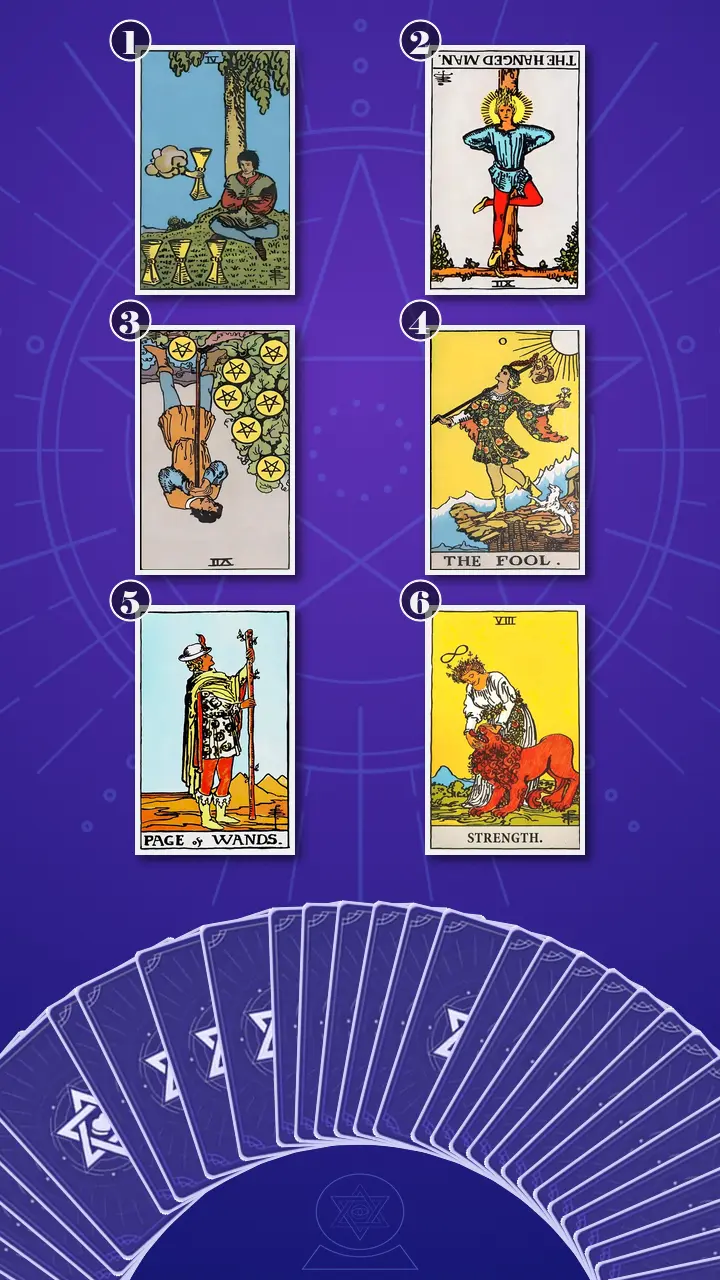
The Map Begins Where the Body Says No
Present Lock-In: The Four of Cups, Upright
Now I turned over the card representing Present lock-in: the concrete waiting behavior, emotional withdrawal, and comfort-zone routine that appear when Avery encounters an opportunity to stretch. It was the Four of Cups, upright.
The seated figure's crossed arms gave me the first visual clue. Three cups rested safely on the ground, while a fourth was offered from a cloud. In Avery's modern life, the three cups were the saved courses, familiar tasks, and endlessly revisable plans. The fourth cup was the Toronto content role that could not guarantee confidence before being opened.
The Four of Cups is often associated with withdrawal, contemplation, and a missed invitation. Here, its upright water was not empty; it was held too tightly. The energy was excessive inward evaluation and deficient receptivity. Avery's attention kept circling what was already known, because an uncertain invitation did not feel like usable information until it arrived with competence, security, and a guaranteed reward.
Avery gave a short laugh with a bitter edge. “That is too accurate. It is almost rude.” Their arms loosened, but their fingers continued circling the phone case.
“It is not saying you do not care,” I said. “It is showing selective attention. The invitation is visible, but your mind has decided it does not count until confidence arrives with it. When you last saw a role, invitation, or visible task that genuinely interested you, what did you do instead of taking the first step, and what familiar routine did that choice protect?”
Immediate Blockage: The Hanged Man, Reversed
Now I turned over the card representing Immediate blockage: the way the Forced Blooming Trap turns pressure to change into another reason to pause, prepare, or demand a perfect internal signal. It was The Hanged Man, in reversed position.
The image showed a figure suspended by one foot, the body inverted and a halo around the head. Upright, that pause can offer a genuinely useful change of perspective. Reversed, the same posture has become a fixed position. For Avery, the paused browser tab still felt like work because it had stayed open for three weeks. The half-finished analytics course and reorganized Notion board looked productive, while the actual experiment remained untouched.
“I am not avoiding it; I am making the plan better,” Avery said. The calendar event titled Start Monday had been dragged forward again. “The plan gets more polished while the real-world evidence stays at zero,” I said.
This was a blockage of chosen perspective. Preparation had become suspension, and the pressure to bloom had made staying still feel responsible. I did not ask Avery to abandon preparation or pretend practical concerns were imaginary. I asked whether the pause was creating insight or simply protecting them from the visible uncertainty that would update their self-trust.
Avery's breath stopped for a beat, then became shallow. Their gaze went unfocused, as if replaying every course, revised plan, and unsent message. Then their jaw tightened before a long breath moved through their chest. “I have been calling it responsible timing because that sounds better than saying I am scared to be seen trying.”
I let the recognition settle without rushing to fill it. A pause can be wise, but indefinite suspension has a cost. The useful question was not, “How do I force myself to leap?” It was, “What is the smallest real-world contact that preparation cannot provide?”
Root Loop: The Seven of Pentacles, Reversed
Now I turned over the card representing Root loop: the recurring promise of a future reward for waiting and the repeated evaluation that keeps direct experience from beginning. It was the Seven of Pentacles, in reversed position.
The figure leaning on the hoe seemed to be checking a life progress dashboard before the next seed had been planted. The vine was real, but the harvest was being judged too early. In Avery's case, the dashboard included skills, savings, confidence, portfolio quality, and the visible progress of peers on LinkedIn. They kept comparing an unfinished growing season with someone else's polished result.
The reversed Seven of Pentacles showed Earth trapped in evaluation. Patience was not missing; it had been turned into a constant audit. Delayed Gratification promised that after one more course, one cleaner brief, or one more realistic schedule, readiness would finally be earned. Repeated checking brought short-term relief because it lowered exposure, but it also kept confidence untested.
“I keep checking whether I am ready,” Avery said. “But I am checking before anything has happened that could actually teach me.”
I watched their shoulders sink by a fraction. “You are not waiting for readiness; you are waiting for a guarantee,” I said. “No first attempt can provide total control. It can provide information. What future reward are you promising yourself for waiting, and how often do you check your readiness instead of letting one small experience teach you something new?”
Preparation becomes postponement when it never has to meet reality. That distinction mattered. I was not asking Avery to shame their research, their need for stability, or their wish to be competent. I was helping them notice when useful preparation had quietly become a way to remain invisible.
The First Doorway Was Smaller Than the Fear
Key Trigger: The Fool, Upright
Now I turned over the card representing Key trigger: the smallest shift that could interrupt the waiting cycle and reconnect Avery's desire for growth with a tolerable first encounter. It was The Fool, upright.
The Fool stood near a cliff with a small bundle, a white rose, and an alert dog. The symbols made the answer proportionate. The bundle was one saved job link, one draft, and one honest question, not a complete five-year map. The white rose was an open intention without a finished identity. The dog kept the edge visible, reminding us that openness did not require reckless denial of risk.
The Fool's energy was a balanced beginning. It did not demand that Avery quit, announce a total reinvention, or ignore money and workload. It challenged the readiness threshold by treating a first step as a beta launch with a clear rollback option. “I do not know enough yet,” I said, “but I might be able to learn from one contact.”
I used my Hero's Journey Alignment lens here. In a story, this is the classic Refusal of the Call, not a moral failure but the scene where a character negotiates with an invitation because the next act would make them visible. As an artist, I have seen a film lose its pulse when a character stays in one painful scene long after the doorway has appeared. I felt that recognition in my own chest, quiet and familiar.
“What would count as a beginning if it did not have to become a life decision?” Avery asked. Their attention moved from the edge of the card to the small rose in the Fool's hand.
“One bounded step is not a new identity,” I said. “You can approach the unfamiliar, learn from it, and still keep the right to pause or change direction.” A small release moved across Avery's face. The fear had not disappeared, but it was no longer the only voice in the room.
Action Experiment: The Page of Wands, Upright
Now I turned over the card representing Action experiment: one bounded, reversible behavior that could produce learning without demanding a total identity change. It was the Page of Wands, upright.
The Page studied a sprouting wand instead of displaying a finished achievement. That was the whole instruction in miniature. The wand did not need to become a career before it could be examined. The Page's open desert was unfamiliar territory, but the figure met it with attention rather than a performance of mastery.
For Avery, this could be a 30-minute portfolio sample, one new question to a more experienced colleague, or a short visit to a beginner-friendly creative meetup. The Page's upright fire was curious rather than explosive. It supplied a shorter feedback cycle: act, notice, record, and decide what the next question is. The goal was not to grade the attempt or prove that Avery belonged in a new role. The goal was to gather evidence through direct experience.
Avery placed the phone face down. “That sounds possible,” they said, then added, “which is probably why part of me wants to make it more complicated.” I smiled. “Let the first version stay small enough that your mind cannot turn it into a referendum on your whole future.”
When Strength Met the Lion Gently
Integrated Capacity: Strength, Upright
The room grew quieter as I reached for the final card. Now I turned over the card representing Integrated capacity: the way readiness can become compassionate self-trust built through practice rather than a prerequisite for leaving the familiar. It was Strength, upright, the strategic antidote in the spread.
The woman in the image held the lion's jaws with gentle hands. Above her head, the infinity symbol suggested continuity rather than a single dramatic victory. This was not force overcoming fear and not fear controlling the whole decision. It was patient courage, compassionate self-regulation, and the ability to stay present with an instinct to retreat while choosing one measured step.
My Hero's Journey Alignment named the old pause as the Refusal of the Call. My Vision Actualization lens helped me rewrite the limiting narrative underneath it. “I am not ready” became “I am a careful beginner who can learn in public within clear limits.” That was not positive thinking pasted over fear. It was a more accurate script, one that gave Avery behavior to practice instead of a verdict to obey.
The room seemed to hold its breath. I returned Avery to the Toronto Line 1 scene: the job posting was still saved, the phone was warm, the fluorescent lights buzzed, and Apply had become a promise for next Monday. They wanted movement and protection from the public proof an imperfect start might bring.
You do not become ready by forcing a bloom or waiting for proof; you build readiness by meeting the lion gently, one chosen step at a time.
Readiness is not a green light that arrives before the journey; it is information that grows when you take one bounded step and notice what actually happens. You can move without forcing a new identity, and uncertainty does not have to become a verdict on your competence.
For a second, Avery did not blink. Their thumb stopped above the edge of the card, and their shoulders rose as if the old elevator had jammed again. Their eyes drifted past me toward the rain-dark window; I could almost see the saved posting, the unfinished course, and every moved Monday replaying in sequence. Their brow tightened. “But does that mean I have been doing it wrong?” The question carried a flash of anger, then a softer fear. I let the silence stay kind. Avery's fist loosened one finger at a time. Their jaw unclenched, though not completely, and a shaky breath left them with a small, surprised laugh. They sat straighter, not triumphant, just less folded around the demand to control the outcome. “I can notice the urge to retreat without handing it the whole decision,” they said. I nodded. “Now, use this new perspective to revisit last week. Was there a moment when one measured step could have given you information without asking you to become someone else?”
This was the crossing I wanted the reading to make: from readiness-threshold paralysis and protective hesitation to grounded self-trust through bounded experiments. Readiness was not a permission slip handed down by the deck. It was evidence Avery could gather through contact with the unfamiliar. Confidence was feedback, not a prerequisite.
Finding Clarity in a One-Page Experiment
I gathered the cards into a single story. The Four of Cups showed the present lock-in: a wider life was wanted, but familiar routines were protected whenever an opportunity made competence visible. The reversed Hanged Man showed preparation becoming suspension. The reversed Seven of Pentacles showed delayed gratification becoming constant evaluation, with every start date moved to next Monday before the work had gathered enough data to teach anything.
The Fool opened the middle hinge. The Page of Wands turned that opening into a beginner-sized action. Strength showed the capacity that could grow afterward. There were no Swords in this sequence, and that mattered. The solution was not another argument about whether Avery was ready. Clarity would come from a small experience, not from winning a debate inside their head.
I described the pattern as a seed in a pot. The pressure to bloom made the seed resist, and the waiting was then called patience. But pulling a seed upward cannot make it grow. The practical alternative was to create one small encounter with soil, notice what happened, and decide again. In the language of my own practice, a life in production does not need a perfect next act. It needs the next honest scene.
The cognitive blind spot was treating every tightening shoulder as a timing report and every tidy plan as progress. The transformation direction was not from cautious to reckless. It was from waiting for permission to gathering evidence through one bounded, reversible experiment. Avery could move slowly without remaining still.
“We are going to make this so specific that it cannot become another abstract self-improvement project,” I said. “The cards are offering actionable advice, but you remain the person who decides the boundaries.” I used my Character Bible Directive to turn the integrated Strength card into a practical exercise. Instead of imagining a flawless future self, Avery would write the psychological and behavioral specifications of a careful beginner who already exists in the next scene.
- Contact Before ConfidenceBefore opening another course or advice thread this week, spend 20 minutes in the Notes app on one saved opportunity. Draft three honest questions for the hiring manager, outline one sample content idea, or write one informational message for a trusted colleague. Date the note and, only if you want outside input, send it.If 20 minutes feels too exposed, use the two-minute version: open the opportunity and write one question. No application, purchase, public post, or commitment is required. Close the tab when the timer ends and record what contact taught you.
- The Character Bible DirectiveIn the Notes app, set a 10-minute timer and write the exact psychological and behavioral specifications of your future self in this career chapter: how they respond when unsure, what boundary they keep, and what beginner action they allow. Then choose one 30-minute experiment connected to an existing course or project, such as making one rough portfolio sample, testing one analytics prompt, or asking one new question at work. Finish with a two-column note titled Action and Lesson.Define success as one observation, not approval or a finished identity. Review the log once at the end of the week instead of checking it after every action, and do not add a new course until the existing experiment has had one real-world contact point.
I emphasized the limits aloud. Rent, workload, privacy, safety, and emotional bandwidth still mattered. A reversible first step could be private, free, short, and easy to stop. The exercise was testing the waiting loop, not proving Avery's worth or forcing a total reinvention.

A Week Later: The Quiet Proof
A week later, I received a message from Avery: they had made one rough portfolio sample and sent one honest question to a content strategist. The next morning, “What if I am wrong?” returned with the coffee. They smiled, opened the draft, and let the question remain a question.
The change was small, and that was why I trusted it. Avery had not solved their career or become fearless. They had created one piece of evidence that did not exist before, then kept the choice in their own hands. The comfort zone had stopped looking like proof that waiting was necessary.
I think of tarot as a way to place a difficult inner pattern where both people can see it. The Four of Cups, the suspended Hanged Man, the over-measured garden, the Fool's rose, the Page's wand, and Strength's gentle hands gave Avery a visual language for a decision they already had the authority to make. The cards did not write the next act. Avery did.
When a new door opens and your shoulders tighten over the keyboard, you can want the life beyond your routine and still fear that one imperfect step will expose how little control you have. If readiness did not have to arrive before you began, what small, reversible doorway could you open for ten minutes, with the Fool's white rose in one hand, Strength's gentle grip nearby, and your right to stop still yours?