The Sentence at 8:47: When Creative Ideas Shrink Before Sharing
I recognized the pattern before Taylor had finished settling into my chair: a London creative strategist on a trial leadership assignment, ten minutes before a review, deleting the one sentence that made her proposal hers and calling the edit refinement while a calendar reminder tightened her chest.
She showed me a screenshot from Tuesday morning at her kitchen table in Hackney. At 8:47 a.m., the kettle had just clicked off, the laptop fan hummed, and cold coffee smelled faintly burnt. I watched the cursor hover over the central claim, then watched Taylor replace it with three careful paragraphs and the line, 'I am still figuring this out.' Her jaw locked; her shoulders folded inward.
'Why do I keep shrinking my ideas before I share them?' she asked. She had been invited to lead a small creative initiative, yet every meeting made the full idea feel like a test of whether she belonged in visible authority. She wanted to share it in its real form; another part of her wanted to make it approval-shaped first, so rejection would have less surface to land on.
I saw apprehension move through her like a bright draft being folded into smaller and smaller squares until it could fit inside a pocket, while the original shape disappeared. I knew that late-night uncertainty from Wall Street: the tight chest and clenched jaw before pressing send, when analysis masquerades as protection. 'You are not failing at creativity,' I told her. 'We can look at the exact moment the edit happens and draw a map through it. That is our Journey to Clarity today: not a promise of applause, but a way to give you your own evidence and choice back.'

Choosing a Compass for the Visibility Loop
I asked Taylor to take one slow breath, keep the question in mind, and watch me shuffle. The small pause created a transition from the Slack thread and Google Doc to a focused conversation; it was a way to collect attention, not a performance of supernatural certainty.
For this reading, I used my original Four-Layer Insight Ladder · Context Edition tarot spread. I chose it because Taylor was not asking me to choose between two external paths. She was asking why the same internal pattern kept taking over whenever visibility mattered. A full Celtic Cross would have added more positions than this question needed, while a conventional decision spread would have misrepresented a repeating psychological loop as a simple career crossroads.
This is how tarot works in my practice: I use recognizable images as structured prompts for observation, language, and choice. The cards do not decide whether Taylor's team will approve an idea. They help us separate what has actually happened from what her mind is predicting, so card meanings in context can become an objective cognitive tool rather than a verdict.
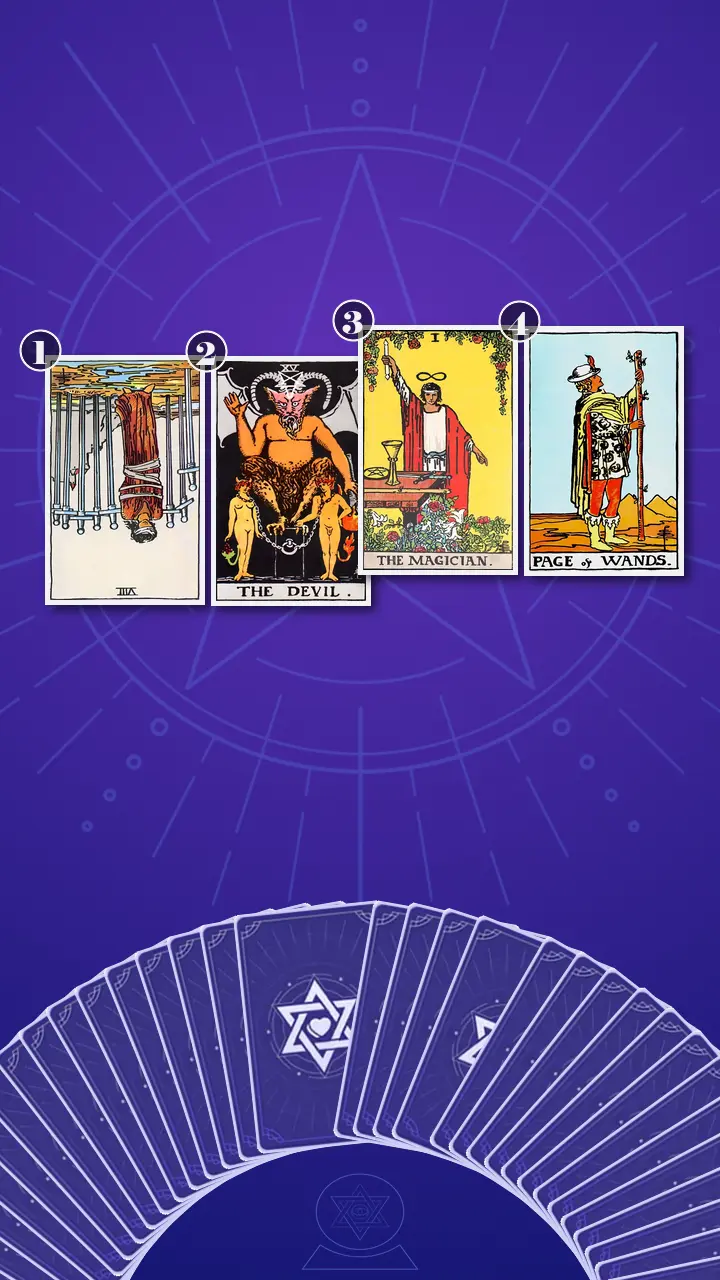
The first position would show the Visible symptom, the concrete act of shrinking or disclaiming an idea. The second would reveal the Repetition loop, including the bargain that makes self-minimization feel protective. The central card would identify the Transformative hinge, where agency could become visible. The final card would offer a Grounded experiment, a small next action that Taylor could choose during the creative leadership trial.
Reading the Draft Before the Room Reads It
Position 1: The Enclosure Inside the Google Doc
Now I turned the card for the position role Visible symptom: the concrete pre-sharing behavior of shrinking, disclaiming, or deleting the strongest part of an idea during the creative leadership trial. It was the Eight of Swords, in reversed position. Its standard meaning is the present situation or visible issue, and here the blindfold and bound wrists showed a restriction maintained inside the draft before anyone else had responded.
In the RWS image, the swords form a narrow enclosure around a figure whose eyes are covered. In Taylor's working life, that enclosure was the Google Doc. She saw the sentence that gave her proposal its point, imagined three possible objections, deleted it, and filled the empty space with careful explanations, evidence, and disclaimers. The document looked more competent, but it no longer said what she originally meant.
The reversed energy was a blockage beginning to loosen, not an instant release. The restriction was real in her body, but its source still needed testing. I asked, 'Which part of the idea is constrained by actual project evidence, and which part is constrained only by a prediction about how the room might judge you?' I also named the overcorrection risk: proving freedom by posting every raw thought at once would create noise, not clarity. The useful move was narrower: keep one central claim intact and test it with a bounded audience.
Taylor did not nod. She gave a short, bitter laugh. 'That is too accurate. Almost rude.' I let the laugh stand instead of turning it into proof that the reading had revealed some fixed truth. Her breath paused; her fingers hovered above the laptop. Her gaze slipped out of focus as if replaying the Tuesday edit, and then her thumb released the laptop's edge. I said, 'We do not have to shame the strategy to examine it. What did the edit protect you from for the next thirty seconds, and what information did it cost you afterwards?'
Position 2: The Bargain Behind the Disclaimer
Now I turned the card for the position role Repetition loop: the inner conflict and repetition compulsion that make self-minimization feel protective. It was The Devil, in upright position. Its standard meaning is the underlying influence or root of the present situation, and its loose chains gave us a precise image for a pattern that felt compulsory while still containing a point of choice.
I asked Taylor to picture the moment before she typed, 'This may still need work.' The loose chain was not a single comment from a senior teammate. It was the small, visible decision to make the idea less specific, followed by the immediate relief of having less exposed surface. I asked her to finish the thought aloud: 'If I make this less specific, then they cannot reject the real me.'
The Devil's energy was attachment with an excess of short-term protection and a deficiency of useful information. The safer version received vague attention because the interesting material had been removed. Taylor then read that muted response as evidence that her original instinct was weak, even though nobody had actually responded to the original claim. I told her, 'A smaller idea can feel safer and still give you worse information.' The chain was the repeated bargain between visibility and immediate relief, not a prophecy about her creative ability.
Her breathing paused first. Then her eyes left the card and fixed on the laptop, as if a familiar rejection were playing again behind the screen. Finally, she rubbed her jaw, let her shoulders drop, and said, 'So the relief is real, but it is not the same thing as safety.' I answered, 'Exactly. We can respect what the relief is trying to do without letting it run the whole meeting.'
When the Magician Put the Whole Idea on the Table
Position 3: The Bridge from Permission to Authorship
The room grew quieter as I reached the position role Transformative hinge: the specific shift from pre-emptive self-editing toward clear authorship, self-trust, and feedback that does not determine worth. I turned the card. It was The Magician, in upright position, the central guidance and the catalyst of the spread.
The raised wand and lowered hand formed a visible channel between intention and action. On the table before him sat the Cup, Sword, Pentacle, and Wand: emotional relevance, discernment, practical grounding, and creative fire. The upright energy was balance through integration. Taylor did not need to delete one dimension to look more competent. She needed to give the whole idea a clear enough form to enter dialogue.
I placed a clean sheet beside the card and drew four headings. What does the idea care about? What exactly is it claiming? What evidence or practical constraint matters? What possibility does it open? Seeing the Magician's orderly tools took me back to a Wall Street desk where I learned that a clean model never removes the variable that makes a decision matter; it isolates it, names it, and tests it. The same discipline could protect Taylor's creative voice without making it cold.
I use what I call my Pseudo-Growth Eradication audit for moments like this. I strip away the glossy self-help instruction to just be more confident and ask for the actual return: did the edit make the idea clearer, improve the execution rate, and increase the chance of useful feedback, or did it only reduce the discomfort of being seen? My Potential Actionability Assessment then translates the insight into observable milestones: one central claim, one context sentence, one honest question, and one bounded test. That is clarity without fluff.
Before I explained the card, I returned to Tuesday morning: coffee cooling beside her laptop, the cursor over the sentence that made the proposal distinctive, and the familiar urge to replace it with something easier to approve before anyone had responded. Her thumb pressed the laptop's edge.
You do not need to shrink the idea to make it safe; place the full central claim on the Magician's table, use the tools you already have to make it clear, and let feedback refine the work rather than define you.
The words did not soothe her immediately. I watched Taylor's breath stop halfway in. Her eyes widened, and the hand holding her pen stayed suspended above the notebook. I saw her look from the card's raised wand to its lowered hand, then to the four headings I had drawn. Her shoulders stayed high for three long seconds before sinking. She looked down, lips pressed together, and gave a small shake of her head. 'But if I could have said it clearly before, does that mean I was wrong every time?' The question came out sharper than her earlier laugh. I told her the cards were not rewriting the past or excusing missed chances. They were separating a protection strategy from a creative capacity. Her fist loosened. A shaky breath escaped, followed by another, deeper one. Outside, a bus hissed at the kerb; inside, the silence no longer felt like an audience waiting to judge. I invited her to notice the difference between needing approval before speaking and choosing a clear form so a real conversation could begin.
'Now, use this new angle to think back to last Tuesday,' I said. 'Is there a moment when keeping the central claim intact would have changed what you were able to learn?'
I named the crossing plainly: this was a move from approval-shaped self-censorship toward clear creative authorship, grounded agency, and curious engagement with feedback. The discomfort might still arrive in her chest. The change was that discomfort would no longer have automatic authority over the sentence.
Position 4: The Living Wand in a Bounded Room
Now I turned the card for the position role Grounded experiment: one small act of sharing that Taylor can choose during the creative leadership trial without waiting for perfect certainty. It was the Page of Wands, in upright position. Its standard meaning is practical advice or the next available action: a fresh creative message, enthusiasm, curiosity, and willingness to begin before the idea is fully proven.
The Page looked directly at the sprouting wand in an open landscape. I connected that gaze to a small meeting, a one-to-one conversation, or a clearly scoped team thread. Taylor could bring the full central idea, say what question it was trying to answer, and invite the team to help test it without apologizing for its unfinished edges. The upright energy was emerging fire in balance: enough visibility to learn, enough boundaries to keep the experiment proportionate and chosen.
Taylor wrote the phrase slowly, then read it back to me: 'I am curious whether this idea could...' I watched her stop before adding a disclaimer. I told her, 'Bring the living premise, not the apology for having one.' The Page of Wands did not promise applause, career success, or an effortless reaction. It offered something more honest: a chance to collect real information about a real proposition.
The Full-Claim Test: Finding Clarity in the Next 30 Days
When I read the four cards as one line, I saw a bright draft being folded into smaller and smaller squares before it reached the room. The reversed Eight of Swords showed the visible document enclosure. The Devil named the attachment that made shrinking feel protective. The Magician gathered language, emotional relevance, evidence, practical constraints, and imagination back onto one table. The Page of Wands carried that integrated capacity into a chosen experiment.
That sequence answered the question without blaming Taylor. She was not deleting the strongest claim because the idea had no value. She was trying to prevent an old rejection pattern from happening again, and then testing the muted version as if it were the original. Her cognitive blind spot was treating reduced exposure as reduced risk. A polished fog could not give her useful feedback because it no longer contained the question she wanted answered.
The transformation direction was specific: move from pre-emptively reducing an idea to prevent rejection toward naming the full idea clearly and allowing feedback to refine the work without defining personal worth. I offered my Evolution KPI Framework as a 30-day strict execution challenge. It would make the philosophical shift measurable: each week, Taylor would keep one central claim intact, attach one specific feedback question, and complete one five-minute debrief separating what people actually said from what she predicted. The KPI would be repetitions completed and information gained, not likes, applause, or proof that she belonged. Strict in measurement, gentle in interpretation.
I wanted the actionable advice to stay small enough for a working week and clear enough to survive a tight chest.
- Restore the central claimThis week, open one existing proposal in Google Docs or Notion and spend ten minutes labelling three lines: central claim, why it matters, and what I want to learn. Keep the central claim intact, add one sentence of context, remove any disclaimer that only apologizes for the idea existing, and draft the question for one trusted colleague.If the urge to explain keeps growing, stop at one context sentence. Writing the question is a complete private rehearsal; sending it remains Taylor's choice.
- Run the unshrunk idea experimentDuring the creative leadership trial, bring one unfinished but meaningful proposition to one small meeting or one-to-one conversation. Begin with, 'I am curious whether...' and name the question the idea is trying to answer. Within ten minutes afterwards, record the exact feedback in one column and the predicted judgment in another, then choose one revision that improves the work without deleting its central claim.Keep the audience bounded and the feedback request specific. A response can edit the work without becoming a verdict on the person who brought it into the room.

The First Unshrunk Sentence
Four days later, I received a text from Taylor at a café: 'I kept the sentence and asked the question.' The meeting had not produced instant applause. She had slept, woken with 'what if I am wrong?', and opened the document anyway. The doubt remained; it no longer held the cursor.
I did not call that a solved life. I called it the first evidence. The cards had made the loop observable; Taylor had made the decision. That is the heart of a Journey to Clarity: not a prediction that removes uncertainty, but a return from approval-shaped self-censorship to clear creative authorship, grounded agency, and curious engagement with feedback.
When the central sentence makes your chest tighten and your jaw lock, it can feel easier to fold the idea into something approval-shaped than risk letting a real response touch the question. Noticing the fold is already a way of finding the original shape.
If the idea could stay whole while feedback only helped you discover what to test next, what small part of that possibility, the sentence, the question, or the first ten-minute trial, would you be curious to place on your own Magician's table for ten minutes?
This story is adapted from psychological research, written so that those in a similar struggle can see their own pattern in it — and find their next step clearly.These insights are not a substitute for professional psychological, medical, legal, or financial advice.
Learn more about our Journey to Clarity.
How did this insight land for you?
🫂 This Resonates Deeply
🌀 Living This Story
✨ Now I See Clearly
🌱 Seeing New Possibilities
🧰 Useful Framework
🔮 The Confirmation I Needed
💪 Feeling Empowered
🚀 Ready for My Next Step
Author Profile
 AI
AI“I spent years in the intense, high-stakes world of Wall Street. I know exactly how isolating and heavy the weight of uncertainty can feel in the dead of night. I use strategic, commercial logic not to be cold, but to protect you from unnecessary friction. Think of me as a fellow traveler who has walked the same rocky path—offering sharp but deeply supportive wisdom to help you clear the fog and confidently win your narrative back.”
In this Personal Growth Tarot Reading :
Core Expertise
- Pseudo-Growth Eradication: Stripping away 'self-help fluff' to audit the actual ROI and execution rate of your personal development efforts.
- Potential Actionability Assessment: Translating abstract cognitive upgrades and inspirations into ruthless, disciplined strategic milestones.
Service Features
- The Evolution KPI Framework: A 30-day strict execution challenge that forces a philosophical realization into a measurable, real-world behavioral change.
Also specializes in :
Explore Related Patterns:
Approval-Driven Self-SilencingTen minutes before the review, Taylor deletes the sentence that makes the proposal distinctly hers and replaces it with language that will be easier to approve. The edit reduces how much of her authorship can be rejected before anyone has actually responded. When you make an idea approval-shaped before sharing it, self-silencing operates as a defense against evaluative exposure. It offers immediate relief by withholding the part that feels most personally revealing, but the cost is that the room can only respond to a version designed around its imagined preferences rather than your real proposition.
Mind ReadingTaylor imagines three objections while the proposal is still in the Google Doc, then edits as though those objections have already been raised. The anticipated room is allowed to judge the claim before the real room has encountered it. When you rely on mind reading, a prediction about another person's reaction begins functioning like observable evidence. That cognitive shortcut can make self-censorship feel responsive and sensible, even though you are responding to an internally generated verdict rather than an actual conversation.
Rejection SensitivityBefore anyone has responded, Taylor imagines three objections and makes the proposal less specific so rejection will have less surface to land on. The leadership review feels like a test of belonging, which makes a response to the idea feel more personally consequential than ordinary creative feedback. When you are highly sensitive to possible rejection, anticipated criticism can become behaviorally influential before there is evidence that it will occur. Shrinking the claim then functions as pre-emptive protection, but it also keeps you oriented toward avoiding a predicted wound instead of learning what the room actually thinks.
Self-Fulfilling ProphecyTaylor removes the interesting material, receives a muted response to the safer version, and then reads that response as evidence that her original instinct was weak. The behavior prompted by the prediction changes the proposal in a way that helps produce the very result used to confirm the prediction. When you enter a self-fulfilling loop, protective behavior contaminates the evidence you later use to judge yourself. Keeping one central claim intact interrupts that loop because the response can finally refer to the proposition you wanted to test rather than to the polished fog created to avoid testing it.
Self-HandicappingTaylor removes the sentence that makes the proposal distinctly hers, then submits a safer version that attracts vague attention. Because colleagues never see the original claim, their response cannot directly reject it, but it also cannot provide evidence about whether it works. When you self-handicap in this way, weakening the evaluated version protects a valued part of the self from a clean test. The strategy preserves an escape route from rejection, yet the same escape route blocks the credible feedback that could support self-trust, revision, or a more accurate assessment of the idea.
Emotional ReasoningTaylor's chest tightens and her jaw locks as the cursor hovers over the central claim, while deleting it produces immediate relief. That bodily shift makes the smaller version feel safer even though no new evidence about the proposal or the team has appeared. When you use emotional reasoning, a change in discomfort can be mistaken for a change in objective risk. The relief deserves recognition because it identifies what the defense is trying to regulate, but it cannot establish whether the original idea was unclear, unacceptable, or unsafe to test.
RationalizationTaylor calls the deletion of her defining sentence refinement, even though the revised document no longer says what she originally meant. A professional-sounding explanation turns the emotional function of the edit into an apparently objective creative decision. When you rationalize a protective choice, analysis can make avoidance feel identical to discernment. The useful audit is not whether the edit sounds sophisticated, but whether it makes the claim clearer, improves its practical testability, or merely reduces the discomfort of being visible for the next thirty seconds.
Defensive OverexplainingTaylor replaces one clear claim with three careful paragraphs, extra evidence, and the disclaimer that she is still figuring it out. The document becomes longer and more conventionally competent-looking, yet it no longer communicates what she originally meant. When you overexplain defensively, additional detail serves as insulation rather than clarification. Each qualification lowers the felt risk of being challenged, but it also makes the central idea harder to locate, leaving you with less useful feedback and more uncertainty about whether anyone understood the proposition in the first place.
Achievement-Based Self-WorthTaylor experiences each visible leadership meeting as a test of whether she belongs, and later asks whether recognizing the protective edit means she was wrong every previous time. A proposal review is therefore carrying more psychological weight than the quality of one proposal can reasonably hold. When you fuse achievement with self-worth, criticism of work can register as evidence about your legitimacy as a person or leader. Making the idea smaller reduces that identity-level exposure, but it also prevents feedback from occupying its proper role as limited information about a particular piece of work.
Explore Related Struggles:
Approval-Safety FusionTaylor makes the proposal approval-shaped before anyone responds, replacing the sentence that makes it hers with careful explanation and the disclaimer, “I am still figuring this out.” The edit brings immediate relief because it gives rejection less surface to land on, but that relief makes anticipated approval a condition for showing the idea in its real form. When you have to pre-approve your own voice through an imagined audience, safety becomes dependent on reducing what others are allowed to evaluate. The result is a locked bargain: you remain present in the room, but the part of the work that carries your authorship stays outside it. Seeing the bargain at the moment of editing returns a point of choice between making the claim clearer and making it merely harder to reject.
Clarity-Exposure SplitAt 8:47, Taylor hovers over the sentence that gives the proposal its point and replaces it with three careful paragraphs. The same sentence would make the work easier to understand and make her authorship harder to hide, so clarity and exposure arrive at the cursor together. When your clearest idea is also the part that feels most personally visible, editing can become a way to control exposure rather than improve meaning. The struggle is not a lack of ideas or professional discipline; it is having to preserve the shape of what you mean while a real response is still uncertain. Keeping one central claim intact gives you a bounded way to test the work without asking certainty to arrive before you speak.
Performance-Worth FusionTaylor experiences the full proposal as a test of whether she belongs in visible authority and completes the sentence, “If I make this less specific, then they cannot reject the real me.” A response to the work is therefore carrying more than practical information; it has been loaded with the power to confirm or unsettle personal worth. When your performance and worth are forced into the same verdict, shrinking the work becomes a rational way to reduce how much of you appears to be on trial. The cost is that professional feedback can no longer remain proportionate to the proposition being discussed. Distinguishing “what did they say about the claim?” from “what did I predict this would say about me?” gives you room to revise the work without surrendering authorship or turning one reaction into an identity judgment.
Expert-Leader Identity SplitTaylor has been invited to lead a creative initiative, yet every meeting turns the full idea into a test of whether she belongs in visible authority. The assignment asks her to author a direction, while her pre-meeting edits reduce the very distinctiveness through which that leadership would become visible. You can become caught between being recognized as capable and occupying the role that capability has opened. In that split, a proposal is forced to function as both working material and an entrance exam for authority. Separating those functions restores a usable coordinate: the idea can be tested for relevance, evidence, and execution without making one meeting responsible for proving whether you deserve the role.
Feedback DisconnectionTaylor removes the proposition she wants the team to assess, receives vague attention for the safer version, and then treats that muted response as information about her original instinct. The room is responding, but it is responding to a different object from the one she needs help evaluating. You cannot collect useful evidence about an idea that never reaches the conversation in recognizable form. That creates a closed loop in which cautious sharing produces weak information and weak information appears to justify more caution. Preserving the central claim and attaching one specific question reconnects the response to the actual work, allowing feedback to refine what you shared instead of silently judging what remained hidden.
Evidence DisconnectionBefore a teammate raises an objection, Taylor imagines three of them and edits as though they have already been made. After the diluted proposal receives muted attention, she applies that response to the original claim, even though nobody has seen or evaluated it. Prediction and observation have become operationally interchangeable. For you, the lock forms when an anticipated judgment can change the work while remaining exempt from verification. The later response then appears to confirm a conclusion that the room never had the opportunity to test. Recording predicted judgment separately from exact feedback restores the missing distinction, giving real evidence authority over the next revision without requiring you to dismiss uncertainty or force confidence.
Explore Related Emotions:
Approval AnxietyAt 8:47 a.m. in the Hackney kitchen, you hover over the sentence that makes the proposal yours and replace it with three careful paragraphs and "I am still figuring this out." Your locked jaw and folded shoulders mark the moment when being visible starts to feel like asking permission rather than opening a conversation. Making the idea approval-shaped reduces the surface on which rejection could land for the next thirty seconds, but it also removes the claim that could generate useful feedback. The unease arrives before anyone has responded, so the edit offers immediate distance while leaving you with weaker evidence about the idea and about your place in visible authority.
Feedback DreadBefore the review, you imagine three possible objections and delete the central claim before anyone has spoken. The safer version then receives vague attention, and that muted response is treated as evidence that the original instinct was weak even though nobody answered the original claim. The response has been preloaded into the draft, turning feedback into something to manage rather than information to collect. Your body pauses at the laptop because a possible judgment has begun to feel more immediate than the actual conversation, and shrinking the idea seems like the only way to reduce its reach.
Voice Erasure DreadIn the Google Doc, you see the sentence that gives the proposal its point and then remove it, filling the space with careful explanation and a disclaimer. The document can look more competent while the part that says what you actually mean becomes harder to find. Each extra qualification turns authorship into something to conceal before another person has had a chance to meet it. The pressure is not about revising for clarity; it gathers around watching your own distinctive claim disappear, leaving you unable to learn how the real idea would have been received.
Impostor AnxietyDuring the trial leadership assignment, you experience each meeting as a test of whether you belong in visible authority. That makes one proposal carry a second question about your right to occupy the role, so the sentence is asked to prove more than whether the idea is useful. Softening the claim lets you avoid exposing both the proposition and the part of you that is unsure it should be there. But a muted response to a muted idea cannot establish anything about your creative capacity or your place in the room, because the room never received the full thing you wanted to test.
Cautious Self-TrustFour days later, you wake with "what if I am wrong?" and open the document anyway. The doubt is still present, but it no longer decides what the cursor is allowed to touch. Keeping the central sentence intact gives your own judgment enough room to be tested instead of demanding certainty before action. The result is not a performance of confidence; it is a small piece of evidence that your idea can remain visible while reality, rather than prediction, supplies the next piece of information.
Grounded AgencyFour days later, you text that you kept the sentence and asked the question. The pattern has become observable, but the decision still belongs to you; you choose the audience, the wording, and the size of the experiment. Separating exact feedback from predicted judgment gives you a way to act without pretending the response is controllable. The central claim can remain yours while the work stays open to revision, allowing choice to govern the meeting instead of the first surge of discomfort.
Explore Related Contexts:
Career Visibility ParalysisAt 8:47, ten minutes before a review, Taylor deletes the sentence that makes the proposal distinctive and replaces it with three careful paragraphs and a disclaimer. The same compression returns whenever a meeting places her ideas inside the visible authority attached to her trial leadership role. Your work can reach the threshold of professional recognition while its clearest authorship is being removed before anyone else responds. In Taylor's case, the team receives a polished but less specific version, so the resulting feedback cannot reveal how the original claim would have landed. Career visibility remains available in formal terms, yet the contribution needed to occupy that visibility is repeatedly held back at the point of sharing.
Evaluation Pressure LoopTen minutes before the review, a calendar reminder appears while Taylor is still rewriting the proposal, and she describes every meeting as a test of whether she belongs in visible authority. The recurring review schedule and the explicitly temporary leadership assignment repeatedly connect creative contribution with an assessment of her emerging organizational position. Each checkpoint gives you another moment in which anticipated objections can begin functioning like unofficial criteria before the room has supplied any evidence. Taylor responds to that recurring structure by narrowing the claim in advance, which prevents the actual review from testing the idea she most needs information about. The loop persists because every muted version produces another incomplete data point for the next evaluation moment.