A Long-Distance Reply Gap Turns Into One Clear Request Before the Call

Long-Distance Relationship Anxiety: The Active Status That Felt Like a Verdict
“You are a Toronto junior product designer who can spend a full workday making a clean user flow, then open your long-distance relationship chat at night and rewrite one follow-up text six times because your partner has been active online but has not replied.” I said it gently, watching Jordan (name changed for privacy) decide whether to laugh or leave the sentence alone.
At 8:47 p.m. on a Tuesday, I had watched Jordan open the same iMessage thread for the fourth time on the TTC Line 1 heading north. The carriage lights buzzed above us, the phone felt warm against their palm, and their breathing had gone shallow. They had typed a follow-up, deleted it, and left one thumb hovering over the keyboard while the train carried them past another station.
When I asked what they wanted from the reading, Jordan said, “I do not need constant attention, but I do need to know I still matter when the day gets busy. Every time a plan changes or a reply takes hours, I start wondering whether I am the only one trying to keep us close. I save the important conversation for our call, and then the whole call becomes the important conversation.”
I could see the contradiction without reducing it to a label: Jordan wanted warmth and ordinary inclusion, yet every gap in contact arrived like a loading screen that their body experienced as a warning banner before the page had finished opening. Longing pulled them toward the phone, frustration tightened their jaw, and guilt followed each carefully edited message. This was long-distance relationship anxiety with a very specific shape: the attempt to protect closeness was turning the limited contact window into another conflict.
“There is nothing shameful about wanting dependable contact,” I told them. “We will not use the cards to read your partner’s mind or predict the relationship’s outcome. We will use them as a clear reflection tool, so you can separate facts from fear and choose what to do next. Our Journey to Clarity begins by giving this pressure a map.”

Choosing a Map Across Two Separate Shores
I invited Jordan to place the phone face down, take one unforced breath, and name the question once more. Then I shuffled slowly, using the small rhythm of the cards as a transition from reacting to observing. Nothing supernatural had to happen for the practice to help; the point was to make enough room for attention to return.
For this consultation, I chose the Relationship Spread · Context Edition, a six-card Relationship Spread for long-distance communication. In plain terms, this layout works because it follows the whole interaction instead of searching for a yes-or-no verdict: the visible conflict, the distance-amplified attachment trigger, the bond that remains available, the communication correction, the possibility of balance, and one practical experiment.
For anyone wondering how tarot works in relationship communication, I treat each card as a prompt for noticing patterns that can be checked against real life. The spread cannot decide what Jordan’s partner feels. It can, however, make an invisible cycle easier to see and turn card meanings in context into actionable advice.
I arranged the cards in a 2 x 3 grid, like a braided bridge between two shores. I would begin with the present relational climate, move down to the attachment trigger, then trace the available connection into Justice’s communication correction, Temperance’s key transformation, and the Page of Pentacles’ grounded next step. The path would move from conflict through uncertainty and reciprocity toward a rhythm both people could discuss and revise.
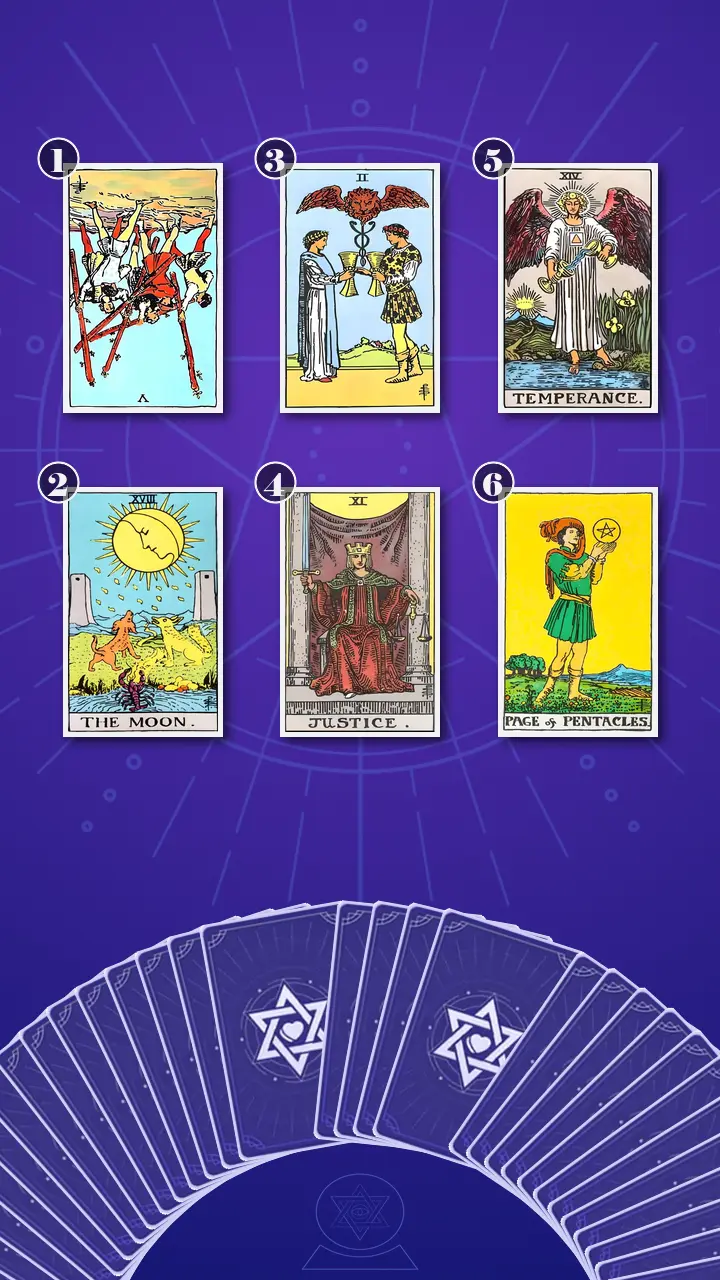
Reading the Map Without Mind-Reading
The Five Wands in a Crowded Call
Now I turned over the card representing the present relational climate: the concrete conflict saturation inside the calls, including overloaded conversations, repeated grievances, and competing bids for reassurance.
The card was the Five of Wands, in reversed position.
In the image, five raised wands cross at competing angles while the figures face different directions. In Jordan’s life, those wands became five draft messages, three recent disappointments, and several guesses about tone arriving inside one rare video-call window. The conversation felt like a crowded group chat where everyone was typing at once. Jordan wanted one concern to be heard, but the partner could experience the entire call as pressure.
Reversed, the fire was not absent. It was blocked, scattered, and turning inward. There was an excess of friction and a deficiency of shared order. Jordan might bring up every old rupture to prevent the newest one from being missed, then receive a reply that briefly soothed the fear before the next gap reopened it. I asked, “What is the one request beneath the latest irritation? What needs to be named before the next call, and what can wait?”
I used my Communication Dissonance Audit here. I do not audit an argument by deciding who used the perfect words. I listen for the mismatch in emotional tempo and frequency: one person may arrive at the call at a high emotional BPM, carrying hours of anticipation, while the other may be coming off a demanding workday with very little capacity left. The same sentence can then sound like a bid for closeness to one person and an accusation to the other.
Jordan gave a short laugh with a bitter edge. “That is almost cruelly accurate.” First, their breath stalled and their finger froze above the phone. Then their gaze went unfocused, as if a recent call were replaying behind the carriage window. Finally, their mouth softened and a long breath left their chest. I told them the card was not accusing them of caring too much; it was showing how much emotional weight one call had been asked to carry. “The call was meant to hold your relationship,” I said, “not carry every unresolved hour.”
The Moon and the Unanswered Screen
Now I turned over the card representing the attachment trigger: the way a long-distance relationship amplifies uncertainty, projection, and the fear of losing belonging when contact changes.
The card was The Moon, in upright position.
The Moon’s winding path between two distant towers mirrored the route from an active status to an imagined conclusion about rejection. Jordan could see one small fact on the phone screen: the partner had been online, and the message remained unanswered. The reason for the silence was not visible, but the mind supplied shadows, landmarks, and a destination before enough information had arrived.
I asked Jordan to complete three lines without forcing a conclusion: “I know ____.” “I am imagining ____.” “My body is reacting as if ____.” After a pause, they wrote, “I know they were active online and the message is unanswered. I am imagining that I have been left outside their life. My body is reacting as if the relationship is already slipping away.”
That distinction mattered. The Moon was not telling me what the partner intended; it was showing distance-amplified uncertainty and projection. A delayed reply can be a loading screen, but Jordan’s nervous system was reading it as a warning before the page finished opening. I offered the sentence I use often in these moments: A pause is missing information, not a verdict. I also made room for the longing underneath the fear. Wanting to be included in someone’s ordinary evening was real, even when the rejection story was not yet supported by the available facts.
Jordan’s hands had been restless near the deck. Now they placed both palms flat on their knees and looked from the Moon to the phone they had set aside. Their expression held recognition without comfort yet, the quiet discomfort of seeing how quickly a blank space had become a complete story.
The Two of Cups, Face to Face
Now I turned over the card representing the relational resource: the mutual recognition and closeness still available when the conversation is not organized around proving that the bond is safe.
The card was The Two of Cups, in upright position.
Two figures faced one another with raised cups, neither one disappearing into the other. I connected that balanced exchange to a different kind of call: Jordan and their partner no longer investigating who cared more about the last missed connection, but each describing what the gap felt like and what they needed next. The relationship would not be placed on trial. Two people would be checking whether they could meet in the same emotional space, even from different cities.
The upright energy was reciprocal and available. It did not promise that every conversation would be easy, and it did not speak for the partner. It showed a resource Jordan could participate in: naming one feeling and one simple request without attaching either to a demand for immediate certainty. I asked, “When was the last time each of you described how a missed call felt without trying to prove who cared more?”
Jordan looked down at the two cups, then rubbed a thumb across the edge of the card. “There have been moments,” they said. “Usually when we are not trying to solve the entire relationship.” Their shoulders remained high, but their voice had stopped rushing. I marked that as important evidence: connection was not missing altogether; it became harder to feel when every contact point had to prove it.
Justice and the Clean Subject Line
Now I turned over the card representing the communication correction: the boundary, request, and shared agreement that could interrupt checking, pursuing, brief relief, and renewed conflict.
The card was Justice, in upright position.
The upright sword and level scales gave the reading a clean line. Justice asks for feeling and fact at the same time. In Jordan’s situation, it sounded like replacing “Are you still committed to me?” with “When a call changes, can we send a quick signal and choose the next realistic time?” The first question carried the weight of a hidden test. The second named a need, a limit, and a practical way for both people to respond.
Justice’s energy was balanced accountability, not cold judgment. It asked what each person could realistically promise, how a changed plan would be communicated, and how repair would happen after a missed connection. I placed the card beside a shared calendar invite: one clear subject line, one observable agreement, no hidden terms. You can ask for closeness without putting the relationship on trial.
I then used my Reactive De-escalation Mapping to locate the high notes that could shatter emotional safety. I was not labelling either person as angry or difficult. I was identifying the moment a vulnerable request might spike into a preemptive criticism, or a tired, flat reply might land as withdrawal. Once the high note had a location, Jordan could choose an interruption before the whole call became an argument.
I asked Jordan to say both versions aloud: “I want reassurance now” and “I need a request we can both realistically answer.” The first came out quickly. The second arrived more quietly. Their fingers curled around the edge of the cushion, then released. I watched them mentally rewrite the loaded question into, “Can we agree on what happens when a call changes?” The exhale that followed was not a solution; it was the first sign that clarity could include both a need and a limit.
When Temperance Made Room for Two Shores
The Measured Rhythm of Temperance
The room grew still when I reached the upper-right card. Even the radiator’s small ticking seemed to recede. I turned over the card representing the key transformation: how Jordan could stay emotionally close while allowing two separate daily lives, without making constant contact the only proof of belonging.
The card was Temperance, in upright position. Its figure stood with one foot on land and one in water, transferring water between two cups. The image gave me the Bridge I had been waiting for: not a command to close every distance gap, but a way to connect two shores without requiring either shore to disappear.
In ordinary life, Temperance looked like one dependable video window, one flexible voice-note option, and protected time for work, friends, and rest. The two calendars could remain separate while the relationship gained a shape both people understood. The upright energy was measured reciprocity, patience, emotional proportion, and self-trust during response gaps. It did not ask Jordan to accept neglect or suppress a need. It asked for a mutually chosen rhythm that could be discussed, tested, and adjusted.
I returned to my Communication Dissonance Audit at this point. The problem was not that Jordan cared too much or that the partner cared too little; I could not claim either conclusion from a spread. The useful diagnosis was a collision of emotional tempos. One nervous system was reaching for immediate confirmation, while the other might need time to transition from work, sleep, or an ordinary separate life. The question became: what signal could let care be heard without demanding instant availability?
I asked Jordan to return with me to 8:47 p.m. on the TTC Line 1. Their phone was warm, the chat was open, and their partner was visibly online. Before another “just checking in,” I asked them to feel the tight chest and the urge to act, then notice what the gap could actually prove. The pause had become a warning banner before the page had finished loading.
Closeness is not measured by how quickly you erase every pause; it is built through a rhythm where a clear need can be heard without turning uncertainty into a verdict.
I let the sentence rest between us. Then I placed Temperance’s two cups beside the shared-calendar image and said the line I wanted Jordan to carry into the next reply gap:
Stop treating every pause as a problem that must be solved immediately, and let Temperance's two cups model a measured rhythm where clear contact and separate lives can coexist.
For three seconds, Jordan did not move. Their breath stopped halfway in, their pupils widened, and one thumb remained suspended as if the phone screen had become a switch they could no longer press. Then their gaze left the card and went soft; I could almost see the train carriage, the active status, and the imagined warning banner replaying behind their eyes. Their jaw tightened once and released. Their shoulders lowered by a fraction, their fingers slowly unclenched, and a fuller breath came out as a quiet, uneven laugh. Their eyes shone, not because a single sentence had guaranteed security, but because they were feeling the ache of how hard they had worked to prevent a loss that had not been established by the facts. For a moment, they looked lighter and slightly unsteady, like someone who had set down a heavy bag and needed to find their balance again. Their voice came low and trembling: “So space does not have to be the opposite of us.”
“Now, with this new view, think back to last week,” I said. “Was there a moment when this insight might have made you feel differently?”
That was the first crossing in the emotional transformation from hypervigilant reassurance-seeking to measured reciprocity, clear requests, and steady closeness with room for two separate daily lives. Not certainty. Not a promise about the partner. A new ability to let one pause remain a pause long enough for a choice to become possible.
The Page of Pentacles and the Seven-Day Test
Now I turned over the card representing grounded integration: the small communication experiment that could make the new rhythm visible in behavior and allow it to be reviewed within a week.
The card was The Page of Pentacles, in upright position.
The Page held one pentacle and studied it carefully above a cultivated field. I connected that steady attention to Jordan writing one agreed check-in practice in a shared note, following it for seven days without adding extra tests, and recording what actually happened after each contact point. The card’s energy was practical, teachable, and patient. It offered a beginning, not a final grade on the relationship.
I asked, “What would you want to learn from a small communication practice, rather than prove?” Jordan considered the question, then opened their Notes app. Their shoulders were still not completely relaxed, and I did not need them to be. The new skill was not pretending that reply gaps felt easy. It was noticing the urge, choosing one grounded action, and observing whether that action supported closeness without demanding constant access.
A Shape for the Next Conversation
When I gathered the six cards together, the story became coherent. The reversed Five of Wands showed how accumulated disappointments crowded a scarce call. The Moon located the deeper mechanism: a delayed reply or changed plan became evidence of rejection before the facts had been separated from the fear. The Two of Cups showed that mutual recognition still existed when neither person had to win the case for caring. Justice gave that recognition a clean structure, and Temperance turned the structure into a rhythm that could hold intimacy and autonomy. The Page of Pentacles made the rhythm testable.
The bridge metaphor held all the way through. Jordan had been gripping both ends of the bridge so tightly that every vibration felt like a collapse. The blind spot was understandable but costly: monitoring, pursuing, and reopening old grievances could feel like care because they were attempts to protect belonging, yet they also loaded the next contact with pressure. The direction of change was not to become less caring or to ask for less. It was to replace repeated reassurance-seeking with one clear request, a communication rhythm both people understood, and the willingness to let more information arrive before deciding what a gap meant.
“This is the Six-card Relationship Spread: Context Edition for relationship communication clarity,” I told Jordan. “It has not told us what your partner will do. It has shown you where your interpretation begins, where a request can become clearer, and what small behavior you can choose next. You remain the person with agency here. The cards are a map; you are the one who decides how to cross.”
The One-Request Reset
I gave Jordan three pieces of actionable advice. Each one was deliberately small enough to begin without waiting for perfect confidence.
- Write one clear requestBefore one planned call this week, open Notes and write: When our call changes, I feel ____. Could we ____ so I know what to expect? Bring only that sentence into the first ten minutes of the call, and ask your partner whether a quick signal and a realistic rescheduling time work for both of you.Keep it to one topic. If old grievances appear, write them down for a separate conversation or pause the call. A request is not a demand for instant access.
- Build a two-shore rhythmUse Google Calendar or a shared note to choose one realistic weekly video-call window, one short voice-note window, and a simple phrase such as today changed; I will reconnect by ____. Also choose one evening when each of you keeps your own plans without using the quiet as a relationship test.Start with the smallest rhythm that fits both schedules. Review it after seven days instead of treating one missed check-in as the final result.
- Run a seven-day no-test experimentFor seven days, record one line after each planned contact: what happened, what did I assume, and what helped? During a reply gap or changed call, use my Syncopation Pause: put the phone down, feel both feet on the floor, breathe out, and count three seconds before sending a follow-up. If contact is still needed, send one request and wait until the agreed reconnection point.Treat this as a low-stakes beta test, not a verdict. Stop the exercise if it feels too activating, and track observable details rather than trying to measure love.
The Syncopation Pause was not a rule for swallowing a need. It was a three-second acoustic grounding technique for lowering the emotional BPM before a defensive high note could damage the conversation. Jordan could still speak, ask for reassurance, set a boundary, or decide that a pattern needed a larger discussion. The difference was that the next move would come from choice instead of the emergency demand to make uncertainty disappear.

The Quiet Proof of a Shared Rhythm
Four days later, I received a text from Jordan: their partner had moved a call, sent the agreed signal, and Jordan had not checked the activity feed. It felt lighter but lonely; they stared at the empty chat for three minutes, closed it, and joined a friend for dinner.
I read the message twice. It did not say that the relationship was permanently fixed, and I was glad it did not. It showed something more honest: a changed plan had happened, the new signal had made the situation legible, and Jordan had allowed a small amount of space without turning it into a courtroom. The old question, Am I the only one trying?, had not vanished forever. It simply no longer had to run the entire evening.
That was the first small proof of the Journey to Clarity. The cards had not created the steadiness; Jordan had practiced it. A shared rhythm could be revised, a need could be spoken plainly, and two lives could remain distinct without making the bridge less real. Closeness becomes steadier when it has a shape you both understand.
When a delayed reply leaves your chest tight and your hands hovering over the phone, you can want closeness while fearing that asking for it will expose you as the only one trying to keep the bond alive. If one pause could remain just a pause for one more breath, what small, honest kind of closeness would you want to notice or name?