Cold Tea, Warm Phone: From the Old Thread to Present-Day Care

Finding Clarity in the 11:40 p.m. Thread
If you are a 27-year-old creative-agency professional who can stay polished through client deadlines but starts rereading old messages the moment you get home to your Toronto apartment, you may recognize this as more than missing someone: it is post-breakup care seeking, comparison fatigue, and the fear that letting go will leave you without reliable care.
Maya (name changed for privacy) sat on the edge of her bed at 11:40 p.m., scrolling from a recent Instagram post into an old iMessage thread. The radiator clicked behind her. The tea beside her had gone cold, while the phone stayed warm in her palm. Her thumb paused over a voice note she had played too many times to count.
She had answered Slack messages all day, kept her client updates clean, and smiled through a meeting about a campaign that had run late. Now the apartment felt loud in its quietness. She wanted to stop checking her ex's Stories and rereading affectionate messages, but closing the thread felt dangerously close to closing the last door to tenderness.
She looked at me and said, “I do not even know if I miss them or who I got to be when they cared for me. I keep looking for the version of the story where this did not happen.”
I watched her fingers tighten around the phone, release it, then find the edge of the case again. Her longing seemed to move through her like a saved location pin she kept using as a live route to somewhere that was no longer open. Beneath it was grief, rejection sensitivity, and a quieter fear: that if she recovered the care lost in the sudden breakup, she might also lose the only reliable place where care had ever felt real.
“That makes sense,” I said. “Missing the care is not the same as needing the door to reopen. We can honour what mattered without asking the past to carry every present need. Today, let us draw a map from the longing to the care it is actually asking for. That is our Journey to Clarity.”

Choosing the Compass for a Care-Seeking Spiral
I invited Maya to take one slow breath and focus on the question beneath the question: What care am I still chasing after a sudden breakup? Then I shuffled slowly, not to summon a fixed answer, but to give her mind a clear transition from replaying the old conversation to observing it.
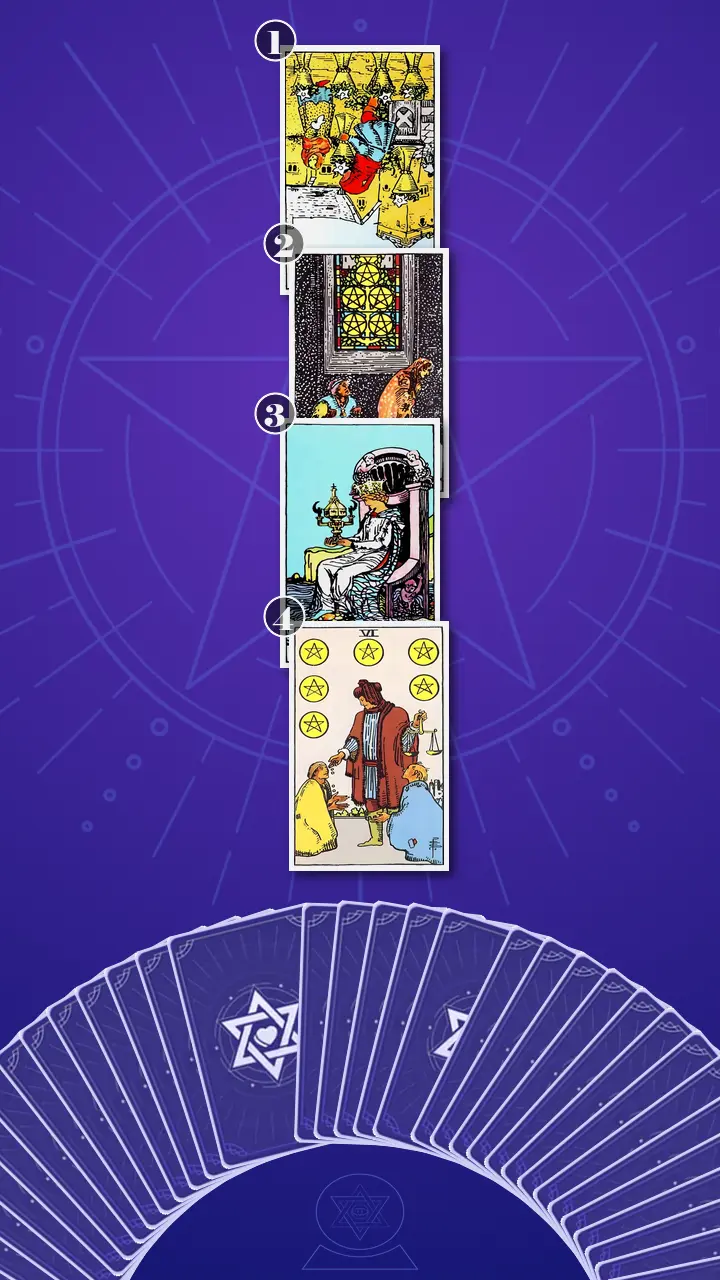
“I am using the Four-Card Spread · Context Edition,” I explained. “It is deliberately small. We do not need a theatrical forecast about whether your former partner will return. We need enough structure to see the chain clearly: the visible pattern, the felt shortage beneath it, the inner resource that can change the response, and a practical way to integrate that insight.”
This kind of tarot spread works as a self-reflection tool because each card has a defined job. The first card shows the current care-seeking pattern. The second names the underlying nurture deficit. The third reveals the emotional capacity that can distinguish grief from an automatic instruction to reach out. The fourth turns the reading toward reciprocal support, boundaries, and next steps rather than predicting relationship outcomes.
I placed the cards in a straight vertical line. The eye travelled downward from memory to scarcity, then through a contained emotional cup and finally toward balanced scales. “We are going to follow that ladder together,” I said. “The cards cannot decide for you. They can help us notice what your attention has been trying to say.”
The Map Beneath the Closed Door
The Archived Tenderness: Six of Cups Reversed
Now turned face-up, the card representing the current care-seeking pattern was the Six of Cups, in reversed position.
In the image, a child offers a cup filled with white flowers inside an enclosed courtyard. I saw the remembered affectionate message in that cup, the old voice note made vivid again by a quiet evening, and the courtyard as the small digital world Maya kept returning to. She was not foolish for finding warmth there. The question was what that warmth had become in the present.
“This card looks like opening an archived iMessage thread after work and replaying a voice note because tenderness briefly feels available again,” I said. “The affection was real, but the memory is time-bound. Which quality are you reaching for now: gentleness, reassurance, consistency, or the feeling of being chosen?”
The reversed energy was blocked and turned backward. Memory was no longer simply helping her remember what she valued; it had become a measuring tool for whether care still existed. Each reread gave her perhaps thirty seconds of closeness, followed by another search for the exact sentence that would make the breakup reversible. The urge to check was carrying a need, not delivering an instruction.
Maya let out a small, bitter laugh. “That is too accurate,” she said. “Almost cruel.”
“I do not mean it as a verdict,” I said. “The card is showing a loop, not a flaw in your character. A remembered offer can be real without becoming a lifetime contract. You can keep the meaning of what happened without giving the old thread the next move.”
She stopped rubbing the phone case. For a moment she looked down at the card, then toward the window, her mouth pressed into a line that softened only slightly. The recognition had landed, but it had not made the grief disappear. That mattered too.
Outside the Lit Window: Five of Pentacles Upright
Now turned face-up, the card representing the underlying nurture deficit was the Five of Pentacles, in upright position.
Two figures moved through snow beneath an illuminated stained-glass window. I connected the scene to Maya walking home through Toronto after a long day at the agency, passing a bright cafe and assuming nobody had room for her hurt. The crutch in the image held the weight of ordinary routines: answering messages, buying groceries, making dinner, and pretending that functioning meant feeling supported.
“This card does not prove that care is absent,” I told her. “It shows how a sudden loss can make available care difficult to see, trust, or request. The window is lit. The door is not necessarily closed. But the fear of being turned away can keep you moving past it.”
Her breathing paused. Her eyes fixed on the window in the card as if she were watching a cafe from across a snowy street. Then her fingers tightened once around the phone and loosened.
“Everyone else has somewhere to put this feeling,” she said quietly. “I am outside. Asking would prove I was left.”
I let the sentence remain in the room before answering. “That is the felt experience, and it deserves respect. It is not the only fact available. Your friends live across different Toronto neighbourhoods and have demanding schedules, so support may need to be requested rather than assumed. One closed relationship is not the same thing as a closed care system.”
Her shoulders lifted as though she were bracing against cold, then lowered by a fraction. The Five of Pentacles named the shortage without declaring it permanent. It showed the belief underneath the checking: if the former relationship was suddenly gone, perhaps warmth, belonging, and safety could disappear everywhere. Naming that belief created the first small distance between the sensation of exclusion and the actual capacity of the people around her.
When the Queen of Cups Held the Feeling Still
The Transformative Inner Resource: Queen of Cups Upright
The room seemed to quiet around the third card. Even the radiator's clicking felt farther away as I turned over the card in the position of transformative inner resource: the Queen of Cups, in upright position.
She sat at the water's edge, holding an ornate cup with both attention and care. I returned to Maya's thumb hovering over the old thread. “This is the pause before pressing send,” I said. “The Queen is emotionally open, but she does not forward every urgent feeling to the person least able or willing to hold it now. She asks you to name the need before naming the person.”
I used my signature diagnostic lens, Toxic Script Identification, gently and precisely. “After a rupture, people can be pulled into repetitive roles without choosing them: one person becomes the rescuer, the other becomes the rejected one waiting to be rescued. In your loop, the former relationship is being cast as the only possible saviour, while you are left trying to earn one more scene of reassurance. That is a pattern, not an identity.”
I also heard a dialogue loop inside the unsent drafts. “If I can understand why they left, I can restore the care I lost.” Each time that sentence appeared, it turned grief into research and research into another reason to contact someone unavailable. The Queen of Cups did not demand emotional shutdown. Her closed cup was a container: the feeling stayed visible without automatically receiving access to the old relationship.
Maya stared at the card. “But if I do not need them to make care real,” she said, her voice suddenly sharper, “does that mean I was wrong to need them? Or that I should have known how to do this before?”
“No,” I said. “It means the relationship mattered, and the care you received mattered. It also means one person was never the entire definition of care. You are not being asked to rewrite the past. You are being invited to stop making your present safety wait for its return.”
She went still. Her breath stopped halfway in, and her eyes lost focus as if an old scene had begun playing behind them: the sudden breakup, the unanswered questions, the first night she had searched the message archive until dawn. The thought moved through her slowly. Her jaw trembled once. Then her shoulders dropped, her fist opened against her knee, and a breath left her chest with a small, uneven sound.
“I feel grief,” she said. “I need someone to stay with me for a little while. I do not have to send this feeling to them.”
For several seconds she looked almost startled by the simplicity of it. Relief came first, followed by a brief, weightless dizziness, the vulnerability of seeing a clear path where she would now have to choose the next step herself. Her eyes grew wet, but she smiled without forcing it. I asked, “Now, use this new perspective to recall whether there was a moment last week when this insight could have made you feel differently.”
She remembered a Tuesday night on the Line 1 train, searching for the exact sentence that explained the breakup while the fluorescent lights buzzed against the dark window. “I could have asked my friend for company instead of trying to solve the whole story,” she said. “I thought I needed an answer. I think I needed a calm voice.”
That was the bridge. The Queen of Cups was not an outside saviour; she was the part of Maya capable of listening closely enough to separate a valid longing from an automatic instruction. This was the first movement from achingly lonely confusion toward steadier self-trust: not certainty, not emotional detachment, but a need becoming specific enough to meet.
The Scales of a Living Support System: Six of Pentacles Upright
Now turned face-up, the card representing the integration practice was the Six of Pentacles, in upright position.
A standing figure held balanced scales while offering coins to two kneeling people. I translated the image into something practical: a clear ten-minute call request, a walk scheduled around two people's capacity, a meal received without an apology, and a place where Maya could offer connection without using generosity to earn belonging.
“This is not a forecast about who will show up,” I said. “It is a practice of making care visible. Who is asking? What is possible? Is the exchange freely chosen and mutual? The scales work like a balanced project brief: the request, the time, and the capacity are clear enough that nobody has to rely on mind-reading.”
Maya looked at the card and nodded slowly. “I used to ask one person to prove care. Maybe I can participate in care that is specific and mutual.”
“Exactly. Receiving support does not make you demanding, and offering support does not require you to become the person who never needs anything.”
Her hand moved away from the phone and rested beside the Six of Pentacles. The movement was small, almost ordinary, but it changed the geometry of the table. The two sixes now framed the five: remembered harmony, felt shortage, and then a more deliberate balance. The cards were not promising a replacement relationship. They were showing a route through breakup rumination toward present-day connection.
The Ten-Minute Path Back to the Present
When I placed the four cards together, the story became clear. Maya had begun by returning to remembered tenderness, treating an affectionate message as current evidence that care still existed only there. Beneath that was the Five of Pentacles: the sudden breakup had turned one absence into a larger belief that warmth, safety, and belonging were unavailable everywhere. The Queen of Cups offered the missing capacity, emotional attunement with a boundary. The Six of Pentacles then grounded that inner clarity in specific, reciprocal exchanges.
The blind spot was not that Maya cared too much. It was the assumption that more information about the breakup would restore the safety the breakup had disrupted. The research project offered a brief imitation of control, but it kept the present support network waiting outside the lit window. The shift was from asking whether the former relationship could still supply care to naming the need beneath the longing and meeting it through self-respect, direct requests, and mutual support.
I showed her how I would use my Pattern Interruption Script. We role-played the familiar moment: she was at home, the tea was cold, and her thumb had reached the old thread. Instead of performing the old role of chasing reassurance from an unavailable person, she would say aloud, “I am reaching for company. I can give this feeling ten minutes without sending it to the past. My next care action is a clear request or a kind act I can offer myself.” The point was not to speak perfectly. It was to interrupt the scene before it wrote itself.
- Name the need before the personAt home, before opening the old message thread, set a two-minute timer in your Notes app and finish the sentence, “I am reaching for…” Choose one concrete need: reassurance, company, rest, clarity, or comfort. Then place one hand on your chest or throat, take three unforced breaths, and choose one response for the next hour: food, rest, a friend, movement, or quiet.Use the smallest version when the exercise feels exposing: write one word before checking anything. You do not need to contact anyone, and you can stop if body focus feels uncomfortable.
- Make one bounded support requestChoose one trusted person who is currently available and send, “I am having a tender evening. Do you have ten minutes for a call, or would tomorrow be better?” During the next seven days, schedule one concrete exchange, such as a Wednesday walk after work or a shared dinner, and put it in both calendars.Offer two low-pressure options. A busy friend's no is information about capacity, not a verdict on your worth. Receive a kindness with a simple thank you instead of immediately trying to repay it.
- Create a temporary digital boundaryFor one evening, mute your ex's Stories or move the old thread out of your main inbox. When the urge rises, wait ten minutes and do one present-day care action: make tea, eat something warm, step outside your building, or call a friend. At the end of the evening, record what the urge was asking for and what actually helped.Keep the boundary reversible. You are not declaring permanent no contact or pretending not to care; you are changing who gets the next move while your feelings become clearer.
“The aim is not to stop missing them on command,” I said. “It is to let the memory remain meaningful without allowing it to become the only place you are permitted to receive tenderness.”

A Week Later, the Quiet Proof
A week later, Maya sent me a message during her commute home. “I almost opened the thread while waiting for the pasta water,” she wrote. “I put a timer on instead and wrote ‘company.’ I asked Sam for ten minutes. We talked, and then I still missed my ex. But I did not feel like I had to solve the breakup before dinner.”
She had also muted the Stories for one evening and put a walk with Sam on her calendar. The next morning, the first thought was still, “What if I am getting this wrong?” She made coffee, saw the empty space where the old checking ritual usually went, and smiled despite the uncertainty. The apartment was not suddenly transformed. It was simply no longer the only witness to her grief.
I understood that as the first real evidence of change: not a reunion, a perfect closure text, or a finished healing story, but one clear request made in the present. The care system had begun to widen. Maya could miss the relationship and still choose what helped her now.
When the apartment goes quiet and your hand reaches for the old thread, part of you may be grieving the person while another part braces for the frightening idea that being left means reliable care can disappear everywhere. The cards do not take that fear away. They help you look at it closely enough to recognize the need beneath it.
Clarity is not always the final answer to why someone left. Sometimes it is the moment you stop treating one closed relationship as a closed care system. You keep the memory, hold the feeling with Queen of Cups discernment, and let present-day support meet you through small, reciprocal choices.
If you could let the relationship remain meaningful without making its return the price of feeling cared for, what is one small, present-day form of connection you might be curious to receive?