Waiting for Divorced Parents to Reunite, Then Booking Sunday Dinner
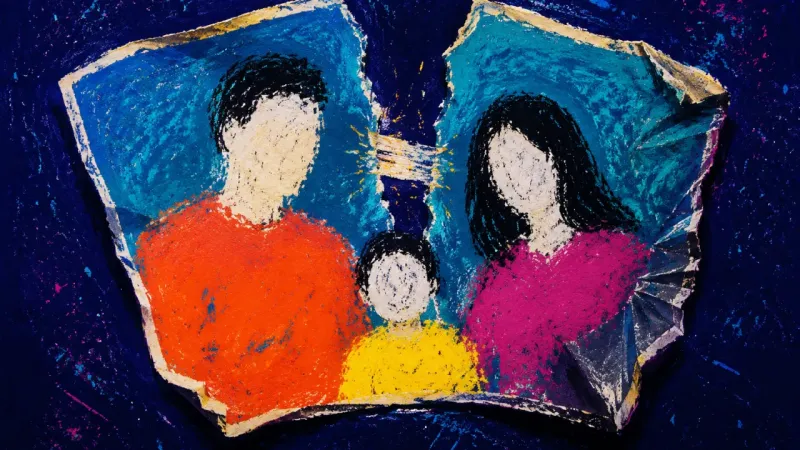
The 9:38 p.m. Calendar That Stayed Blank
I met Alex (name changed for privacy), a 29-year-old UX designer in Toronto who could lead a tense stakeholder workshop without losing the room, yet one pair of separate holiday invitations could leave her own calendar blank. She brought me directly into the previous Sunday night: 9:38 p.m., two unfinished Google Calendar tabs glowing on her laptop after separate calls from her parents, the radiator hissing beside the sofa, and a streetcar bell sounding through the glass. Her phone had grown warm in her hand as she scrolled through an old Christmas album.
“I keep thinking one good holiday could put us back together,” she said. “I know they’re divorced, but part of me is still waiting for them to come home.”
I noticed the way she held her breath after saying home. She described a hollow opening in her stomach and a slab-like heaviness across her chest whenever one parent mentioned the other. Her longing did not feel soft or sentimental. It felt like standing barefoot in a childhood hallway, listening for two keys to turn in the same front door while the rooms behind her slowly emptied.
She was waiting to book a long weekend because booking it would feel like closing the door on reconciliation. She was waiting to hang framed prints because making her apartment permanent would feel like confirming that the former family home was gone. She was waiting to answer two invitations because choosing either one seemed to make her responsible for the split.
“You are not only missing two people together,” I told her. “You are missing the version of yourself who knew exactly where home was.”
Her eyes lowered. “That’s it,” she said. “I don’t know where to put my life while everything still feels unfinished.”
I did not tell her to move on. I did not reduce her grief to a boundary problem or suggest that she should stop hoping by force. I told her, “Let’s make a map of what the waiting is protecting, what it is costing, and what can belong to you without erasing anyone you love. We’re looking for clarity, not a verdict.”

A Ladder Rising Out of the Waiting Room
I invited Alex to place both feet on the floor, take one unforced breath, and hold the question in plain language: “Why am I still waiting for my divorced parents to restore my old family?” I shuffled slowly, using the physical rhythm to mark a transition from circular thinking into focused observation. The cards were not being asked to predict whether her parents would reconcile. That future belonged to them, not to the deck.
I chose the Four-Layer Insight Ladder tarot spread. I use this four-card structure when a visible habit is being sustained by a deeper emotional wound and insight needs to lead to an actionable next step. Tarot works best here as a cognitive map: it places the pattern outside the person long enough for us to examine it without shame.
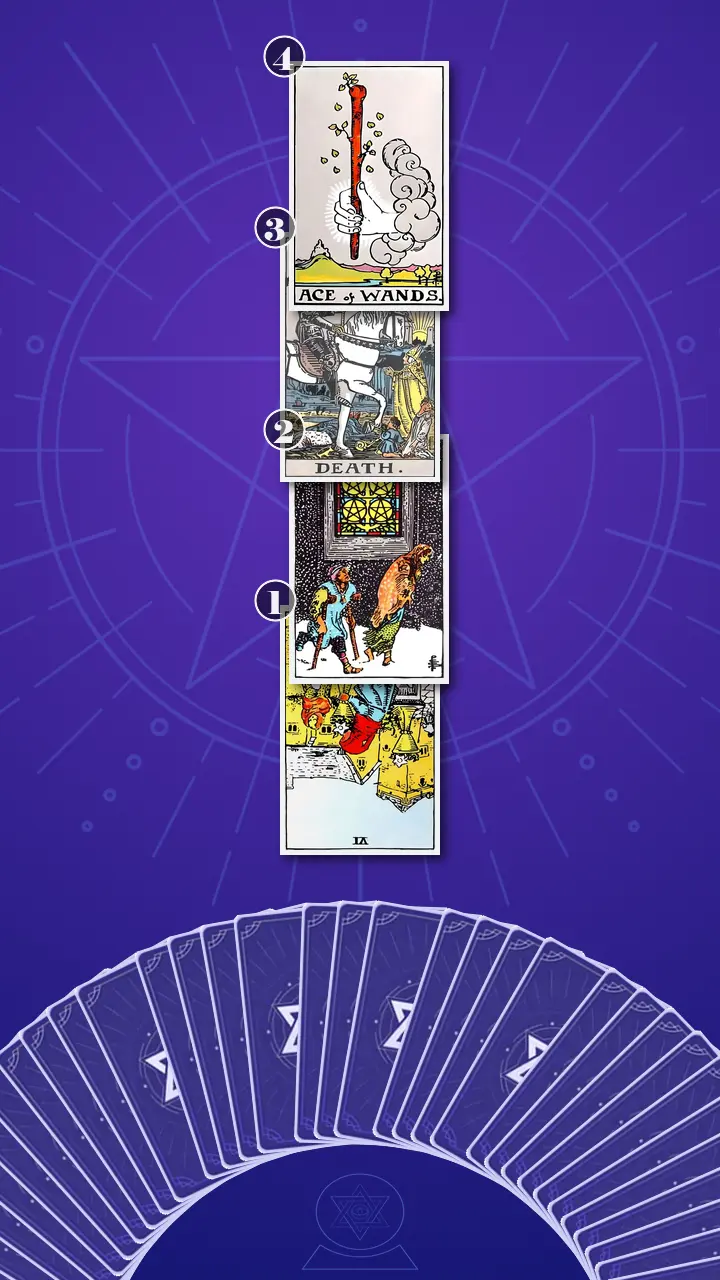
I arranged the four cards in a vertical column, like rungs ascending from a waiting room. The bottom card would reveal how Alex’s inner-child fixation appeared in her nostalgic monitoring and postponed decisions. The second would identify the loss of safety beneath her hope for reconciliation. The third, the threshold card, would separate enduring love from the expectation that the old structure must return. The top card would translate that acceptance into one self-directed act.
I explained that the card meanings would matter only in context. A childhood card would not automatically mean innocence; it might show memory becoming an operating rule. A card associated with hardship might reveal felt exclusion even when support was available. The spread’s movement was simple: visible waiting, underlying wound, transformative acceptance, grounded initiative.
When Nostalgia Started Running the Calendar
Position One: The Childhood Courtyard Kept on Standby
“Now I’m turning over the card that represents how the present pattern appears in your observable waiting, nostalgic monitoring, and postponement of an independent life,” I said.
The card was the Six of Cups, reversed.
I pointed to the child offering a flower-filled cup inside an enclosed courtyard. Upright, the Six of Cups can hold memory, tenderness, and continuity. Reversed in this position, I read its Water energy as a blockage: emotion was circulating backward through an idealised version of the past instead of carrying grief into the present.
“This is the sequence you described,” I said. “You finish separate Sunday calls. You open old holiday photos. You reread the family group chat. Then you leave the next long weekend blank because the remembered family feels more authoritative than your current preference.”
I returned to the sentence embedded inside that sequence: “If I keep this weekend open, then maybe this is the weekend they choose to be together. If I stay available, then maybe I haven’t abandoned the family. If I make my own plan, then maybe I’m the person who admits it is over.”
Alex gave one short laugh, but there was no humour in it. “That’s so accurate it’s almost cruel.” Her fingers tightened around the edge of her sleeve before she looked back at the card.
“The cruelty is in the loop, not in you,” I said. “The memory is real, and the safest parts of it deserve tenderness. The problem begins when nostalgia stops being somewhere you visit and becomes the approval system for every present-day decision.”
I thought of an archived design version being treated as the only valid release. Every current version of Alex’s life remained in draft because the original product had once felt complete. Her mind was behaving like an algorithm trained exclusively on intact-family photographs: every polite message, shared joke, or warm interaction was recommended back to her as another possible reunion clue.
“Keeping your calendar empty is not the same as keeping your family together,” I said. “It only keeps your life available for a decision you do not control.”
Her mouth pressed into a thin line. She looked at the two children in the card and whispered, “I think I keep waiting for them to hand that world back to me.”
“After your last call with either parent,” I asked, “what did you postpone while you searched their words or old photos for evidence?”
She named a Montreal trip, a framed print still leaning against her bedroom wall, and a Sunday dinner she had discussed with friends but never scheduled. I could hear recognition arriving before relief. The reversed Six of Cups had not accused her of living in the past. It had shown her the precise moment when love for the past became a rule against participating in the present.
Position Two: Two Invitations and No Shared Doorway
“Now I’m turning over the card that represents the deeper loss of safety and belonging beneath your hope that reconciliation will end this suspended feeling,” I said.
The card was the Five of Pentacles, upright.
Two figures moved through falling snow beneath an illuminated stained-glass window. I read the Pentacles energy here as a felt deficiency of shelter: not necessarily an absence of relationships or material safety, but an inability to register available support as home when it did not resemble the original structure.
I asked Alex about the two separate holiday invitations she had received on the Line 1 train. She described the brakes shrieking near St George, damp coats pressing against her arm, and takeaway coffee hanging in the carriage air. Both parents had invited her. Still, heaviness had spread across her chest as she stared at the two notifications without answering either one.
“Two people want me,” she had thought, “so why do I still feel like I have nowhere to go?”
“That question is the Five of Pentacles,” I said. “You are moving between two heated homes while part of you still feels locked outside because neither one contains the shared doorway you remember. The card is not claiming that your current relationships are inadequate. It is showing the gap between support being present and support feeling recognisable.”
Her inhale stopped halfway. Her thumb hovered above the face of the card as if she were about to point but had forgotten where. Her gaze shifted toward the window, unfocused, replaying something I could not see. Then a slow breath left her chest, and her shoulders dropped by a fraction.
“I make the schedule so complicated,” she said. “I try to stop either of them from feeling abandoned. I never ask which invitation I actually want.”
This was where I introduced what I call Family Casting Analysis. I told her that family roles are not always formally assigned. A role can emerge through repetition: one parent shares loneliness, the other shares frustration, and the most emotionally vigilant person begins carrying information between them. Without choosing an audition, Alex had been cast as both the Peacemaker and the Keeper of Continuity.
“That role gives you temporary purpose,” I said. “It also implies that if you stop coordinating, translating, or staying available, the family will lose its final connecting thread. But you can love both parents without becoming the bridge they use to reach each other.”
She flinched at the word bridge. “But if I step out, what if they become even more separate?”
“They may communicate more, less, or differently,” I said. “That outcome belongs to two adults and their choices. Your role cannot guarantee connection between them. It can only guarantee that you remain on alert.”
I pointed again to the illuminated window. “The Five of Pentacles often asks whether hardship has narrowed our field of vision. Your parents’ divorce removed one shared setting, but it did not remove every source of belonging. Your friends, your own apartment, the routines you can create, and your separate relationships with each parent are not counterfeit forms of shelter. They simply do not have the old front door.”
The card made the root of the struggle legible. Alex was not merely waiting for two people to reunite. She was waiting for one structure to prove that she had not lost her place in the world.
When Death Raised the White Rose
Position Three: The Ending That Did Not Erase the Love
The room seemed to become quieter as I reached for the third card. Even the muted traffic below the window receded for a moment.
“Now I’m turning over the card that represents the central shift: the truth that can separate your love for the old family from the expectation that its former structure must be restored.”
The card was Death, upright.
I watched Alex’s eyes widen at the name, so I clarified immediately. “I do not read this as a prediction of literal death, and I am not using it to frighten you. In this spread, Death is the energy of an ending becoming honest enough to be integrated. It is release at a threshold, not punishment.”
I pointed to the black banner bearing a white rose and then to the rising sun between the distant towers. “The rose preserves meaning inside the ending. The sun shows continuation beyond it. This card does not ask you to stop loving your original family. It asks you to stop making one expired structure the only form in which that love is allowed to remain valid.”
I described the modern-life moment held inside the card: one parent speaks warmly about the other; Alex feels the familiar surge and starts assembling a reconciliation forecast; then she interrupts the prediction with a more honest sentence: “Their marriage ended. My relationships with them, my history, and the love I received did not.” Warm contact can remain warm contact without becoming evidence that the old household is returning.
At that point, Alex was still inside one painful equation: if she named the ending, she would become disloyal; if she preserved the possibility, every current desire had to remain tentative. Two calendar tabs could stay open indefinitely while her parents unknowingly held the authority to approve the present.
You do not have to keep the old family structure alive to preserve what it gave you; Death's white rose and rising sun affirm that naming the ending is what allows a new life to become visible.
I let the sentence rest between us.
Alex’s face became still first. Her lips parted, but no sound came. Her pupils widened slightly, and the colour rose along the skin beneath her eyes. Then her shoulders drew upward, not down, as if her body were bracing against an impact. Her right hand closed into a fist against her knee.
“But doesn’t that mean I’ve been wrong?” she said. Her voice was sharper than before. “All this time, all the holidays, all the checking on them—doesn’t accepting it now mean I wasted years waiting?”
I did not rush to soften the question. I watched the anger pass through her jaw, then falter into grief. Her fist loosened finger by finger. Her gaze fell to the white rose, blurred for a moment, and a trembling breath left her chest. Relief arrived, but it brought a brief dizziness with it: if the waiting was no longer her job, she would have to decide what to do with the space it had occupied.
“It means the waiting protected you from a loss that once felt too destabilising to name,” I said. “Protection can become outdated without becoming stupid. You were trying to preserve safety with the tools you had.”
As an artist, I often experience life as a film still in production, and this was the moment I used my Narrative Enmeshment Diagnosis. Alex’s adult storyline had become dependent on her parents reopening a completed set. She was serving as continuity editor for their former marriage, checking each new scene for proof that the old plot might resume. Her personal story had not disappeared, but its next act kept being delayed until two other characters resolved theirs.
“The diagnosis is not that you care too much,” I said. “It is that your life has been waiting for a parental storyline to provide its ending before you permit your own storyline to move. Death takes the pen out of that contract.”
I added, “Something can be over without becoming meaningless. Acceptance does not delete the love; it ends the requirement that the old structure return. You do not have to keep the old family structure alive to keep its love; naming the ending releases your life from waiting for the past to approve the present.”
Alex wiped beneath one eye and gave a small, uneven laugh. “I hate that this makes sense.”
“You do not have to enjoy the ending for it to be real,” I said. “You only need enough honesty to stop organising your whole life around its reversal.”
I leaned closer to the spread. “Now, using this new perspective, think back to last week. Was there a moment when this insight might have allowed you to feel differently?”
She recalled her mother mentioning that her father had sounded cheerful after a mutual friend’s birthday. Alex had spent the evening rereading old messages and cancelled an AGO visit because she wanted to stay available in case another call came.
“I could have said, ‘That was warm contact, not a forecast,’” she said slowly. “I could have gone to the gallery.”
I nodded. That sentence marked the real breakthrough: not perfect detachment, but a movement from suspended longing and reunion monitoring toward grief-informed acceptance and grounded ownership of adult life. She was not abandoning the waiting child. She was relieving that younger part of a job it could never complete.
The First Green Shoot on a Real Calendar
Position Four: A Beginning Before the Whole Future Is Known
“Now I’m turning over the card that translates acceptance into one self-directed action, something that can build identity, momentum, and a lived sense of home,” I said.
The card was the Ace of Wands, upright.
A hand emerged from a cloud holding a living wand, fresh green shoots opening along its length. Beyond it lay an open landscape and a distant building. I read the Fire energy as balanced, available initiative: not a demand for a dramatic reinvention, but a spark that would become meaningful through participation.
“The spread does not end by asking you to define home for the next five years,” I said. “It ends by asking you to place one living commitment in the present.”
I gave the card its real-world translation. Alex could put a Sunday dinner in her Toronto apartment on the calendar, invite two friends, and buy groceries before checking either parent’s plans. The dinner would not be a replacement family or a permanent declaration. It would be one event generated by her own desire rather than by monitoring everyone else’s availability.
“I do not need a five-year definition of home to choose next Thursday,” she said, testing the sentence aloud.
“Exactly. The distant building is not the assignment,” I replied. “The fresh shoot is. This is the minimum viable version of home: small enough to revise, real enough to show you what feels alive.”
Her shoulders relaxed. She picked up her phone, opened her calendar, and hovered over the following Sunday. This time I did not see the suspended alertness that had appeared whenever she mentioned her parents. I saw uncertainty, but I also saw curiosity.
“What if one of them calls and sounds lonely?” she asked.
“Then guilt may arrive,” I said. “Guilt is a feeling, not an automatic cancellation notice. You can check whether there is an actual need, whether you have capacity, and whether changing your plan is freely chosen. Another person’s disappointment does not automatically become your veto.”
She entered a thirty-minute block titled Dinner at Mine—Choose a Date. It was not a solved life. It was Fire replacing surveillance for one small square of time.
“Home can begin as a ritual before it arrives as a feeling,” I told her.
The Present-Tense Home Plan
I read the Four-Layer Insight Ladder back to Alex as one coherent story. The reversed Six of Cups showed childhood memory functioning as a decision-delay system. The Five of Pentacles revealed why: without the original shared household, part of her felt exiled from safety even while relationships and support remained present. Death drew the necessary line between love and structure. The Ace of Wands returned the released energy to her as initiative.
Her cognitive blind spot was not hope itself. It was the belief that making an independent plan would somehow cause, confirm, or morally endorse an ending that had already occurred. By keeping her calendar, apartment, and identity provisional, she briefly avoided grief. Yet the resulting lack of stability made the old family structure feel even more necessary, reinforcing the very waiting that kept her unsettled.
I also noted the absence of Swords in the spread. Alex had already analysed hundreds of messages, pauses, invitations, and warm exchanges. More analysis was unlikely to produce the missing safety. The transformation required grief and embodied action: naming what had ended, recognising what remained, and building one source of steadiness that did not depend on parental reconciliation.
Before we finished, I introduced The Script-Flipping Rehearsal. I played the role of a parent saying, “Your dad sounded lonely when I spoke to him. Maybe you should check on him.” Alex’s first response was immediate: “What happened? Did he say something about you?”
I asked her to try an intentionally out-of-character line instead.
She inhaled. “I care about both of you, but I don’t want to pass messages. Please ask him directly.”
“That sounds nothing like me,” she said, half laughing and half alarmed.
“That is why we rehearse it,” I replied. “The old character keeps the connection moving and then searches it for reunion evidence. The new response does not withdraw love. It returns communication to the two people who own it.”
We left the consultation with three bounded experiments rather than one grand promise:
- The 10-Minute Ended-Remains-Builds Check. Open a private phone note and create three headings: “What ended,” “What remains,” and “What is mine to build.” Add one factual line under each. Do this when you have ten uninterrupted minutes and no immediate family call to answer. If the language feels too final, write one word beneath each heading and stop. The note is not a statement for either parent, and you may close it whenever the exercise becomes more intense than useful.
- The Calendar-First Home Ritual. Before discussing the next long weekend with either parent, place one parent-independent commitment on the calendar: a twenty-minute home-making task, an AGO visit with a friend, or Sunday dinner in your apartment. Give it a defined start and finish. Use the minimum version if guilt appears: twenty minutes, one friend, or one corner of the apartment. A small prototype can create evidence without forcing a permanent identity decision.
- The No-Messenger Script-Flipping Rehearsal. Practise saying, “I care about both of you, but I don’t want to pass messages. Please ask them directly.” Rehearse it once in a voice note or with a trusted friend, then use it for one low-stakes request when a parent asks about the other. Keep the response brief and repeat it once rather than debating the divorce. If direct refusal feels unsafe, use a quieter version by delaying your reply, sharing less information, or declining one specific task.
I reminded Alex that none of these actions required her to stop missing the old family. They only tested whether present stability could begin somewhere other than her parents’ relationship. The goal was not independence as emotional isolation. It was participation in a life that no longer needed to remain an empty set between other people’s scenes.

A Week Later, the Quiet Proof
Six days later, I received a screenshot from Alex. A solid green calendar block read: Sunday Dinner Here, 6:30. She had invited two friends, bought groceries, and finally hung the framed print that had been leaning against her bedroom wall. Afternoon light fell across the kitchen table in the photo she sent me.
Her message underneath was honest: “Mum called that morning and sounded lonely. I still wanted to cancel. I didn’t. I checked whether she needed practical help, then kept dinner.”
That night, Alex slept all the way through. Her first thought the next morning was still, “What if accepting this means I’m wrong?” She told me she lay there for a moment, felt the old hollow space in her stomach, and then smiled without having to answer it.
I did not credit Death, the Ace of Wands, or tarot itself with changing her life. The cards had provided an external structure through which Alex could see a private feedback loop: memory produced hope, hope delayed action, delayed action weakened present stability, and that instability made the old family seem even more necessary. She was the person who interrupted the loop. She named one ending, preserved the love, and placed one beginning on the calendar.
I think of that as the real Journey to Clarity. Clarity did not arrive as certainty about her parents. It arrived as ownership of what she could choose while uncertainty remained. Her grief was still present, but it was no longer the director of every scene.
When two separate holiday invitations make your stomach drop, I want you to remember that it is not only the schedule that hurts. Part of you may still be waiting for one shared doorway to prove you have not lost your place in the world. Noticing that longing does not betray your family; it is the moment you begin distinguishing the love you can keep from the structure you cannot control.
If home did not have to wait for anyone else’s relationship to change, what tiny present-tense ritual would you place on your calendar this week as your own first green shoot?