Finding Clarity in the 11:47 p.m. Scroll
You can run a product launch, answer Slack on time, and look completely grounded until one unanswered message after intimacy turns your evening into a post-intimacy ghosting investigation.
Maya came to me on a wet Sunday in Toronto with a cooling coffee beside her and an iMessage thread still open on her phone. At 11:47 the night before, she had sat on the edge of her bed in Parkdale, switched from that thread to Instagram, seen that the person had posted, and rewritten a casual follow-up for the fourth time. The phone had felt warm in her palm while a streetcar hissed over wet rails outside.
“I know silence is an answer,” she said, pressing her thumb against the side of the phone, “but it never feels like enough. If I stop, it feels like I’m admitting the intimacy meant nothing to them. Like I was easy to discard.”
Her urgent longing behaved like a smoke alarm wired to one person’s name: every screen glow pulled the air tight across her chest and sent her hand moving before her judgment could catch up. She said she wanted clarity, but each action was trying to recover control over whether the closeness was allowed to end.
“Wanting a reply after intimacy is understandable,” I told her. “I’m not going to shame that desire or pretend ghosting is painless. But we can look at the moment desire turns into pursuit, because that is where your choice has been getting buried. Let’s give this fog a map.”
Choosing the Five-Card Compass
I asked Maya to place both feet on the floor and phrase the question without trying to sound detached: Why do I keep chasing when someone stops responding after intimacy? I shuffled slowly while she breathed. I use this preparation as a practical transition from reacting to observing, not as a ritual that hands authority to the cards.
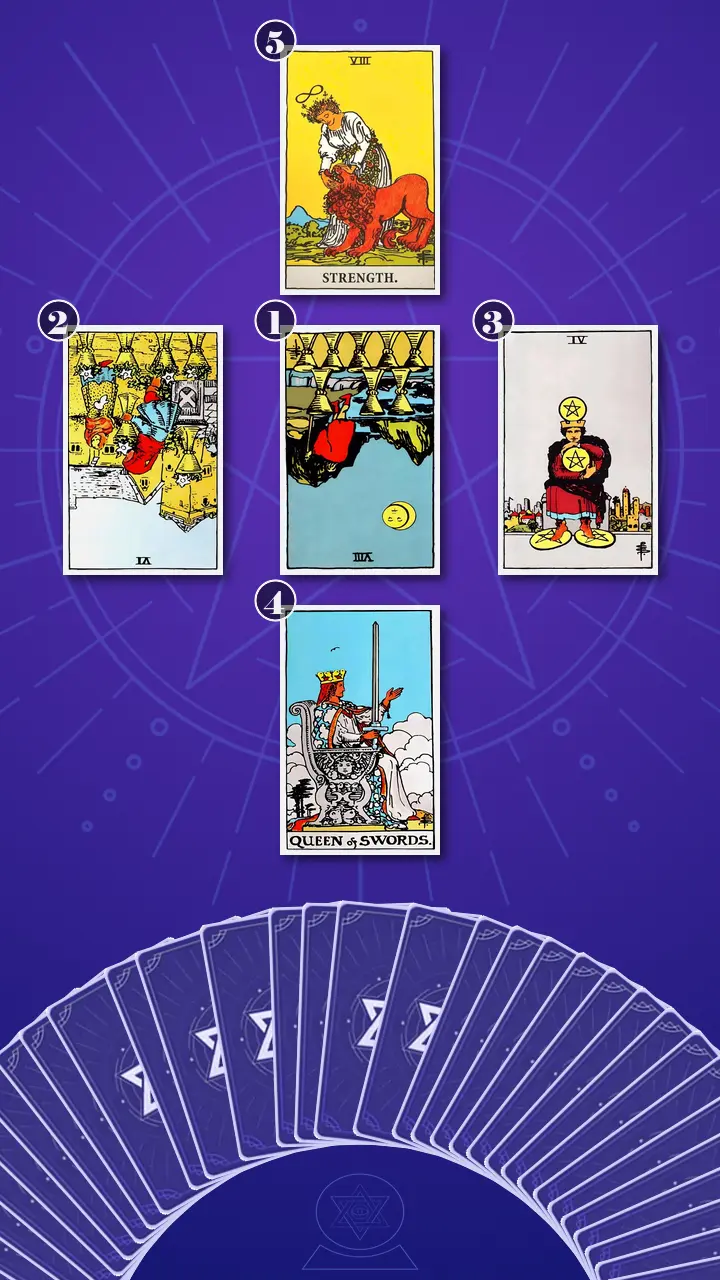
I chose the Five-Card Cross · Context Edition. A ten-card Celtic Cross would have introduced more layers than this focused loop needed. These five positions were enough to map the visible chase, the familiar emotional script behind it, the hidden need for control, the most constructive boundary, and the capacity required to live that boundary when the urge returned.
I placed the first card at the centre for the messaging, monitoring, and mental return that formed the presenting problem. The second went to the left for the familiar script that made this episode hard to release; the third went to the right for the fear linking lost contact with lost worth. The fourth rested below the centre as grounding guidance, and the fifth rose above it as the capacity Maya could develop through practice.
For anyone wondering how tarot works in a consultation like this, I do not use the spread to reveal why an absent person behaved as they did or to predict whether they will return. I use card meanings in context to place a repeating pattern outside the querent for a moment, where behaviour, emotion, evidence, and choice can be examined without panic. The horizontal arm of this cross would show why Maya kept circling. The vertical arm would show where she could begin moving differently.
The Loop Hiding Inside “Closure”
Position 1: The Thread That Would Not Stay Closed
I turned over the card representing the observable presenting problem: the messages, profile checks, and mental returns after intimacy was followed by ghosting. It was the Eight of Cups, reversed.
In the Rider-Waite-Smith image, a cloaked figure should be walking away from eight carefully arranged cups, but the reversal stalls that departure. I pointed to the visible gap in the cups. In Maya’s daily life, that gap had become the missing reply she kept trying to fill. She would close the chat at 11:47 p.m., reopen it minutes later, check the person’s profile, and edit a third follow-up to sound casual enough to hide how much depended on the answer.
The reversed water showed a blockage: feeling was not moving through disappointment and grief; it was recirculating through the phone. The next check created movement on the screen but no movement from the other person. Each return briefly relieved helplessness, then produced another silence to interpret.
“The thought underneath it sounds something like this,” I said. “I know silence is information, but if I phrase this casually enough, maybe the intimacy will become real again. You want mutual closeness, but right now you are performing all the movement alone.”
Maya gave one short laugh, but there was no amusement in it. Her fingers tightened around the coffee cup and then released. “That’s accurate enough to be rude,” she said.
“I know,” I replied. “The card is not accusing you of caring too much. It is showing the mechanical moment when looking for closure becomes an attempt to restart contact. That distinction gives us somewhere to work.”
Position 2: When Yesterday’s Warmth Became Today’s Evidence
I turned to the card representing the familiar emotional script that made the present ghosting episode compelling enough to repeat rather than release. The Six of Cups, reversed, appeared.
The upright image contains a flower-filled cup being offered between two figures in an enclosed courtyard. Reversed, that remembered exchange can become insulated from current evidence. I asked Maya about the Wednesday morning when she had reread the line saying the person wanted to see her again. She told me the kettle had clicked off before her remote stand-up while her coffee went bitter beside the laptop. Four days had passed without a reply, yet that one affectionate sentence still felt more authoritative than the silence.
Here the energy showed an excess of remembered sweetness and a deficiency of present-tense evaluation. The tender evening did not have to be declared fake. It simply could not perform the work of an ongoing relationship by itself.
“Remembered tenderness is not current reciprocity,” I said. “If an old version of a webpage was warm and responsive, that does not make it live data today. Which remembered sentence are you using to argue against what the person is doing now?”
Maya’s gaze dropped to the thread. Her lips pressed together, then softened. “The message about wanting to see me again,” she said. “That’s always the screenshot I send my friends first.”
I heard both recognition and grief in her answer. I did not ask her to erase the memory. I asked her to place it in the correct tense.
Position 3: The Digital Grip Behind the Chase
I turned over the card representing the hidden attachment fear beneath the visible pursuit: the fear that losing contact meant losing worth and control. It was the Four of Pentacles, upright.
The figure presses one coin against the chest while pinning two beneath the feet. His effort to prevent loss leaves him unable to move or receive. I connected that posture to Maya’s commute on Line 1: the brakes shrieking into Bloor-Yonge, a wet coat brushing her sleeve, and her stomach dropping when she saw the person view her Story while leaving the direct message unanswered. Within seconds, she had the chat, profile, Story views, and friends’ interpretations open like twenty browser tabs slowing the entire system.
In this position, upright earth had become an excess of control. Monitoring offered a quick sense of possession over the facts, but it could not secure the bond. It only reserved more of Maya’s attention for someone who was not participating.
“The sentence beneath the grip may be, If I stop holding this, then it means the connection meant nothing and I was easy to discard,” I said. “So you keep pulling on a locked door because the room behind it once felt warm. But pulling harder cannot create mutual access.”
Maya’s body answered before her voice did. Her fingers locked around the phone; her eyes shifted past me as if she were replaying the subway moment; then a long breath left her chest and her hand loosened. “I hate that stopping feels like agreeing with them,” she said quietly.
“Stopping does not endorse whatever story you fear their silence tells,” I replied. “It only ends your side of the repeated pulling. Silence can be incomplete and still be information.”
When the Queen Put Silence in Its Proper Column
Position 4: The Boundary With One Hand Still Open
The rain thinned against the window as I reached the card below the centre. A narrow strip of afternoon light caught its edge. This position defined the key shift from pursuing an explanation to setting a clear, self-governed limit on unanswered contact. I turned over the Queen of Swords, upright.
The Queen held her sword vertically in one hand and extended the other hand open to the air. I read the sword as discernment: the line between what Maya could observe and what she hoped, feared, or inferred. I read the open hand as equally important. A boundary did not require numbness, contempt, or a performance of being too cool to care.
Looking at that upright blade, my mind went to the small factual ledgers I have kept beside countless cups of coffee over twenty years: what was said, what was done, and what remains unknown. Clarity is often a sorting task before it becomes a feeling.
I used my Daily Friction Deconstruction lens here. Instead of putting the absent person’s motives on trial, I stripped the cycle down to its ordinary mechanics: screen lights up; chest contracts; profile opens; message gets revised; sending briefly restores control; another nonresponse renews shame; the loop restarts. The leverage point was not a grand explanation. It was the mundane interval between the chest surge and the next action.
At 11:47 p.m., Maya had been trapped inside one sentence: I must send the right message before this becomes final. The visible activity elsewhere made her confuse the wish for clarity with one more chance to reverse the silence and recover control.
You do not need to cross-examine silence until it becomes closure; raise the Queen's sword by separating observable reciprocity from hopeful interpretation, then keep the boundary her open hand allows you to choose.
I let the words remain in the room without rushing to explain them.
For one beat, Maya’s breath stopped. Her thumb hovered above the dark screen, and her eyes seemed to lose focus as if the last intimate evening were replaying behind them. Then her jaw set. “But if I separate it like that, doesn’t it mean I got the whole thing wrong?” she asked, her voice suddenly sharp. “That I made it more meaningful than it was?” I let the resistance stand. “No,” I said. “The warmth can have been real then, and reciprocity can still be absent now. Clarity is not contempt, and it is not an indictment of your judgment.” She blinked twice; her eyes reddened; then her shoulders lowered and her phone hand opened against her knee. A small “Oh” arrived on an uneven exhale. Relief was there, but so was the disorienting responsibility of seeing where her choice began. I asked, “Now, with this new perspective, think back to last week. Was there a moment when this insight could have changed how you felt?”
“Thursday,” she said. “I saw the Story view and thought I had to do something. I might still have felt hurt, but maybe I wouldn’t have felt challenged to win.”
I opened a plain Notes page and drew a line down the middle. On the left I wrote Observable Behaviour. On the right I wrote Meaning I Added. One unanswered follow-up belonged on the left. I was disposable belonged on the right. Visible app activity belonged on the left. A complete theory about the person’s motives belonged nowhere on the page because neither of us could verify it.
“A reply might explain their behaviour; it cannot certify your worth,” I told her. “You can want an answer and still decide what access silence receives.”
This was the reading’s pivotal movement: from urgent longing and control-seeking pursuit toward clear-eyed boundaries and steadier openness to reciprocal intimacy. It was not the end of Maya’s grief. It was the first separation between grief and instruction.
Strength at the Send Button
Position 5: The Urge That Did Not Have to Become a Message
I turned over the card representing the integrated capacity available through practice: holding longing without converting it into pursuit. It was Strength, upright.
In the image, the woman does not crush or fight the lion. Her hands guide it gently. I read the lion as Maya’s bodily impulse at the instant a notification appeared: the chest jolt, the restless thumb, the assumption that the alert might finally be the person returning. In ordinary life, the notification could turn out to be a delivery update, yet her body would already have launched toward the thread.
Strength showed balanced, contained fire. It did not promise that the discomfort would disappear. It showed the potential to acknowledge the impulse without granting it immediate publishing rights. The spread contained no Wands card urging a faster message, a bolder exit, or a dramatic new date. Its final fire was slower: deliberate action chosen after one full breath.
“The inner sentence here is, The urge is here; it does not have to become an action in the next sixty seconds,” I said. “The urge can be real without becoming the next message.”
Maya glanced at the phone as another notification appeared. Her shoulders jumped. She looked at the sender, saw that it was a food delivery alert, and gave a tired half-smile. Then she unclenched her fingers, placed the phone face down, and allowed one breath to finish before speaking.
“That feels less like forcing myself not to care,” she said.
“Exactly,” I replied. “The Queen writes the boundary while you are clear. Strength helps you keep it when your body wants immediate relief. The cards are not commanding you. They are showing you the difference between suppression and self-leadership.”
The Boundary Boring Enough to Work
I gathered the five cards into one story. Reversed Cups had kept Maya circling between the unavailable connection and the memory of its warmth. The Four of Pentacles had turned uncertainty into a grip on digital access, as if enough monitoring could keep loss from becoming final. The Queen introduced air by separating behaviour from interpretation. Strength supplied contained fire, carrying that distinction into the physical moment when another check would normally begin.
The hands across the spread told the same story: a cup offered, a coin clutched, the Queen’s hand opened beside a clear blade, and Strength’s hands guiding rather than seizing. Maya’s problem was not that she wanted closeness. It was that she had begun trying to manufacture mutuality through movement from one side.
I also used Emotional Clutter Sorting to separate the real relational information from everything intensifying it. The lack of current reciprocity went in one pile. Late-night fatigue, an app on the home screen, the warm phone beside the bed, and repeated screenshot analysis went in another. Those daily pressures made the pain louder, but they did not create reciprocal communication where none was occurring.
The cognitive blind spot was clear: Maya had been mistaking information gathering for relational progress. Each check felt active, each rewritten message felt careful, and each friend’s theory felt like new data. None of it changed the central evidence. She had expressed interest; one clear follow-up had gone unanswered; the other person was not presently participating.
“A boundary is not pretending not to care,” I said. “It is deciding what caring gets to make you do. Your shift is not from caring to indifference. It is from asking their reply to prove your worth to using consistent reciprocity as the standard for continued access.”
The Next Twenty-Four Hours
I offered three deliberately small actions. I made clear that these limits concerned emotional pursuit, not urgent questions involving safety, consent, sexual health, property, shared obligations, or practical logistics. Those situations may require direct communication and appropriate support.
- Make the Queen’s two-column note. On one calm evening, open Notes for no more than ten minutes. Put five details under Observable Behaviour or Meaning I Added, then write one sentence defining your contact limit, such as: After one clear unanswered follow-up, I will not send another emotional check-in or contact them through another platform. Minimum version: record one fact, one feared meaning, and one limit. The purpose is to support your decision, not manufacture an explanation for their motives.
- Use the 24-Hour Micro-Boundary Reset. For the next twenty-four hours, archive the unanswered thread and leave it archived. Do not check the person through Instagram, a dating app, a mutual friend, or another account. Tell your roommate: Can you sit with me for ten minutes without analysing the screenshots again? Keep the boundary boring and self-directed. If twenty-four hours feels too large, begin with one evening or move the app off the home screen until morning.
- Practise the three-minute Strength pause. When a notification or checking urge arrives, set a three-minute timer, place both feet on the floor, turn the phone face down, and say: Longing is here; sending is not decided yet. Decide only after the timer ends. Minimum version: take three slower exhales before touching the message field. If focusing on the body feels uncomfortable, name five visible objects in the room instead.
I reminded Maya that a boundary designed to provoke a reaction would still keep the absent person at its centre. The reset was not a punishment, a test, or a performance of indifference. It was a temporary structure protecting the part of her attention that remained hers to govern.

A Week Later, the Screen Wasn’t the Whole Room
Six days later, I received a message from Maya: “Archived it for one night. Slept through. Woke up thinking, What if they reply? I laughed, made coffee, and left it archived.” The relief was real; so was the ache.
She also told me she had asked her roommate to walk around the neighbourhood without discussing the thread. She still checked once the next afternoon. Instead of turning that check into proof that the reset had failed, she recorded the urge, noticed that it had left her more activated after five minutes, and began another pause.
I did not read this as a life solved or a person transformed into someone who never cares. I read it as credible evidence of movement: one unanswered message had remained unanswered without automatically producing another; one evening had widened beyond the screen; one painful feeling had existed without being sent back to the person who triggered it.
That was the real Journey to Clarity. The cards did not rescue Maya, close the door for her, or decide what her intimacy meant. They helped her see the locked-door mechanism clearly enough to release the handle for a moment. She supplied the choice. She kept the limit. Her authority had been present all along, even when urgency made it difficult to feel.
When a phone lights up after intimacy and your chest jumps before you even see the name, the hardest part is not only missing them; it is fearing that letting the silence stand means agreeing you were disposable. I would hold that fear gently while allowing the silence to remain accurate information about what reciprocity is available now.
If their reply no longer had to certify your worth, what small contact limit could you draw with the Queen’s sword and honestly keep tonight, even with her other hand open to the fact that you still care?
This story is adapted from psychological research, written so that those in a similar struggle can see their own pattern in it — and find their next step clearly.These insights are not a substitute for professional psychological, medical, legal, or financial advice.
Learn more about our Journey to Clarity.
How did this insight land for you?
🫂 This Resonates Deeply
🌀 Living This Story
✨ Now I See Clearly
🌱 Seeing New Possibilities
🧰 Useful Framework
🔮 The Confirmation I Needed
💪 Feeling Empowered
🚀 Ready for My Next Step
Author Profile
 AI
AI“For twenty years, I’ve listened to stories unfold over the warm aroma of coffee. I don’t believe life’s complexities always require grand theories to be solved; often, we just need a safe place to tidy up our reality. I don’t offer high-minded preaching—just grounded, heartfelt insights to help you regain your sense of control amidst the clutter of daily life.”
In this Love Tarot Reading :
Core Expertise
- Daily Friction Deconstruction: Stripping away dramatic accusations to locate the mundane, mechanical breakdowns in your shared daily routine.
- Emotional Clutter Sorting: Separating actual relationship incompatibility from the stress of household chores, fatigue, or external life pressure.
Service Features
- The 24-Hour Micro-Boundary Reset: A highly pragmatic exercise to establish one non-negotiable physical or time boundary in your shared space to instantly reduce friction.
Also specializes in :
Explore Related Patterns:
Anxious AttachmentMaya closes the chat, reopens it minutes later, checks the person's profile, and prepares another follow-up even though she already recognizes that the silence carries information. The pursuit becomes most urgent when stopping feels equivalent to admitting that the intimacy meant nothing and that she was easy to discard. That sequence reflects an attachment-based defense against relational withdrawal. Contact-seeking temporarily protects her from the finality of separation, but it also gives the absent person's next reply disproportionate authority over whether the bond was real and whether she remains worthy of care. When you recognize this pattern, the useful distinction is not between caring and becoming detached. It is between wanting connection and asking one-sided pursuit to regulate the fear created by its absence. That distinction returns choice to the moment before another message is sent.
Closure ChasingMaya says that silence is an answer but that it never feels like enough, then rewrites a casual follow-up for the fourth time after seeing the person active elsewhere. The stated goal is clarity, yet the hoped-for result is not merely information; it is another chance to make the intimacy feel active and meaningful again. Closure chasing turns an understandable desire for explanation into a control strategy. As long as one more message might produce the missing answer, Maya does not have to fully encounter the uncertainty, grief, or feared conclusion attached to the silence. The search continues because closure has been defined as something only the absent person can provide. When you separate explanation from permission to stop, closure becomes less dependent on extracting a final response. The unanswered contact may remain incomplete, but you can still decide how much pursuit incomplete information is allowed to generate.
Illusion of ControlMaya keeps the chat, profile, Story views, and friends' interpretations open while refining a message casual enough to conceal how much depends on the answer. The activity gives her something to adjust and monitor when the other person's participation is outside her control. The illusion of control forms when an influenceable task, such as wording a message or gathering app data, substitutes for an uncontrollable outcome. These actions can change what Maya sends and what she sees, but they cannot make the other person communicate voluntarily. The sense of agency is real in the short term even though it is attached to the wrong leverage point. When you distinguish control over your conduct from control over another person's availability, your agency becomes more accurate. You can choose a follow-up, a limit, or a pause; you cannot manufacture reciprocity through precision, persistence, or surveillance.
Protest BehaviorEvery screen glow tightens Maya's chest and sends her hand toward the phone before reflective judgment can catch up. The checking, casual follow-ups, and attention to Story views are not neutral information gathering; each action attempts to test whether contact can still be restored. This is how protest behavior operates when perceived withdrawal activates the attachment system. The action briefly reduces helplessness because Maya is no longer passively waiting, but the relief depends on doing something that invites another response. When no reply arrives, the protest generates fresh evidence of disconnection and begins again. If you can name the action as a protest rather than as the only route to clarity, the urge becomes information instead of an instruction. You can acknowledge the wish to re-establish closeness while checking whether the next action would create mutual contact or merely extend one-sided pursuit.
Rejection SensitivitySeeing that the person viewed her Story while leaving the direct message unanswered makes Maya's stomach drop and produces an immediate urge to do something. The silence does not remain a limited fact about communication; it rapidly becomes evidence that she was easy to discard. Rejection sensitivity amplifies ambiguous or rejecting cues by linking them to a broader threat to belonging and self-worth. Once the app activity feels like a personal verdict, another message promises more than contact. It promises the possibility of disproving the conclusion that the intimacy was insignificant and that Maya was not worth a direct response. You can validate the pain of rejection without treating its most self-critical interpretation as verified. The other person's nonresponse describes the reciprocity currently available from them; it does not provide a reliable measurement of your value or of everything the earlier intimacy meant.
Uncertainty ToleranceMaya archives the thread for one night even though silence still feels incomplete and she wakes wondering what will happen if the person replies. She does not obtain a final explanation before making the decision to leave the conversation archived. Uncertainty tolerance means allowing the missing explanation to remain missing while using the evidence that is already available. The silence cannot reveal the absent person's complete motives, but it does reveal that reciprocal communication is not currently happening. Maya can make a contact decision from that limited fact without pretending it answers every emotional question. When you stop requiring total certainty before drawing a boundary, unanswered questions lose some of their power to dictate behavior. You may still care, wonder, and grieve, but those experiences no longer have to reopen every available channel of pursuit.
Boundary DiscernmentMaya writes a concrete limit: after one clear unanswered follow-up, she will not send another emotional check-in or approach the person through a different platform. The limit is based on observable nonreciprocity rather than on a claim that she should no longer care. Boundary discernment separates feeling from access. Maya can acknowledge that the intimacy mattered to her, remain open to grief, and still decide that repeated silence will not receive unlimited attention or pursuit. The boundary governs her own behavior; it is not a punishment, test, or attempt to provoke the other person. When you define the limit while clear, you do not have to renegotiate your worth every time the phone lights up. The question becomes whether a proposed action fits the boundary you chose, not whether the current urge is intense enough to erase it.
Compulsive CheckingAt 11:47 p.m., Maya moves from the unanswered thread to Instagram, sees that the person has posted, and returns to a follow-up she has already rewritten several times. Closing the chat does not end the investigation because she reopens it, checks the profile, and searches for another digital signal. The checking loop is reinforced by brief relief. Each check replaces passive uncertainty with an observable action, but it cannot create participation from the other person. When the screen produces activity without a reply, the same check that promised relief supplies new material for interpretation and another reason to check. You can interrupt this mechanism by auditing the result rather than the urge's promise. If checking reliably leaves you more activated while producing no relational progress, that outcome is usable evidence about the behavior, even while the desire for contact remains real.
Internal ValidationMaya says that stopping feels like agreeing that she was disposable, and the consultation directly separates those two acts. Ending her side of the repeated pulling does not validate the feared meaning she has assigned to the other person's silence. Internal validation relocates the authority to assess Maya's worth. A reply could provide information about the other person's behavior, but it could not objectively certify that Maya mattered, just as silence cannot objectively revoke her value. Her standard for continued access can therefore be consistent reciprocity rather than the hope of receiving a reassuring verdict. When you stop outsourcing self-worth to an unavailable person's next action, a contact limit becomes less like surrender. It becomes a decision about what behavior aligns with your own standards while leaving room for the honest fact that you still care.
Emotional RegulationWhen a notification appears during the consultation, Maya's shoulders jump before she discovers that it is only a delivery alert. She then places the phone face down, unclenches her hand, and lets one breath finish before speaking. Emotional regulation here is neither suppression nor forced indifference. Maya allows the bodily surge and longing to exist while delaying the behavioral decision, which breaks the automatic link between activation and sending. The pause creates enough reflective distance for her chosen contact limit to become available again. Six days later, one check leaves her more activated, but she records the effect and starts another pause instead of treating the lapse as total failure. When you can resume regulation after an imperfect moment, the practice becomes a repeatable capacity rather than a test of flawless self-control.
Nostalgia BiasFour days after the last reply, Maya still treats the earlier message about wanting to see her again as more authoritative than the current silence. It is the sentence she rereads and the screenshot she sends her friends first when trying to understand what is happening. Nostalgia bias does not require the tender interaction to have been fake. It appears when remembered warmth receives more decision-making weight than present behavior, allowing a real past moment to perform the work of a relationship that is not currently reciprocal. The memory becomes evidence for continued pursuit instead of one fact held beside newer facts. You do not have to devalue a meaningful memory in order to place it in the correct tense. The shift is to let past tenderness remain true as a past experience without allowing it to overrule what the other person is consistently doing now.
Explore Related Struggles:
Availability-Worth FusionMaya said that stopping would feel like admitting the intimacy meant nothing and that she was easy to discard. Later, she described stopping as agreeing with whatever the other person's silence seemed to say. Her hand kept returning to the phone because continued contact had become tied to whether she could still regard herself as valued. You can want a reply while also asking that reply to deliver a verdict it cannot fairly provide. When another person's availability becomes evidence that you mattered, a missing response threatens more than access to one person. It puts your own worth on trial, and seeing that fusion separates their choice about contact from your authority to define your value.
Closure-Belonging SplitMaya said that silence was an answer but never enough, and that stopping would make the intimacy feel meaningless. Each revised follow-up therefore carried two jobs at once. It asked for information while also trying to keep the bond from becoming final. When the message briefly restored control, the attempt to get closure had already become an attempt to reopen contact. You are not simply waiting for an explanation. You are trying to make the ending say that the connection counted, and a reply has been assigned the power to settle both questions. That split keeps you chasing because releasing the thread can feel like surrendering the relationship's meaning, even when the other person's present participation is absent.
Control-Reciprocity LockAt 11:47 p.m., Maya closed the chat, reopened it, checked Instagram, and rewrote a casual follow-up for the fourth time while the other person remained silent. The activity gave her something to do with the uncertainty, but it moved only her side of the connection. Each check changed the screen without changing the other person's participation. You are caught where pursuit feels like a way to preserve mutuality, even though a bond can become mutual only through movement from both people. The central friction is not wanting too much closeness. It is asking unilateral effort to create the reciprocity that effort is trying to confirm, which keeps your attention locked to the very absence you are trying to resolve.
Explore Related Emotions:
Certainty HungerMaya knows that silence contains information, yet it never feels sufficient. She moves between the message thread, Instagram activity, Story views, screenshots, and friends' theories as though the next piece of data might finally make the situation settle. The investigation expands while the central evidence remains unchanged. Certainty Hunger emerges when ambiguity feels too exposed to leave alone and one definitive answer seems capable of restoring internal order. You may keep searching because uncertainty feels harder to hold than another disappointing clue. Recognising that appetite helps you distinguish the understandable wish for an explanation from the belief that enough monitoring can produce certainty where the other person is not providing it.
Finality DreadMaya says that silence is an answer, yet stopping still feels like admitting the intimacy meant nothing and that she was easy to discard. Her pursuit is therefore doing more than seeking information. It is trying to postpone the moment when the closeness might have to be placed in the past. When letting a thread remain unanswered feels equivalent to making the ending real, you can become compelled to create one more opening. Finality Dread captures the fear attached to that perceived point of no return. Recognising it allows you to separate the pain of an ending from the belief that another message can prevent one-sided contact from being one-sided.
Longing Exposure DreadMaya rewrites the follow-up four times so it will sound casual enough to conceal how much the answer matters. The message must somehow reach for closeness while hiding the intensity of the reach. That split leaves her desire exposed internally even as she tries to make it invisible on the screen. When intimacy has already opened you and the other person withdraws, wanting them can begin to feel dangerous in its own right. Longing Exposure Dread names the fear of being seen as the person who cared more, needed more, or assigned more meaning to the connection. Naming that fear makes it possible to respect the longing without using another message to disguise or discharge it.
Relational UrgencyAt 11:47 p.m., Maya closes the unanswered thread, reopens it minutes later, checks Instagram, and rewrites a casual follow-up for the fourth time. Each screen glow tightens her chest and moves her hand before her judgment can catch up. Unanswered contact has become an emergency signal in her body even though no new relational information has arrived. When silence feels capable of ending the connection at any moment, waiting can register as passive surrender rather than ordinary time. You may then experience another message as the only available way to keep closeness from becoming final. Relational Urgency names that pressure to act immediately while making an important distinction: the pressure is a real feeling, but it does not have to function as an instruction.
Retroactive Rejection DreadFour days after the last reply, Maya still treats the message about wanting to see her again as more authoritative than the silence that followed. She is not only remembering a tender moment. She is using that memory to protect the intimacy from being rewritten by what is happening now. When present rejection seems able to travel backward and invalidate earlier closeness, you may chase contact to preserve the meaning of your own experience. Retroactive Rejection Dread names the fear that their current absence proves you misunderstood the entire connection. The past warmth and present lack of reciprocity can both remain accurate without granting the silence authority over what you genuinely felt then.
Vulnerability HangoverAfter intimacy, every notification makes Maya's chest jump before she even sees the sender. The warm phone, unanswered thread, and remembered evening keep her openness physically present after the other person has withdrawn from contact. Her body remains oriented toward a closeness that the current interaction no longer holds. A Vulnerability Hangover is the exposed aftermath of having let someone close without receiving enough present-tense reciprocity to contain what was opened. You are not merely missing a person; you are carrying the heightened sensitivity of intimacy into an environment of silence. That distinction makes room to care for the exposure itself instead of sending it back to the unavailable person for resolution.
Bittersweet ReleaseMaya loosens her phone hand, allows a full breath to finish, and later leaves the unanswered thread archived for one night. Six days afterward, she describes genuine relief alongside an ache that has not disappeared. The screen is no longer the whole room, but the connection still matters to her. Bittersweet Release names the experience of putting down the pursuit without pretending the loss is painless. You can stop pulling on the contact while preserving the truth that the earlier warmth mattered. The release becomes credible precisely because it does not require indifference; it gives your care a boundary that no longer depends on another message.
Clarity AmbivalenceWhen Maya hears that the warmth may have been real then while reciprocity is absent now, her first response is sharp resistance. Her eyes redden, her shoulders lower, and a small acknowledgment arrives on an uneven exhale. The distinction gives her relief while also removing the imagined task of proving the intimacy through another reply. Clarity Ambivalence captures the mixed internal weather of seeing accurately before the new view feels comfortable. You can feel steadier because the evidence is finally sorted and unsettled because your next choice is now visible. Both responses belong to the same moment of recognition; neither requires you to deny the care that made the truth difficult to hold.
Reassurance CrashEach time Maya reopens the thread, checks the profile, or revises a message, the activity briefly interrupts her helplessness. Something appears to be happening because the screen changes and another possibility has been created. The other person still does not participate, so the temporary lift gives way to a fresh silence that feels even more charged. That rise and drop form a Reassurance Crash. You receive a momentary sense of control from checking or sending, but the action cannot provide the mutual response your nervous attention is seeking. Seeing the crash clearly explains why repetition can intensify the need it was meant to settle.
Replaceability DreadMaya presses her thumb against the phone and says that stopping would make her feel easy to discard. The unanswered message has become entangled with a verdict about her worth, so a reply is asked to do far more than continue a conversation. It is being asked to prove that she mattered. When another person's participation becomes the certificate of your value, their silence can feel like evidence that you were replaceable all along. Replaceability Dread captures the threat beneath the visible pursuit. Separating a lack of reciprocity from a judgment about your worth returns that judgment to a place the absent person does not control.
Agency ReliefMaya places one unanswered follow-up under Observable Behaviour and the thought "I was disposable" under Meaning I Added. She then archives the thread, asks her roommate for company without another screenshot analysis, and allows a notification to exist without immediately reopening the conversation. These actions do not explain the other person's motives; they reveal what remains within her control. Agency Relief arrives when you stop asking an unavailable reply to govern your next move. The unanswered contact can remain painful and incomplete while your attention, access, and messaging decisions return to you. That relief is not certainty about the relationship; it is the felt recognition that uncertainty does not erase your capacity to choose.
Cautious Self-TrustAfter one night with the thread archived, Maya checks again the following afternoon. She does not turn that check into proof that the boundary has failed. She notices that it leaves her more activated, records the result, and begins another pause. Cautious Self-Trust grows through that imperfect repetition. You do not have to prove that you will never feel the urge again; you only need enough confidence to observe what an action does and choose again. Maya's trust becomes grounded in evidence from her own behaviour rather than in the absent person's return.
Explore Related Contexts:
Ghosting After IntimacyThe intimate evening was followed by an unanswered message, yet the person was still visible on Instagram and in a Story view. You kept reopening the thread, revising follow-ups, and checking the profile because the connection had ended in practice without a clear shared transition. That combination leaves the earlier closeness competing with present evidence. A reply can feel like the missing event that would decide whether the intimacy counted, so pursuit becomes a way of asking the absent person to settle the meaning of the encounter. You can keep the warmth as part of what happened while treating current reciprocity as a separate, observable condition. The useful distinction is between wanting clarity and assigning the other person control over your next action. One unanswered follow-up gives you information about participation now, even when it does not explain their motives or measure your worth.