A Lisbon Promise Felt Like Proof: Asking What Action Exists Now
The 11:42 p.m. Promise-to-Fantasy Loop
“You were almost getting your distance back when the message arrived.” I said it slowly, and Jordan gave me the exhausted half-smile of someone hearing her whole week compressed into one sentence.
She had come to me after a Tuesday night in her small Toronto condo when, at 11:42 p.m., the radiator clicked beside a rumpled duvet and wet tyres hissed on the street below. She had saved a screenshot of the message, “When work settles down, we should finally do Lisbon together,” enlarged it until the words filled her screen, and opened a flight app. The phone had grown warm against her palm. They had not even confirmed their plans for the coming weekend.
“Before there was a date, a budget, or even a next dinner, I had the apartment, the airport, the little cafés,” she told me. “I know the pattern is repeating, but this message feels different.”
I watched her press one hand lightly against her sternum. Her longing seemed to sit there like a phone vibrating beneath the ribs: bright, urgent, impossible to ignore even when no new information had arrived. She could manage campaign deadlines, rent, and the TTC, yet a few future-tense sentences could restart three hours of rereading, checking online status, and mentally rehearsing a relationship that had not been established in the present.
The contradiction was painful because both sides mattered. Jordan wanted to remain open to a meaningful future, but she was tired of being pulled into the same fantasy before consistent action had earned her trust. She feared that asking for present proof might make the imagined future disappear. Beneath that fear was an even sharper one: if the promise dissolved under a direct question, perhaps she had never been worth choosing.
“I am not going to use tarot to decide whether Lisbon will happen or to claim I know what this person intends,” I told her. “We are going to look at what the promise does inside your attention, what keeps the loop active, and where your choices return. Let us give this fog a map.”

Choosing a Map for Mixed Signals
I invited Jordan to place both feet on the floor, take one unforced breath, and hold the latest interaction in mind while I shuffled. I use this pause as a transition from reacting to observing, not as a test of intuition or a mystical performance.
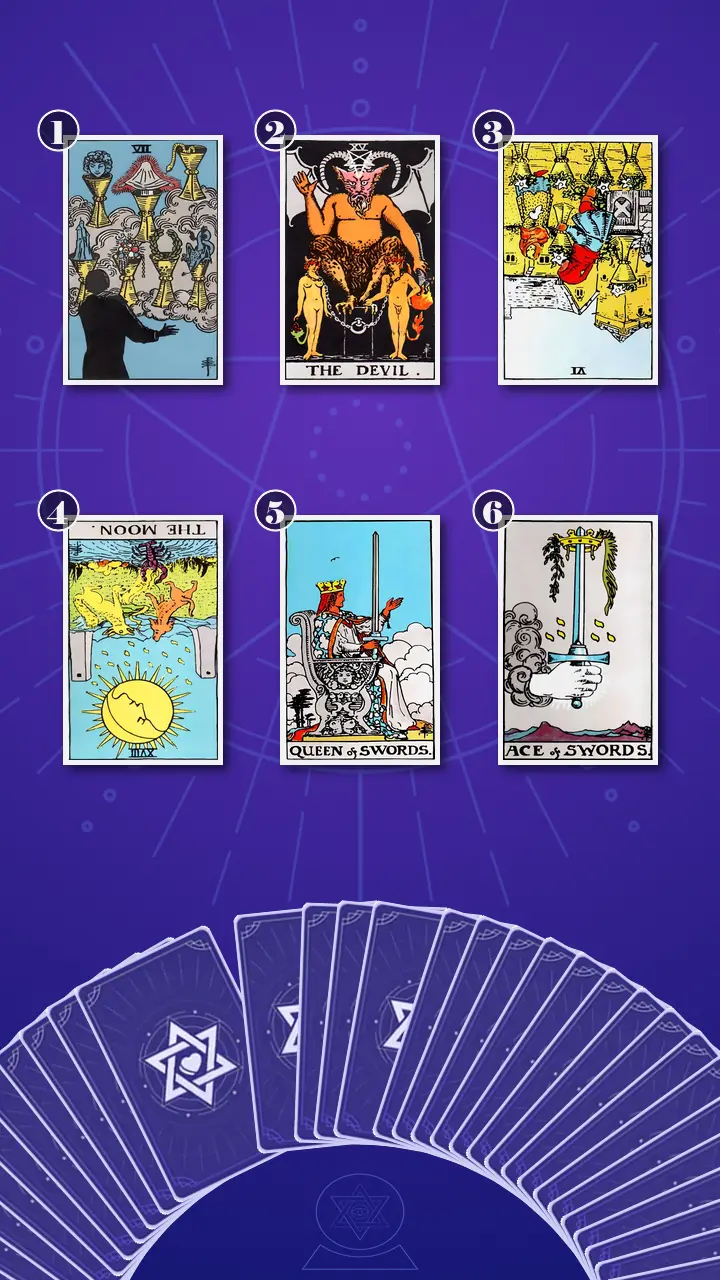
I chose the Transformation Path Grid (6) · Context Edition, arranged as two rows of three cards. For anyone wondering how tarot works in a reading like this, I use the cards as an external cognitive map. My Jungian lens treats each image as a way to surface and examine subconscious patterns, but the cards do not manufacture evidence about another person. They help me organise what Jordan has already experienced into categories she can compare clearly.
This six-card relationship tarot spread suited mixed signals and future promises because the question was not simply, “Will this relationship work?” The upper row would show the visible fantasy, the force that made it feel binding, and the familiar emotional script beneath it. The lower row would reveal the turning point, translate that insight into a boundary, and establish a grounded basis for Jordan's next choice. A broader relationship spread might have centred the other person's intentions; this grid kept the focus on Jordan's perception, emotional access, and agency.
I told her that the layout would first look like a closed loop: promise, attachment, repetition. Then the fourth position would act as a hinge, opening a path toward accurate language, present-tense action, and self-trust. Tarot would not select the destination for her. It would make the route easier to read.
When One Message Became an Entire Timeline
Position One: Seven Floating Futures
I turned the card for Position One, representing the observable surface of the issue: what visibly happened when a future promise triggered daydreaming, rereading, and emotional re-entry. The card was the Seven of Cups, upright.
I pointed to the seven cups floating in clouds and the figure facing away from the grounded world. “At lunch, you receive, ‘When work settles down, we should spend a month in Europe.’ Before a date has been chosen or your next dinner has been confirmed, you screenshot the message, check flights, picture shared breakfasts, and feel the vividness of those scenes as evidence that the relationship is progressing.”
Jordan nodded once. She had done almost exactly that between Slack notifications. I described the process as an internal recommendation algorithm receiving one hopeful signal and filling the entire feed with confirming content: they said Europe, so perhaps they were thinking long term; if they were thinking long term, perhaps commitment was coming; if commitment was coming, perhaps the recent cancellations did not matter as much.
I read the upright energy here as excess. Imagination itself was not the problem. Its speed and authority were. The fantasy was generating a complete emotional experience before present behaviour had supplied the next scene. “A promise can be sincere and still not be proof,” I said. “The fantasy is not foolish; it is simply ahead of the evidence.”
Jordan let out a short laugh with a bitter edge. “That is so accurate it is kind of brutal,” she said. Her fingertips stopped worrying the seam of her sleeve, then pressed flat against the table. I asked, “What is actually happening now, and what are you adding from the imagined future?”
“What is happening is that they mentioned a trip,” she said after a pause. “What I added was that we would still be together by then, that we would be stable, and that saying it meant they had already chosen me.”
Position Two: The Chain Made of Attention
I turned the card for Position Two, representing the blocking force that made the fantasy feel binding. It was The Devil, upright.
I kept my interpretation precise. The Devil was not evidence that the sender was malicious, deceptive, or deliberately future faking. Tarot could not establish motive from a message. In this position, the card showed the effect of the dynamic on Jordan: attachment to possibility had begun narrowing her freedom to observe, ask, wait, or step back.
The loose chains around the figures mattered. Jordan could technically put down her phone, but emotionally the sequence felt compulsory: unlock, open the thread, reread the promise, check whether the sender was online, experience thirty seconds of relief, then check again when uncertainty returned. After midnight she might open the conversation for the sixth time and replay a voice note about their future. No new action had occurred, yet putting the phone down felt strangely similar to losing the relationship itself.
This was where I used my Attachment Loop Diagnosis. I do not use that lens to stamp someone with a clinical label. I use it to separate four functional parts: the trigger, the protective response, the immediate reward, and the longer cost. Here the trigger was a warm promise after distance. The response was checking, archiving, and mentally pursuing certainty. The reward was a brief sense of closeness. The cost was more preoccupation, less direct communication, and greater vulnerability to the next promise.
I also checked whether the loop looked primarily like an anxious-avoidant trap between two people or like an older threat to Jordan's self-worth becoming activated. We did not have enough evidence to define the entire relationship system, but Jordan had already told me what she feared: “If I ask directly and they pull away, I will know I was never really chosen.” That sentence showed me why the promise carried more than information. It temporarily soothed a wound around worthiness.
“If I stop looking, I might miss the proof,” I reflected. “If I ask directly, I might lose the possibility.”
Jordan's shoulders rose before she noticed and lowered them. She drew a long breath through her nose. “The checking does make me feel better,” she admitted. “Just not for very long.”
That distinction was important. The loop persisted partly because it hurt, but also because it offered relief. Once Jordan could see the reward, she no longer had to shame herself for lacking willpower. She could interrupt a mechanism instead of fighting an imagined flaw in her character.
Position Three: The Highlight Reel Behind the Present
I turned the card for Position Three, representing the familiar emotional script beneath the repetition and the reason the same kind of hope remained persuasive when current evidence was thin. It was the Six of Cups, reversed.
I asked Jordan to imagine the flower-filled cups as her warmest archived messages. After another vague cancellation, she would scroll back four months to a tender paragraph saying the connection could become serious. The earlier colour and warmth would replace the recent pattern in her mind. A highlight reel would become the full analytics report.
In reversal, I read this as a blockage in updating the emotional record. The past was not false, and I did not ask Jordan to erase every tender moment. The problem was that remembered tenderness kept overruling current consistency. A new promise therefore felt like a return to something established rather than a possibility that still needed new evidence.
“Your phone can archive a possibility without making it a relationship,” I said. “Which remembered version of this connection becomes louder when the present disappoints you?”
Jordan looked down at the card for several seconds. Her thumb rubbed once across the edge of her phone and then moved away from it. “The version where we were almost there,” she said quietly. “I keep thinking that because we nearly had it before, I only need to wait for that version of us to come back.”
I did not invent a childhood explanation for the Six of Cups. A Jungian reading should open inquiry, not impose a biography. I only noted what Jordan had shown me: the familiar feeling might be the return of hope itself, not proof that trust had been rebuilt. Her expression softened, but there was grief in it. Letting the past remain meaningful without allowing it to govern the present was more bittersweet than simply calling it a mistake.
When The Moon Made Uncertainty Legible
Position Four: Fact, Story, Question
The rain ticking against the window slowed as I reached for the lower-left card. The room seemed to widen around the silence, and the wet street outside reflected separate lines of red and white instead of one blurred field. I turned the card for Position Four, the catalyst that could expose the difference between present fact, personal interpretation, and imagined future. It was The Moon, reversed.
At 11:42 p.m., one warm message about a future trip had made Jordan's phone glow like evidence. She reread it, pictured the apartment and airport, and left the present-tense question unsent. She was still caught between two forced verdicts: this proves commitment, or this proves rejection.
I traced the winding path between The Moon's towers. In reversal, I read the card as a blockage beginning to release, not as perfect certainty. The whole route was not visible, but enough fog had cleared to identify the next point on the path. Instead of searching the message for hidden certainty, Jordan could write: “Fact: they mentioned living together someday. Story: commitment is now guaranteed. Question: are they proposing a concrete step in the present?”
This was the natural place for my Shadow Projection Analysis. Projection did not mean Jordan's hope was fake, or that every positive interpretation was wrong. It meant that when observable information ended, her psyche supplied scenes shaped by longing, fear, and the unmet need to feel securely chosen. I asked her to separate the sender's actual behaviour from the internal narrative activated by it. That distinction protected her from both idealising the promise and assuming ambiguity automatically meant rejection.
You do not have to keep treating future promises as proof of intimacy; you can let The Moon's winding path become legible by separating observed action, personal interpretation, and the question that still needs an answer.
I let the longer sentence settle, then gave Jordan the cleanest version of the insight.
A promise can describe a possibility without proving a relationship. Clarity begins when the future story has to meet present-tense action.
Jordan's breath stopped. Her index finger remained suspended above the edge of The Moon, and her pupils widened before her gaze slipped past me toward the rain-marked window. I watched the sentence move from hearing to recognition: first the freeze, then the silent replay of Lisbon, the cancelled weekend, and the unsent question. Her mouth tightened.
“But doesn't that mean I was wrong about all of it?” she asked, her voice suddenly sharper. “That I wasted months because I wanted a story?” The anger was brief but real. Underneath it, I heard grief and the old threat to her worth.
I kept my voice level. “No. It means your hope was working with incomplete data. Being moved by a promise is not a moral failure, and becoming more accurate now does not invalidate every tender moment then.”
Her fist loosened one finger at a time. Her shoulders dropped, but the release did not look triumphant. She inhaled shakily, blinked against wet eyes, and gave a small, almost disoriented laugh. Clarity had removed the familiar task of decoding the other person; in its place sat the more vulnerable responsibility of deciding what access the present had earned.
“Now, with this new perspective, can you think of a moment last week when this insight might have made you feel differently?” I asked.
Jordan returned to a Thursday cancellation that had arrived without an alternative plan. She had immediately reopened the Lisbon message to reassure herself. “I could have let the cancellation be the current fact without deciding it erased every feeling,” she said. “And I could have asked whether they wanted to reschedule instead of using Lisbon to explain it away.”
I opened a blank note with her and introduced my Projection Detachment Exercise, adapted to The Moon's path. We made three headings: “What happened,” “What I imagined,” and “What I still need to ask.” I gave her ten minutes at most and asked for one sentence under each heading, using only the latest interaction. I explicitly ruled out checking activity status, Story views, or social media for extra clues. This was a clarity practice, not surveillance.
I also gave her a minimum version for moments when her chest tightened and the exercise threatened to become another analysis spiral: “The promise is possible; the proof is not here yet.” She could stop after that sentence, save the note, and return later. She did not need an immediate verdict to tolerate an unanswered question.
I named the transition plainly. This was the first move from longing-driven fantasy and compulsive message checking toward reality-based discernment, clearer boundaries, and self-trust. The Moon had not revealed whether the future would happen. It had shown Jordan how to keep uncertainty from writing the answer for her.
The Open Hand and the Clean Blade
Position Five: A Boundary Without a Battle
I turned the card for Position Five, representing the conscious response available to Jordan: a direct present-tense question, an observable boundary, and a decision to weigh consistent action more heavily than emotionally vivid language. It was the Queen of Swords, upright.
I showed Jordan the Queen's upright sword and raised open hand. The sword represented precise language; the open hand represented willingness to receive an answer without controlling it. Together, they offered directness without hostility.
In ordinary life, this could sound like: “I like hearing that, and future plans matter to me when they connect to something we are doing now. Are you asking to make a specific plan?” Jordan did not need to accuse, over-explain, or decide the other person's motives. She could name what would make the promise meaningful to her and observe the response.
I read the Queen's upright energy as balance: feeling remained present, but it no longer had to substitute for discernment. The boundary was not, “Prove you love me right now.” It was, “I will treat a plan as established when it has a date, an agreed action, and follow-through.”
Jordan's hand moved toward her phone and stopped. “I honestly don't know if I can send that,” she said. “If they pull away, I will feel like I caused it.”
“Then sending it is not your first task,” I replied. “Draft it in Notes and read it aloud. Directness is an option, not an obligation you must perform before you are ready. Their response would be information, but it would not be a verdict on your worth, and it would not require an immediate decision.”
I repeated the principle beneath the Queen: “You do not need a verdict to ask for a fact. Let present access be earned by present consistency.”
Jordan swallowed, then read the draft aloud once. Her voice caught on “what we are doing now,” but steadied by the final question. I saw nervousness remain in her posture, yet it no longer occupied the whole room.
Position Six: Possibility Is Not Proof
I turned the final card for Position Six, representing the integration practice that could return clarity and self-trust without predicting the relationship's outcome. It was the Ace of Swords, upright.
The crowned sword rising into open sky offered one clean organising sentence: “A promise is a possibility, not proof.” Before reopening daily emotional contact, Jordan could review what had been promised, what present action followed, and whether consistency had developed over time. Hope was allowed to exist. Access would be based on observable behaviour.
I read the Ace as balanced, newly available mental energy. Its sharpness did not ask Jordan to become cold or to declare the entire relationship fake. Overcorrection would only replace idealisation with another premature verdict. The Ace offered accurate language: sincere is not the same as established; vivid is not the same as agreed; possible is not the same as proven.
Looking at the sword, I thought of departure boards I had watched during years of travelling across cultures. A destination can appear in bright letters while the gate remains unassigned. The destination is not necessarily false, but movement still requires a present route, a time, and an actual boarding call. Future language could name a destination. It could not transport Jordan there by itself.
“So I don't have to decide that Lisbon is fake,” Jordan said. “I just don't have to live there emotionally before there is a plan.”
“Exactly,” I said. “Your phone may store the itinerary. You still decide whether present behaviour has earned the journey.”
She typed three lines at the top of a new note: “Promise. Present action. Pattern over time.” Then she placed one final sentence above the old screenshots: “Possible is not established.” The Ace did not hand her certainty about the relationship. It gave her a clearer basis for choosing what to do next.
From Movie Trailer to Present-Tense Proof
I gathered the six cards into one story. The Seven of Cups showed the visible moment when a few future-oriented words became an entire relationship timeline. The Devil revealed why the timeline held such power: checking and rereading briefly relieved uncertainty, so attention itself kept renewing the bond. The reversed Six of Cups uncovered the familiar root, where the warmest archived version of the connection outweighed current inconsistency. The reversed Moon interrupted the loop by separating observation, interpretation, and the unanswered question. The Queen of Swords turned that distinction into precise communication and a present-access boundary. The Ace of Swords made accurate language the foundation of self-trust.
The core metaphor was simple. Jordan had been standing inside a vivid movie trailer and treating its emotional impact as proof that the full film was already being made. Her cognitive blind spot was not that she had hope. It was that she treated the intensity of hope, the physical urgency to check, and the permanence of a saved screenshot as relationship evidence. She also believed she had to understand the promise perfectly before she was entitled to ask a direct question.
The transformation direction was therefore not “stop believing people” or “detach from all feeling.” It was to let possibility remain open without granting it emotional certainty. Future-oriented words could matter, but commitment would be assessed through actions that were specific, consistent, and aligned with those words. This was the practical value of the six-card Transformation Path Grid: it moved Jordan from emotional projection to accurate language without making her choice for her.
The Present-Tense Proof Check
I turned the reading into three small experiments. None required Jordan to end the relationship, send a confrontation, suppress hope, or monitor the other person. Each experiment was designed to create usable information while preserving her autonomy.
- Make the Fact / Story / Question note.During one work break this week, open a phone note and spend five minutes on the latest future-oriented message. Write one observable sentence under “Fact,” one meaning you added under “Story,” and one present-tense question under “Question.”Use only the interaction itself. Do not add online-status checks or social-media research. If three headings feel overwhelming, write one fact with no prediction attached.
- Take a 24-hour possibility pause.After the next future promise, make no new emotional or logistical commitment for 24 hours. Before reopening the thread, look at the note once and say, “I want certainty right now.” Then decide whether another reread would add information or only repeat relief.Treat the pause as observation time, not punishment or a test. The smallest version is ten minutes with the phone in another room.
- Draft one present-tense clarification.In Notes, write: “I like hearing that. What specific step are you suggesting we take now?” If a plan is mentioned, ask for one observable detail such as a date, booking, call, or next check-in. Choose one access boundary for the week based on whether that action occurs.Remove paragraphs that defend your right to ask. You may send the question, revise it, or only read it aloud. A response is information, not an order to decide immediately.
I reminded Jordan that the Projection Detachment Exercise was not meant to drain warmth from a meaningful message. It gave imagination and evidence separate places so neither had to impersonate the other. The cards had offered actionable advice, but the authority to ask, wait, stay, leave, or revise a boundary remained entirely hers.

Six Days Later: The Quiet Proof
Six days later, I received a message from Jordan. During a Wednesday work break, she had opened the note instead of the saved screenshot. She wrote that a future trip had been mentioned, that she had imagined it as proof of commitment, and that she still needed to know whether a specific plan was being proposed. Then she drafted the Queen of Swords question and sent it without an explanatory essay.
The reply was warm but vague. Jordan did not call it rejection, and she did not open a flight app. She slept through the night; in the morning, her first thought was still, “What if I got this wrong?” This time, she smiled, read the three lines, and went to work.
I did not see that as a solved relationship or a perfect ending. I saw the first credible evidence of change. Jordan had allowed disappointment, hope, and uncertainty to coexist without asking any one of them to decide what the relationship already was. She had moved from compulsive confirmation-seeking toward reality-based discernment, one present-tense action at a time.
That was the real Journey to Clarity. The cards had not rescued Jordan from ambiguity or awarded her a guaranteed future. They had helped her observe the promise-to-fantasy loop from outside it. She was the one who wrote the note, asked the question, tolerated the open outcome, and chose what emotional access the present had earned.
When one future-tense message makes your chest tighten and your whole imagined life light up, I know asking what is real now can feel as though it might cost both the possibility and the proof that you were worth choosing. I also know that noticing this fear already gives you a place to stand.
If the possibility could stay open without becoming a promise, what is one present-tense detail you would place under The Moon's clearing light: a date, a booking, a call, or a pattern of follow-through?