Idealizing Partners After Red Flags: Give Behavior an Equal Vote

The 12:40 a.m. Red-Flag Highlight Reel
I met Maya (name changed for privacy), a 28-year-old client success manager who could handle a full day of escalations at a Toronto software company, yet one inconsistent Hinge message at midnight could send her into red-flag rationalization mode: screenshots open, context assembled, concern postponed.
At 12:40 a.m., she sat on the edge of her bed in the apartment she shared with a roommate. Her phone was warm in one hand. A radiator clicked beside the dark window, and a late streetcar ground through the wet road below. A message from the person she was dating had brushed past a preference she had stated clearly. Before she let that action count, her thumb was already scrolling back to first-week screenshots.
She found the line about their “rare connection.” Her chest loosened. The small surge of energy was immediate enough for me to see through the video call: her shoulders dropped, her eyes brightened, and the imagined future came back into focus.
“I know it looked bad,” she said, “but you didn't hear the way they explained it. I just need more context before I decide it means something.”
Then, more quietly, she added, “I keep falling for who they could be.”
I heard the central conflict clearly. Maya was not struggling to notice the mismatch between words and actions. She was struggling to acknowledge it without feeling that she had personally destroyed something rare. Her longing felt like a hand lingering against a warm doorway: staying there hurt, but pulling away seemed to mean losing the last trace of heat.
“I don't want to turn this person into a villain,” she told me. “But I also don't want to do this again.”
“We don't need a villain,” I said. “And we don't need a verdict tonight. I want us to make a map of what happens between the first stomach drop and the moment you start defending the connection. The goal is finding clarity without shaming your attraction or handing your choices to the cards.”
I let the distinction settle before continuing. “You are not failing to see the red flag; you are negotiating with what seeing it might cost.”

Choosing a Compass for the Dating Fog
I asked Maya to place both feet on the floor, take one slower breath, and hold the question in ordinary language: “Why do I idealize someone after red flags start showing?” I shuffled while she breathed. I use that pause as a transition for attention, not as a mystical test anyone can pass or fail.
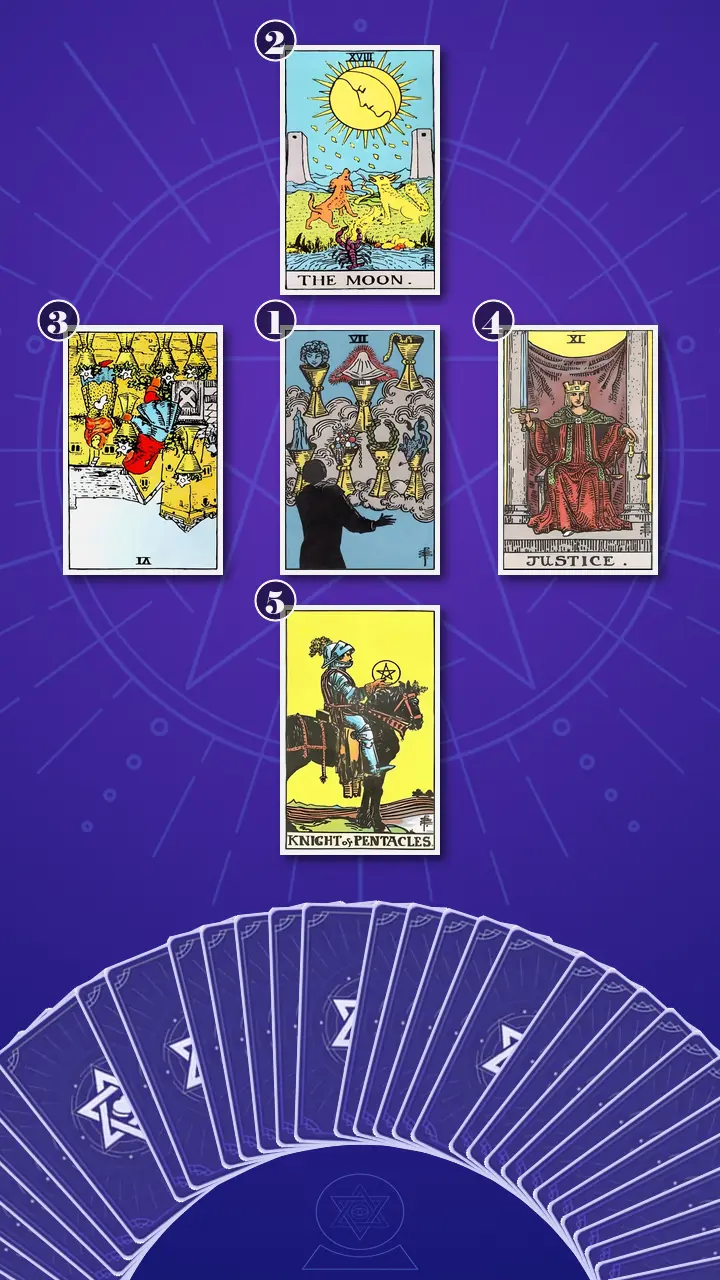
I chose a five-card layout called The Shadow Spread. This is how tarot works in my practice: I do not use it to spy on another person's motives or predict whether a relationship will succeed. I use card meanings in context to make a repeating inner sequence visible enough to examine.
For anyone following the reading, the Shadow Spread was the smallest useful map for Maya's question. A larger spread could have produced more detail about the other person, the environment, or possible outcomes, but those were not the issue she had brought me. She wanted to understand her own recurring response: red flag, idealization, rationalization, and increased investment.
I placed the first card in the center for the active shadow, the behavior Maya could already see. The second sat above it for the trigger that activated restless checking. The third went to the left for the protective root, the familiar script that kept the loop alive. The fourth went to the right for the capacity she needed to reclaim. The fifth anchored the cross below, where insight would become a repeatable relationship pace.
The layout looked like a compass. Its upper half would show how ambiguity became emotional weather; its lower point would ask what Maya could actually do. The two horizontal cards would hold remembered sweetness and present evidence opposite each other without forcing either one to disappear.
“These cards won't choose whether you stay, leave, ask a question, or wait,” I told her. “They can help us see what has been choosing your pace on your behalf.”
Seven Tabs, One Unsettling Fact
Position 1: The Future Versions in the Clouds
I turned over the card representing Maya's present symptom: idealizing a partner after red flags appear and allowing imagined potential to outrank observable behavior.
It was the Seven of Cups, upright.
I pointed to the shadowed figure facing seven cups suspended in clouds. Some cups held treasure. Others held veiled or threatening forms. I read the image as desire multiplying possibilities faster than reality could verify them.
“At 12:40 this morning, you had one unsettling message in front of you and about seven possible partners in your head,” I said. “There was the overwhelmed professional, the wounded person who needs patience, the secretly serious dater, the future partner who will become consistent once they feel secure, and several other hopeful versions. Each possibility became more vivid as you moved farther away from the exact action.”
I compared the cups to browser tabs opened after an unsettling date. One tab searches attachment styles. One rereads affectionate screenshots. One drafts a defense for the group chat. Another imagines the conversation in which the partner finally becomes the person the beginning seemed to promise. Meanwhile, the plain tab labeled “What actually happened?” remains open but unread.
In this position, I read the Seven's Water energy as excess. Hope itself was not the problem. The excess appeared when possible explanations received more emotional weight than observable conduct. Maya's mind kept completing the same sentence: “What happened was that they dismissed my preference, but maybe it really means they were overwhelmed, scared, confused, or not ready to show how much they care.”
“Think about the most recent unsettling moment,” I said. “Before you described the action plainly, which future version of them did you use to make it feel less important?”
Maya's breath caught. Her index finger hovered over her phone, her gaze moved toward the screenshots, and then she gave one dry, bitter laugh.
“That's so accurate it feels a little brutal,” she said. “I literally had Reddit open to a thread about why people pull away after intense texting.”
“Then we'll slow down,” I replied. “Recognition is only useful if it doesn't humiliate you. I am not asking you to stop imagining a future. I am asking us to notice when an imagined future starts overruling the scene currently in production.”
Position 2: The Message in the Tunnel
I turned over the card representing the trigger: the kind of warning-sign ambiguity that activated longing, projection, restless checking, and an urge to restore the preferred story.
It was The Moon, upright.
I traced the narrow path between the two towers with one finger. The path existed, but moonlight distorted its distance and detail. The dog and wolf reacted differently to the same uncertain light; something old and instinctive rose from the dark water below.
“This is the TTC ride home after the second last-minute plan change,” I said. “The cancellation text glows on a warm phone while tunnel lights flash across the window. The facts are incomplete. Before the train reaches Bloor-Yonge, your mind tries to create enough context to stop the drop in your stomach.”
I repeated the fragments Maya had described: “I don't know why they changed the plan. Maybe work exploded. Maybe they are overwhelmed. Maybe asking for consideration would make me seem demanding. If I find the right explanation, I won't have to feel this drop.”
I was careful about what the card did not mean. “The Moon is not evidence that this person is lying or deceiving you. It shows incomplete information and the reactions that incomplete information activates. Uncertainty is real. The reassuring story longing supplies is still a story until behavior supports it.”
I read the Moon's energy here as a blockage created by excess projection. Maya was not allowing “I don't know yet” to remain an honest answer. She was rushing to resolve uncertainty internally, then sending an extra-warm message to recreate emotional safety externally.
“When the last vague cancellation happened, what did your hands do in the next ten minutes?” I asked.
“Checked the chat. Searched Reddit. Opened the voice note from our first week. Then I sent, ‘No worries at all, I know you've got a lot going on.’”
Her palm pressed briefly against her sternum. Her eyes lost focus as she replayed the train ride, and then she released a low breath. I could see the recognition land: the context search had not been neutral research. It had been an attempt to change the way the uncertainty felt.
Position 3: When the Pilot Episode Becomes an Exemption
I turned over the card representing the protective root: the familiar emotional script in which remembered sweetness was used to rationalize present inconsistency.
It was the Six of Cups, reversed.
Upright, the card shows a flower-filled cup being offered in an enclosed courtyard. Reversed in this position, I saw that sweet scene becoming a keepsake repeatedly lifted above the present, as though the beginning could testify against every later disappointment.
I asked Maya to picture a split screen. On the left were first-week messages, playlists, future-oriented Hinge prompts, and the voice note in which the person sounded tender and certain. On the right was the latest moment when Maya's stated preference was brushed aside. The left side was warm, edited, and familiar. The right side contained one uncomfortable piece of new footage.
“The beginning was too real to mean nothing, so this can't mean what it looks like,” Maya said, recognizing her own inner argument before I had to finish it.
“The beginning can have been real without becoming a lifetime exemption for the present,” I replied.
I read the reversed Cups energy as blockage. The Water was circulating backward into nostalgia. Remembered intensity had become a standing credit against present behavior, and familiarity was being mistaken for safety.
This was where I used a diagnostic lens I call Toxic Script Identification. I was not labeling Maya or the person she was dating as toxic. I was naming the repetitive script produced by the interactions she described. One person introduced a mismatch and later supplied an explanation. Maya automatically became the Continuity Editor, cutting around the mismatch so the romantic story would still appear coherent. She absorbed the impact, supplied missing context, and restored the emotional tone before the other person had to show repair.
“The script gives you a job,” I told her. “Your job is to make every scene fit the promise of the opening montage. As long as you keep performing that role, the relationship never has to reveal whether it can survive an unedited scene.”
Maya's fingers tightened around the cuff of her sweatshirt, held there, then slowly released. Her gaze shifted away from me toward the dark window. When she spoke, her voice carried recognition and grief together.
“If I admit my friends are right, I also have to admit I ignored it again. And if I stop explaining, maybe the whole thing just... disappears.”
“I hear both losses in that,” I said. “There is the possible loss of this connection, and the grief of revisiting an old choice with new awareness. But you do not have to prosecute your past self to protect your present self. You were trying to preserve belonging with the tools you had. Now we can give you another tool.”
When Justice Restored the Missing Frames
Position 4: The Fact That No Longer Needed Editing
A streetcar bell sounded faintly through Maya's window just as I reached for the card on the right side of the spread. The room seemed to become quieter around that single clear note. I turned over the card representing the capacity Maya needed to reclaim: balanced evaluation of behavior, explanations, boundaries, and consequences.
It was Justice, upright, the key card and catalyst of the reading.
I looked at the scales in the figure's left hand and the vertical sword in the right. The scales did not throw attraction away. They kept attraction and evidence visible at the same time. The sword separated what happened from the motive, justification, or future promise added afterward.
As an artist, I thought of an editing suite. A beautiful close-up can make an audience forgive a continuity error, but the missing frame still exists in the raw footage. Justice was not asking Maya to make the film colder. It was asking her to stop deleting the frame that changed the meaning of the scene.
I translated the card into a phone note with four lines: “Exact action,” “Explanation offered,” “Impact on me,” and “What happened next.” A plausible explanation could remain. So could attraction. Neither one was permitted to erase the action or leave the follow-through line permanently blank.
I then used Dialogue Loop Auditing. I asked Maya to replay the exact phrases that moved the latest conflict into a dead end. The trigger was, “Sorry, tonight got complicated. I'll explain later.” Her automatic reply was, “No worries at all, I know you've got a lot going on.” The person answered with a heart. Warmth returned. The original question about consideration vanished from the conversation.
“The loop is not only in what they said,” I explained. “It is in the sequence. Ambiguity triggers fear. Fear triggers your reassuring line. Reassurance restores contact. Restored contact gets interpreted as resolution. The impact and requested change never receive dialogue.”
I brought her back to 12:40 a.m.: the unsettling message still open, her thumb scrolling toward first-week tenderness, her chest tightening and then loosening when one reassuring screenshot made the imagined future possible again. She had been trying to decide whether the person was good or bad because that binary question felt easier than leaving both attraction and contradiction visible.
Clarity is not a verdict on their character; it is the moment their repeated behavior gets the same vote as your hope.
I paused and allowed the sentence to sit between us.
Do not erase a red flag to keep the fantasy intact; place desire and behavior on Justice's scales, then choose your pace from what is actually there.
Her breath stopped halfway in. Her fingers, which had been rubbing the phone case, went still above the screen. For several seconds she looked past the cards, eyes unfocused, as if she were replaying the cancellation, her warm reply, and the heart emoji in their original order. Her pupils widened; moisture gathered along her lower lashes. Then her jaw tightened.
“But doesn't that mean I got it wrong?” she asked. “Like I made the whole beginning up?” The words came out sharper than anything she had said all night. I heard anger first, then grief beneath it.
“No,” I said. “Updating your view when new evidence arrives does not make the earlier feeling fake. It means you are no longer requiring the beginning to explain the present.”
Her shoulders dropped by an inch. Her hands opened on her knees. The exhale that followed shook slightly, and with the relief came a brief, almost dizzy blankness. I could see the new vulnerability in it: if she stopped editing the evidence, she would have to choose her pace herself.
“Now, with this new perspective, think back to last week,” I invited. “Was there a moment when this insight could have made you feel different?”
“Friday in the condo lobby,” she said. “I was already wearing my coat when they moved the date across town. I opened their old voice note and started calculating how quickly I could get to the new bar. I never asked whether the change worked for me.”
“What might Justice have made possible?” I asked.
“I could have liked that they still wanted to see me and also said the new plan didn't work. Both could have been true.”
That was the critical movement in Maya's Journey to Clarity. It was not a leap from attraction to suspicion. It was a first step from compulsive longing and red-flag rationalization toward evidence-based discernment and grounded self-trust.
I set a timer for eight minutes and asked her to open a blank note with two headings: “What I observed” and “What I added.” Under the first, she wrote one sentence using words a camera or message log could verify. Under the second, she wrote the reassuring interpretation she had supplied. I asked her to cap each side at three lines so the explanation could not become another elaborate defense.
She added one direct question she might ask later: “When the plan changed after we'd confirmed, I felt caught off guard. What happened, and how would you handle that next time?” I told her not to send it that night. Drafting a question and sending it were separate choices. If the exercise felt exposing, pressuring, or unsafe, she could close the note and take no further action.
“Clarity does not need a villain; it needs an unedited record,” I said. “Their explanation is information. Their follow-through is information too.”
The Horse That Refused to Rush
Position 5: A Pace Slow Enough to Reveal the Pattern
I turned over the final card, representing the method of integration: a practical relationship pace based on consistency, direct questions, and observable follow-through rather than intensity.
It was the Knight of Pentacles, upright.
The black horse stood motionless. The knight held one pentacle steadily in view, with cultivated fields stretching into the distance. Nothing in the image rushed to prove itself. I read its Earth energy as balance: patient observation, repeatable behavior, and investment that grew only when reality could support it.
“This isn't a command to end the relationship or commit to it,” I said. “It is permission to leave the connection in a realistic observation period. No extra texting to repair ambiguity. No new commitment based on one intense evening. No canceling established plans for an unconfirmed date. You watch whether plans, boundaries, and communication hold across several interactions.”
I pointed out the spread's elemental movement. Water had dominated the first three cards through fantasy, uncertainty, and memory. Justice introduced Air by naming facts and separating them from interpretations. The Knight brought Earth by creating time and structure. Fire was subdued because more intensity was not the missing ingredient.
“I always thought slowing down meant playing games,” Maya said.
“Games hide the rules to control someone else's response,” I replied. “A pacing boundary tells you what you will do with your own time, availability, and investment while you gather information. You are allowed to communicate it plainly. You are also allowed to revise it.”
Maya considered the categories I suggested: plans kept, boundaries respected, and words matched by action. She could mark each one “seen,” “not seen,” or “not enough information.” None required a dramatic verdict.
“I don't need the answer tonight,” she said, testing the words slowly. “I need enough time to see the pattern.”
Her shoulders lowered again, but this time the movement looked less like relief from a reassuring message and more like space returning to her body. She still wanted the relationship. She also wanted reliable consideration. The card allowed both desires to remain in the room.
“Intensity can start a connection,” I told her. “Only consistency can show what it can carry.”
The Unedited Record for the Next Seven Days
When I read the spread as a whole, I saw a coherent story rather than five separate tarot meanings. The Seven of Cups showed Maya turning one concerning action into multiple hopeful future versions of the partner. The Moon showed the activating moment when incomplete information made her body reach for reassurance. The reversed Six of Cups revealed why the strategy felt protective: the sweetness of the beginning offered familiarity, hope, and a temporary sense of belonging. Justice returned the missing facts to the frame. The Knight of Pentacles gave those facts enough time to become a pattern instead of demanding a final answer from one evening.
The central contradiction had been preserving an idealized image of the partner versus acknowledging the red flags that threatened it. Maya had treated the relationship's pilot episode as the entire series bible, then worked as its unpaid Continuity Editor whenever later scenes contradicted the premise. Her longing was not foolish, and the opening intensity did not have to be false. The problem was that remembered potential had become more authoritative than present conduct.
I named her cognitive blind spot directly: endless context gathering felt like fairness, but it was not neutral when every search ended by protecting the same preferred conclusion. She believed she needed indisputable evidence before she was allowed to slow down. Justice showed that she did not need to prove someone was bad before choosing a pace that protected her time, boundaries, friendships, and attention.
The transformation direction was practical: record the observed behavior before explaining it, ask one direct question when appropriate, and slow emotional investment until consistency can be evaluated over time. I turned that direction into three small next steps.
- The Eight-Minute Justice Note After the next confusing interaction, Maya would open Notes before old screenshots and create three headings: “Observed behavior,” “Story I added,” and “What happened next.” She would write one item under each within eight minutes, using exact words or observable verbs where possible. The final line could remain “not enough information” until a realistic opportunity for follow-through had passed. Tip: Cap each section at three lines. The minimum version is one observable verb and one interpretation. This is a private clarity tool, not a legal case and not an obligation to stay, confront, or leave.
- The One-Event Direct Question At home, while calm, Maya would spend five minutes drafting one question about one event: “When the plan changed without notice, I felt caught off guard. What happened, and how would you handle that next time?” Before sending it, she would tell one trusted friend the exact question without first presenting the partner's best-case explanation. If she chose to ask, she would record both the answer and the relevant follow-through across the next few interactions. Tip: Ask about behavior and impact, not a hidden motive. If direct contact could expose Maya to retaliation, pressure, or unwanted escalation, the safer next step would be distance and outside support rather than sending the question.
- The Pattern Interruption Script I had Maya rehearse the trigger she knew well: a warm message arriving after inconsistency or a last-minute plan change. Instead of automatically increasing warmth, rearranging her schedule, or saying that anything was fine, she practiced: “That change doesn't work for me. I can do Thursday at seven if we confirm by noon.” She would keep one existing plan unchanged for seven days and then review plans kept, boundaries respected, and words matched by action. Tip: Treat this as information gathering, not punishment or a loyalty test. The smallest version is a ten-minute pause before replying or a twenty-four-hour pause before escalating availability, disclosure, or commitment.
I reminded Maya that the Pattern Interruption Script was not designed to produce a particular response from the other person. Its purpose was to interrupt her automatic role in the old dialogue loop. Whatever came next, warmth, defensiveness, repair, another explanation, or no response, would be new information she could consider without abandoning herself.
A Week Later, One Unedited Morning
A week later, Maya sent me a screenshot of a three-line note. She had kept dinner with a friend and slept through the night. Her first thought that morning was, “What if I'm wrong?” She told me she smiled, because the question no longer required an immediate answer.
The note concerned another affectionate message after a stretch of inconsistent contact. Maya had written: “Warm message received. Three quiet days also happened. Not enough information about follow-through yet.” She still liked the person. She still hoped the connection might become steadier. She had simply stopped letting one warm return reset the record to zero.
She had also used the Pattern Interruption Script when a date moved at the last minute. The person offered a plausible explanation, and Maya accepted it as information. Then she kept watching what happened next. She did not call the exchange a breakthrough, a failure, or proof of compatibility. She left it open without leaving herself on standby.
I did not read that as coldness. I read it as the first grounded proof of self-trust: attraction and concern coexisting while repeated behavior guided the pace. The five-card Shadow Spread had given Maya language and structure, but the cards had not changed her relationship. Maya changed her next action. She remained the writer, editor, and decision-maker in the life still being filmed.
If your chest tightens over a crossed boundary while your hand still reaches for the first-week screenshots, I want you to remember that the hardest part may not be seeing the red flag. It may be fearing that seeing it clearly will cost you the belonging you thought had finally entered the scene. Noticing that fear means it is no longer the only voice in the editing room.
If attraction and concern were both allowed onto Justice's scales tonight, what is one small piece of investment you could leave unchanged for seven days, so time, rather than urgency, can show you what this connection actually knows how to carry?