One Warm Voice Note Outweighed Three Dating Red Flags, Then She Paused

The Warmest Message at 11:47
You are the evidence-minded city professional who can defend every decision in a Monday review, then spend Sunday night explaining away a cancelled date because chemistry makes potential versus consistency feel less clear. I recognized that tension in Maya before she said a word.
At 11:47 p.m. on a Tuesday in her small Toronto apartment near the streetcar line, Maya had her Notes app open with three lines: cancelled twice, joked about my boundary, went quiet after getting close. The radiator clicked behind her, metal wheels squealed somewhere outside, and her phone sat warm in her palm. She switched back to the chat, replayed an affectionate voice note, deleted the boundary message she had drafted, and typed, Thursday works.
Her stomach had already dropped, but accepting the invitation kept the possibility alive. She had named the red flag in a group chat, received one tender message, and then acted as if the tender message were the more honest version of the relationship. The longing in her chest felt like a bright hook pulling her toward an imagined future, while her tight jaw held the facts in place.
“I can see the problem and still want it, which makes me feel ridiculous,” she said. “I keep treating potential like evidence. I do not want my standards to become an excuse to miss something real.”
I leaned forward and kept my voice steady. “Wanting the connection does not exempt the evidence from your standards. And seeing a red flag does not make your wanting ridiculous. We do not have to decide the entire future tonight. We can make a map of what is happening, then let you choose what the next piece of access is allowed to rest on.”
That was the beginning of our Journey to Clarity: not a prophecy about whether someone would finally become consistent, but a careful return to Maya's own discernment.
Choosing a Compass for Relationship Discernment
I asked Maya to put the phone face down, take one slow breath, and name the question exactly as it was: Why do I keep choosing what I want over the red flags I already see? Then I shuffled slowly. The movement gave her mind a clean transition from replaying the chat to examining the pattern. It was a focus practice, not a supernatural demand for certainty.
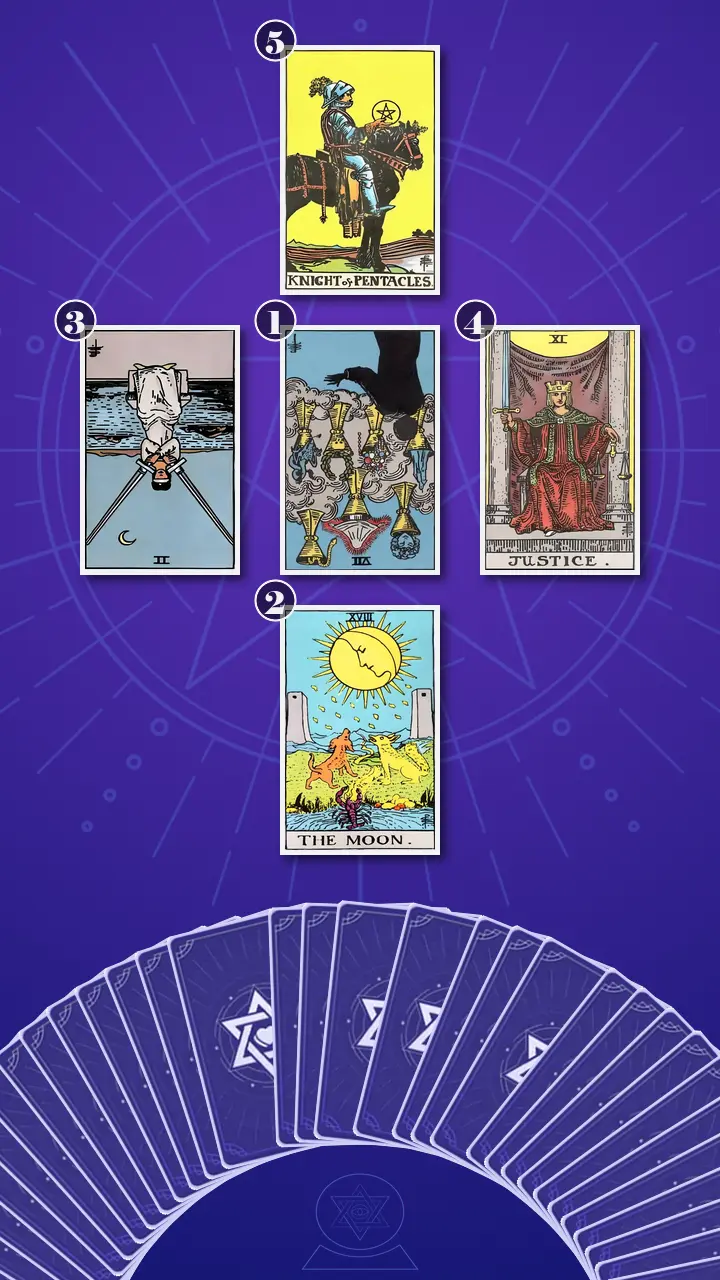
For this relationship discernment reading, I chose The Shadow Spread. It is an F5 Inner Excavation question: Maya was not asking me to predict whether another person would change, guarantee a romantic outcome, or tell her whom to leave. She was asking why a consciously recognized pattern still had so much power.
For anyone wondering how tarot works in a situation like this, the spread creates a complete chain without making the other person the centre of the story. The first card shows the current shadow pattern. The second reaches the underlying fear. The third identifies the protective habit that keeps the loop active. The fourth offers an integration resource, and the fifth turns that resource into an observable next step.
I placed the cards in a cross like a small compass rose. We would descend beneath the preferred relationship story, cross from defensive analysis into discernment, and rise into grounded practice. The reading would move from what Maya feels and imagines, through how she evaluates and sets a standard, toward what she can actually observe over time.
Reading the Map Without Editing the Record
Position 1: The Preferred Story in the Foreground
Now turning over is the card representing the current shadow pattern: choosing the preferred relationship story after consciously noticing behavior that contradicts it. The card is Seven of Cups, reversed.
In the image, a silhouetted figure faces seven cups suspended in clouds. Some hold alluring rewards; others contain threats or strange forms. The eye is drawn toward the display, toward whatever might become the most desired outcome, while the concrete ground beneath the figure receives almost no attention.
At position one, that image became Maya's 11:47 p.m. switch from Notes to the chat. Three troubling behaviors sat in plain language, but one affectionate voice note was replayed until it felt more representative than the cancellations and the boundary-testing joke. Seven of Cups reversed showed the field of evidence collapsing into fixation. The issue was not that Maya could not see. It was that chemistry changed what she allowed herself to count.
I described the energy as an excess of captivated attention and a deficiency of selection. Her mind was not empty; it was crowded with imagined rewards, possible explanations, and a future that had not yet happened. The beginning of a reality check was present, but so was an overcorrection risk: if Maya decided she must never overlook a warning sign again, she could turn one ordinary mistake into an instant verdict. I invited her to record each concern neutrally for seven days, add one plausible alternative explanation, and wait for more behavior before deciding what either explanation meant.
“I know X happened, but maybe Y means it is not the real story,” she murmured. “I know they cancelled twice, but maybe this sweet message means the connection is still the real thing.”
Maya did not nod. She gave a short, bitter laugh and pressed her thumb against the edge of her phone. “Damn, this is exactly me: I can literally name the red flag, then use one sweet message to act as if it did not happen.”
I told her that the recognition was useful precisely because it did not require shame. Desire was not the error. Selective attention was the part we could study. Potential can explain your attraction. It cannot stand in for follow-through.
Position 2: The Fear Beneath the Glow
Now turning over is the card representing the underlying fear: what feels emotionally at risk if Maya takes the warning signs seriously and loosens her attachment to the desired outcome. The card is The Moon, upright.
The Moon shows a winding path between two towers, continuing beyond the light available to the traveller. A dog and a wolf react beneath the moon, while a creature rises from dark water. I did not read the dog or wolf as a prediction of danger. I read them as two responses to incomplete information: familiar hope and instinctive caution, both awake at once.
I brought Maya to a scene she knew well: an 8:18 p.m. Line 1 train after a date cancellation. Wet coats smelled faintly of rain. The brakes shrieked into the station. Her hand tightened around her warm phone as a vague message appeared: crazy week, sorry. Before the next stop, she had already generated four charitable explanations. Then she opened Instagram and saw an anniversary carousel that made stepping back feel like choosing loneliness.
The Moon's energy was ambiguity without a stable container. It was not proof that something bad was hidden; it was the strain of admitting, I do not know yet. When evidence was incomplete, Maya filled the dark with the story she most wanted to be true. The fear underneath was not simply losing this particular person. It was the possibility that taking the red flag seriously would prove she was too demanding to be chosen.
I asked her to finish the sentence aloud: “If I admit I do not know, then I might have to face...”
Her breath paused. Her shoulders pulled inward. For a moment she looked past the card, as if the dark path in the image had opened into a late-night platform. Then she said, “That I might have to stop waiting. And if I stop waiting, maybe I will find out they were never going to choose me.”
I let the silence stay kind and ordinary. Instinctive unease was information to include, not a verdict to obey. Hope could remain in the room without being asked to manufacture reassurance. The Moon was asking Maya to tolerate the next block of uncertainty without turning imagined context into live evidence.
Position 3: The Research Loop That Never Becomes a Boundary
Now turning over is the card representing the protective habit: the specific cycle of rationalizing, gathering reassurance, and delaying a direct response after a red flag appears. The card is Two of Swords, reversed.
The blindfolded figure holds two crossed swords over the chest, with restless water behind her. Reversed, the air element has become blocked and overloaded. There is too much information available to remain neutral, but no stable method for responding to it. Thought keeps moving while the decision stays defended.
I connected it to Saturday night. After a boundary-testing joke, Maya opened six chats, two friend conversations, the dating profile, the original message, and her Notes app. She drafted three replies, deleted them, and asked, “What do you think they really meant?” Her cursor blinked while her shoulders crept upward. Forty minutes later she sent a meme and acted normal, even though she could already state the behavior and its impact.
“One more opinion, one more reread, and then I will know how to respond,” she said. The phrase sounded less like a plan than a treadmill.
I named the distinction carefully: decoding intent was not the same as responding to impact. Gathering information was not always the same as using information already available. The reversed Two of Swords could push her toward an opposite overcorrection too, an all-or-nothing explanation demanded while emotionally activated. I did not want a boundary to become a courtroom or a test. I wanted one fact, one feeling, and one limit.
Maya's jaw tightened. Her fingers hovered above the screen, then dropped into her lap. She exhaled once, sharply, as if she had been holding her breath through every open tab. More context is not always more evidence.
When Justice Put Desire and Evidence on the Same Page
The room seemed to quiet when I reached for the fourth card. Outside, the streetcar passed with a low metallic shudder, then disappeared. The cross had brought us from clouded cups to moonlit uncertainty to crossed blades. This was the card that could turn the pattern without shaming the desire that had kept it alive.
Now turning over is the card representing the integration resource: the quality of discernment that can hold attraction and evidence together while applying a consistent boundary standard. The card is Justice, upright. In this position, Justice is the antidote.
The balanced scales let desire and observed behavior remain present together. The single upright sword replaces the two defensive blades with one clearly expressed standard. The forward-facing figure does not pretend that feelings are irrelevant, and she does not allow feelings to rewrite the record.
For anyone searching for the Justice tarot meaning in dating boundaries, this is the practical centre of the card: evaluate the connection by the standard you would use if the chemistry were half as intense. Maya knew how to do this at work. As a content designer, she could present research tabs, user evidence, and a clean rationale in a Monday review. I watched the frustration move through her when she realized that private longing had been receiving an exception her professional decisions would never survive.
I brought in my first signature lens, Decision Timing Calibration. After a decade of sitting with people through their cycles, I have learned to ask whether the current emotional environment is structurally sound for a high-stakes crossroads choice. Peak chemistry, a sudden burst of warmth after distance, or the relief that follows a feared loss can make the decision window unstable. This lens does not predict whether Maya should stay or leave. It asks whether now is a reliable time to grant more access.
Then I used Cyclical Variable Filtering. I asked Maya to separate temporary situational friction from the variables that would shape the long-term orbit of the connection. A genuinely chaotic work week might explain one changed plan. It could not, by itself, explain a repeated pattern of cancelled plans, jokes about a stated boundary, and effort that appeared mainly when Maya pulled away. One awkward moment could be repaired. Repetition was the variable to observe.
That was my professional association with the card: I have seen people mistake a dramatic turn in the sky for the whole season. Justice asks for a cleaner record. It does not erase the weather; it checks whether the same conditions keep returning.
At 11:47 p.m., you can have the red flag written plainly in Notes and still switch back to the affectionate voice note, hoping the best moment explains the pattern that made your stomach drop.
Do not silence desire or excuse the evidence; place both on Justice's scales and choose the next level of access by what the behavior can support.
Maya froze first. Her thumb stopped above the screen, her breath held, and her eyes stayed on the word evidence. Then her gaze went unfocused, as if she were replaying the cancelled plans, the joke, the deleted draft, and the sudden warmth in a new order. Her pupils widened slightly. Finally, her mouth softened. She took a screenshot of the central line, and a long breath moved through her chest. Her shoulders lowered, but not into certainty; they lowered into the unfamiliar responsibility of choosing with both truths visible. A small, almost dizzying blankness followed the relief. If desire could stay, she could no longer use its presence as an excuse to abandon herself.
I asked her, “Now, use this new perspective to think back to last week: was there a moment when this distinction could have let you feel differently?”
Within the next ten minutes, I invited her to open a blank note with two headings: What I want and What has actually happened. She added one sentence beneath each and compared the observed behavior with one of her three prewritten non-negotiables. I told her not to decide the entire future of the connection. The only decision was whether the next level of time, access, or intimacy was supported. If the exercise felt flooding or pressuring, she could close the note and return later. The smallest version was one observable fact.
“I can want this, and I can still ask what the behavior supports,” she said. The sentence came out quietly, with a tremor in it. I heard the first movement in her emotional transformation: from chemistry-driven rationalizing and fear of being unchoosable toward grounded self-trust and proportionate access. Fairness to yourself is not coldness toward someone else.
Position 5: The Pace That Lets Trust Prove Itself
Now turning over is the card representing the embodied next step: a slower, observable method for pacing investment according to repeated behavior rather than imagined potential. The card is Knight of Pentacles, upright.
The Knight sits on a stationary black horse and studies one pentacle held at eye level. Behind him, cultivated fields stretch in quiet lines. Nothing in the image is rushing to make an impression. The energy is balanced through patience, consistency, and attention to what can be sustained.
I told Maya that the stationary horse was not passivity. It was active observation. For the next week, she could keep her existing routines and compare plans, words, and follow-through without supplying explanations for every gap. Trust would not be built by one dramatic apology or another intensely intimate conversation. It would be built by ordinary behavior repeating in a form she could actually see.
Her shoulders lowered again. She looked at the pentacle and said, “I do not need the final answer tonight. I need the next observable data point.”
I agreed. The Knight of Pentacles did not order her to stay, leave, forgive, confront, or disclose. It offered a pace. Let access increase at the speed consistency proves it can hold.
The Desire-and-Evidence Check
When I laid the five cards together, the story became direct. Seven of Cups reversed showed Maya placing one five-star interaction at the top of the relationship algorithm while manually hiding every data point that lowered the score. The Moon showed why: uncertainty activated the fear that stepping back would make her unchoosable. Two of Swords reversed turned that fear into six open chats, deleted drafts, and reassurance seeking. Justice supplied one consistent standard. The Knight of Pentacles brought that standard into ordinary time.
The core blockage was not a failure to recognize dating red flags. Maya had recognized them with impressive accuracy. The blind spot was making recognition so expensive that she had to keep explaining the evidence away. If taking a warning seriously meant losing the desired connection, then not seeing clearly became a form of short-term emotional protection. A warm message brought relief, the investment increased, inconsistency returned, and her self-trust grew quieter.
The absence of Wands mattered to me as well. This spread did not ask for more momentum, more chemistry, or a bolder leap toward potential. It asked for emotional containment, clear evaluation, and grounded repetition. The transformation was not from wanting to wanting nothing. It was from allowing desire to overrule standards to holding desire and evidence on the same page.
I translated the key shift into small next steps. Maya would move from deciding at peak chemistry to recording observed behavior, waiting before increasing access, and checking the pattern against standards she had written before the next burst of warmth arrived.
- The Desire-and-Evidence CheckBefore the next date or emotionally charged reply, open a phone note with two headings, "What I want" and "What has happened." Add one concrete sentence under each. Then read three prewritten non-negotiables before rearranging your schedule, sharing private information, inviting the person home, or making yourself available at short notice. Ask, "Would I call this acceptable if the chemistry were half as intense?"Keep it to five minutes. You may add one plausible alternative explanation, but do not let it erase the observed behavior. The minimum version is one fact and one want.
- The Orbital Pause StrategyFor one non-urgent invitation this week, wait until the next day before changing your schedule or increasing emotional access. When the decision is high-stakes or you feel pulled by a sudden burst of warmth, use my Orbital Pause Strategy: a calculated 72-hour delay while you keep normal plans and observe what remains true outside the emotional peak. At the end, choose only the next proportional step: maintain the pace, reduce extra investment, ask for clarification, or offer slightly more access if consistency supports it.The pause is an observation window, not punishment, manipulation, or a test. You can reply sooner for logistics or safety. If 72 hours feels too difficult, begin with 30 minutes and return to your normal routine.
- The Fact-Feeling-Boundary NoteWhen a warning sign appears, write three lines: Fact, what happened; Feeling, one emotion; Boundary, what you will or will not participate in. Set a 30-minute timer and put the phone face down. When it ends, use one clear sentence when appropriate: “When plans change at the last minute repeatedly, I stop holding the time open; let me know when you can confirm something specific.” Then watch the next behavior instead of polling several chats for an explanation.Do not wait for perfect wording. The boundary does not need to prove intent or prosecute the other person. If communication feels unsafe or coercive, you do not owe engagement; protect your capacity first.
I reminded Maya that these exercises were not a rigid one-strike screening system. One mistake and a repeated pattern are not the same thing. The purpose was to let consistency become information rather than an obstacle to hope. Tarot had offered an image and a structure; Maya remained the person deciding what her time, intimacy, and availability could responsibly support.

A Week Later, the Quiet Proof
Four days later, Maya messaged me that she had used the two-column note before replying. She kept brunch with a friend, waited until morning, and watched whether the person offered a specific plan rather than another warm explanation. They followed through once. She wrote, “It is one data point, not proof of forever, but I did not let it erase the rest of the record.”
She slept through the night. At breakfast, her first thought was still, “What if I am wrong?” This time she smiled, checked the log, and chose a measured reply. The doubt remained; it no longer held the steering wheel.
I told Maya that this was the real quiet proof of our Journey to Clarity. The cards had not decided her relationship or removed uncertainty. They had helped her move from hopeful urgency and stomach-drop self-doubt toward grounded openness, where desire could remain welcome without being given sole control.
When the message goes warm again and your clenched jaw finally loosens, it can feel easier to doubt what you saw than to risk the connection and wonder whether your standards made you unchoosable. But noticing that pull is already a movement away from the starting point. You can let the wanting stay, keep the evidence visible, and allow repeated behavior to earn its place.
I leave you with this: if wanting the connection and trusting what you observed could sit on the same page, what is the smallest next level of access you would feel comfortable letting repeated behavior earn?