When a Third Chair Feels Like Replacement: Asking for Private Time

When a One-to-One Date Becomes Three
If you are a late-twenties hybrid tech worker in Toronto who can analyse a product flow in minutes but freezes when a date becomes a group hang, the words Do you mind if they join? can land like a trapdoor. You may know the invitation is reasonable while your body reacts as if someone has quietly changed the terms of belonging.
I met Jamie at 8:47 p.m. on a Tuesday in a crowded Ossington bar. I watched a friend drag a metal chair across the concrete floor, heard the bass pulse beneath the glasses, and noticed Jamie unlock a warm phone without reading the screen. Their knee moved against their date's, their jaw tightened, and a private joke arrived before anyone had asked for it.
Jamie had spent the workday looking forward to rare, uninterrupted one-to-one time around TTC delays, a roommate's schedule, and two overloaded calendars. Then their date had said, Do you mind if they come too? Jamie looked at me and asked, Why do I get possessive whenever someone joins our date?
I heard the contradiction clearly: Jamie wanted protected closeness, yet feared that a newcomer would dilute the bond or replace them. Their jealousy felt less like a single emotion than like an analytics dashboard wired to a fire alarm, updating every glance, laugh, and follow-up question until ordinary social attention looked like a live ranking. I could see the tight chest, shallow breathing, and shame waiting behind the irritation.
I do not want to control them; I want proof I still have a place, Jamie said. I told them that both truths could be held at once. We could understand the reaction without turning it into a verdict about their character, and we could examine the behaviour without pretending the underlying need was foolish. I placed my coffee beside the cards. Let us draw a map of the pattern, so the fear does not have to drive the whole evening.

Choosing a Compass for the Relationship
I invited Jamie to put both feet on the floor, take one slow breath, and hold the question in a plain sentence. I shuffled gradually, treating the movement as a practical transition from the crowded bar in their memory to the facts we could examine together.
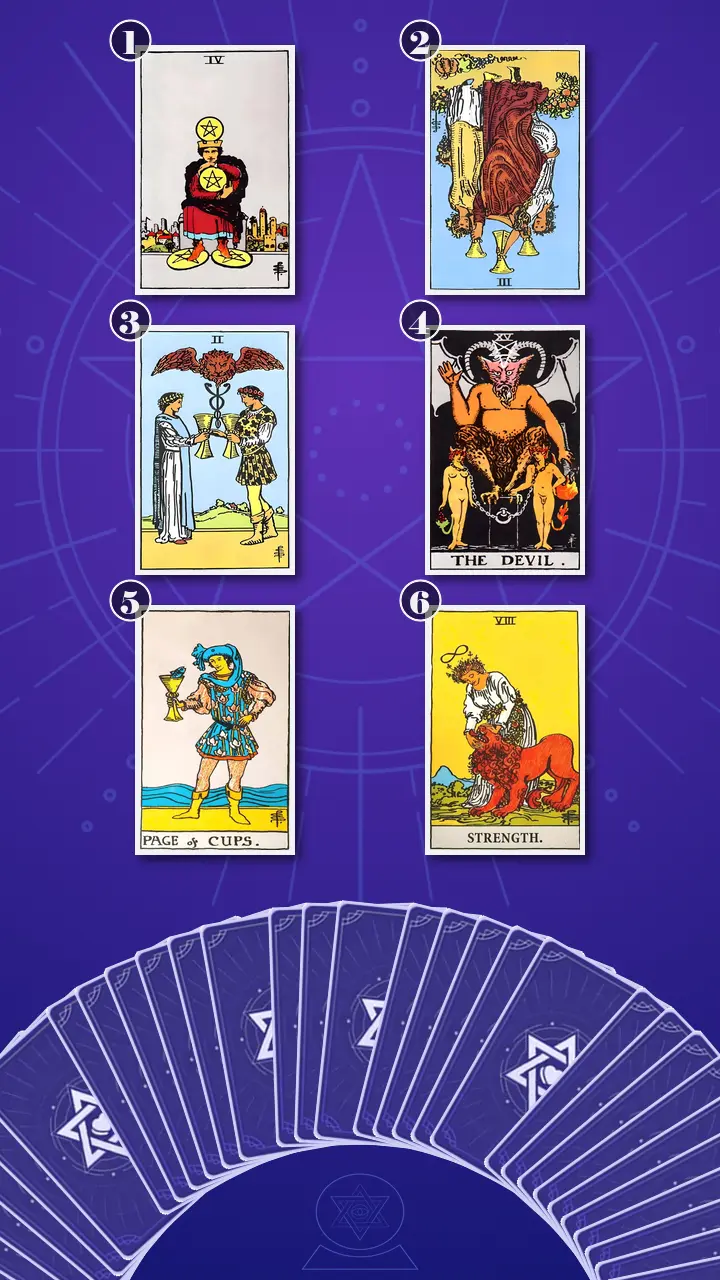
For readers wondering how tarot works in a consultation like this, I was using the cards as an objective cognitive mirror, not as a prediction or a supernatural ruling. Today I chose the Relationship Spread: Context Edition, a six-card relationship tarot spread designed for a focused third-person jealousy loop.
The spread suited Jamie because it could follow one clean chain without adding unnecessary drama: current stance, trigger projection, relational foundation, compulsive obstacle, vulnerable need, and self-led integration. The six cards would show how attention monitoring begins, what meaning gets attached to the newcomer, what is already solid in the bond, and what deliberate next step could interrupt the loop.
I arranged the cards in two columns and three rows. The upper pair formed the trigger mirror, the middle pair placed the bond beside its obstacle, and the lower pair brought emotional understanding beside a self-led practice. I told Jamie that position two would examine their projection onto the newcomer rather than claim to read another person's mind, and that position six would offer an available path, not a fixed future.
The Rails Between Holding and Belonging
Position 1: The Pentacle Pressed to the Chest
Now I turned over the card representing Jamie's current observable stance when a third person joins, including the attention monitoring, conversational gripping, and contracted jealousy I had seen at the bar. It was the Four of Pentacles, upright.
The Rider-Waite-Smith figure presses one pentacle against the chest and pins two more beneath the feet. I read the image as an excess of Earth: security is being pursued through holding on so tightly that movement becomes difficult. At the Ossington table, Jamie had shifted closer, touched their date's arm, and inserted a story from an earlier date that the newcomer could not enter. From the outside it looked like a claim. From inside, it was an attempt to keep every point of connection still because saying I was counting on private time felt more exposing than taking control of the conversation.
I asked Jamie to complete the sentence, If I loosen my hold, then...
Jamie gave a short, bitter laugh. That is exactly what I do. I call it etiquette, but I am actually scanning for proof that I am being replaced. Their eyes dropped to their hands, and their thumb rubbed the edge of the phone case without opening it.
I nodded. I did not need to make Jamie agree with a label. I wanted the physical and conversational grip to become visible enough to choose from. The card is not calling you bad or controlling by nature, I said. It is showing a protective move that has started doing a job direct language could do more safely. We can respect the wish for private time without making another person's attention prove your worth.
Position 2: The Circle That Looked Closed
Now I turned over the card representing the meaning Jamie projects onto the newcomer, especially the assumption that shared attention indicates ranking, exclusion, or replacement. It was the Three of Cups, reversed.
In the upright image, three figures raise their cups toward a shared centre. Through the reversal, I could see how a social circle might feel closed instead of welcoming. I brought Jamie back to the small patio table in their memory: three drinks touching near the centre, two people laughing over a story, and one person suddenly trying to find the only valid place to stand.
I separated the observation from the conclusion. What happened was that your date and a friend laughed and followed one another's story, I said. What your fear concluded was that your date had ranked the friend above you, and that you were moving outside the circle. The reversed Cups showed blocked social flow, not proof that the newcomer was a rival or that the connection was failing.
I wrote the sentence that had been forming between the two cards: The third cup does not erase the first two; fear is what turns addition into subtraction. Jamie stopped stirring the coffee. Their face held the brief, uncomfortable pause of someone replaying a specific night rather than considering an abstract theory. I asked what a camera would have recorded in the first ten seconds, before the mind supplied a ranking. Jamie whispered, They pulled up a chair. That is all I actually know.
Position 3: The Two Cups That Were Chosen
Now I turned over the card representing what Jamie values in the existing one-to-one connection and what distinguishes genuine reciprocity from a demand for continuous exclusive attention. It was the Two of Cups, upright.
The two figures exchange cups at equal height beneath a winged emblem. Neither figure is gripping the other, and the open space between them matters. I read this as balanced Water: the relationship has meaning because two people repeatedly choose to offer attention, affection, time, and care, not because every other person must disappear from the room.
I asked Jamie to look beyond the loudest ten minutes of the group evening. I named the evidence I had heard: five months of mutual dates, messages initiated by both people, plans kept, physical closeness offered freely, and a shared preference for making time when their calendars allowed it. A lively conversation with a friend could change the temperature of one moment without deleting that history.
This connection exists because we both choose it, not because nobody else receives attention, Jamie said, testing the sentence. Their shoulders lowered by a fraction, and the hand that had been guarding the phone turned palm-up on the table.
I let the softness stay without using it to erase the practical need. One-to-one time can be genuinely valuable, I told Jamie. Wanting it is not the same as requiring continuous proof that you are the only interesting person present. The useful question is not whether you should need private time. It is whether you have asked for the format of the time you want.
Position 4: The Loose Chain of Reassurance
Now I turned over the card representing the self-reinforcing challenge: fear of replacement leading to controlling or withdrawing behaviour, brief reassurance, relational tension, and renewed fear. It was The Devil, upright.
The card's most important detail was not the horned figure above the pair. It was the loose chain around each neck. I read the card as a blockage in which fear promises relief through control. At the bar, Jamie noticed a laugh, compared it with the laughter they had received, introduced a private joke, got a reassuring touch, and relaxed for a few seconds. Then the table grew strained. Jamie went quiet, and that tension became fresh evidence that outsiders threatened the bond.
The loop resembled an autoplay feed: one threatening cue served up the next comparison, and the brief hit of attention kept the feed running. Jamie's product-design habit of reading subtle feedback had become a nervous system dashboard. But no single metric could answer the real question, Am I still important?
A reclaimed glance is relief, not security. I said it gently because the distinction needed to be useful, not punishing. The glance could soothe the first surge, but it could not create the stable belonging Jamie wanted.
I saw Jamie's thumb stop mid-tap. First, their breath paused and their fingers hovered above the phone. Then their gaze went unfocused, as though the chair scraping the floor, the private joke, and the later silence were replaying in sequence. Finally, a long breath moved through their chest, and their clenched hand opened. There is a moment before I interrupt, they said. It feels automatic, but there is a moment.
I told Jamie that the loose chain represented an interruptible learned pattern, not an unavoidable identity. The aim was not to suppress jealousy, perform being chill, or stay in an unwanted situation. The aim was to notice the first action that turns fear into a test, then give the feeling another route.
Position 5: The Fish Beneath the Accusation
Now I turned over the card representing the vulnerable need beneath possessiveness and what Jamie needed to understand before communicating without accusation or an attention test. It was the Page of Cups, upright.
A fish rises unexpectedly from the Page's cup. The Page does not smash the cup or pretend the fish is not there; they look directly at the surprising message. I read this as Water beginning to move again. Jealousy could arrive carrying information about a changed plan, a wish for reassurance, or the loss of anticipated privacy without becoming an order to control the evening.
I asked Jamie to remove every accusation from the sentence they had wanted to send at 12:14 a.m. in the bathroom. The draft Were you more into them than me? could be translated into something smaller and more honest: I had emotionally prepared for one-to-one time, and the change unsettled me. I would like to know when we can protect some private time.
The feeling is a message, not a verdict and not a command. I said this was the Page's contribution. It did not prove the newcomer had done anything wrong, and it did not require Jamie to dismiss the feeling. It made the feeling available for listening.
Jamie inhaled, looked at the fish, and then looked at me. Their mouth tightened as if an old argument were ready to return, but the expression softened before the argument arrived. I wanted to say I felt left out, they said. I kept trying to make them notice without having to say it. I asked them to try one sentence that began with their experience and ended with a request, without adding a motive about anyone else's interest.
When Strength Met the Lion Without Force
Position 6: The Pause That Gives Choice Back
Before I touched the final card, the espresso machine clicked off behind me. Outside the window, a streetcar bell sounded once and faded. The room seemed to make space around the last position, the one representing a self-led integration practice that could help Jamie tolerate the trigger, request protected time, and participate in a group setting without controlling another person's attention. I turned it over: Strength, upright.
The woman in the Rider-Waite-Smith image meets the lion with gentle, steady hands. She does not overpower the instinct, shame it, or let it choose the next movement. I read the card as balanced Fire joined with compassionate self-command. Jamie could let the chest tighten, identify the fear of becoming optional, and still decide whether to pause, take a brief break, or ask for one-to-one time later.
This was also where I used one of my signature lenses, Emotional Clutter Sorting. I asked Jamie to separate the actual relationship question from the rest of the pile: the invitation had changed after emotional preparation; the bar was loud; private time was hard to coordinate; fatigue and overlapping social circles added pressure; and beneath all of it was the fear of replacement. If a person repeatedly mocked a direct request or changed an explicitly agreed plan without care, that behaviour could be assessed on its own terms. Sorting the clutter did not excuse incompatibility. It stopped one frightened evening from carrying every fact into a single verdict.
It was 8:47 p.m. in a crowded Toronto bar: a friend pulled up a chair, Jamie's date was laughing, and a warm phone rested in Jamie's hand. The familiar sequence was already loading: glance, chest, comparison, private joke, silence. Jamie believed there were seconds to win the evening back.
You do not have to cage the lion of jealousy or let it lead; meet it with Strength's steady hands, then make one clear request.
Jamie went still. First, their inhale caught and their hand hovered above the phone. Then their eyes lost focus, replaying the chair, the laugh, and the private joke as separate moments instead of one emergency. I watched their shoulders lower by degrees and the hard line of their mouth loosen. Their fist opened against the table. After a silence, Jamie spoke in a low voice that trembled at the edges: The feeling says I am becoming replaceable. I can choose to say I was expecting private time and want to know when we can have it. Relief moved through their face, but it brought a small, dizzying blankness too. Without the old instruction to compete, the next move belonged to them. I asked, Now, use this new perspective to think back: was there a moment last week when this insight could have helped you feel or act differently?
Jamie saved the sentence in a Notes entry. I told them that this was the key shift: from hypervigilant attention monitoring and fear of replacement to compassionate self-command, direct requests, and steadier connection in shared social spaces. The transformation did not require jealousy to vanish. It began when the feeling could remain present while behaviour became deliberate. Strength is not pretending to be chill; it is staying honest without handing the impulse the controls.
Finding Clarity in the Fact-Fear-Request Map
When I connected the six cards, I saw a practical story rather than a prophecy. Jamie had arranged precious private time around roommates, TTC delays, hybrid work, and overloaded calendars, so an unexpected third chair touched something genuinely valuable. The Four of Pentacles showed the grip; the reversed Three of Cups showed the mind turning a trio into a ranking contest; and the Two of Cups showed the reciprocal bond that existed before and after the loudest conversation. The Devil explained why monitoring repeated: a reclaimed glance offered immediate relief, but the resulting tension made the original fear look confirmed. The Page of Cups supplied the honest sentence, and Strength supplied the pause that allowed Jamie to choose it.
The core metaphor was simple: Jamie had been gripping a seat whenever another passenger stepped onto the train, treating every shift in attention as a contest that had to be won. The blind spot was assuming that control was communication and that attention behaved like a fixed battery, with every laugh given elsewhere draining the connection. A direct request about the date format could protect private time without controlling who else their date spoke to.
I brought in another part of my professional toolkit, Daily Friction Deconstruction. I stripped away dramatic accusations and asked what had mechanically broken down in the evening: Had the plan ever been clearly named as one-to-one? Did the invitation arrive after Jamie had already organised their emotional day around privacy? Was the room too loud for easy entry into the conversation? Had anyone actually said the bond was less important, or had the fear supplied that line? This made the problem specific enough to act on.
Then I used Emotional Clutter Sorting again. Actual relationship incompatibility would be information such as repeated dismissal, mockery, or disregard for an agreed boundary. Household stress, fatigue, social noise, and a last-minute plan change belonged in different piles. Tarot gave Jamie a way to sort those layers, but Jamie remained the person who decided what each fact meant and what to do next.
Three Small Experiments for the Next Date
- Fact / Fear / RequestBefore the next date, open a private Notes entry titled Fact / Fear / Request and set a seven-minute timer. Write three lines: Fact: a friend joined. Fear: I will be replaced. Request: can we decide whether tonight is one-to-one or social, and protect another hour together if the plan changes?Keep the note private and do not send it automatically. If seven minutes feels too much, complete only the first line in two minutes; the purpose is to separate a camera-verifiable fact from a prediction.
- Feeling, Fact, ChoiceAt the first chest-tightening moment in a group setting, place both feet on the floor and exhale once for slightly longer than you inhale. Silently complete, Jealousy is here; it is warning me about... If you need space, tell your date, I need a minute to reset; I will check back in shortly, and step somewhere quieter for up to five minutes.A pause is not surrendering your place or promising to stay. It is one small hold before an emotionally loaded message, interruption, private joke, or comparison search chooses the evening for you.
- The 24-Hour Micro-Boundary ResetWithin the next 24 hours, choose one non-negotiable time boundary in your shared plans: label one calendar hour as protected one-to-one time, then ask, I was picturing one-to-one time tonight. Is that what you had in mind, or is this becoming a group hang? If the answer is social, request a different hour or another evening for the two of you.Keep the boundary about the format of shared time, not about whom your date may speak to. Offer a genuine choice, and remember that you can choose a different plan without turning the request into a hidden loyalty test.
These next steps are intentionally small. They do not promise that jealousy will never return, and they do not ask Jamie to tolerate disrespect or perform emotional perfection. They create a little space between the first surge and the familiar behaviour, then turn an indirect bid for reassurance into an honest, consent-based agreement.

The Calendar Invite Stayed Honest
Four days later, I received a message from Jamie: I used the script. Friday stayed one-to-one, and I still felt weird when Sam waved. They had slept a full night, but woke with the first thought, What if I am wrong? This time they opened the note, wrote down what the camera could have recorded, and smiled before choosing their next sentence.
I could feel the difference in that small report. Jamie had not solved every relationship question or become relaxed in every group setting. They had asked for the time they wanted, noticed that the request was answered, and allowed a brief wave from a friend to remain a wave. The clarity was sturdy because it did not depend on pretending the fear was gone.
That was the quiet proof of the Journey to Clarity. The cards had not removed the third chair, guaranteed a particular outcome, or taken responsibility for Jamie's choices. They had helped Jamie see the sequence clearly enough to reclaim authorship: the querent, not the spread, remained the one steering the relationship.
When a date becomes a trio and your chest tightens, the hardest part is not only sharing attention; it is the sudden fear that if you stop holding the connection in place, you may discover your place was never secure. Naming that fear does not make it true. It simply gives you a chance to respond to the real situation rather than to the alarm's most dramatic prediction.
If you allowed that fear to be present without letting it decide the evening, what small, honest request might you imagine making before the third cup arrives?