The 10:47 p.m. Draft That Hid an Ordinary Need
"You can defend a product decision in front of six stakeholders, but when your partner asks where you want to eat, a clear preference suddenly feels like an unreasonable amount of admin: the low-maintenance partner trap," I said to Maya.
She gave me a tired half-smile and described the previous Tuesday night in her Liberty Village condo. At 10:47 p.m., the refrigerator hummed and rain ticked against the kitchen window while her phone warmed her palm. She typed, "Could we choose a quieter place on Friday? I've had a draining week." After five rereads, she deleted the second sentence and sent, "Anywhere works for me."
"I keep telling myself it's too small to bring up," she told me, rubbing a thumb along the edge of her phone case. "I want them to notice without me having to ask. But then I say I'm fine and wonder why I feel alone."
I heard the contradiction clearly. Maya wanted her partner to know and respond to her ordinary needs, but naming those needs felt like submitting evidence that she was difficult to love. The apprehension lived in her body like a form that auto-submitted "no preference" while she was still entering her answer: throat tight, chest braced, every honest sentence erased before anyone else could see it.
Being easy to date is not the same as being known. Maya's performance was protecting the interaction from visible friction while slowly removing her from the relationship she wanted to preserve.
"I don't want the cards to decide whether you're asking for too much," I said. "I want us to map what happens between noticing a need and hiding it. Then we can find one place where you still have a choice."

Choosing the Map for What Goes Unsaid
I invited Maya to take one slow breath and hold the question, "Why do I hide my needs to seem low-maintenance?" I shuffled while she exhaled. The pause was not about creating a mystical performance; it gave her nervous system a clean transition from replaying messages to examining the pattern.
I chose the Relationship Spread · Context Edition, a five-card relationship tarot spread designed to examine self-silencing, reciprocity, boundaries, and communication. I use this compact cross when one repeating relational loop needs context but does not require a sprawling prediction about the relationship's future.
The first position would show the easygoing stance Maya presented. The centre would reveal how hidden information shaped the current dynamic. The upper card would offer a self-led path forward. Importantly, the spread would not claim to read her partner's private thoughts; it would distinguish Maya's predictions from anything the partner had actually said or done.
This is how tarot works best for me: not as a verdict, but as a visual system for putting feelings, assumptions, and observable behaviour in separate places. Card meanings in context can make a loop visible enough to interrupt.
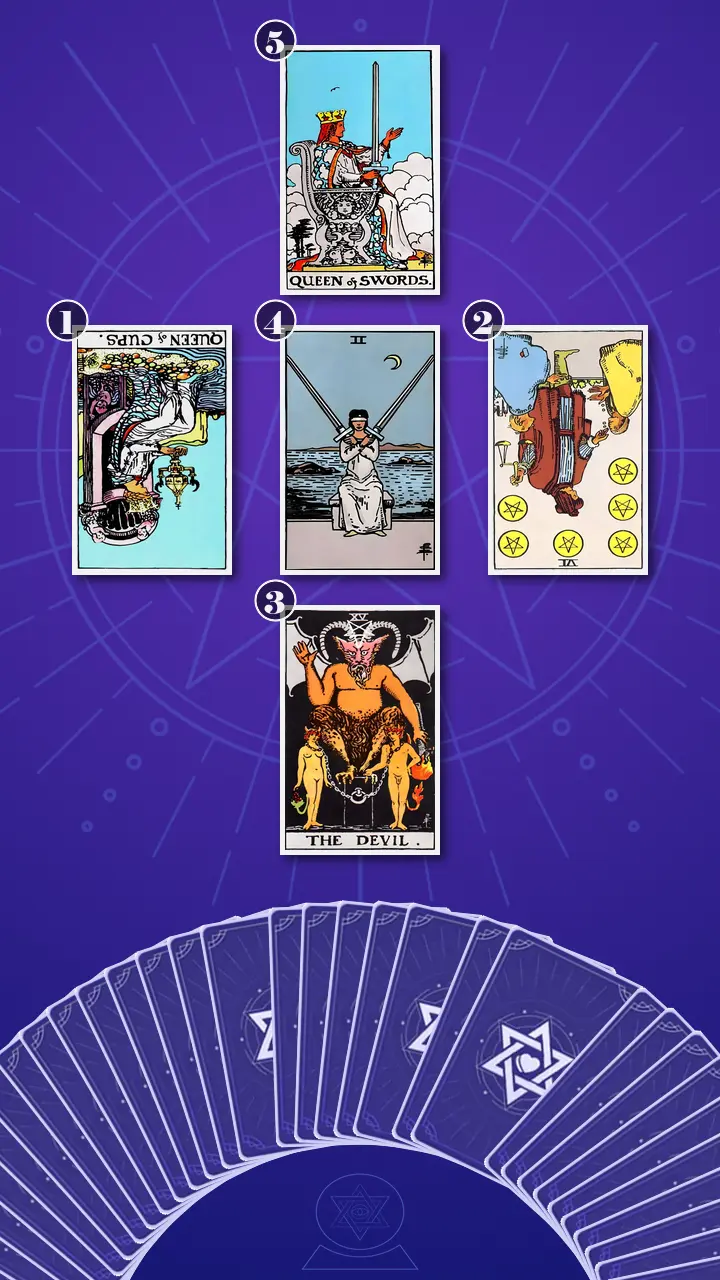
From the Sealed Cup to the Invisible Ledger
Position 1: The Message That Never Left the Phone
The card I turned over first represented Maya's observable self-silencing stance: how she presented as easygoing while directing emotional attention away from her own needs. It was the Queen of Cups, reversed.
I pointed to the Queen's ornate, sealed cup and her absorbed gaze. Reversed, her emotional sensitivity was not absent. It was blocked and overextended outward. Maya could identify every possible inconvenience a quieter restaurant might create for her partner, yet she gave little attention to the exhaustion that made the request necessary.
"That cup is your complete message sitting in Notes," I said. "You study it carefully, but the person who could respond never receives it. The inner line is: 'I know exactly how this could inconvenience them, but I haven't asked what abandoning it will cost me.'"
Maya let out a short laugh with a bitter edge. "That's so accurate it's almost rude." Her fingers tightened around her mug, then eased. "I'm excellent at reading them. I keep skipping myself."
I told her the card was not criticizing her sensitivity. It was asking her to restore its inward half. Before saying "anything is fine," she could pause long enough to identify what she felt, preferred, and might be willing to request.
Position 2: The Splitwise Account No One Agreed To
The next card represented Maya's projected belief about what a partner would tolerate, especially her assumption that care had to be earned through over-giving. It was not evidence of her partner's motives. I turned over the Six of Pentacles, reversed.
The scales became an invisible Splitwise ledger. Maya had found the restaurant, made the booking, and agreed to travel across Toronto. When she considered asking to meet closer to home next time, she checked an imaginary balance: Had she been useful enough to justify one adjustment without owing anything?
This was an imbalance of earth energy, an excess of giving paired with a deficiency of receiving. The more she planned, paid, travelled, and smoothed things over, the harder it became to tell whether reciprocity was genuinely available. She was prepaying for belonging before anyone had issued an invoice.
"A need is information, not an invoice," I said. "A request can receive a yes, a no, or a counteroffer. None of those answers means you committed a relational offence by asking."
Maya's eyes dropped to the card. Her lips moved silently as if she were adding up the last month of bookings and longer journeys. Then she released a slow breath. "I thought I was being generous. Some of it is generosity. Some of it is insurance."
Position 3: The Contract That Kept Renewing Itself
The third card represented the learned low-maintenance bargain beneath the repetition: the fear that expressing a need would threaten belonging. I placed the Devil, upright, below the centre of the cross.
I watched the light from the rain-grey window darken across the card's pedestal. I kept Maya's attention on the loose chains, not the horned figure. The Devil did not declare her relationship doomed, and it did not define her partner. Its energy showed an excess of attachment to a rule that felt compulsory even though it could still be questioned.
That rule was an auto-renewing contract: "Connection remains available only while I create no inconvenience." The Little Mermaid's voice bargain came to mind, not as romantic tragedy but as a familiar cultural warning. Maya was trying to secure acceptance by trading away the very voice intimacy would need in order to know her.
I call this part of my work Toxic Script Identification. "Toxic" describes the cost of the script, not the people inside it. In Maya's version, she repeatedly played the Effortless Partner and silently cast her partner as the Judge of Need, even when no present conversation had assigned either role.
Her breathing stopped for a beat. Her gaze drifted past the table as though she were replaying several dinners at once. Then her shoulders lowered and her fingertips uncurled. "No one said that rule out loud today," she said quietly. "But I've been acting like it's binding."
That recognition mattered. A hidden contract can feel like reality; a named contract can be examined. Maya did not have to blame anyone or reconstruct a history she was not ready to explore. She only had to notice when an old condition was impersonating a current fact.
Position 4: The Calm Conversation Missing Half Its Data
The card I turned over at the centre represented how Maya's hidden needs currently shaped the relationship through incomplete information, apparent calm, withdrawal, and recurring resentment. It was the Two of Swords, upright.
The blindfold and crossed swords showed air energy in blockage. Thought and speech were being used to freeze the situation rather than clarify it. The water remained behind the figure, just as Maya's actual feeling remained off-screen after she sent a meme instead of asking, "Could you reassure me that we're okay after last night?"
"If I say it, I might create tension; if I hide it, I can keep the evening calm," I said, giving language to the fork she kept reaching. "But your partner can only respond to the version of you that the conversation receives."
The sentence tightened Maya's chest; I saw her press a palm lightly against her sternum. She had been treating the absence of reassurance as evidence that asking would be unsafe, even though her partner had received "I'm fine" and a meme. No one can negotiate with information they were never given.
"So the calm isn't security," she said. Her voice had gone flat with recognition. "It's just no visible disagreement."
"Exactly," I replied. "Immediate harmony and informed intimacy are not always the same thing."
When the Queen of Swords Raised Her Blade
Position 5: One Clear Request, One Real Answer
The room became very still as I turned over the final card, the position offering a self-led communication practice without predicting the relationship's outcome. The card was the Queen of Swords, upright.
Her energy was balanced air: clear self-definition without cruelty. I placed my finger beside the single upright sword, then beside her open hand. One symbol separated honest need from imagined rejection; the other left room for dialogue, negotiation, and an independent response.
I used Dialogue Loop Auditing to show Maya the sequence. The trigger was an ordinary question: "What do you want?" The internal alarm translated preference into burden. The automatic line was, "Anything is fine." The immediate reward was no friction. The delayed cost was a partner acting on incomplete information while Maya went quiet and carried the resentment alone.
The Queen offered a replacement line: "I would prefer the quieter place. Would that work for you?" It was specific enough to answer and flexible enough to negotiate. Clarity is not control; it leaves room for a real answer.
At 10:47 p.m., Maya had typed the honest restaurant request, softened it, deleted it, and sent "Anywhere works." The immediate tension dropped, but her throat stayed tight because the relationship had received her compliance, not her actual information.
Being low-maintenance is not the same as being secure; replace self-erasure with one clear request, using the Queen of Swords' raised blade to separate honest need from imagined rejection.
I let the sentence remain between us while rain traced a thin line down the window.
Maya froze first. Her next breath stopped high in her chest, and her fingers hovered above the table as if she had been interrupted mid-message. Then her eyes lost focus. I could see her mentally revisiting the restaurant draft, the longer commute, the meme sent in place of reassurance. Her pupils widened; colour rose beneath her eyes. When the understanding finally reached her body, her shoulders dropped, but the release left her looking briefly unsteady, as though putting down a heavy bag had changed her sense of balance. She exhaled with a tremor, opened her hands, and then pulled one back toward herself.
"But doesn't that mean I've been doing this wrong the whole time?" she asked, sudden anger sharpening the last word. "I've spent years trying to be easy."
"It means the strategy worked at one job," I said. "It reduced visible conflict. It just cannot perform the other job you gave it, which is helping someone know you. We aren't putting your past self on trial. We're updating the script with better information."
I condensed the Queen's instruction into the sentence I wanted Maya to carry out of the room:
"You do not have to stop fearing that you are too much before you speak. Name one proportionate need, then let the real response replace the rejection you rehearsed."
Her jaw loosened. The relief was real, but so was the new vulnerability: if she spoke, she would receive information she could no longer control through anticipation.
"Now, with this new perspective, think back: was there a moment last week when this insight might have made you feel different?" I asked.
Maya remembered standing on Line 1 while the brakes shrieked into Bloor-Yonge. She had agreed to a loud bar that added forty minutes to her journey. "I could have said, 'I'm wiped. Could we meet closer to mine this time?'" she said. "They might still have said no. But at least I wouldn't have rejected myself first."
I set a timer for seven minutes and asked her to choose one current, low-stakes need. She wrote three lines: "What I notice is..."; "What I would prefer is..."; "Would you be open to...?" She could send it, save it, or revise it once. The minimum version was simply naming the preference privately. I also made the boundary explicit: this exercise was not for a conversation that felt unsafe or coercive, and she could stop whenever the discomfort exceeded what she chose to engage with.
This was not a leap from fear to flawless confidence. It was a smaller and more credible movement: from contracted relational apprehension and mind-reading toward cautious self-trust in mutual negotiation. Maya was learning to treat a need as information rather than evidence that she was burdensome.
Rewriting the Scene Behind "I'm Fine"
I drew the cards together as one sequence. The reversed Queen of Cups showed Maya containing emotional data instead of consulting it. The reversed Six of Pentacles turned care into a private ledger. The Devil revealed how that ledger hardened into a compulsory contract. The Two of Swords showed the result: a calm-looking relationship conversation missing the facts required to move. Finally, the Queen of Swords transformed the crossed barrier into one visible line of speech.
I often think of a life as a film still in production. Maya had bravely stayed in the role of the Effortless Partner because it once seemed to protect the connection. Her cognitive blind spot was treating the alarm in her throat as proof that the request was unreasonable, then treating the partner's response to incomplete information as proof that the need would have been rejected.
The transformation was not "become demanding" or "disclose everything." It was to move from automatically saying "I'm fine" to naming one proportionate need, observing the actual response, and using that evidence to evaluate reciprocity. Tarot could illuminate the script, but Maya remained the writer, editor, and final decision-maker.
The Pattern Interruption Script for the Next Seven Days
- The Two-Minute Feel, Prefer, Ask Check The next time her partner asked what she wanted, Maya would open Notes before replying and complete three lines: "I feel..."; "I prefer..."; "I can ask for...." She would set a two-minute timer and keep the first version private until all three lines existed. Tip: One word per line counted. Naming the preference was the minimum version, and sharing it remained her choice.
- The One Clear Request Experiment Once that week, Maya would interrupt "anything is fine" with one low-stakes adjustment to a shared plan: "I would prefer the quieter place," or "Could we meet closer to mine this time?" She would record the actual answer separately from what she had predicted. Tip: She would test the sentence once without an unnecessary apology. A genuine no or counteroffer was allowed; the goal was usable information, not manufactured agreement.
I called this The Pattern Interruption Script because it changed one line at the exact moment the old scene usually took over. There was no requirement for a dramatic confrontation. The missing fire in the spread suggested something smaller: one honest sentence could supply enough spark for the next real action to become visible.

A Week Later, the Quiet Proof
Six days later, I received a message from Maya. Before another Friday plan was settled, she had written, "I've had a draining week, so I would prefer somewhere quiet and closer to home. Would you be open to that?" She sent it before she could optimize herself out of the sentence.
Her partner agreed to choose somewhere near her neighbourhood and asked which of two restaurants she preferred. Maya chose one. The exchange did not solve every imbalance or guarantee every future answer. It simply gave both people the same information for once.
She slept through the night. Her first thought in the morning was, "What if I was too much?" This time she smiled, because fear had arrived after the evidence instead of replacing it.
I did not credit the cards with changing Maya's relationship. They had helped us make the hidden script visible; Maya created the change when she kept her voice inside the scene and allowed reality to answer it.
When an ordinary request catches in your throat behind "I'm fine," you may be standing between the wish to be fully known and the fear that the real you could cost you belonging. Noticing that conflict already means the old contract is no longer completely invisible.
If you treated one small need like the Queen of Swords' upright blade, as information rather than a verdict on your lovability, which sentence currently sealed in your Notes app would you let yourself notice first?
This story is adapted from psychological research, written so that those in a similar struggle can see their own pattern in it — and find their next step clearly.These insights are not a substitute for professional psychological, medical, legal, or financial advice.
Learn more about our Journey to Clarity.
How did this insight land for you?
🫂 This Resonates Deeply
🌀 Living This Story
✨ Now I See Clearly
🌱 Seeing New Possibilities
🧰 Useful Framework
🔮 The Confirmation I Needed
💪 Feeling Empowered
🚀 Ready for My Next Step
Author Profile
 AI
AI“I’ve always felt our lives are films currently in production. As an artist, I know that when you feel stuck, it’s often because you’ve bravely stayed in a painful scene for just a little too long. I’m not here to coldly analyze you. I want to sit closely with you, look at those difficult moments with profound empathy, and gently hand you the pen so you have the courage to write your next beautiful act.”
In this Love Tarot Reading :
Core Expertise
- Toxic Script Identification: Recognizing the repetitive, destructive roles you both automatically play (e.g., the Savior and the Victim) during conflicts.
- Dialogue Loop Auditing: Analyzing the specific triggering phrases that consistently escalate your arguments into dead ends.
Service Features
- The Pattern Interruption Script: A creative role-play directive to consciously change your default response to a known trigger, forcing the relationship dynamic to shift.
Also specializes in :
Explore Related Patterns:
Approval-Driven Self-SilencingAt 10:47 p.m., Maya has already written a proportionate request, but she deletes the sentence that reveals her exhaustion and sends "Anywhere works for me." She repeats the same move when she accepts a loud bar and a longer journey despite being wiped, allowing anticipated approval to determine which parts of her experience become speakable. When you censor yourself to remain easy to accept, the defense begins to work against the connection it was meant to preserve. Approval-Driven Self-Silencing captures this reversal: you reduce the risk of immediate disapproval, but the relationship receives your compliance instead of the information needed to know and negotiate with you.
Conflict AvoidanceAfter five rereads, Maya replaces a specific restaurant request with "Anywhere works for me," and after another tense moment she sends a meme instead of requesting reassurance. Both actions remove the immediate possibility of disagreement, so the strategy successfully produces short-term calm. When you use the absence of friction as evidence of relational safety, silence becomes a defensive mechanism rather than a neutral choice. Conflict Avoidance explains why hiding a need can feel protective in the moment even as it deprives both partners of the information required for informed intimacy.
Relationship PerformanceMaya deletes the sentence about her draining week, agrees to inconvenient plans, and presents herself as the Effortless Partner even when a clear preference is already available. The performance is not random politeness; it is a protective role designed to make continued acceptance feel more predictable by keeping her needs out of view. When you rely on an easygoing persona to secure belonging, the relationship can interact only with the edited version of you. Relationship Performance captures the gap between seeming easy to date and allowing yourself to be known, revealing why successful performance can still produce loneliness.
Transactional IntimacyMaya finds restaurants, makes bookings, pays, travels farther, and mentally checks whether she has contributed enough to justify one adjustment. Her generosity becomes partly an insurance payment, with usefulness treated as credit that might eventually permit her to have a need. When you experience care as something that must be prepaid, intimacy starts operating like a private ledger rather than an open exchange. Transactional Intimacy explains how over-giving can function as a defense against uncertain acceptance while making ordinary receiving feel indebted, risky, or undeserved.
Mind ReadingMaya wants her partner to notice what she needs without being told, while also predicting that a direct request could make her difficult to love. She then interprets the response to "I'm fine" as information about how the deleted request would have been received, even though her partner never received that request. When you answer for another person before they have access to your real preference, prediction takes the place of negotiation. Mind Reading keeps the feared verdict under your control, but it also creates a closed loop in which an imagined rejection can never be corrected by an actual response.
People-Pleasing Resentment CycleAcross the restaurant draft, the longer commute, and the reassurance she replaces with a meme, Maya uses accommodation to remove immediate tension. The relief is short-lived because the undisclosed need remains active, leaving her to withdraw, feel alone, and carry resentment that her partner has not been given a fair opportunity to address. When pleasing creates instant calm but delayed resentment, the behavior becomes a self-reinforcing loop. The People-Pleasing Resentment Cycle names the hidden tradeoff: each act of smoothing rewards the old strategy now, while making reciprocity harder to evaluate and emotional distance more likely later.
Emotional ReasoningMaya feels her throat tighten while composing an ordinary request and treats that bodily alarm as confirmation that the request itself is excessive. She also interprets missing reassurance as evidence that asking would be unsafe, even though the message her partner received was "I'm fine" rather than the need she wanted answered. When apprehension is treated as proof, the emotional reaction can replace the interpersonal evidence it is supposed to interpret. Emotional Reasoning explains why a proportionate need feels objectively burdensome before anyone responds, and why the corrective move is not eliminating fear but allowing the real response to exist alongside it.
Explore Related Struggles:
Belonging-Authenticity SplitMaya says she wants her partner to notice and respond to her ordinary needs, yet the partner repeatedly receives "I'm fine," a meme, or "Anywhere works." The connection is being protected from the very information that would allow it to become more informed and mutual. You can remain included in a relationship while still feeling absent from its shared decisions when belonging depends on presenting an edited version of yourself. The split is not between wanting closeness and rejecting it; it is between preserving your place through accommodation and allowing the person in that place to be genuinely known. Maya's preference therefore carries more than logistical information: it marks whether authenticity is permitted to coexist with belonging.
Harmony-Safety FusionEach time Maya says "Anything is fine," the interaction stays smooth and the possibility of immediate disagreement disappears. The same sentence also removes her exhaustion, preference, and requested adjustment from the decision, leaving her partner to act on a calm-looking but incomplete conversation. When you use harmony as the main evidence that a connection is secure, even proportionate honesty can begin to register as a threat. The relief arrives quickly because no friction becomes visible, while the delayed cost appears as quiet withdrawal and resentment. Maya is caught between keeping the moment undisturbed and giving the relationship enough truth to become genuinely secure.
Low-Maintenance Worth LockAt 10:47 p.m., Maya writes the request that accurately reflects her capacity, rereads it five times, deletes the reason, and sends "Anywhere works for me." The editing does more than soften her tone: it converts an ordinary preference into a test of whether she can remain lovable while requiring anything at all. When you make low maintenance the entry fee for connection, every need carries two jobs at once: communicating what would help and risking the identity that has kept you acceptable. That is the lock in this story. Maya is not simply struggling to choose a restaurant; she is trying to preserve belonging by ensuring that her partner never has to encounter her as someone with needs.
Clarity-Exposure SplitWhen Maya finally sends, "I would prefer somewhere quiet and closer to home," her partner agrees and asks her to choose between two restaurants. The request supplies the clarity she has wanted, but it also opens the conversation to an independent answer she cannot control by rehearsing rejection in advance. You gain usable information when your preference becomes visible, yet visibility also removes the protective certainty of deciding the outcome before anyone else can respond. That is why clarity can feel exposed even when the request is proportionate. Maya's point of agency lies in allowing reality to answer while keeping her own voice inside the exchange.
Earned Love BindMaya finds the restaurant, makes the booking, pays, travels across Toronto, and then checks an imaginary balance before asking to meet closer to home. Her useful actions become private credit toward the right to request one adjustment, even though her partner never issued that invoice. When you treat care as something that must be earned in advance, receiving can remain conditional no matter how much you contribute. Every act of generosity risks becoming additional proof that you should be able to need even less, so the threshold for asking keeps moving. The bind is that Maya uses effort to secure belonging while the same effort makes ordinary mutuality feel increasingly undeserved.
Unspoken Expectation LoadMaya wants her partner to notice that she needs quiet, a shorter journey, or reassurance, but the available messages say "Anywhere works," "I'm fine," or communicate through a meme. Her partner's response is then measured against a request that remained sealed inside the draft. When you hope to be understood without exposing what needs understanding, the unspoken expectation carries a double load. It holds the original need and becomes a silent test of whether the other person knows you well enough to discover it unaided. The resulting disappointment can feel relationally meaningful even though the conversation never contained the information needed to produce a meaningful answer.
Explore Related Emotions:
Low-Maintenance ShameMaya can defend a product decision before six stakeholders, but naming a restaurant preference with her partner feels like unreasonable admin. After years of trying to be easy, she has begun treating ordinary needs as evidence that the Effortless Partner role might be false. Low-Maintenance Shame captures the painful self-judgment beneath that performance. You may feel that needing rest, reassurance, proximity, or quiet reveals a less lovable version of you, so you hide the need before anyone can evaluate it. Naming the shame makes an important distinction visible: having a preference is information about your experience, not proof that you have failed at being a good partner.
Need Exposure DreadAt 10:47 p.m., Maya writes a proportionate request, rereads it five times, deletes the sentence explaining her draining week, and sends "Anywhere works for me." The request has not been refused, yet her throat tightens and her chest braces as though making the need visible could itself damage the bond. Need Exposure Dread names the inner weather between recognizing what you need and allowing another person to see it. You are not only anticipating a possible no; you are experiencing exposure as a possible verdict on whether you remain easy to love. Separating that prediction from the response you have actually received restores a point of choice before self-erasure becomes automatic.
Performative CalmMaya sends an easygoing answer and prevents visible disagreement, but her throat stays tight after the immediate tension drops. At the center of the spread, she recognizes that the conversation is calm only because half of its information is missing. Performative Calm describes a surface that looks settled while your internal state remains braced. You may call the absence of friction security even when maintaining it requires constant editing, accommodation, and silence. The distinction matters because calm created by concealment cannot tell you whether the relationship can hold your reality. Once you see the performance, you can seek clarity without assuming that clarity must become confrontation.
Usefulness-Based Belonging FearMaya finds the restaurant, makes the booking, pays, travels farther, and smooths over inconvenience. When she considers asking to meet closer to home, she checks an imaginary balance to decide whether she has been useful enough to justify one adjustment. Usefulness-Based Belonging Fear describes the feeling that your place in a relationship must be prepaid through effort. Receiving care can then feel less secure than providing it, because asking interrupts the role that has been proving your value. Seeing the private ledger clearly allows you to examine whether belonging is actually conditional or whether anticipated rejection has been setting the terms before a real conversation begins.
Cautious Self-TrustMaya completes the lines "I feel," "I prefer," and "I can ask for," then sends one request before she can optimize herself out of it. She does not demand agreement; she lets her preference remain intact long enough for a real answer to arrive. Cautious Self-Trust is present because the old alarm has not disappeared. You begin treating your own signal as credible while accepting that another person may answer independently. The trust is grounded in process rather than guaranteed approval: identify what is true, communicate a proportionate version, and compare the prediction with observable reality. Each step returns authority to evidence without requiring flawless confidence first.
Cautious VulnerabilityMaya sends a clear request while leaving room for yes, no, or a counteroffer. Her partner agrees, but the new openness still feels unsteady because speaking means receiving information she can no longer control through rehearsal. Cautious Vulnerability captures that combination of exposure and retained agency. You allow one real need to become visible without disclosing everything or demanding a particular outcome. The thought that you may be "too much" can still arrive, but it now arrives beside evidence rather than replacing evidence. Openness becomes a measured experiment in being known, not a surrender of your boundaries or judgment.
Clarity ReliefMaya's shoulders lower when she recognizes that no one stated the low-maintenance contract in the present conversation. Later, an actual request produces an actual answer, replacing the invisible ledger and rehearsed rejection with specific shared facts. Clarity Relief comes from separating bodily alarm, prediction, behavior, and evidence. You do not need to conclude that every request will be welcomed; the relief lies in no longer treating anticipation as settled reality. Once the hidden rule becomes an examinable script, your past strategy can be understood without putting your past self on trial, and your next choice can be based on clearer information.
Mutuality HungerMaya gives attention to every inconvenience her request might create, handles bookings and longer journeys, and quietly hopes her partner will notice what she needs without being told. The giving channel stays active while the receiving channel remains largely untested. Mutuality Hunger names the longing beneath the low-maintenance performance. You do not only want a specific accommodation; you want evidence that care can move toward you without threatening the bond. That hunger becomes harder to satisfy when anticipation replaces dialogue. Allowing one proportionate need into the exchange gives reciprocity something concrete to respond to while preserving the other person's freedom to negotiate.
Profound LonelinessMaya wants her partner to notice that she is depleted, yet the complete sentence remains sealed in Notes. She sends "Anywhere works," says "I'm fine," or substitutes a meme for a reassurance request, then wonders why she feels alone. Profound Loneliness here is not simply the absence of company. It is the experience of being beside someone while the part of you that most needs contact remains unavailable to them. You may long to be known without risking an explicit ask, but the protection also keeps recognition out of reach. Seeing that bind can help you distinguish being rejected from remaining unseen because the relevant information never entered the relationship.
Self-Betrayal AcheMaya types the honest request, removes the part that explains her condition, and sends accommodation instead. Later, she recognizes that her partner may still say no, but at least a clear request would stop her from rejecting herself first. Self-Betrayal Ache is the pain of watching your protective strategy speak over your actual experience. You preserve the interaction's surface while losing the chance to stand beside your own need, and the body continues carrying what the message erased. The ache becomes useful information when it reveals exactly where your voice leaves the scene and where a smaller, more truthful choice remains possible.
Hidden ResentmentMaya says she is fine, agrees to the loud bar, adds forty minutes to her journey, and later goes quiet with the delayed cost. The partner receives accommodation rather than the information required to negotiate a different plan, leaving Maya to carry the imbalance privately. Hidden Resentment grows where repeated giving is visible but the need beneath it remains unspoken. You may feel overlooked while also knowing that the other person was never given a clear opportunity to respond, which makes the feeling difficult to place. Recognizing both sides does not invalidate the resentment; it clarifies how incomplete information has been helping it accumulate.
Explore Related Contexts:
Unspoken Expectations GapMaya wanted her partner to notice that she needed a quieter restaurant and reassurance after a difficult evening, yet the messages that reached the partner were "Anywhere works," "I'm fine," and a meme. The need existed in her draft, but not in the conversation available to both people. That information gap placed Maya and her partner inside different versions of the same interaction. She evaluated the absence of accommodation or reassurance while her partner responded to messages that contained no visible request for either one. When you rely on an unspoken expectation, the relationship cannot produce a clean answer about responsiveness because the relevant information never becomes shared. The gap can preserve surface calm while repeatedly denying you the evidence needed to assess whether your needs can be negotiated in the relationship.