Reopening the Chat in a Stalled Relationship, Then Naming the Need
The Old Chat at 11:38 PM: Returning When Nothing Changes
After twenty years of readings, I listen closely when someone says “it is complicated” even though they can list every message and still cannot name one new plan. Jordan (name changed for privacy), a 28-year-old marketing coordinator, joined my late video session from the kitchen of their shared Toronto apartment. They stood barefoot on cold tile while the fridge hummed behind them. A half-finished mug of tea had gone metallic-tasting, but the phone in their palm was still warm from scrolling.
Jordan had closed Slack after answering one last campaign thread, then reopened an old chat and scrolled toward the softest exchange instead of the unanswered question. “I want the relationship to move forward,” they said, “but every pause feels temporary until I realise we are standing in the same place again. I want an answer, but I keep choosing another sign instead.”
I heard the contradiction immediately: Jordan wanted reciprocal direction, yet kept returning because remembered tenderness felt safer to touch than present availability. Their longing had the physical weight of a wet winter coat buttoned across the chest, while an invisible notification kept tugging their wrist back toward the phone.
“A return can prove that you still care; it cannot, by itself, prove that the relationship has changed,” I told them. “I am not here to shame the caring or predict an ending. Let us use the cards to make a map of what keeps happening, what is actually available, and which choices still belong to you.”
Choosing the Six-Card Relationship Spread
I invited Jordan to sit, place both feet on the floor, and take one slow breath before looking at the chat again. I shuffled while they held a single question in mind: “Why do I keep returning when nothing moves forward?” The pause was not a mystical performance. It was a small transition from reacting to observing.
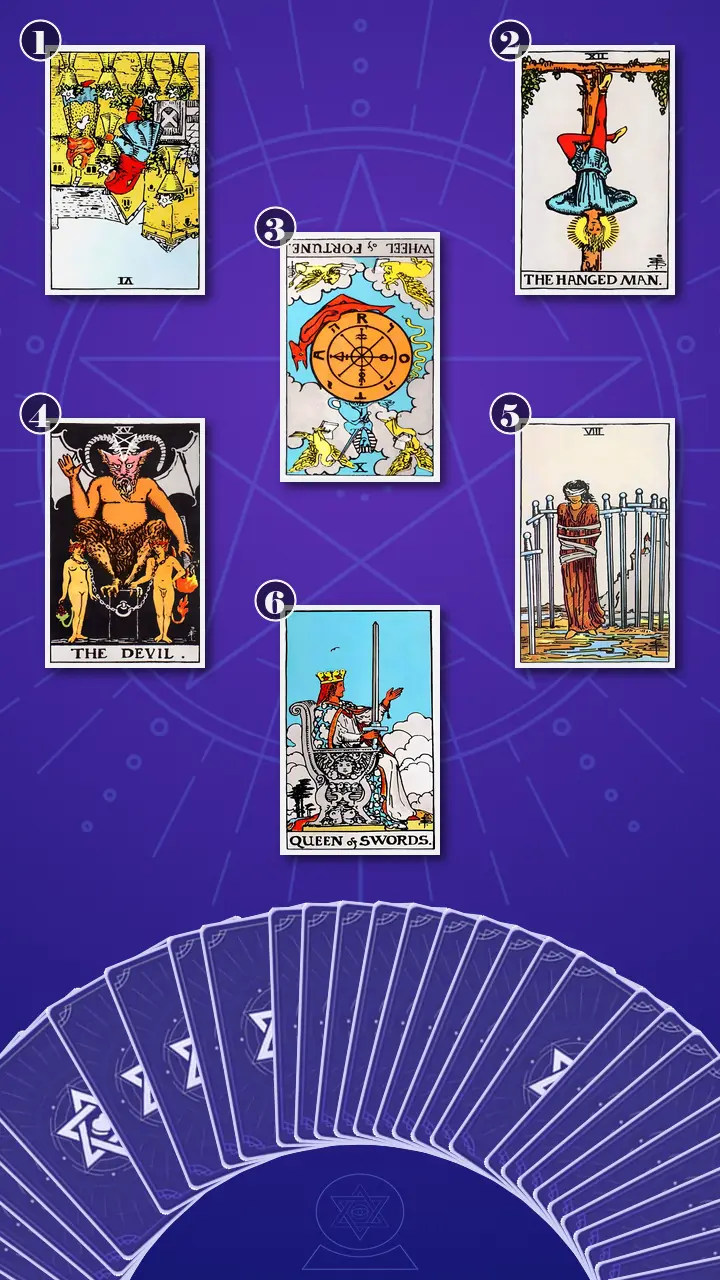
I chose the classic six-card Relationship Spread. For anyone wondering how tarot works without prediction or mind-reading, this spread is useful because it separates experiences that usually arrive as one emotional knot. It distinguishes Jordan's returning impulse from the response they actually encounter, then shows the relationship pattern, the force sustaining it, the central obstacle, and the guidance that remains under Jordan's control.
I placed the first two cards opposite each other: Jordan's contribution on the upper left and the experienced counterpart energy on the upper right. The third card sat between them to reveal whether the connection was developing or repeating. Beneath it, the fourth and fifth cards held the bond's sustaining force and its challenge. The sixth rested at the bottom as grounded guidance for observable evidence, direct communication, and a personal boundary.
I explained that the second position could show what the relationship makes available in practice, but it could not grant me private access to another person's feelings. The spread would not tell Jordan whether they were destined to stay, leave, wait, or return. It would help us examine the pattern clearly enough for Jordan to choose their own next step.
Reading the Loop: Warmth Without Movement
Position One: The Memory That Reopens the Door
I turned the card representing this case's returning impulse: the emotional need and personal contribution that draw Jordan back after the relationship stalls. It was the Six of Cups, in the reversed position.
In Jordan's daily life, this was the old chat opened after a quiet stretch, the saved photo, the voice note, and the message that still felt emotionally alive. The flower-filled cup on the card became the sweetest exchange on the screen. Jordan would stop there and think, “I remember when this felt easy, therefore maybe that version of us is about to return.” The remembered warmth then became a reason to reach out, even when current contact had not visibly changed.
I read the reversal as both a blockage and an excess of backward-facing Water. The tenderness was real, but too much present-day meaning was being drawn from it. Memory had begun to behave like a recommendation algorithm serving the relationship's top five moments while quietly burying the long pauses, vague replies, and conversations that never acquired a next step.
“You can miss the tenderness without mistaking it for direction,” I said. I placed a sheet beside the card and drew two headings: Present evidence and Remembered possibility. “The question is not whether the good memories count. They do. The question is whether you are responding to what exists now or carrying an old emotional offering back through an unchanged doorway.”
Jordan gave a short, bitter laugh. Their fingers tightened around the cold mug before loosening again. “That is so accurate it feels a little brutal.”
“Then we slow it down,” I replied. “The card is not accusing you of inventing the connection. It is showing how a genuine memory can be asked to do a job it cannot do: prove the future. We can respect what happened without using it as current evidence.”
Position Two: The Calendar Invite Still Marked Maybe
I turned the card representing the experienced counterpart energy: what Jordan was actually encountering from the other side and from the relationship's available response, without claiming to know anyone's private thoughts. It was The Hanged Man, upright.
In context, The Hanged Man looked like contact that could be warm but remained suspended. It was a calendar invite left in limbo: not clearly cancelled, but still without a date, an agenda, or a confirmed next step. Jordan kept treating the pause as something to wait through rather than information about what the relationship was presently able to offer.
Energetically, I read this as a deficiency of outward motion paired with a balanced opportunity for observation. The upright card did not tell me that waiting was good or bad. It asked what became visible when Jordan stopped trying to fill the pause with another careful message. If no direct conversation, specific plan, or consistent follow-through appeared, the suspension itself was part of the available evidence.
“When warmth arrives but movement does not, what is actually available to you in practice?” I asked.
Jordan's eyes moved from the card to the phone beside their laptop. They turned the screen face down and pressed one palm flat against the table. “A moment of closeness,” they said after a while. “Not a plan.”
Position Three: The Wheel That Travels in a Circle
I placed the next card in the centre, representing this case's repeating connection: the loop between returning, temporary emotional activation, and no observable forward movement. It was the Wheel of Fortune, in the reversed position.
The modern scene was exact: silence, a profile check on TTC Line 1, a familiar Story view, a warmer message, a carefully revised reply, ten minutes of lifted energy, and another wait. Contact created motion around the relationship, but no new direction within it. The wheel turned; the unresolved question stayed fixed at its centre.
I read the reversal as the spread's main blockage. Cyclical energy had become stalled repetition. Jordan was treating recurrence as a turning point, even when the latest contact did not contain a clear conversation, a specific plan, or consistent follow-through.
This was where I used what I call Daily Friction Deconstruction. I stripped away the dramatic question, “What does this all mean?” and wrote the mundane mechanics instead: quiet stretch, profile check, warm signal, low-stakes reply, no direct request, no plan, waiting. Once the sequence was visible, the relationship stopped looking mysterious. The pain remained, but its machinery could be examined.
My mind flashed to the campaign dashboards Jordan worked with. Clicks can rise while conversions stay flat. Activity is real, but activity is not the same as outcome. “The loop can be real without being a future,” I said. “Something happened, but what changed?”
Jordan's breath caught first. Their gaze lost focus as if the last three returns were replaying behind their eyes. Then their shoulders lowered by a fraction. “The wording changed,” they said. “The time of night changed. But there was still no conversation and no plan.”
Position Four: The Loose Chain of Almost
I turned the card representing this case's sustaining strength: the memory, tenderness, hope, or emotional charge that made the bond meaningful enough to revisit. It was The Devil, upright.
I was careful with this card. The Devil did not mean the relationship was evil, doomed, or secretly manipulative. In this position, it showed the emotional grip of waiting for the next return to make the connection feel chosen and real. Jordan was attached not only to the person, but also to the intensity of almost: the lift when a name appeared, the relief when a reply was warm, and the renewed belief that this time might be different.
Energetically, this was an excess of concentrated attachment, with the card's Fire compressed into compulsion rather than directed action. The pattern resembled a variable-reward notification. Most checks produced nothing, but an occasional tender message kept the checking habit alive. The warmth could be sincere and still be insufficient to create reciprocal direction.
I pointed to the chains around the figures' necks. They were loose. “That does not mean leaving is easy, and it does not mean you must leave,” I said. “It means we can ask what gives the chain its grip. When you imagine not checking, not reopening the chat, or not keeping Saturday available, what exact hope or fear makes returning feel urgent?”
Jordan's shoulders rose, and their thumb rubbed the edge of the phone case. “If I stop returning, I am scared it means I have finally accepted I was not worth choosing.”
“That is the tender part under the habit,” I said. “The relationship's availability and your worth have been made to answer the same question. They are not the same question.”
Position Five: The Third Choice Outside the Swords
I turned the card representing this case's central challenge: the belief, boundary gap, or lack of reciprocal movement that kept the pattern unchanged. It was the Eight of Swords, upright.
I recognised the card in Jordan's Wednesday evening outside a Queen West cafe. A streetcar bell cut through the cold while an unsent “Hey, hope you are doing well” sat on the screen after six revisions. The actual need remained underneath it: “Are you available for a relationship that is moving somewhere with me?”
The upright Eight showed a blockage of Air. Thought had narrowed into a binary rule: if Jordan returned, possibility survived; if Jordan paused or asked directly, everything might be lost. The blindfold was the belief that clarity would destroy hope. The loose ropes were the third choices that fear had hidden: observe the pattern, ask one direct question, stop holding an evening open, or choose a personal limit without forcing the other person's decision.
“What option becomes hard to see when your mind insists that you must either return or lose everything?” I asked.
Jordan's jaw tightened. Their fingers hovered above the dark phone screen, then settled on the table. “I could stop sending messages that pretend I need nothing,” they said. “But if I ask clearly and the answer is not what I want, I cannot go back to guessing.”
“That is true,” I said. “Directness may remove some ambiguity, and that can hurt. But the question would not create the relationship's present availability. It would help you see it. You are allowed to take this slowly, draft without sending, and decide which amount of uncertainty you are willing to organise your life around.”
When the Queen of Swords Opened the Window
Position Six: One Clear Question, One Boundary
A gust pushed rain against my window as I reached for the final card, and Jordan's refrigerator clicked off at the other end of the call. The sudden quiet gave the last position more space. I turned the card representing self-directed guidance for distinguishing present evidence from hoped-for progress and choosing an honest next step. It was the Queen of Swords, upright.
In Jordan's life, the Queen was not emotional shutdown. She was a clean Notes page with two lines: “What has changed?” and “What do I need?” Her upright sword separated remembered possibility from present fact. Her open hand represented communication and a boundary that described Jordan's action without controlling anyone else's response.
Energetically, the Queen restored balanced Air after the Eight's constriction. Feeling was not removed; it was translated into precise language. Jordan could honour the longing while defining observable movement as a direct conversation, a specific plan, or consistent follow-through. They could also decide what they would do if those things remained absent.
I used my Emotional Clutter Sorting lens before drawing any conclusion. On my notepad, I separated ordinary external noise such as work fatigue, busy weeks, and difficult timing from the relationship's repeated structure: long pauses, warm returns, no named direction. In a third column, I placed the emotional meaning Jordan had attached to that structure: “If it does not progress, I was not worth choosing.” The sorting prevented us from calling one difficult week an incompatibility, but it also prevented indefinite suspension from being explained away as one more difficult week.
I asked Jordan to return to 8:47 PM on Line 1: rain blurring the window, carriage lights buzzing, one familiar Story view lifting their chest. In that moment, they were still trying to make a tiny signal answer the whole relationship.
Another return cannot create clarity by itself. Clarity begins when you name what is observable, what you need, and which boundary belongs to you.
Do not use another return to secure certainty; use the Queen of Swords' upright blade to name what is true, what has changed, and what boundary or next step is yours.
I let the words remain between us. Jordan's breathing stopped first; their fingers stayed suspended over the mug as though the body had paused before the mind could catch up. Their eyes shifted away from me and lost focus, replaying something I could not see. Then their jaw set. “But does that mean every time I went back, I was wrong?” they asked, the sentence sharper than anything they had said all evening. I did not rush to turn the anger into gratitude. “No,” I said. “Those returns were attempts to preserve a connection and quiet a painful uncertainty. We are not putting your past self on trial. We are noticing what the attempts taught you.” Their eyes reddened. Their fist opened slowly against the table, one finger at a time, and a shaky breath left their chest. Their shoulders dropped, but the new space seemed to make them briefly unsteady. Clarity had removed the familiar task of decoding, and responsibility for the next choice now felt exposed.
“Now, with this new perspective, think back to last week,” I said. “Was there a moment when this insight could have made you feel different?”
“Outside the cafe,” Jordan answered. Their voice was quieter, but cleaner. “I could have admitted that I was writing for warmth, not asking for movement. I still might have sent something, but at least I would have known which one I was choosing.”
I set a ten-minute timer and asked Jordan to write three short lines: “What changed?” “What do I need?” and “What will I choose if nothing changes?” I reminded them that they did not have to send a message or make a final decision that night. If the exercise became too activating, they could close the app, place the phone down, and return to something grounding of their own choosing.
Jordan wrote: “A warm message arrived. I need a direct conversation and consistent follow-through. If nothing changes, I will stop keeping my weekends open for a maybe.” I watched them read the lines twice. This was not certainty about the relationship. It was the first clear step from longing-driven returns and mixed-signal rumination toward evidence-based clarity, direct communication, and steadier self-trust.
A Clean Line Through the Emotional Clutter
When I drew the six cards together, their story was coherent. The reversed Six of Cups showed the past exerting influence through selective tenderness. The Hanged Man showed the suspended response Jordan repeatedly encountered. The reversed Wheel revealed the return-and-wait loop. The Devil named the emotional payoff and fear that kept the loop charged. The Eight of Swords showed how fear reduced the situation to two choices. The Queen restored the resource that had been present but underused: Jordan's ability to observe, speak clearly, and protect their own time.
The core pattern was like circling the same doorway because going back felt safer than admitting the door had not opened. Each return briefly warmed Jordan's hands, but it did not move them through. The cognitive blind spot was not simply nostalgia. It was the belief that recurrence counted as progress, combined with the fear that clarity would become a verdict on personal worth.
“Clarity is not a verdict on your worth; it is a record of what is available now,” I said. “The shift is not from caring to becoming cold. It is from using another return to test the relationship to using the return as information. Name the movement you need before you decide what another return means.”
I translated the six-card Relationship Spread into two practical next steps. Neither required Jordan to end the relationship, send a message immediately, or suppress a feeling. The aim was small-scale evidence, not a dramatic ultimatum.
The Return-as-Information Check
- Keep a four-line warmth-versus-movement log. For seven days, use the Notes app whenever contact occurs. Record what happened, what concrete movement occurred, how your body felt ten minutes later, and what remained unchanged. Count a direct conversation, a specific plan, consistent follow-through, or no visible movement. Read the entry once before replying. Keep each entry under two minutes. If waiting ten minutes feels too difficult, take three slow breaths instead. This is a clarity tool, not a case file to use against the other person, and Jordan can stop if it increases distress.
- Use the 24-Hour Micro-Boundary Reset. Choose one 24-hour window. At 10:30 PM in the shared apartment, charge the phone outside the bedroom and leave the old chat closed until breakfast. During that window, draft one direct question: “I value what we have, and I need to understand whether you are available for a direct conversation and consistent movement now.” Beside it, write one personal limit describing what Jordan will do if the pattern stays unchanged. Drafting and sending are separate choices. A five-minute private version is enough. The boundary should govern Jordan's time or attention, such as no longer holding evenings open for unconfirmed plans; it should not punish or control the other person.
I called the second exercise a reset because it interrupted one piece of the mechanism for a single day. It did not promise instant detachment or guaranteed closure. It gave Jordan one protected stretch of time in which the phone was no longer deciding when reflection began.

A Week Later: The Evening Jordan Kept
A week later, I received a message from Jordan with a screenshot of the Notes page rather than the old chat. There were four brief entries. Beside one affectionate emoji, they had written: “Warm contact. No visible movement yet.” They had not dismissed the message as meaningless, and they had not promoted it into a new beginning.
Jordan had also drafted the direct question. They had not decided whether to send it, but they had stopped holding Saturday evening open and met a friend near Kensington Market instead. “I checked my phone twice,” they wrote, “but I did not cancel myself for a maybe.”
That night, Jordan slept through. Their first thought in the morning was still, “What if I am wrong?” They told me they smiled, put both feet on the floor, and read the log before touching the chat.
I recognised that as the quiet proof of our Journey to Clarity. The cards had not solved Jordan's relationship or taken command of their future. They had made the pattern visible; Jordan supplied the honesty, the boundary, and the next choice. The deck was the map, but Jordan remained the person holding it.
I still think of the flower-filled cup and the upright blade together. If you keep reopening the same chat because closing it feels like admitting you were not worth choosing, let both truths sit beside each other: the tenderness you remember can be real, and the exhaustion of finding the same silence can be real too. Noticing both means the fog has already begun to thin.
If you let the good memories remain real without asking them to prove the future, what is one small truth about the present you might be willing to place beneath the Queen's clear blade and name for yourself?