Pet Adoption Form Closed Again; Three Criteria Led to Clicking Submit

The 10:45 p.m. Pet Adoption Spiral
I have seen pet adoption anxiety arrive disguised as diligence: a realistic salary, a colour-coded calendar, twelve contingency rows, and one surprise Slack message that suddenly becomes evidence against an entire future. Maya, a 29-year-old communications coordinator living alone in Toronto, brought that exact pattern into our reading. She set her phone beside her coffee and showed me a screenshot taken at 10:45 on a Tuesday night.
In the screenshot, a specific pet's adoption profile glowed beside a Google Sheets budget. Maya described the refrigerator humming behind her and the laptop pressing warmth into her wrists as she typed two sentences into the application, checked next month's hybrid-work calendar, added another hypothetical emergency cost, and closed the form. Again.
"I keep thinking one more piece of information will make the answer obvious," she told me. "I want this, but wanting it doesn't feel like enough evidence. If I wait, I might be responsible, or I might just be scared."
I watched her press two fingers against the centre of her chest. The feeling there was like a ratchet tightening one click whenever commitment became concrete: longing pulled her toward the application, while the demand for certainty locked her breath in place. She wanted this pet, but she did not want affection to outrun capacity. She wanted to wait responsibly, but she did not want fear to make the decision while pretending to be caution.
"Being torn does not mean you care too little," I said. "It may mean you have asked certainty to do a job it cannot do. I won't use tarot to tell you whether you must adopt. Let's use it to tidy the decision, separate care facts from larger fears, and draw a map through the fog. The choice will remain yours."

Choosing the Compass: The Five-Card Decision Cross
I invited Maya to take one unforced breath and hold a narrower question: "What would allow me to choose adoption, waiting, or declining with honesty?" I shuffled slowly. The pause was not a mystical performance; it was a way to interrupt the browser-tab momentum and give one question our full attention.
I chose a five-card Decision Cross tarot spread because Maya's question was a genuine two-option crossroads. A larger spread, such as a Celtic Cross, could have supplied more timelines, influences, and possible outcomes, but more information was already part of the problem. The Decision Cross was the smallest useful map for comparing adoption and waiting while revealing the fear distorting both.
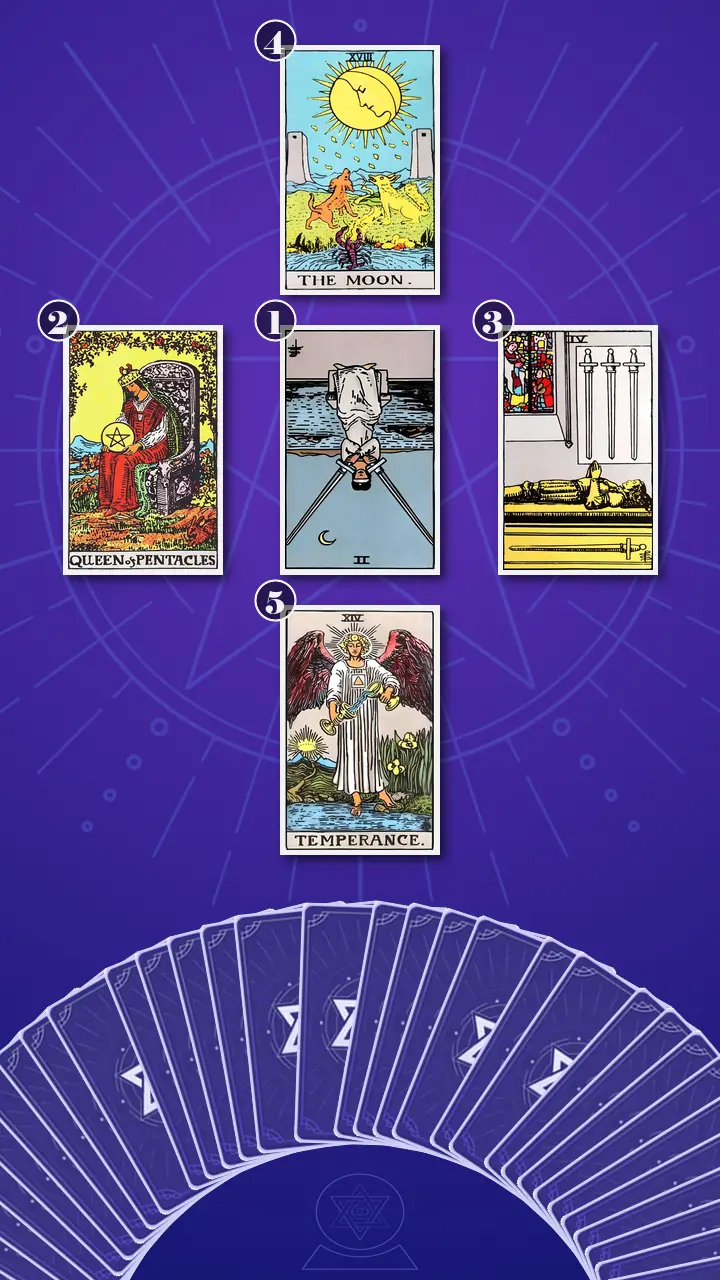
I placed the first card at the centre to show the behavioural knot. The second went to the left for what adoption would genuinely activate and require. The third went to the right for what waiting could constructively provide. Above the centre, the fourth would uncover the hidden concern hanging over both choices. Below it, the fifth would become the grounding principle that could turn conflict into a measured decision process.
The layout resembled a compass. Its horizontal line held the two legitimate options; its vertical line ran from obscured fear to grounded discernment. For me, this is how tarot works best: not as a prediction machine, but as an objective cognitive map. The cards give different parts of a dilemma separate places to speak, making card meanings in context easier to test against reality.
When Every Open Tab Gets a Vote
Position One: Two Swords Across a Tight Chest
The card I turned over first was the one representing Maya's current behavioural knot: repeatedly approaching the adoption application, gathering more information, and withdrawing without choosing or scheduling a decision. It was the Two of Swords, reversed.
I pointed to the blindfold and the crossed swords held defensively over the figure's chest. In Maya's life, the image looked less like an ancient stalemate and more like the adoption form, budget, work calendar, shelter FAQ, Reddit threads, and friends' opinions all open at once. She would type an answer, discover a new possible disruption, add another contingency, and close the application because none of those inputs could guarantee the future.
"Each tab has become an argument," I said. "The calendar says your routine is possible until one late meeting appears. The budget says the cost is manageable until another worst-case column is added. A friend's experience sounds useful until you remember that her schedule is different. Every new argument cancels the previous one, so no piece of evidence has decision authority."
The reversed card showed Air in excess until it became a blockage. Thought was not deficient here; Maya had plenty of it. The problem was that thought had been assigned an impossible task: forecasting every expense, schedule change, and emotional reaction before she could call either choice responsible. Closing the form released the pressure for a few minutes, which quietly trained the loop to repeat.
"What happened immediately before you closed it last time?" I asked. "Was it a fact, or a thought beginning with 'what if'?"
Maya gave a short laugh with a bitter edge. "That is too accurate. It's almost cruel. It asked about long-term care, and I thought, 'What if my job changes, what if my rent jumps, what if I travel more, what if I become the kind of person who resents the responsibility?' Then I opened another cost calculator."
I let the laugh settle before answering. "The card is not criticising your caution. It is showing where a responsible instinct became a relief mechanism. You are not failing to decide because you are careless. You are trying to make a risk-free decision, and neither option can meet that standard."
Her fingers stopped worrying the paper sleeve around her coffee. I could see recognition arrive without complete comfort. The first distinction was now visible: more information is not the same as clearer decision criteria. Waiting was already happening, but Maya had not deliberately chosen it or defined what would bring it to an end.
Two Options Brought Down to Earth
Position Two: The Queen's Ordinary Tuesday
The card I turned over next was the one representing what adopting the pet genuinely activates and requires, including Maya's practical capacity for care and her hope that adoption might make home feel more purposeful. It was the Queen of Pentacles, upright.
The Queen held her pentacle with focused care inside a cultivated garden. I read her as balanced Earth: affection supported by repeatable time, money, attention, and infrastructure. This was not an automatic yes. It was an invitation to replace the cosy picture of companionship with a normal weekday that still had feeding, cleaning, appointments, daily attention, and backup arrangements when work ran late.
"Adoption becomes real when it enters your actual take-home budget and your actual calendar," I said. "Not your ideal week. I mean an office day, a home-working day, and the Friday when a 4:57 p.m. Slack request lands after your coffee has gone cold. The question is not, 'Could I handle everything forever?' It is, 'What does dependable care require on an ordinary Tuesday, and can I build that repeatably?'"
I saw her shoulders lower by a fraction. The card had moved us away from a mood board and toward production-ready care: a recurring-cost category, visible care blocks, known health needs, and one credible source of backup support. Maya could also observe whether the routine felt like meaningful stewardship or like a role she hoped would repair every quiet evening.
"Affection becomes readiness when it can live inside an ordinary Tuesday," I told her.
She looked at the pentacle in the Queen's lap, then at the appointment blocks on her phone. "That actually makes it smaller," she said. "I can test a Tuesday. I cannot test the next twelve years."
That exhale mattered. The Queen did not prove that Maya should adopt. She showed an underused capacity: Maya already knew how to create reliable systems, but she had been spending that skill on multiplying forecasts rather than testing present-day care. Balanced Earth gave her apprehension something solid to meet.
Position Three: Waiting With a Return Time
The card I turned over now was the one representing what waiting could constructively provide, while distinguishing a purposeful pause from open-ended postponement. It was the Four of Swords, upright.
The resting figure lay beneath three suspended swords, with no weapon clutched in the hands. I read this as Air returned to balance. Thought had not vanished; it had been placed outside the body for a protected interval. In modern terms, this was a calendar-blocked maintenance window, not an application left permanently in draft.
I described a 72-hour pause with exact start and end times. During it, Maya could mute shelter-profile notifications, stop polling friends, and keep one note titled "Observed, Not Imagined." She would record only what actually happened with her schedule, energy, budget, and desire. At the scheduled end, she would reopen her three criteria before reopening Reddit, cost calculators, or advice threads.
"I am not deciding today" could be a healthy sentence, I explained, if it was followed by, "I know exactly when and why I will return." Waiting did not have to mean cowardice, just as immediate adoption did not have to mean courage. The energy stayed balanced only when the pause had evidence to gather and an end point.
A pause needs a purpose and an end date, or it starts choosing for you.
Maya inhaled, held the breath for a beat, and then released it slowly. Her palms opened on the table. "Mine has no end date," she said. "I've been calling it waiting, but mostly I've been hoping the profile will disappear so I won't have to find out what I choose."
I nodded without turning that admission into a verdict. "Then this card gives waiting its dignity back. You may still wait. The difference is that you would choose the pause, decide what it is for, and return when you said you would."
The Snowy Sunday Question Beneath the Question
Position Four: The Moon's Partially Lit Path
The card I turned over next was the one representing the hidden fear of losing control and the broader uncertainty attached to the pet decision. It was The Moon, upright.
I traced the winding path between the towers. Only one section was visible at a time. The Moon did not tell me that something terrible was hidden ahead, nor did I present it as a warning about the pet. It showed what happens when partial visibility feels intolerable and the mind fills the unlit distance with projected conclusions.
Maya had described a snowy Sunday at 7:18 p.m. when she saw that the adoption profile had been updated. The radiator clicked; wet tyres hissed on the street below; blue screen light spread across the quiet sofa. She pictured the apartment feeling warmer and more purposeful. Then the practical question, "Am I ready for this pet?" became, "Am I lonely? Do I understand adulthood? Does my home life have direction? Can I trust myself with anything that cannot be undone by closing a tab?"
The Moon's Water became a blockage when every submerged fear flooded the care assessment. A busy workday stopped being a scheduling problem and became a verdict on Maya's entire competence. The possibility of adjusting a care plan became proof, in advance, that she might have confused loneliness with readiness.
"When you imagine adopting and later struggling," I asked, "which conclusion frightens you more: that the care plan would need adjustment, or that the struggle would prove you cannot trust yourself to manage your own life?"
Her hand froze halfway to her cup. Then her gaze slipped beyond the table as though she were replaying several future scenes at once. Finally, the muscles around her mouth softened and one low breath left her chest. "The second one," she said. "Definitely the second one. I don't want the pet to become the answer to a question I haven't named yet. But I also don't want that fear to mean I can never choose anything meaningful."
"That is the distinction this position needed," I said. "Some concerns belong to actual care: monthly cost, daily routine, known needs, backup support. Others belong to a wider uncertainty about purpose, loneliness, and control. Both deserve honesty, but only the first category can serve as direct readiness criteria."
I thought of a late-night search algorithm that receives one practical query and keeps recommending larger questions until the original search is almost invisible. The Moon showed the same mechanism. It also showed the correction: enough of the path was visible for one careful step. Responsible commitment required neither denial nor total foresight.
When Temperance Moved Between Two Cups
Position Five: The Bridge From Conflict to Evidence
The room became unusually quiet as I reached for the grounding card below the centre. Even the small click of the radiator seemed to fall into the pause.
The card I turned over was the one representing the integrating principle that could convert Maya's inner conflict into a measured readiness process and a time-bound decision. It was Temperance, upright.
Water moved continuously between the angel's two cups. One foot stood on land and the other touched water. I read this as balanced integration: practical limits and emotional truth exchanging information without either being forced to defeat the other. For Maya, the two cups became a short care simulation, a realistic recurring budget, one confirmed backup option, an honest statement of desire, and a fixed date for reviewing the evidence.
I watched the familiar sequence regroup behind her eyes: profile, spreadsheet, calendar, one busy afternoon promoted into a forecast of every future year. Closing the application had bought ten minutes of relief before the question returned. She was still asking which side could win completely.
This was where I used what I call Analysis Paralysis Deconstruction. I stripped away every abstract future that could not be tested now and placed only Maya's immediate constraints on the table: sustainable monthly cost, workable daily care, and credible backup care. Then I applied Complexity Reduction, not by oversimplifying adoption into a careless yes or no, but by giving each criterion a clean status: supported by evidence, or not yet supported by evidence.
After twenty years of hearing decisions unfold over coffee, I have learned that mental clutter behaves like unfiltered grounds. Stirring harder does not make the drink clearer. A useful filter does not erase complexity; it prevents every particle from receiving equal authority.
Waiting for perfect certainty will not make the decision safer; combine longing with practical evidence and let Temperance's two cups turn inner conflict into a workable process.
I stopped speaking and let the sentence remain between us.
First, Maya went completely still. Her breath paused high in her chest, and her fingertips hovered over the edge of the Temperance card without touching it. Then her eyebrows pulled together and colour rose along her cheeks. Recognition had landed, but it carried a sharp edge. "But doesn't that mean I've been doing this wrong for months?" she asked, her voice suddenly louder. "I've spent all this time trying to be responsible."
I did not rush to turn the anger into relief. "No," I said. "It means a responsible instinct was using a method that could never finish the job. The research was not pointless. It gave you facts. What kept you stuck was requiring those facts to remove uncertainty before you trusted yourself."
Her jaw tightened once, then released. Her eyes lost focus as she replayed the closed applications and expanded spreadsheets. Finally, her shoulders dropped, her fingers unfolded, and a shaky breath came from low in her chest. Relief was there, but so was the brief, exposed feeling of realising that a clearer process would return the responsibility to her. No more research loop would be available to choose by default.
I distilled the shift into one further sentence:
You do not need the whole future to be visible; you need enough practical evidence to make a time-bound choice you can honestly call your own.
"Now, with this new perspective, think back to last week," I said. "Was there a moment when this insight could have made the situation feel different?"
Maya returned to the Friday when a late Slack request pushed a trial care block out of place. "I treated one messy afternoon as proof that I couldn't sustain anything," she said. "But the real question was whether a backup plan would make it manageable. I never asked anyone. I just promoted the disruption into a verdict."
That was the crossing point in the reading. Maya had moved from contracted certainty-seeking postponement toward practical self-trust and calm ownership of a time-bound choice. The discomfort did not disappear. What changed was its authority. Fear could contribute information without becoming the sole decision-maker.
The Coffee Bean Filter and the Ordinary Tuesday
I gathered the five cards into one coherent story. The habit that brought Maya here was not a lack of care; it was an old equation between responsibility and total control. At the centre, the reversed Two of Swords showed abundant thought locked against itself. The Queen of Pentacles grounded adoption in repeatable stewardship. The Four of Swords restored waiting as a purposeful, bounded option. The Moon revealed that loneliness, purpose, adulthood, and self-trust had been loaded onto a practical care decision. Temperance gave all of those truths a container without pretending they were the same kind of evidence.
The central blind spot was now clear: Maya had asked adoption to prove that it could never go wrong, while allowing waiting to remain largely unexamined. If both paths contained uncertainty, only one had been required to guarantee safety. Her next shift was not from "wait" to "adopt." It was from repeatedly checking the map to testing the ground through three criteria and a defined decision date.
I gave her two pieces of actionable advice. Both were small enough to begin without submitting an application, buying supplies, or making a promise to the shelter.
- Run the 24-Hour Coffee Bean Filter Protocol.At the kitchen table, set a 20-minute timer and write each decision variable on a separate scrap of paper. Sort the scraps into two columns: "Absolute Must-Haves" and "Emotional Noise." The must-have column may contain exactly three headings: sustainable monthly cost, workable daily care, and credible backup care. Under each, record one fact already known and one fact still needed. Place an "Adoption decision review" event in the calendar within seven to ten days, when the choice will be adopt, wait with a specific reason and new date, or decline.Treat "emotional noise" as real feeling that deserves attention, not as evidence that automatically decides pet-care capacity. If 20 minutes feels too heavy, use five minutes and write one sentence under each heading. Do not add a fourth criterion.
- Use the Ordinary Tuesday Readiness Test.Choose three ordinary days, including one office or high-workload day, and place realistic care blocks in the calendar as though the pet were already home. Move one estimated month of recurring pet costs into a separate savings category without spending it. Ask one trusted person or paid local service a specific backup question: "Would you realistically be available at this frequency and notice period, and what would it cost?" Record friction, relief, and trade-offs as evidence.A simulation cannot prove the entire future, and it does not need to. If the full test feels artificial, try only the hardest care window. Difficulty means a plan may need adjustment; it does not automatically mean yes or no.
I reminded Maya that the protocol protected all three answers. If the criteria were supported, she could apply without waiting for her body to feel perfectly calm. If a criterion was unsupported, she could choose a purposeful wait and name exactly what would need to change. If the fit was not right, she could decline without treating that as a failure of love or adulthood.
"You do not need the whole future to be visible," I repeated. "You need enough evidence to own the next choice. The cards have helped us structure the evidence, but they do not hold the authority. You do."

A Week Later: The Quiet Proof
Eight days later, I received a message from Maya. She had run the Coffee Bean Filter, and the paper marked "I must know I will never feel overwhelmed" had gone into Emotional Noise. The recurring monthly cost was workable if she reduced food delivery. Her trial calendar exposed one difficult office-day window, but a local service had confirmed realistic backup care. The shelter had answered the few remaining questions that directly affected her three criteria.
At the review event, she chose to submit the application. She told me her hand still shook slightly over the button. She clicked anyway, not because the tarot had promised a perfect outcome, but because she could explain the evidence, the limits, the support plan, and what she genuinely wanted.
That night she slept through until morning. Her first thought was still, "What if I'm wrong?" She smiled at the ceiling, made coffee, and let the question remain unanswered without reopening the spreadsheet.
The application was not a guarantee that the adoption would proceed, and submitting it did not solve every larger question about purpose or loneliness. It was simply the first concrete proof of the journey from certainty-seeking postponement to practical self-trust. Maya had not eliminated uncertainty. She had stopped charging herself complete certainty as the entry fee for responsible action.
I remember this reading whenever an open application, a tight chest, and the choice between clicking submit and closing the tab begin to feel like a test of whether someone can trust their own life. It makes sense for one meaningful commitment to carry that weight. Being able to name the weight already changes how it is held.
If complete certainty were no longer the entry fee, which single must-have would you place beside Temperance's two cups, and what small piece of real-life evidence would you be curious to gather before your own decision date?