The 7:10 p.m. Disappearance: Identity Outside the Family Fixer Role
If you're a twenty-something city renter who can map every stakeholder's needs but freezes when someone asks what you want tonight, I suspect you'll recognize the particular exhaustion Jordan brought into our reading: looking decisive while everyone needs something, then going blank the second the choice becomes personal.
Jordan joined my video consultation from their Toronto apartment a little after eight on a Tuesday evening. At 7:10 p.m., they had been sitting at the kitchen table with a neighbourhood ceramics class open on their laptop, payment details ready, the blue booking button lighting their hands. The radiator clicked behind them. Mint tea cooled beside the trackpad. Then the family group chat began vibrating across the table.
Jordan showed me what happened next. They closed the class tab, opened Google Maps, compared Saturday routes, and built a shared itinerary. Their jaw set and their shoulders crept toward their ears, yet every message became brighter: “No worries!” “I can sort that.” “Whatever works for everyone.” By the time they returned to the studio page, the class had sold out.
“No one even asked me to organize it,” they said. “I know what everyone needs from me, but I cannot tell what I want. The second I'm with my family, I become the old version of myself.”
I could hear the central contradiction clearly: Jordan wanted to define who they were outside the family fixer role, but family contact worked like autocomplete. A few words appeared, and the old response completed itself before their adult preference had a chance to speak. The resulting disorientation was not a vague cloud; it was like expertly planning everybody else's subway route, stepping onto the platform, and discovering that their own station had been wiped from the map.
“I don't want to abandon anyone just to find out who I am,” Jordan added.
“Then we won't begin with that false choice,” I said. “I won't ask the cards to tell you whether your family is good or bad, or whether you should stay or leave. We'll use them to make the pattern visible. Our journey today is to find enough clarity for one preference to survive the next notification.”

Lowering the Lantern into the Five-Card Shadow Spread
I asked Jordan to put both feet on the floor, let one breath finish before beginning the next, and hold the question without trying to improve it: “Who am I outside the family role I keep slipping back into?” I shuffled slowly. The small ritual was not supernatural theatre; it marked a transition from automatic response to deliberate attention.
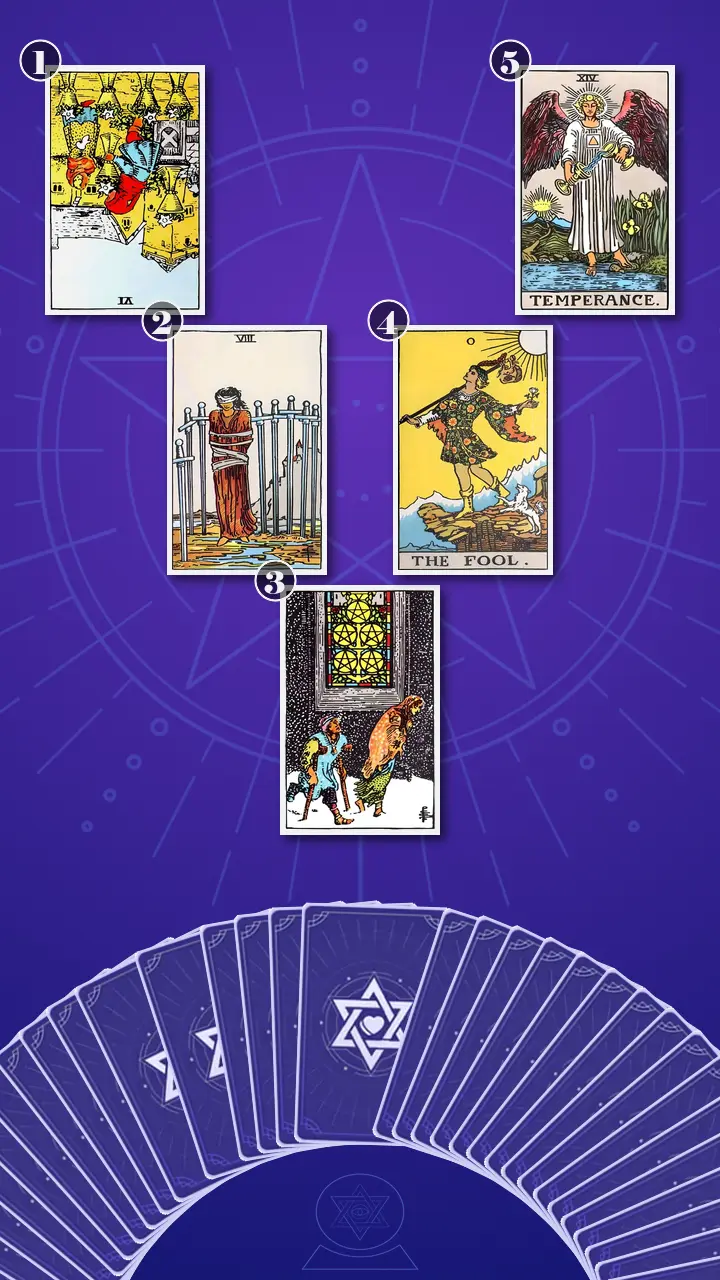
I chose a five-card Shadow Spread because the problem was not a simple decision between two external options. Jordan was asking about identity beneath an inherited persona. A larger spread would have added forecasts and environmental details we did not need. These five positions offered the smallest complete map of the pattern: the visible role, the hidden rule beneath it, the fear that powers the rule, the underused quality that can interrupt it, and the everyday practice that can integrate connection with individuality.
I placed the cards in a V. The first sat at the upper left, showing the familiar persona. The second descended toward the hidden contract. The third occupied the bottom of the valley, where the belonging fear waited. The fourth began the ascent through an unclaimed capacity, and the fifth stood at the upper right as the bridge into daily life.
This is how tarot works best in my practice. It gives private assumptions an external structure, so we can examine card meanings in context instead of treating every thought as a fact. The spread would not decide Jordan's identity. It would help Jordan distinguish what was inherited, what was feared, and what they were free to test.
Down the V: Where the Old Script Took Hold
Position 1: The Persona That Arrived Before Jordan Did
Now I turned over the card representing the observable family persona Jordan performed during calls, messages, and visits. It was the Six of Cups, reversed.
In the Rider-Waite-Smith image, one child offers another a cup filled with flowers inside an enclosed old courtyard. Upright, the exchange can carry affection, memory, and familiarity. Reversed in this position, I read its energy as a blockage: a once-useful exchange had stopped developing, so the remembered version of Jordan kept entering present-day conversations before their twenty-eight-year-old self could check whether the role still fit.
I brought us back to 7:10 p.m. Jordan entered the chat with a ceramics class ready to book. Two notifications later, their language had brightened, their own plan had disappeared, and the capable organizer was building an itinerary. The family warmth was not the problem. The blockage was that the old exchange left no room for a current preference.
“It's a little like the split in Severance,” I said, “except the switch is relational rather than technological. Inside the assigned function, you're calm, competent, and easy to recognize. Outside it, the less-practised self has to answer an open question without a script.”
Jordan gave a short laugh, but it caught bitterly at the end. Their fingers tightened around the mug, then loosened. “That's so accurate it feels a bit cruel.”
“Then let's make the accuracy useful rather than punitive,” I replied. “This card is not saying the capable version is fake. It is showing us the moment one real part of you takes over the whole interface. During the next family interaction, we can watch for the first signal: the brighter voice, the lifted shoulders, the deleted preference, or the offer to take charge.”
Jordan looked back at the sold-out page in their browser history. “I entered the chat wanting ceramics. Two messages later, I was planning everyone else's Saturday.”
“Exactly,” I said. “Familiar is not the same as compulsory.”
Position 2: The Reply Screen with One Available Button
Now I turned over the card representing the hidden rule beneath the persona: Jordan's belief that the inherited role was compulsory and alternative responses were not safely available. The card was the Eight of Swords, upright.
The figure is blindfolded and loosely bound, surrounded by swords that look imposing but do not form a sealed enclosure. In this reading, the sword energy was in excess. Thought had repeated the same rule so often that familiarity had hardened into apparent fact: if the family needed coordination, Jordan had to provide it immediately.
I described the message that often triggered the sequence: “Can we figure out Sunday?” Nobody had assigned Jordan the job or demanded an instant reply. Yet their chest compressed, Maps opened, calendars appeared, and the draft “I can confirm my own availability later” was deleted.
“If this were one of your UX flows,” I said, “every response except ‘I'll handle it’ would appear greyed out. But the important detail is that no one checked the permissions. The other buttons may not be disabled by the current request. An old setting is making them look unavailable.”
Jordan's hand paused halfway to the tea. Their gaze moved from the blindfold to the gap between the swords, as if they had only just noticed the opening.
“No one said I had to solve all of it,” they said quietly. “My body just acts as if the decision has already been made.”
“The request may be small; the rule you inherited is doing the heavy lifting,” I said. “The card does not prove every alternative will be comfortable. It asks us to separate observable constraint from anticipated relational risk. What was literally requested, and what responsibility did you supply before anyone asked?”
Jordan read the family message again. “They asked if we could figure out Sunday. I translated that into: I must figure out Sunday, for everyone, now.”
That distinction did not solve the pattern, but I watched it create the first millimetre of space inside it.
Position 3: The Warm Window at the Bottom of the Valley
At the lowest point of the V, I turned over the card representing the underlying fear that gave the hidden rule its emotional force: the fear that a self-directed choice might remove Jordan from the family's circle of belonging. It was the Five of Pentacles, upright.
Two figures cross through snow beneath an illuminated window. I was careful here. The card did not predict rejection, estrangement, or punishment. It showed the image Jordan's mind produced before anyone had responded. When they hovered over “I can't organize this one,” they imagined the group chat moving on without them, invitations cooling, and the affectionate word “dependable” disappearing.
The energy had hardened into a blockage around security. A moment of possible disconnection felt like permanent exclusion. The boundary had not yet been sent, but Jordan's stomach was already responding as though they stood outside in the snow.
“The first boundary may feel like exile before it looks like information,” I said. “That feeling deserves respect, but it is not the same thing as evidence that connection has ended.”
This was where I used a method I call Cognitive Stratigraphy. On an archaeological site, the object at the surface is rarely the entire story. I treat a sudden emotional trigger in the same way. The buzzing notification and rising shoulders are surface artifacts. Beneath them lies the working rule, “I must fix this now.” Deeper still sits the older foundation: “My place is safest when I am useful.”
My mind went briefly to trenches I had worked on, where a dark band of ash could prove that something burned without proving the whole settlement vanished. Years at Cambridge and on digs taught me to resist turning one fragment into an entire civilization. Jordan's guilt could tell us that an old structure had been disturbed. It could not, by itself, prove that love or belonging had been destroyed.
Jordan stopped moving. Their breath held high in their chest; their eyes lost focus as if an old sequence were replaying; then their shoulders lowered by a fraction.
“What if the warmth was for the useful version of me?” they asked.
“That is the fear this card lets us name,” I said. “I won't insult it by pretending one reassuring sentence can erase it. But we also won't promote it from fear to forecast. Changing a role may produce discomfort, questions, or adjustment. None of those automatically means you no longer belong.”
The Fool Opens a Door That Needs No Label
Position 4: Curiosity Before Certainty
On the rising side of the spread, I turned over the card representing the underused quality capable of interrupting Jordan's drift: curiosity that could test a preference without demanding a finished identity. The card was The Fool, upright.
The Fool carries a small bundle, holds a white rose openly, and looks toward unfamiliar ground. I read the card's fire as a healthy energy Jordan had not been using enough. Their research folders were full, but direct experimentation was in deficiency. They were asking each hobby to prove who they were before allowing it to become one afternoon of experience.
A streetcar bell sounded faintly through Jordan's window as they reopened the ceramics page. I asked them to imagine booking one future drop-in session because the colour, pressure, and texture seemed interesting, not because they had decided to become “a ceramics person.” The choice did not need to be useful to the family, approved by friends, or capable of explaining the next decade.
“Think like a designer running a low-stakes prototype,” I said. “The first test does not have to validate a permanent product. It gathers information. The Fool is an Eventbrite RSVP to curiosity, not a lifetime subscription to a new personality.”
Jordan exhaled and clicked into the studio's next available date. Their face softened, then tightened again with caution. “I don't know if this defines me. I only know I'm curious enough to try once.”
“That is sufficient data for one reversible choice,” I said. “You do not need a finished identity; you need one preference that gets to remain visible.”
I also named the overcorrection we wanted to avoid. The Fool was not advising Jordan to refuse every family request, disappear from the chat, or turn autonomy into a dramatic rupture. Its invitation was smaller and more demanding in a useful way: make one choice without using rebellion or certainty as permission.
When Temperance Refused the False Choice
Position 5: Two Cups, Two Calendar Blocks
We had reached the final position, representing the conscious practice through which Jordan could integrate family connection with an individual identity. The radiator gave one last click and went quiet. I turned over Temperance, upright.
The figure transfers water between two separate cups, with one foot on land and one in water. I read this as balance, but not a flawless fifty-fifty split. Temperance is calibrated exchange. The containers remain distinct, and that distinction is precisely what makes a conscious relationship between them possible.
In Jordan's ordinary week, the image became two calendar layers. Wednesday evening could remain protected for ceramics. A family message could receive: “I can't organize Saturday, but I can confirm my own availability tonight. I could also call Sunday afternoon if that works.” Connection remained active, but it no longer overwrote every personal block by default.
I brought us back to 7:10 p.m.: the ceramics tab still open, the family chat buzzing, Jordan telling themself the itinerary would be quicker. An hour later the class was gone, their shoulders were heavy, and their own preference had vanished beneath a job no one had assigned.
You do not have to empty yourself into the inherited role to remain connected; mix family connection with one self-directed choice at a time, as Temperance keeps water moving between two distinct cups.
I let the sentence stand without softening it.
For one full breath, Jordan froze. Their fingers hovered above the trackpad, neither closing the studio page nor reaching for the family chat. Their pupils widened, and then their gaze slipped out of focus, as if the past week's messages were replaying in sequence. Colour rose around their eyes. The hand that had been curled against the mug slowly opened, one finger at a time.
Their shoulders dropped on the exhale, but relief did not arrive alone. I saw the slight dizziness that can follow when a burden has been carried so long that setting it down changes the body's sense of balance. Jordan swallowed and said, with a small flare of anger beneath the tremor, “But doesn't that mean I've been doing it wrong all these years?”
“No,” I said. “It means the role was intelligent enough to create predictability and belonging when you needed those things. We are not putting your history on trial. We are checking whether an old structure still deserves full control of the present. Gratitude for what it once did does not require permanent obedience to it.”
I leaned closer to the screen. “Now, using this new perspective, think back: was there a moment last week when this insight might have changed how the situation felt?”
Jordan remembered cancelling a tentative drink after a relative praised them for “always keeping us organized.” “I could have let the compliment be affectionate without treating it like a job description,” they said. The words came slowly, then settled.
I call this Ruins Restoration Thinking. Restoration does not mean rebuilding every old wall exactly as it stood, and it does not mean flattening the site to prove we are free of it. I look for what remains sound, what has become restrictive, and what new structure can stand beside the old foundations. Jordan's dependability could remain. Compulsory self-erasure did not have to remain with it.
This was the key crossing: from disoriented obligation and boundary guilt toward steadier self-recognition, flexible boundaries, and connection without self-erasure. It was not certainty about who Jordan would become. It was calibrated self-trust, expressed as one adult preference allowed to occupy its own cup.
Restoring the Two-Cup Plan: Actionable Next Steps
The Pattern Beneath the Pattern
I gathered the five cards into one coherent account. The Six of Cups reversed showed the past arriving as an automatic persona. The Eight of Swords revealed how repetition turned that persona into a no-choice contract. The Five of Pentacles exposed the fear beneath the contract: that a separate preference might cost Jordan their place in the warmth. The Fool restored movement through one low-stakes experiment, and Temperance showed how repeated adjustment could preserve both connection and difference.
The V-shaped spread had taken us down from behaviour to belief to belonging fear, then back up through curiosity into integration. The family interaction was not the entire cause of Jordan's blankness. The pattern kept renewing itself because immediate fixing created short-term calm, while every erased preference left Jordan with less lived evidence about what they enjoyed, wanted, or valued.
The cognitive blind spot was the assumption that this blankness proved an absent self. I saw something more practical: Jordan's preferences had been underused. Another blind spot was treating the first wave of guilt as a moral verdict. Guilt might simply be the old role noticing that the usual sequence had changed.
The direction was therefore precise. Before answering one non-urgent family request, Jordan would pause, identify one personal preference, and choose a response that did not erase it. The cards offered a map, but no card could take that action for them.
Jordan frowned at the twenty-minute pause. “But some days I can't even find twenty minutes. By the time I stop, I'll already have replied.”
“The buffer is elapsed time, not twenty minutes of homework,” I said. “You can put down the phone and continue making dinner. The active exercise takes three minutes, and the minimum version is one line. Urgent health, safety, or genuinely time-critical matters are different. We are testing this only on a request that can reasonably wait.”
The Smallest Workable Tests
- The Three-Minute Trigger Excavation When one non-urgent family notification arrives this week, put both feet on the floor, open a pinned phone note, and write three lines: “The actual request says...”, “The old role adds...”, and “My preference is...” Set a three-minute timer. Nothing has to be sent or decided during the exercise. This traces the surface reaction back to its older epoch while keeping the present request separate from the inherited rule. If three lines feel too activating, write only “My preference is...” and stop. The exercise is information, not a test of endurance.
- The 20-Minute Reply Buffer For that same non-urgent request, wait twenty minutes before responding and check your own calendar before opening Maps or coordinating anyone else. Draft a reply containing only your availability, such as: “I can't coordinate this one, but I can confirm my own time by 8 p.m.” Keep the message short. A limited response does not need a long defence, and offering another time is optional rather than proof that the boundary is kind.
- The One-Session Curiosity Prototype By Thursday evening, reopen one saved Toronto class or event through Eventbrite, BlogTO, the public library, or a venue page. Choose a drop-in, refundable, free, or single-session option based only on curiosity, place it in the calendar, and protect the actual time. Afterward, write: “I wanted more, less, or something different because...” Do not ask the experience to define you. If booking is too large a step, spend five minutes choosing one date and leave confirmation for later. Participation remains your decision.
I told Jordan that these were not techniques for becoming less caring. They were preference repetitions. Each one would collect evidence that care could be chosen consciously, boundaries could stay flexible, and a personal life could become visible without requiring a dramatic break from family.

A Week Later: The Quiet Proof of Finding Clarity
Six days later, I received a message from Jordan. A family notification had arrived while they were looking at the next ceramics drop-in. Their shoulders rose before they finished reading it, but this time they noticed. They opened the pinned note.
“Actual request: Who is free Saturday? Old role's rule: Build the whole plan before anyone gets annoyed. My preference: Keep Wednesday ceramics and don't spend tonight organizing.”
Jordan waited twenty minutes, then sent: “I can't coordinate this one, but I'm free Saturday after two.” One relative confirmed a time. Another chose the restaurant. Jordan remained in the conversation without becoming its entire infrastructure.
They also booked the drop-in session. That night, Jordan slept through, then woke with the thought, “What if ceramics isn't really me?” They smiled, left the booking in the calendar, and made coffee. Clarity had not erased doubt; it had stopped doubt from making every decision.
I did not regard this as a solved identity or a guaranteed family transformation. I regarded it as proof of authorship. The five-card Shadow Spread had made the inherited structure visible, but Jordan had created the change by pausing, naming a preference, and choosing what moved between the two cups.
That was the real Journey to Clarity: not discovering a hidden, finished self beneath the ruins, but allowing a living self to emerge through repeated choices. Jordan's history remained part of the site. It no longer had to occupy every room.
When the family chat lights up and your shoulders rise before you have even read the message, I know it can feel as though one visible preference might cost you the warmth you have spent years helping to preserve. Simply noticing that old exchange beginning does not place you outside connection. It places your hand back on the cup.
If connection and preference did not have to cancel each other out, what is one small choice you might be curious to leave visible in your second cup this week?
This story is adapted from psychological research, written so that those in a similar struggle can see their own pattern in it — and find their next step clearly.These insights are not a substitute for professional psychological, medical, legal, or financial advice.
Learn more about our Journey to Clarity.
How did this insight land for you?
🫂 This Resonates Deeply
🌀 Living This Story
✨ Now I See Clearly
🌱 Seeing New Possibilities
🧰 Useful Framework
🔮 The Confirmation I Needed
💪 Feeling Empowered
🚀 Ready for My Next Step
Author Profile
 AI
AI“Having spent a lifetime at Cambridge and on archaeological digs, I’ve witnessed the rise and fall of countless civilizations. Please know that your current struggles are not a permanent fate, but merely a necessary fracture before rebuilding. I won't lecture you; instead, I invite you to sit with me in the ruins, using a patient, historical perspective to gently dust off the true, enduring value hidden beneath your temporary doubts.”
In this Introspection Tarot Reading :
Core Expertise
- Cognitive Stratigraphy: Treating sudden emotional triggers as 'surface artifacts', systematically digging down to locate their foundational trauma or obsolete belief system.
- Ruins Restoration Thinking: Reframing fragmented identities and chronic mental exhaustion as a necessary phase of profound internal transition.
Service Features
- The Trigger Excavation Exercise: A logical framework to trace a current, disproportionate emotional reaction back to its original 'epoch', separating the past from the present.
Also specializes in :
Explore Related Patterns:
Defensive OverfunctioningThe family chat begins vibrating, and Jordan closes a nearly completed ceramics booking to open Maps, compare routes and construct an itinerary no one assigned. This rapid shift into competence is not simply generosity. Taking charge converts an ambiguous social request into a structured task Jordan already knows how to perform, restoring predictability before a personal preference has time to compete. When you manage uncertainty by becoming the most capable person in the interaction, visible competence can function as a defense against the discomfort of waiting, negotiating or letting someone else take responsibility. Defensive Overfunctioning names that extra psychological job: doing more than the situation requires so you do not have to remain inside the uncertainty of what others might need, how they might respond or what you might choose for yourself.
Family Role RegressionTwo family notifications arrive, and the version of Jordan who was about to book ceramics is rapidly replaced by the familiar organizer opening Maps and solving Saturday. Jordan identifies the transition themselves when they say, "The second I'm with my family, I become the old version of myself," and the story shows the sequence recurring across messages, visits and cancelled personal plans. When you re-enter a familiar relational setting, an earlier role can become contextually automatic even though it no longer represents the whole of your adult identity. Family Role Regression names this return to a well-rehearsed family position under relational pressure. The capable organizer is real, but the regression occurs when that one role takes over the entire interface and prevents your current preferences from participating in the decision.
Guilt-Driven People-PleasingJordan's jaw sets and their shoulders rise while the messages they send become increasingly cheerful: "No worries," "I can sort that" and "Whatever works for everyone." The brightness conceals a costly negotiation in which accepting an unassigned responsibility feels safer than risking guilt, disappointment or a change in how the family recognizes them. When you use immediate agreement to prevent anticipated relational discomfort, kindness can become a defensive performance rather than a freely chosen response. Guilt-Driven People-Pleasing describes the loop in which an imagined moral failure makes "yes" feel compulsory before anyone has reacted to a possible "no." The short-term reward is smoother contact; the long-term cost is that your preference repeatedly disappears before the relationship has a chance to show whether it could accommodate it.
Self-AbandonmentThe ceramics class sells out after Jordan closes the booking to organize the family's weekend, and a tentative drink is cancelled after a relative praises them for always keeping everyone organized. In both moments, the personal choice is not defeated by an explicit demand. Jordan removes it from consideration while supplying the responsibility that maintains the familiar role. When you repeatedly preserve connection by deleting your own preference first, self-erasure can become an automatic coping sequence. Self-Abandonment captures more than the loss of an evening: every cancelled experiment leaves you with less lived evidence about what you enjoy, value or want. The resulting blankness can then appear to prove that no independent self is present, even though the pattern itself has been preventing that self from accumulating experience.
Boundary DiscernmentSix days later, Jordan writes down the actual request, the responsibility added by the old role and the preference they want to preserve. Their reply, "I can't coordinate this one, but I'm free Saturday after two," keeps them inside the conversation while leaving the restaurant and remaining logistics for other people to decide. When you can separate what was requested from what your conditioning automatically adds, a boundary stops being a verdict on the relationship and becomes a decision about your share of responsibility. Boundary Discernment captures Jordan's emerging ability to tell the difference between caring, participating and taking over. The distinction makes room for connection without requiring their calendar, attention and identity to be absorbed by every family need.
Usefulness-Based Self-WorthJordan names the hidden rule directly: "My place is safest when I am useful." The same rule appears when they wonder whether the family's warmth belongs only to the useful version of them and when an affectionate compliment about being organized starts to feel like a permanent job description. When you repeatedly receive connection through what you provide, usefulness can become more than a valued strength. It can become the evidence your mind uses to confirm that you deserve a place in the relationship. Usefulness-Based Self-Worth explains why stepping back from one task carries identity-level weight for Jordan: the boundary does not merely interrupt planning; it tests whether belonging can remain available when usefulness is no longer being performed.
Zero-Sum ThinkingJordan says, "I don't want to abandon anyone just to find out who I am," and imagines that declining one organizing task could make invitations cool and the family move on without them. A limited act of differentiation is therefore represented internally as a much larger choice between preserving belonging and developing an individual life. When you organize a relational problem into two mutually exclusive outcomes, intermediate options become psychologically invisible. Zero-Sum Thinking makes connection appear to require self-erasure and autonomy appear to require rupture. Jordan's later response exposes the missing middle: they can decline coordination, state their availability and remain in the conversation while other people carry their share of the plan.
Uncertainty ToleranceJordan reopens the ceramics page and allows "curious enough to try once" to become sufficient grounds for a booking. The next morning, the doubt returns as "What if ceramics isn't really me?" but Jordan leaves the session in the calendar rather than forcing the question to produce a final identity answer. When you have relied on a familiar role for clear instructions, open-ended preference can feel unsafe because it offers no guarantee that a choice will be correct, lasting or self-defining. Uncertainty Tolerance lets a living identity develop through evidence instead of demanding certainty in advance. For Jordan, that means doubt can remain present as information while one reversible, self-directed choice is still permitted to exist.
Explore Related Struggles:
Autonomy Guilt BindJordan hovers over the words 'I can't organize this one' and imagines the group moving on before any limit has been sent. A protected ceramics session and continued family warmth become loaded into the same decision, so an ordinary boundary feels like possible exile before it has the chance to function as information. You are then asked to carry two forces at once: the wish to author a personal life and the wish to remain recognizably connected. Guilt enters at the exact point where those aims could coexist, making a self-directed choice feel morally or relationally expensive. The resulting bind can keep your preference invisible even when nobody has demanded that sacrifice and no actual evidence of exclusion has appeared.
Competence-Desire SplitJordan can map every stakeholder's Saturday needs, yet a question about what they personally want makes the answer disappear. At 7:10 p.m., a ceramics choice is ready to become real; two notifications later, Maps and calendars have taken over. Your competence is genuine, but it has been rehearsed far more often in service of other people's routes than in identifying your own destination. When the capable function occupies the whole interface, desire has no equally practised way to register. You can therefore look decisive while a personal choice stalls or becomes subject to endless identity testing. The struggle is not proof that you lack a self. It is the split between a highly developed ability to solve external needs and an underused ability to let your own preference carry comparable weight.
Inherited Role LockTwo family notifications are enough to close Jordan's ceramics tab and bring the familiar organizer fully online. The brighter messages, rising shoulders, opened Maps, and deleted draft show the role arriving before a current preference can take part. Even affectionate praise for being dependable is absorbed as a continuing job description. When an inherited function controls the first response this completely, you do not encounter each request as a present-day choice. You enter a prewritten position whose competence creates predictability but whose speed leaves little room for authorship. The lock is not that the capable part of you is false; it is that one real part has gained authority to represent your entire identity whenever the family field becomes active.
Utility-Belonging FusionJordan asks whether the family's warmth might belong only to the useful version of them. That question gives the organizing behavior its deeper weight: the itinerary is not merely a task when usefulness has become the clearest evidence of having a secure place. Being called dependable then lands as both affection and an instruction to remain functional. When usefulness carries your claim to belonging, reducing practical output can feel like reducing your relational value. You may continue supplying coordination long after the actual request ends because the action appears to hold the connection together. The fusion makes it difficult to test whether you can remain loved, present, and recognizable without constantly proving your place through service.
Competence-Obligation FusionJordan rereads a message that asks whether the family can figure out Sunday and discovers that nobody actually assigned them the task. Nevertheless, their ability to organize routes and calendars has already converted the shared question into a private command: solve the entire plan, for everyone, immediately. Your capacity becomes difficult to separate from compulsory ownership when being the person who can help is treated as evidence that you must help. Choice disappears inside competence, and an optional contribution becomes a standing obligation before anyone negotiates it. The struggle sits in that collapsed distinction: you can value your capability while still needing room to decide when, how, and whether it belongs to the current request.
Self-Erasure ReliabilityThe ceramics tab closes, the class sells out, and a tentative drink is later cancelled after Jordan is praised for always keeping the family organized. In each scene, reliability remains highly visible while the preference, plan, or limit belonging to Jordan is the part removed from the shared picture. You can remain present in a relationship by becoming its infrastructure, but that form of presence carries an unseen cost when your own calendar repeatedly supplies the space. The struggle is not dependability itself. It is a version of dependability that requires you to disappear from the arrangement so that everyone else can experience it as smooth, leaving fewer lived choices from which a distinct identity can develop.
Explore Related Emotions:
Boundary GuiltJordan hovers over the sentence "I can't organize this one" while their stomach already responds as if they have been placed outside the illuminated window. No limit has been sent and no relative has objected, yet the body treats reduced availability as a relational offence. When you experience a boundary as evidence that you have failed someone, a practical limit acquires the emotional weight of a moral verdict. Boundary Guilt captures that weight while preserving a crucial distinction: the feeling is real, but it does not prove that the boundary is harmful or that connection has ended.
Cautious AutonomyJordan protects Wednesday ceramics and offers their Saturday availability without taking responsibility for the whole plan. The response does not reject the family, overexplain the limit, or convert independence into a dramatic break. Cautious Autonomy is the felt permission to occupy a separate cup while remaining connected to what matters. You are not required to know your complete identity before making that claim; each small choice supplies another piece of evidence that your preferences can have boundaries, continuity, and authorship.
Cautious Self-TrustWhen the next family notification arrives, Jordan notices their shoulders rising, writes down the actual request and their own preference, and waits before replying. They send only their availability, preserve the ceramics booking, and allow someone else to choose the restaurant. Cautious Self-Trust grows from these small pieces of observed evidence rather than from sudden confidence. You can still feel activation and doubt while trusting yourself enough to keep one preference present, test one boundary, and watch what actually happens next.
Existential VertigoJordan describes becoming an old version of themself as soon as family contact begins, and the story compares the aftermath to planning every subway route except the one leading to their own station. When the organizer role loosens, even the physical release carries a moment of dizziness because the familiar burden had also been providing orientation. If a role has answered "Who am I here?" for years, setting it down can leave you temporarily unsure where the present-day self stands. Existential Vertigo captures that loss of internal coordinates without declaring the self absent; it marks the unstable interval in which a new position has to be discovered through choices rather than inherited instructions.
Integration ReliefJordan replies, "I can't coordinate this one, but I'm free Saturday after two." One relative confirms a time, another chooses the restaurant, and Jordan remains fully present in the conversation without carrying its entire infrastructure. The easing comes from concrete proof that connection and individuality can occupy the same exchange. Integration Relief names the feeling of discovering that you can contribute without emptying yourself into the role, preserving both the relationship and the distinct personal life that continues beside it.
Self-Betrayal AcheJordan returns to the ceramics page only after the class has sold out, then looks back at a tentative drink they cancelled after being praised for always keeping the family organized. In both moments, their competence remains intact while the choice that belonged to them disappears. You can be genuinely caring and still feel the pain of watching your own hand repeatedly remove your preference from the plan. Self-Betrayal Ache names the inward sting left after automatic service wins another short-term calm at the expense of something you had wanted to keep visible.
Usefulness-Based Belonging FearThe ceramics payment details are ready when the family chat starts vibrating, and Jordan closes the class to coordinate a Saturday no one asked them to organize. Their body braces while their messages become more cheerful, showing how usefulness has become tied to their felt access to family warmth. When your place in a family has long been reinforced through what you solve, saying "I can't coordinate this one" can feel like risking membership rather than limiting a task. Usefulness-Based Belonging Fear names that inner weather while leaving the anticipated rejection open to evidence instead of treating it as a settled fact.
Clarity ReliefJordan writes three separate lines: what the family actually asked, what the old role added, and what they personally prefer. Their shoulders lower and their hand opens as one fused command becomes three distinguishable pieces of information. Clarity Relief arrives because you can finally see where the request ends and the inherited obligation begins. It does not provide a finished identity or erase doubt; it gives your current preference enough definition and breathing room to remain visible when the next notification appears.
Grounded CuriosityJordan reopens the ceramics page and focuses on the colour, pressure, and texture of one possible session rather than demanding that the class define their personality. They choose a future date because the experience seems interesting enough to test once. Grounded Curiosity lets you meet identity through direct contact with what draws your attention. The feeling stays anchored because it asks only for one reversible encounter, allowing a preference to become real without forcing it to explain your family history or your next decade.
Liberating UncertaintyJordan says, "I don't know if this defines me," and still leaves the ceramics session in the calendar. Six days later, the same doubt returns over morning coffee, but it no longer removes the booking or makes the decision on their behalf. You do not need to eliminate uncertainty before a genuine preference can count. Liberating Uncertainty is the spacious feeling that appears when not knowing stops functioning as a veto, giving the living self permission to gather evidence through experience instead of producing a final identity in advance.
Numbed DesireJordan can map every stakeholder's needs but goes blank when someone asks what they want tonight. The ceramics interest is initially clear, yet two family messages later it has been displaced by routes, calendars, and bright assurances that anything works. When your preferences are repeatedly interrupted before they become lived experiences, desire can become difficult to detect even when it has not disappeared. Numbed Desire describes the muted inner signal that follows underuse; it allows you to view the blankness as limited practice and evidence, not proof that there is no self underneath the role.
Obligation DreadA message asking whether the family can figure out Sunday makes Jordan's chest compress before anyone assigns a coordinator. Maps open, calendars appear, and the ceramics tab closes as though the request had already contained a complete instruction to take responsibility. Obligation Dread begins before the task itself because your body is anticipating the full weight of a role, not merely reading the words on the screen. Naming that anticipation helps separate the size of the current request from the much larger responsibility your internal rule adds to it.
Explore Related Contexts:
Family Calendar Boundary CreepJordan is sitting at their kitchen table with payment details ready when the family chat begins vibrating. The ceramics tab closes, Maps opens, and the limited class place disappears while Jordan constructs an itinerary that nobody explicitly assigned. The concrete resource being redistributed is time: a personal evening, a scarce class opening, and attention already committed to one plan are absorbed by non-urgent family logistics. Because the takeover arrives through ordinary coordination rather than a declared emergency, the boundary loss can remain socially unobtrusive even while its cost is visible. You are facing Family Calendar Boundary Creep when family planning repeatedly expands beyond the actual request and occupies time that already had another claimant. Auditing the request, deadline, and ownership of each task makes the external overreach measurable before your calendar is rewritten around it.
Inherited Family Role Lock-InAt 7:10 p.m., Jordan closes a ready-to-book ceramics tab and starts building a family itinerary even though nobody assigned them the job. The lost class, accommodating messages, and immediate move into Maps show a familiar family function taking control of the available time before Jordan states a current preference. This is more than a busy group chat. Repeated family contact makes the dependable organizer the most legible position Jordan can occupy, while present-day availability and personal plans receive little social space. The role persists because it already carries a history of usefulness, predictability, and recognition. You can recognize Inherited Family Role Lock-In when participation repeatedly defaults to a function established in an earlier family era. Mapping what was literally requested, what you supplied automatically, and what the role displaced lets you examine the structure without treating it as a permanent definition of you.
Family Boundary NegotiationSix days later, Jordan waits twenty minutes and sends, “I can't coordinate this one, but I'm free Saturday after two.” One relative confirms a time and another chooses the restaurant, giving the exchange several active participants and a clearly stated individual limit. The response turns a private preference into usable social information. Jordan names the contribution they can make, the group distributes the remaining planning, and family contact continues through concrete adult responses. The relationship is being recalibrated through observable terms rather than an all-or-nothing declaration. You are in a Family Boundary Negotiation when connection is being updated through specific limits and real responses. The important evidence is that a personal commitment and family participation can both remain visible while everyone learns the revised scope of your involvement.