Life Reset v7, Cold Tea, and the Call That Prompted a Seven-Day Test

The 11:40 p.m. All-or-Nothing Life Reset
I met Alex (name changed for privacy) at 11:40 p.m. on a rainy Wednesday, when their Toronto kitchen had the blue-white glow of a screen that had been asked to solve too much. I could see an untouched mug of Earl Grey cooling beside their laptop. The Notion page in front of them read "Life Reset v7," while browser tabs offered Montreal studios, UX research certificates, rental calculators, a new gym, and a cleaner wardrobe. The fridge hummed. Rain kept ticking at the window. One note titled "what felt bad today" remained blank.
I watched Alex press their thumb against a tight jaw and say, "I can picture a whole new life in sharp detail. I just cannot answer the email from a former client asking if I can take another draining project. What am I trying to escape whenever I plan a total life reset?" Their restlessness looked like a phone buzzing under the skin: enough charge to open twenty tabs, not enough stillness to name one hurt. The urge was pulling in two directions at once: toward dramatic reinvention, and away from the one emotionally specific thing that might need to end.
I am Hilary Cromwell, and I have spent enough years at Cambridge and on archaeological digs to know that a fracture is not a prophecy of collapse. I told Alex, "The reset urge is not nothing. It is just not a full set of instructions. We are not here to decide whether you should move, quit, or stay. We are here to make a map of what the urge is trying to protect, so you can choose your next step with more clarity."

Choosing the Compass: The Shadow Spread
I asked Alex to take one slow breath, hold the question in mind, and shuffle. I treated the cards as a focusing device, not a supernatural verdict: a way to place a recurring pattern on the table where we could examine it together.
I chose The Shadow Spread because Alex was not truly choosing between cities, careers, or routines. The more useful question sat beneath those options: what inner experience did the all-or-nothing reset planning protect them from approaching? A larger Celtic Cross would have added more future-facing detail than we needed, and a decision spread would have mistaken an escape fantasy for a menu of choices.
This five-card map gave us a clean route: the visible reset impulse, the avoided disappointment beneath it, the protective story that multiplied future selves, the hidden resource, and a grounded practice. I told Alex that I would be listening especially closely for the moment where a total life reset became one honest present-tense need.
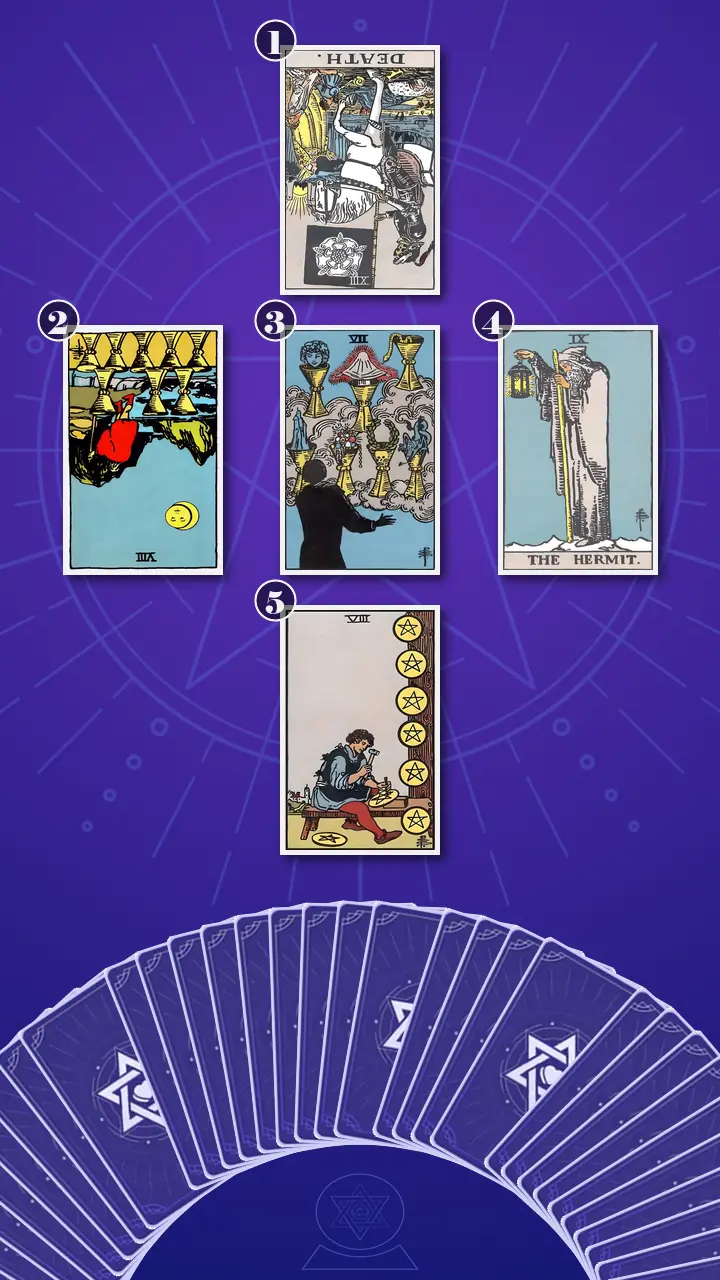
Reading the Map: Card Meanings in Context
The Unfinished Ending: Death Reversed
Now I turned the card representing the surface symptom: the conscious behavior through which the unacknowledged pattern became visible. It was Death, reversed.
I pointed to the skeletal rider still moving forward beneath the black banner. Reversed, this was not an absence of change. It was transition caught in a blockage: the urge to transform was real, but Alex was trying to control its scale and timing. Instead of allowing one clear ending, they were drafting an entire replacement identity.
I connected it to the screen between us. A flat client day had become evidence that their whole Toronto life needed replacing: city, role, social circle, morning routine, and public aesthetic. Yet the small ending sat untouched in their inbox, glowing more heavily than every exciting tab. I said, "This is the difference between redesigning your entire operating system and closing the one app that keeps crashing. The fantasy gives you momentum, but one honest no would ask you to tolerate grief, uncertainty, or somebody else's disappointment."
Death reversed showed an overcorrection risk, too. If Alex tried to prove that change was real by cancelling everything at once, they could create instability without learning which change actually mattered. A plan can be a painkiller and still not be a map.
I heard a short, bitter laugh catch in Alex's throat. "That is painfully accurate," they said. "I can redesign everything, but I cannot answer this one thing." I saw their fingers circle the edge of the cold mug, as if even that small movement offered a safer exit than pressing send.
The Departure That Keeps Looping: Eight of Cups Reversed
Now I turned the card representing the avoided experience: the disappointment, unmet need, or incomplete departure concealed beneath the reset fantasy. It was the Eight of Cups, reversed.
The red-cloaked traveler appeared unable to complete the journey. The cups still stood behind them, materially present but emotionally incomplete. In Alex's life, I saw the same movement on the Line 2 commute: the repeated search for another city or a career exit after an emotionally flat workday, followed by a return to the same week without recording what had happened first.
I brought us back to the client call Alex had described. Their design recommendation had been reduced to a quick polish pass. No one had asked what they wanted to lead next. Rather than write, "I want more authorship and clearer respect for my work," Alex had searched for the best cities for creatives in their late twenties. The energy of this reversed card was blocked departure. It kept offering a destination while withholding the name of what the familiar arrangement no longer provided.
"I thought I wanted out," Alex said quietly after I paused. I watched their shoulders lower a fraction. "Maybe I wanted something named."
I told them that this was an important distinction. Wanting a move may still be real. Wanting a different career may still be real. But an exit is more useful when it answers a known need rather than carrying every unnamed feeling across a border. I asked, "In the hour before your next reset spiral, what happened: were you dismissed, lonely, overextended, bored, or facing too much unstructured time?"
Seven Cloud-Borne Futures: Seven of Cups Upright
Now I turned the card representing the protective story: the belief or imaginative strategy that kept the pattern outside full awareness. It was the Seven of Cups, upright.
The shadowed figure faced seven cups floating in clouds. I saw Alex's browser in the image immediately: apartment listings, retraining programmes, freelance plans, travel ideas, language classes, and the perfect-routine video that promised a version of Monday with no friction.
Here, the energy was excess. Imagination was not the problem; it was running without a grounded question. Alex had been treating novelty and emotional intensity as evidence that an option was relevant. It resembled a TikTok For You page that keeps serving five aspirational identities because it has not received one clear signal about the problem it is meant to solve.
I said, "If you keep every option alive, none of them can disappoint you yet. But none of them can give you information, either." I watched Alex look from the card to the rows of tabs. The laptop fan was working hard enough to make possibility sound like progress.
The blind spot was not that Alex had too many possible lives. It was that each possible life had been asked to erase a diffuse feeling before it had been tested against an ordinary Tuesday. The Seven of Cups invited discernment: not which future looked most transformative, but which small option responded to an observable need for authorship, rest, connection, privacy, or room.
When The Hermit's Lantern Reached the Next Stair
The Hidden Resource: The Hermit Upright
Then I turned the card representing the hidden resource: the capacity that becomes available when the avoided material is acknowledged rather than rejected. The room seemed to settle around us. It was The Hermit, upright, the key card in this reading.
The lantern in the Hermit's hand did not illuminate the whole mountain. It showed only the next stretch of path. I described that distinction to Alex as the difference between demanding a drone view of the next five years and using a phone flashlight on the next stair.
Before I said more, I could see the familiar calculation holding Alex in place: their screen promised a move, a new role, and a cleaner identity, while the possibility of one small change carried a sharper risk. If it changed nothing, what then?
A new location, role, or identity will not automatically resolve the drift; hold The Hermit's lantern over one honest discomfort, then take the smallest step it reveals.
I let that sentence rest between us, then added, "You do not need to demolish your life to learn what you are trying to escape. Name the one feeling the reset fantasy is covering before you change the container around it."
I watched Alex's breath stop halfway in. Their index finger hovered above the mug, then slowly lowered to the table. For several seconds their eyes did not settle on the card or the screen; I could see them replaying meetings, transit rides, and late-night tabs. Their pupils widened, then their mouth tightened, as if the idea had first landed as an accusation. A little colour rose around their eyes. "But that means I might have been blaming the city for something smaller," they said. "And smaller feels scarier, because I could actually have to deal with it." The sentence ended in a thin laugh. Then I saw their jaw release, their shoulders descend, and their next breath reach lower than the ones before it. The room did not become easy. It became specific. That can feel briefly dizzying: a clear next step also returns responsibility. I did not rush them past that.
I said, "Now, with this new perspective, think back over last week. Was there a moment when this would have helped you feel differently?" Alex named the client call. Within ten minutes, I invited them to open a plain note and write: "Right before I wanted a total reset, I felt dismissed." The sentence was not a solution. It was a lantern switched on.
This was where I used what I call Cognitive Stratigraphy. On a dig, I do not mistake the first object on the surface for the whole site. I trace it carefully through layers until I can see what older structure it belongs to. Alex's sudden urge to leave was a surface artifact, not proof that the present landscape had to be razed. Beneath it, I found an obsolete rule: "If I change only one thing and still feel empty, I will have proved I cannot control my life."
I offered a second archaeological frame I use often: Ruins Restoration Thinking. A life that feels fragmented is not automatically a failed life in need of demolition. Sometimes it is a site in transition, asking for patient attention to what is structurally sound, what has become uninhabitable, and what can be rebuilt without erasing the person who lived there.
The Hermit's energy was balanced discernment. It did not demand permanent solitude or a flawless answer. It offered partial clarity: enough light to distinguish an authentic need from an urgent escape fantasy. I named the shift I saw as a move from restless, browser-tab future projection toward patient self-trust and grounded agency. You do not need a new life to name what this one is missing.
One Pentacle at a Time: Eight of Pentacles Upright
Now I turned the card representing the integration practice: the grounded action through which the insight could enter ordinary life. It was the Eight of Pentacles, upright.
I pointed to the craftsperson shaping one pentacle while completed work remained visible nearby. This card carried balanced Earth energy: focused practice, repetition, and evidence. It translated the Hermit's private clarity into a small, observable experiment rather than another identity-scale declaration.
I connected it to a plain seven-row note, not an aesthetic life dashboard. If the named feeling was dismissal, Alex could protect twenty minutes each workday to define one decision they wanted to own and record whether that changed their energy. If the named feeling was isolation, they could send one specific invitation and observe the result. The question was not whether one week fixed everything. The question was whether one condition made the current week more or less livable.
The spread had moved from Water into Earth. The Cups had carried longing, emotional incompletion, and compelling fantasy. There were no Swords telling Alex to gather more analysis, and no Wands promising that a larger burst of motivation would carry the answer. The medicine was smaller: felt experience held in a practical container. I watched Alex give a slow nod when I said, "Make it small enough to learn from, not big enough to disappear into."
From Mood to Method: A Seven-Day Life A/B Test
I gathered the reading into one story. Death reversed showed Alex imagining transformation at maximum scale while delaying one necessary ending. The reversed Eight of Cups showed the emotionally incomplete arrangement beneath the exit plans: a need for more authorship and respect that had not been named. The Seven of Cups showed how a crowded browser-tab future protected Alex from testing a single imperfect choice. The Hermit gave us a lantern-first pause. The Eight of Pentacles gave us a method.
I named the cognitive blind spot directly but without blame: Alex had been treating relief as proof of clarity. The transformation direction was from asking, "Which complete new life will remove this feeling?" to asking, "What happened immediately before the urge, and what reversible condition can I test?" The cards did not decide Alex's future. They helped Alex recover the information needed to decide it.
I suggested two bounded practices. I made them deliberately unglamorous, because their value was not in performing a better identity. Their value was in producing usable evidence.
- Before I Reset: Trigger ExcavationI asked Alex to create a phone note titled "Before I Reset." The next time they opened relocation, career-change, or total-routine tabs, they would write one unedited sentence: "Right before this, I felt ____." Then, before Friday, they would spend five to twenty minutes on one related closure: reply to the former client, decline a low-value commitment, cancel an unused subscription, or close an application that no longer fits. For quitting, leases, public pivot announcements, costly courses, and other safe-to-pause irreversible decisions, I asked them to use a 72-hour hold unless a real deadline applied.I framed this as my Trigger Excavation Exercise: separate the current trigger from the older rule it activates. If the blank feels too exposed, one word is enough. The closure is evidence gathering, not a claim that the larger feeling is trivial.
- The Lantern-First Seven-Day TestI asked Alex to make a seven-row note from Monday through Sunday and test one named need for ten to thirty minutes a day. For authorship, they would protect the first twenty minutes of a workday from Slack and draft one decision they wanted to lead. Each evening, they would record only: "more alive," "same," or "worse," plus one short note about what happened immediately before the rating.I told Alex to put the phone in another room or use Focus mode for ten minutes. A missed day did not mean the experiment had failed; one checkmark and one word still counted. On day seven, they could spend five minutes deciding whether to repeat, revise, or drop the test.
I reminded Alex that partial clarity is still clarity they can use. A seven-day experiment cannot issue a verdict on a city, career, or identity. It can show whether more authorship, rest, connection, or room changes the lived texture of an ordinary week. That is enough information for a next step, and Alex remained free to make a bigger change later.

A Week Later: The Quiet Proof
A week later, I received a message from Alex: "I wrote the client-call line, blocked twenty minutes for my proposal, and did it four days. I still looked at Montreal listings this morning, but I sent the email first."
I did not read that as a finished transformation, and neither did Alex. I read it as the first visible proof of agency: the reset fantasy had not vanished, but it no longer had exclusive access to the steering wheel. Alex had moved from packing for an unnamed journey to learning what the journey was for.
When I think of multiplying tabs, a tight jaw, and Monday approaching, I remember how much safer it can feel to imagine replacing a whole life than to risk discovering which ordinary part is quietly hurting. I would ask you: if you gave yourself only the next seven days, what one small condition would you be curious to test before asking your whole life to change?