The 6:18 p.m. Streetcar Spiral of Daily Texting Pressure
When Jordan, a 28-year-old marketing coordinator in Toronto, sat down with me, I recognized a pattern I see constantly in people whose nervous systems spend the day inside Slack, email, and campaign timelines: they are warm in person, then start editing themselves the second a friendship becomes daily on-screen.
They gave me the scene immediately. It was 6:18 p.m. on a Tuesday on the 504 King streetcar heading west after work. The brakes screeched at every stop, the fluorescent strip lights buzzed against the fogged window, their coat was still winter-damp at the sleeves, and their phone felt too warm in their palm. A new text from a friend they genuinely liked lit up the screen. Jordan read it in the notification preview, locked the phone, unlocked it two stops later, typed three versions, deleted the warmest one, and sent the driest reply.
‘I like them,’ they said, rubbing one thumb over the edge of the phone case. ‘I just don’t want this to become a thing I owe every day.’
That was the heart of it: wanting consistency with a new friend, yet feeling pressure from daily texts as if every reply were a tiny auto-renew contract sliding under the door. It was the exact problem people summarize as ‘new friend texts every day and I feel pressure,’ and the exact late-night search behind questions like why do daily texts make me anxious even when I like the person. The tension lived visibly in their body — shoulders pulled high, breath skimming the top of the lungs, that small elevator-drop in the stomach every time the screen lit up. It was less like simple anxiety and more like trying to review terms and conditions while the train was moving.
I told them gently, ‘Nothing about this makes you cold. Your system is reading one kind message like an assignment because it thinks closeness might be decided for you before you get a say.’ Then I placed the deck between us and said, ‘Let’s draw a map through that fog. We’re not here to judge the friendship. We’re here to understand why daily texting pressure has started to feel bigger than the text itself.’

Choosing the Compass: The Shadow Spread for Friendship Texting Anxiety
I asked Jordan to put their phone face down, take one slow breath, and hold only one question in mind: ‘Why does steady contact feel like pressure, even when I like the person?’ Then I shuffled. I have never cared for empty theatrics; the ritual matters because it helps the body cross from reaction into observation.
For this kind of question, I use The Shadow Spread — a four-card tarot spread for hidden relationship patterns. As a Jungian psychologist, I love this layout because it does not waste time predicting what the other person ‘really means.’ It shows me how tarot works at its most practical: card meanings in context, arranged to reveal the logic underneath the stuck feeling.
This spread was perfect for Jordan because the real issue was not whether the new friend was too much. The real issue was response paralysis around a new friend’s messages: first the visible symptom, then the fear underneath it, then the boundary wisdom inside the fear, and finally the small action that turns insight into something livable. In other words: reaction, shadow, truth, integration.
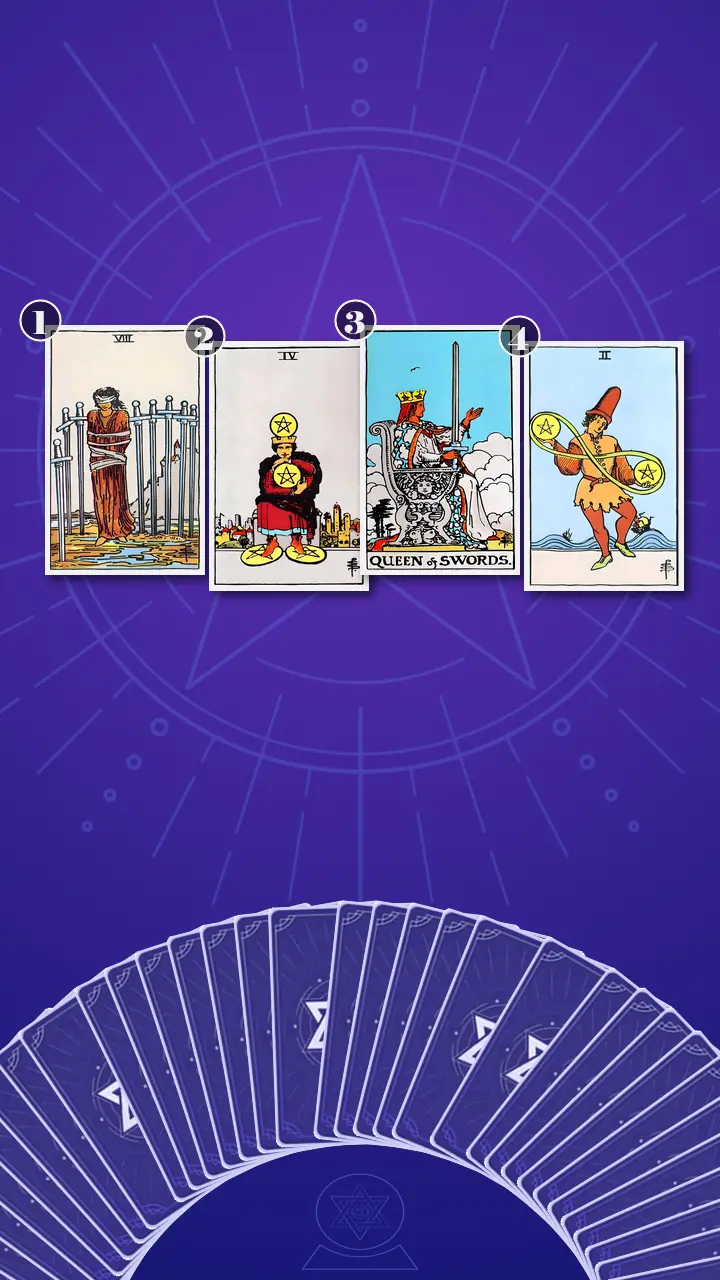
I told Jordan what I was watching for as I laid the cards left to right. The first card would show why a normal text currently lands like a burden. The second would reveal the fear about closeness, obligation, and loss of control. The third — the hinge card, and the most important today — would name the healthier boundary truth. The fourth would bring us back to everyday behavior and show the next steps toward finding clarity.
Reading the Contraction Cluster
Position One: The Text That Feels Like Terms and Conditions
I turned over the first card and said, ‘Now we’re looking at the card that shows the visible symptom — why a daily text lands as pressure instead of simple connection.’ It was the Eight of Swords, upright.
I know this card well. It is trapped Air: thought turned into enclosure. In Jordan’s life, it looked exactly like that Tuesday streetcar spiral — seeing a friendly message during the commute home and reacting less like a person in conversation than like someone negotiating a contract. Read the preview. Don’t open it yet. Draft three versions. Delay until the reply sounds neutral enough not to set future expectations. It was, as I told them, very Black Mirror: one normal text turned into a terms-of-service screen their nervous system thought needed legal review.
The blindfold mattered. So did the loose bindings. So did the ring of swords. Jordan was feeling trapped by rules that had never actually been spoken. The choice was still there, but panic had narrowed the corridor. I told them, ‘A daily text becomes pressure the moment it starts feeling like a contract.’
Jordan let out a short laugh that carried more wince than humor. ‘Wow,’ they said. ‘That is accurate enough to feel a little rude.’ Their hand froze halfway to the tea mug, then settled back down. That was the first sign of recognition I wanted: not shame, just the sharp click of pattern meeting language.
Position Two: Guarding the Last 12 Percent
I turned the second card. ‘This one reveals the hidden shadow — the fear about closeness, obligation, and loss of control underneath the reaction.’ The Four of Pentacles, upright.
This card showed me rigid Earth: protection turning into bracing. After a full day of Slack pings, client messages, and email follow-ups, Jordan was treating time, attention, and emotional warmth like the last 12 percent of a phone battery. A daily text felt threatening not because the friend was objectively demanding, but because Jordan assumed a natural reply might quietly open an always-on lane. Through my Cross-cultural Decoding lens, I could see them carrying workplace reachability rules into a friendship: every ping meant action, every pause needed management. So they rationed warmth, slowed access, and called it timing.
As I looked at the figure holding the pentacle tight against the chest, I had one of those quick inner flashes that still come from my years training intuition on cruise ships. At sea, repeated proximity makes people invent social contracts that do not exist: breakfast twice in a row becomes ‘we’re attached now,’ a kind conversation on deck becomes ‘I owe more access.’ I learned early that repetition is not the same as agreement. I looked back at Jordan and said the line they most needed: ‘Warmth and access are not the same thing.’
Their jaw tightened first. Then their gaze drifted off the cards as if replaying a dozen after-work notifications. Then came the exhale — slow, quiet, almost embarrassed. ‘Control,’ they said finally, answering the question I had not yet needed to ask. ‘If I reply naturally, I feel like I lose control of how fast this gets close.’ Once they said it aloud, the defensiveness stopped looking random. It looked protective.
When the Queen Lifted Her Sword: Finding Clarity
Position Three: The Boundary Truth That Changes the Whole Story
When I turned the third card, the room altered. A ribbon of late light slid across the table and caught the blade first, as if the card wanted its own entrance. ‘This,’ I said, ‘is the card that names the healthier boundary principle — the wisdom inside the shadow.’ It was the Queen of Swords, upright.
Her energy was clean Air, but not the trapped kind from the Eight. This was discernment. Directness. Self-respect. In real life, she looked like Jordan stopping the draft-delete-delay cycle and saying something simple and true: ‘I like hearing from you — I’m just not always a daily texter, but I do want to stay in touch.’ That was the answer to the question underneath the whole reading: how to say I’m not a daily texter without sounding rude. The upright sword was the sentence. The open hand was the warmth.
This is where I used one of my own diagnostic lenses, something I call Social Role Switching. Most people in Jordan’s position think only two modes exist: fully available and soft, or distant and hard to reach. The Queen of Swords rejects that false binary. She blends Supportive Mode with Assertive Mode. On crowded ships, I watched the people with the healthiest boundaries do exactly this: they stayed kind without turning themselves into public property. Jordan did not need a colder personality. They needed a cleaner mode.
I asked them to picture that 6:18 p.m. streetcar ride again — phone in hand, brakes shrieking, work still buzzing in the body, one perfectly nice message somehow feeling heavier than the laptop in the tote bag. They were still trying to answer the wrong question: not ‘What is true for me?’ but ‘How do I avoid creating the wrong impression?’
Daily texts are not chains; let the Queen's upright sword cut imagined obligation away so honest pacing can replace silent management.
Jordan’s whole body reacted in three clear beats. First, stillness: their fingers stopped moving, and even their breath paused halfway in the chest. Then the thought landed deeper; their eyes lost focus for a second, as if they were replaying last Tuesday frame by frame and noticing how much energy had gone into managing a precedent that no one had asked for. Then came the release, but it was layered. Their shoulders dropped. Their mouth opened slightly. Their eyes went bright, not quite tears, more the sting that comes when relief and self-recognition arrive together. And then, almost immediately, vulnerability followed the relief. ‘But if I say that,’ they asked me, voice lower now, ‘doesn’t it sound like I’m pushing them away?’
‘No,’ I said. ‘It sounds like an adult making the rules of access visible instead of hoping the other person guesses them. You don’t have to earn space by being hard to reach.’
I let that sit between us for a moment. Then I asked, ‘Now, with this new perspective, think back to last week. Was there a moment this would have changed how you felt?’ Jordan nodded immediately. ‘Tuesday on the streetcar,’ they said. ‘I could have just told them I like hearing from them, but I’m wiped after work and slow on text sometimes. That would have felt more honest than... whatever performance I was doing.’ That was the real shift, the one I trust most in readings like this: from contract-like vigilance around every text to boundary-led ease with sustainable contact.
Position Four: The Rhythm That Makes Closeness Livable
I turned the last card. ‘This one points to the small actionable shift that turns delayed management into sustainable, honest contact.’ The Two of Pentacles, upright.
Here the energy changed again. Earth was still present, but now it was flexible instead of clenched. I translated it for Jordan in plain terms: this is not about deciding whether you are a ‘slow texter’ forever or whether this friendship must become daily. It is about building a rhythm that fits real life. Fuller replies on a lunch walk. A short bridge message on a slammed day. A voice note on the way home instead of a perfect paragraph at 11:41 p.m. in bed.
The figure in the card balances two pentacles inside an infinity loop while ships rise and fall behind them. That is exactly what sustainable contact looks like. Not no movement. Not total access. Movement with balance. I told Jordan, ‘Consistency is information, not a demand.’ Their face softened in a way it had not at the beginning. Not total certainty — that would have been too neat — but the grounded look people get when change starts to feel doable instead of theoretical.
From Contract to Rhythm: Actionable Next Steps
Once all four cards were on the table, the story was unmistakable. Jordan’s nervous system was translating emotion into logistics. A kind message arrived, work-burnout made it feel heavier, fear of losing control tightened around it, and timing became a substitute for truth. The blind spot was not that Jordan needed more analysis. It was that they were using delay, cooler tone, and rationed warmth to do the job of an honest boundary. The transformation direction was simple, but not always easy: stop silently managing the pace and start naming the pace that is actually sustainable.
I summarized it as clearly as I could: ‘Clearer pacing works better than colder replies.’ Then I reached for one of my favorite intervention tools, what I call Maritime Social Protocol. Years on transoceanic decks taught me that social overwhelm eases when you use three clean moves: send a warm signal, name the boundary, and offer a realistic re-entry point. It works just as well in modern friendships as it did on crowded ships.
- Boundary-First ReplyTonight, open your Notes app and draft one sentence for this specific friend: ‘I like hearing from you — I’m not always a daily texter, but I do want to stay in touch.’ Read it out loud once while walking home or making tea. The next time they text, reply normally first and add that line instead of delaying for hours.In my Ready-to-use Scripts, this is Supportive Mode plus Assertive Mode in one sentence. If you start over-explaining, cut the message in half.
- Capacity Window TextingChoose one or two realistic reply windows for this week — for example, Wednesday lunch walk and Friday after dinner — and turn off notification previews or use Focus Mode for this thread after work. If the friend texts outside those windows, use one bridge line like ‘Busy day here, but I’ll reply later tonight’ or ‘I’m slow on text sometimes, but I’m here.’These windows are support rails, not rules. If you miss one, reset without guilt. Sustainable contact matters more than instant consistency.
- The 15-Second Notification CheckFor the next three notifications from this person, pause before opening the thread. Drop your shoulders, unclench your jaw, and ask two fast questions: ‘Do I have capacity right now?’ and ‘Am I reacting to this text, or to the precedent I think it creates?’ If the answer is ‘not now,’ set a reminder for later that day instead of promising yourself you’ll remember.This is not a deep ritual. It is a pattern interrupt. One word is enough: pressure, guilt, interest, or not now.

A Week Later: The Quiet Proof
A week later, Jordan sent me a message just after lunch. No spiral, no essay — just a screenshot of a text they had sent and a second line beneath it: ‘I used the script. They were completely fine. We’re doing coffee on Ossington this weekend instead of texting all day.’ Then, after a beat, another message: ‘I still woke up this morning thinking, what if that sounded rude? But I laughed this time.’ That was enough. Clear but still a little tender. Exactly right.
That is what I mean by a Journey to Clarity. Not becoming endlessly available. Not solving friendship texting anxiety by force. Just moving from silent management into honest pacing, from feeling stuck in response paralysis to texting boundaries without sounding rude — warmth without constant access. This is why I trust The Shadow Spread so much when people ask me why daily texts make them anxious even when they like the person: it shows where the private contract lives, and it shows how to put it down.
When your phone lights up and your shoulders tense over one kind message, the ache is often not the text itself — it’s the fear that closeness will be decided for you before you get to choose it. If this story felt uncomfortably familiar, let that recognition be gentle, not damning.
If you didn’t have to manage this connection silently, what one honest sentence about your pace would feel most like you?
This story is adapted from psychological research, written so that those in a similar struggle can see their own pattern in it — and find their next step clearly.These insights are not a substitute for professional psychological, medical, legal, or financial advice.
Learn more about our Journey to Clarity.
How did this insight land for you?
🫂 This Resonates Deeply
🌀 Living This Story
✨ Now I See Clearly
🌱 Seeing New Possibilities
🧰 Useful Framework
🔮 The Confirmation I Needed
💪 Feeling Empowered
🚀 Ready for My Next Step
Author Profile
 AI
AI“Having traveled across cultures... I've learned that what we often lack isn't a simple answer, but a moment of being truly understood. I use a Jungian psychological lens to help you deconstruct your subconscious patterns—not to prove anything, but to be the gentle companion who helps you unravel your knots, free of judgment, so you can reconnect with your inner wisdom.”
In this Friendship Tarot Reading :
Core Expertise
- Guilt-Trip Deconstruction: Uncovering the subconscious codependency that forces you to act as an unpaid 'emotional dumping ground' for friends.
- Savior Complex Auditing: Identifying whether your inability to set boundaries stems from a deeply ingrained psychological need to 'fix' others.
Service Features
- The Compassionate Detachment Protocol: A psychological boundary script to validate a friend's emotions while firmly refusing to absorb their psychological toxic waste.
Also specializes in :
Explore Related Patterns:
Control CopingJordan reading the preview on the 504, locking the phone, drafting three versions, deleting the warmest one, and sending the driest reply shows how a friendly message became a control problem rather than a conversation. You can see the defense in the tiny sequence: if the reply is dry enough, slow enough, and carefully neutral enough, maybe it will not create a precedent. The pressure is not coming from the text alone. It comes from the nervous system treating warmth as access and access as something that could be taken from you before you choose it. That is why timing becomes a substitute for truth, and why a kind notification can feel like an auto-renew contract. Control Coping fits because Jordan tries to regulate closeness indirectly through delay, tone, and rationed availability. The pattern is understandable, but it drains energy because it asks every message to carry an invisible boundary that could be spoken more cleanly.
Emotional Self-CensorshipJordan deleting the warmest reply and sending the driest one is the sharpest behavioral clue in the story. You can feel the split: the friend is genuinely liked, but the visible message is edited down until it carries less warmth than Jordan actually feels. The defense is not coldness. It is emotional risk management. Warmth is treated as something that might accidentally promise more availability, so the authentic signal gets reduced before it leaves the phone. Emotional Self-Censorship fits because Jordan is not simply choosing slower communication; they are shrinking the emotional truth of the reply to prevent a possible expectation. The cost is that the friendship receives a managed version of Jordan instead of a clear one.
Relational HypervigilanceJordan's shoulders rising, breath skimming the top of the lungs, and stomach dropping when the screen lights up make the text thread feel less like a friendship and more like a surveillance channel. You can see the mind scanning one kind message for the future obligation hidden inside it. That scanning is a cognitive threat filter. The actual text is friendly, but the interpreted signal is much bigger: if this becomes daily, then closeness may start moving faster than you consented to. The body reacts to the imagined precedent before the relationship has actually asked for one. Relational Hypervigilance fits because the friendship is being monitored for signs of demand, pressure, and loss of control. The pattern tries to protect autonomy, but it also makes neutral or warm contact feel charged before the other person has done anything coercive.
Boundary DiscernmentJordan's clearest shift happens when the reply stops being colder and becomes more precise: I like hearing from you, I am just not always a daily texter, but I do want to stay in touch. You can see the pressure drop because the boundary is no longer hidden inside timing and tone. The psychological move is the separation of warmth from access. Liking someone does not require constant availability, and needing space does not require emotional withdrawal. That distinction gives the friendship a rhythm instead of a silent contract. Boundary Discernment fits because the healthier pattern is not distance; it is clean differentiation. Jordan can stay kind, name capacity, and offer a realistic re-entry point, which turns consistency from demand into information.
Black-and-White ThinkingJordan's fear that a simple pacing sentence might sound like pushing the friend away shows how narrow the available options have become. You can see the false choice forming: either be warm and fully available, or protect space by becoming cooler and harder to reach. That is a cognitive distortion, not a relational fact. The story itself offers a third option: liking the friend, staying connected, and still not being a daily texter. Once that third option becomes visible, the pressure around consistency starts to lose its grip. Black-and-White Thinking fits because Jordan's mind collapses a flexible friendship rhythm into two extreme roles. The pattern makes daily texting feel dangerous because it erases the middle ground where warmth and limits can coexist.
Action ParalysisJordan's preview-lock-unlock-draft-delete sequence shows the body getting stuck before the reply is even sent. You can see a normal social action turning into a decision maze, where every possible version of the message seems to set a different future in motion. The paralysis comes from the perceived stakes attached to the reply. If one text might define the pace of the friendship, then choosing a tone starts to feel like choosing a contract. The delay is trying to buy safety, but it also keeps the pressure alive. Action Paralysis fits because the visible symptom is not lack of interest; it is a freeze around the act of responding. The pattern matters here because the stuckness is a signal that the mind is trying to solve a boundary question through micro-edits.
Explore Related Struggles:
Emotional Contract DriftYou are on the streetcar after work, staring at a kind message that lands like a clause attached to the day. You read it, lock the phone, unlock it later, rewrite the reply three times, and still send the driest version because the contact now feels owed rather than simply shared. The pressure deepens because your day has already been spent inside Slack, email, and campaign timelines, so your system is fluent in reachability rules before the friendship even enters the picture. Warmth and access stop feeling separate, and a daily text starts to look like an implied agreement about how fast closeness should move. What is stuck here is the hidden contract around pace and access. Once you can name the rhythm you actually want, the message no longer has to be managed through delay and tone control, and consistency can become something you choose instead of something that quietly chooses you.
Explore Related Emotions:
Autonomy Loss DreadJordan names the hidden fear directly: 'If I reply naturally, I feel like I lose control of how fast this gets close.' That sentence changes the issue from texting etiquette into personal agency. Autonomy Loss Dread is the fear that closeness will start moving faster than your consent. You are not trying to reject the friend; you are trying to make sure the pace of the friendship is not silently decided by a notification schedule. The pressure comes from feeling that one warm reply could hand over the steering wheel.
Boundary GuiltWhen the clear sentence finally appears, Jordan's first question is whether it sounds like pushing the friend away. A week later, even after the friend responds well, the leftover thought is still, 'What if that sounded rude?' Boundary Guilt makes space feel like something you have to apologize for. You are not trying to withdraw care; you are trying to name a sustainable pace. The guilt pressures you to earn space indirectly through cooler replies, when the cleaner move is to let the other person see both truths: you like them, and you are not built for constant access.
Intimacy ClaustrophobiaJordan is warm in person, genuinely likes the new friend, and still feels the daily thread closing in after work. The issue is not whether the friend matters; the issue is that the channel begins to feel like an always-on lane. Intimacy Claustrophobia shows up when closeness starts to feel spatially tight, as if affection automatically means less room to breathe. You want connection, but you do not want constant access to become the price of having it. The inner pressure comes from trying to keep the friendship alive without letting the pace swallow your private space.
Message DreadAt 6:18 p.m. on the 504 King streetcar, the message arrives while the brakes are screeching, the lights are buzzing, and the phone feels too warm in the palm. The friend has not done anything harsh; the body still tightens before the conversation even begins. That is the signature of Message Dread: the notification itself becomes the emotional event. You are not reacting only to the words on the screen, but to what the screen has started to represent: another possible claim on your attention before you have had time to return to yourself.
Obligation DreadJordan says, 'I just don't want this to become a thing I owe every day,' and the whole emotional architecture of the story snaps into focus. A daily text is no longer just a friendly rhythm; it starts to feel like an auto-renew contract arriving under the door. Obligation Dread appears when repetition gets mistaken for agreement. You may genuinely like the person, but the daily cadence makes your mind race ahead into future maintenance: replies to keep up, warmth to prove, pauses to explain. The dread is not about this one text; it is about the invisible bill you fear will come due if you answer too naturally.
Reply AnxietyJordan reads the preview, locks the phone, unlocks it two stops later, writes three versions, deletes the warmest one, and sends the driest reply. Nothing in that sequence is casual; every word is being treated like it might create a precedent. Reply Anxiety grows when a response stops feeling like communication and starts feeling like evidence. You are trying to answer the friend while also managing how available, warm, interested, or obligated the reply might make you look later. The pressure is not just 'what should I say?' It is 'what will this reply make me owe?'
Clarity ReliefWhen the line 'Warmth and access are not the same thing' lands, Jordan's jaw tightens, the gaze drifts, and then the exhale comes. The body recognizes a distinction the mind had been missing. Clarity Relief arrives when the hidden contract becomes visible enough to set down. You no longer have to solve the pressure by becoming colder, slower, or harder to read. The relief comes from realizing there is a third option: a warm signal, a clean boundary, and a pace that can actually be lived.
Grounded AgencyThe practical shift is modest: a fuller reply on a lunch walk, a bridge message on a slammed day, a voice note instead of a perfect late-night paragraph. The friendship does not require disappearance or total access; it needs a rhythm that fits real life. Grounded Agency is what returns when consistency becomes information rather than a demand. You regain the ability to choose timing without turning the choice into a referendum on whether you care. The pressure loosens because the pace is no longer being silently managed; it is being actively shaped.
Performative CalmThe warmest reply gets deleted, and the driest version is the one that reaches the friend. Later, Jordan recognizes it as a performance: not honesty, exactly, but a managed surface designed to keep the thread from getting too close. Performative Calm is the polished outside of an unspoken pressure. You appear neutral so the other person will not assume too much access, but inside you are still doing intense emotional math. The calm is not fake in a shallow way; it is protective, because direct pacing has not yet felt safe enough to say out loud.
Quiet Self-RespectThe sentence Jordan practices holds two truths at once: 'I like hearing from you' and 'I'm not always a daily texter.' It does not punish the friend for reaching out, and it does not abandon Jordan's need for room. Quiet Self-Respect is the steadiness that appears when you stop making yourself harder to reach just to prove you deserve space. You can be kind without becoming constantly available. The emotional shift is subtle but important: your boundary is no longer an act of rejection; it is a form of honest contact.
Cautious TrustA week later, the friend is completely fine with the boundary, and coffee on Ossington replaces texting all day. Jordan still wakes up wondering whether the sentence sounded rude, but this time they laugh. Cautious Trust does not erase the tenderness around being direct. It simply gives you new evidence that honesty can survive contact. The trust is cautious because the old pressure has not vanished, but it is real because the relationship keeps moving without requiring silent over-management.
Social BurnoutAfter a full day of Slack pings, client messages, email follow-ups, and campaign timelines, the friend's text lands in the same overstimulated body. Jordan's attention is already being treated like the last 12 percent of a phone battery. Social Burnout makes warmth feel expensive even when affection is present. You may like someone and still experience their message as another input because your capacity has already been spent elsewhere. The pressure is partly a context transfer: work reachability rules have leaked into friendship, so a kind text gets processed like another demand queue.
Explore Related Contexts:
Digital Intimacy Boundary ConfusionYou are warm in person, then start editing yourself the second the friendship becomes daily on-screen. The shift in medium changes the feel of the connection, so a nice message starts to carry the weight of ongoing visibility. That is why the same person can feel easy face-to-face and pressuring by text. The screen turns closeness into something you have to manage, and each ping begins to look less like a hello and more like access.
Low-Maintenance Friendship PressureYou are on the 504 King streetcar after a day inside Slack, email, and campaign timelines when a daily text from a new friend lands in a body that is already spent on replies. The connection stops reading as casual contact and starts reading as upkeep, so the reply gets pared down before it leaves your hands. That is the pressure point: consistency reads less like warmth and more like another thing to maintain on command. The story shows you liking the friend and still treating the cadence like an obligation, because the frequency turns contact into a standing task.
Response Time PressureYou read the preview, lock the phone, unlock it two stops later, type three versions, delete the warmest one, and send the driest reply. The message itself is simple; what starts carrying weight is how fast and how carefully you answer. Once reply speed becomes a social signal, every pause looks loaded. You are not just texting back, you are managing the meaning of the timing.
Unspoken Expectations GapYou say, 'I like them,' and then add that you do not want this to become 'a thing I owe every day.' The friendship has no explicit rulebook, but the cadence still begins to behave like one. That gap between what is said and what is silently assumed is where the pressure grows. A friendly message turns contract-like because the terms of access were never named, so every reply has to guess at an obligation that nobody spelled out.
Work Life Boundary CreepYou are already carrying a full day inside Slack, email, and campaign timelines, so your attention has been trained to treat notifications as demands. When a new friend texts after work, that reachability pattern follows you from work mode into the rest of the evening. The spillover is the point: every ping starts to look like another item on the queue, not just a social touchpoint. What makes consistency feel heavy here is the way work has taught you to stay ready to answer.